

Table Of Contents
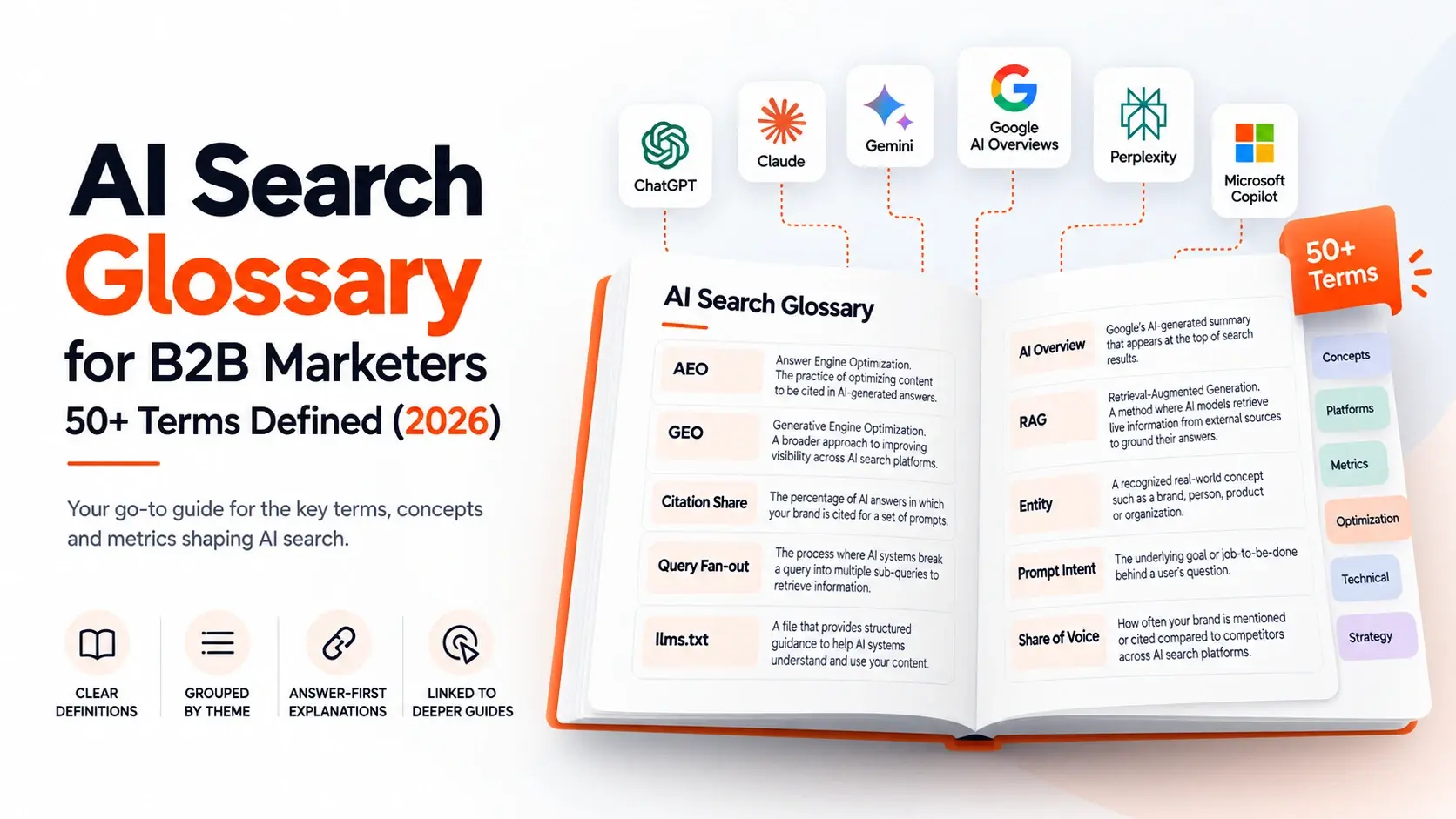
In under two years, the way B2B buyers find and evaluate vendors has split across a new set of surfaces: ChatGPT, Perplexity, Google AI Overviews, Gemini, Claude and Microsoft Copilot. With them came a new vocabulary. Terms like AEO, GEO, citation share, query fan-out and llms.txt now show up in strategy decks, RFPs and board updates, and different people often use them to mean different things.
This glossary fixes that. It defines every term a B2B marketing team needs to talk about AI search precisely. Each definition is grouped by theme, written answer-first so it is easy to quote, and cross-linked to deeper guides where you want to go further. Bookmark it, share it with your team, and use it to keep everyone speaking the same language.
AI search fundamentals
AI Search The use of large language models to answer a query directly with a synthesized response, instead of returning a list of links. It covers dedicated assistants (ChatGPT, Perplexity, Claude), search engines with generative layers (Google AI Overviews and AI Mode, Bing Copilot), and any interface where a model composes the answer. Full guide: What Is AI Search?
AI Search Visibility The degree to which a brand, product or page appears inside AI-generated answers, whether as a mention, a recommendation or a cited source, for the prompts that matter to its buyers. It is the AI-era equivalent of "ranking," but measured in answers rather than blue links. Full guide: What Is AI Search Visibility?
Generative Search Any search experience where the results are written by a generative model instead of assembled from indexed links. Google AI Overviews is the most-used example.
Zero-Click Search A search resolved on the results surface itself, through an AI answer, featured snippet or knowledge panel, without the user clicking through to a website. Zero-click behaviour is what makes AI mentions and citations, not just traffic, the unit of visibility. Related: Zero-Click Search Statistics · Diagnosing traffic loss with zero-click data
AI Search vs Traditional SEO Traditional SEO works to rank a URL in a list. AI search optimisation works to get a brand mentioned and cited inside a generated answer. The inputs overlap (crawlable, authoritative content), but the outcomes, metrics and tactics differ. Full guide: AI Search Visibility vs Traditional SEO
Answer engines and platforms
Answer Engine A system that returns a direct answer to a question rather than a ranked list of documents. ChatGPT, Perplexity, Gemini, Claude and Google AI Overviews are all answer engines. Related: Answer Engine Optimization (AEO) explained
ChatGPT OpenAI's conversational assistant and, with web search enabled, one of the most influential answer engines for B2B research. Getting mentioned and cited in ChatGPT is a primary AI-search goal for most B2B brands. Related: Getting Cited in ChatGPT · ChatGPT User Statistics
Perplexity An answer engine that composes cited responses from live web sources, popular for research-heavy B2B queries. It tends to surface and link its sources prominently, which makes citation patterns easier to observe. Related: Increase Perplexity AI Search Visibility · Perplexity AI Statistics
Google Gemini Google's family of models, powering both the Gemini app and generative features across Google's ecosystem. It matters to B2B marketers as both a standalone assistant and an input to Google's search surfaces. Related: Improving Gemini AI Citations · Google Gemini Statistics
Claude Anthropic's assistant, used increasingly for professional and technical research. Being recommended by Claude depends on clear, well-structured, trustworthy source content. Related: Being Recommended by Claude
Google AI Overviews (AIO) The AI-generated summary that appears above traditional results for many Google queries. It pulls from and cites web pages, so inclusion depends on classic discoverability plus answer-friendly content. Related: Google AI Overviews Statistics
Google AI Mode Google's fully conversational, generative search experience, distinct from AI Overviews, where an entire session is handled by AI. Optimising for it overlaps with AIO but rewards deeper, multi-turn answer coverage. Related: Google SGE and AI optimization for B2B
Microsoft Copilot Microsoft's AI assistant across Bing, Windows and Microsoft 365. An underrated B2B surface, because it reaches buyers inside their work tools.
Grok xAI's assistant, integrated with X, with its own web-search and deep-search modes. A smaller but growing answer engine for B2B.
Optimization disciplines
AEO (Answer Engine Optimization) The practice of structuring, writing and promoting content so answer engines mention, recommend and cite your brand. AEO focuses on being the source an AI uses to build its answer. Full guide: Answer Engine Optimization (AEO) · AEO statistics
GEO (Generative Engine Optimization) Optimisation aimed at generative search results. It is often used interchangeably with AEO, though GEO is sometimes scoped to Google's generative surfaces and broad "get into the generated answer" tactics. Related: SEO vs GEO for SaaS · 15 Best GEO Techniques · Top 5 GEO strategies
AEO vs GEO vs SEO SEO earns rankings for URLs. AEO earns mentions and citations in answer engines. GEO is the generative-search subset of that work. Most B2B programs now run all three together rather than as separate disciplines. Related: How search intent shapes your AI citation strategy
AI SEO An umbrella term for adapting SEO practice to an AI-search world. It covers both using AI in your workflow and optimising to appear in AI answers. Related: AI SEO Statistics
AI Search Optimization (AISO) The end-to-end discipline of earning and growing brand presence across AI answer engines: content, technical readiness, authority and measurement combined. Full guide: AI Search Optimization · AI Search Optimization Checklist
Content Refresh Updating existing pages (facts, structure, freshness signals) so they stay eligible to be retrieved and cited by AI engines, which favour current, accurate sources. Related: Content Refresh
Citations and mentions
AI Citation A specific source URL an answer engine uses and references when composing an answer. Citations are how AI engines attribute the pages behind a response, and they are a primary currency of AI-search performance. Full guide: How to build AI answer citations that drive pipeline
Brand Mention (in AI) When an AI answer names your brand or product, whether or not it links a source. A mention builds awareness even without a citation, so strong programs track both. Related: Improve brand mentions in generative search
Citation vs Mention A mention is your brand named in the answer text. A citation is a source URL the engine references. You can be mentioned without being cited, and cited without being named, so measuring both avoids blind spots.
Citation Share Your proportion of the citations an engine uses across a set of tracked prompts: how often your pages are the source behind answers in your category.
Citation Decay (Visibility Decay) The gradual loss of citations or mentions over time as engines re-crawl, models update, or competitors publish fresher sources. It is why AI visibility needs ongoing monitoring, not a one-time push. Related: Monitor AI citations and prevent visibility decay · Why live model checks matter
Source Selection The process by which an AI engine decides which pages to retrieve and cite for a given prompt, driven by relevance, structure, authority and trust signals. Related: How AI search engines determine which brands to cite
First-Party Data (for AI search) Data you own, such as CRM records, sales-call transcripts, support tickets and reviews, used to identify the real prompts buyers ask and to base content on genuine buyer language. Related: First-Party Data Statistics
Visibility and measurement
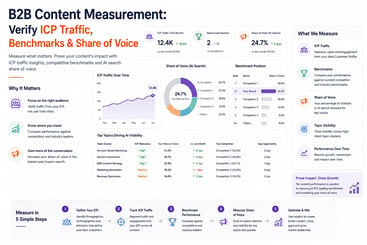
Share of Voice (SOV) in AI Search The share of AI answers in your category where your brand appears, relative to competitors. It is the headline metric for who is winning a topic in AI search. Related: Choose an AI search visibility package with SOV optimization · Verify ICP traffic, benchmarks and share of voice
AI Visibility Score A composite metric that summarises how visible a brand is across tracked prompts and engines, used to benchmark and track progress over time. Related: AI Search Visibility Score and Gap Analysis
AI Search Visibility Metrics and KPIs The measurable indicators of AI-search performance: mention rate, citation share, share of voice, sentiment, and their movement over time. Full guide: AI Search Visibility Metrics and KPIs
AI Search Rank Tracking Monitoring how, and whether, your brand appears across engines and prompts over time. It is the AI-search parallel to keyword rank tracking. Related: What B2B marketers need to know about AI search rank tracking
AI Visibility Audit A structured assessment of where a brand does and does not appear across engines and priority prompts, used to find and prioritise gaps. Related: AI Search Visibility Audit
AI Search Attribution Connecting AI-answer visibility (mentions and citations) to downstream business outcomes such as sessions, leads and pipeline, so AI search can be measured like any other channel. Related: Map AI search citations to the pages that drive pipeline · Turn AI search leads into pipeline in your CRM
Brand Sentiment (in AI) Whether AI answers describe your brand positively, neutrally or negatively, and on which claims. Sentiment shapes perception even when visibility is high.
AI Referral Traffic Website sessions that start from an AI engine's answer, for example a Perplexity or ChatGPT citation click. Isolating it in analytics is how you tie AI visibility to on-site behaviour.
Technical and retrieval
LLM (Large Language Model) The model type behind answer engines, trained to generate text and, with retrieval, to answer using external sources. It is the engine in "answer engine."
Retrieval The step where an AI system fetches external documents, from the live web or an index, to base its answer on. If your page is not retrievable, it cannot be cited.
RAG (Retrieval-Augmented Generation) An architecture where a model retrieves relevant documents first, then generates an answer based on them. Understanding RAG explains why structure, freshness and crawlability decide whether you get cited.
Query Fan-Out When an engine expands one user prompt into several sub-queries, retrieves sources for each, then synthesises a single answer. It means one buyer question can pull from many of your pages.
Chunking How systems split a page into passages for retrieval and embedding. Well-structured, self-contained sections are easier to chunk and quote. Poor structure buries otherwise citable content.
Embeddings Numerical representations of text that let AI systems match a query to semantically relevant passages, regardless of exact keywords.
llms.txt A proposed plain-text file, placed at a site's root, that gives AI systems a curated map of a site's most important content. Adoption and impact are still early, but it signals AI-readiness.
AI Crawlers and Bots The user agents AI companies use to fetch web content, for example GPTBot and OAI-SearchBot (OpenAI), PerplexityBot, ClaudeBot (Anthropic), and Google-Extended. Whether you allow them in robots.txt affects your eligibility to be cited.
Structured Data and Schema Markup Machine-readable tags, such as FAQ, Article, Product and Organization schema, that help engines understand and confidently reuse your content.
Knowledge Base Optimization Structuring help centres, docs and knowledge bases so AI engines can retrieve and cite them accurately. It is a common blind spot for multi-product B2B brands. Related: Knowledge base optimization for AI search · Build KB guardrails for multi-product AI search
Authority and trust
AI Search Authority The set of signals (expertise, reputation, third-party validation, consistent presence) that make an engine treat your brand as a trustworthy source worth citing. Full guide: AI Search Authority: signals that earn citations
E-E-A-T (Experience, Expertise, Authoritativeness, Trustworthiness) Google's quality framework, now just as relevant to AI answers: engines favour content with clear authorship, expertise and corroborating signals. Full guide: E-E-A-T and trust signals for AI visibility
Topical Authority Depth and breadth of coverage on a subject, organised as connected pillars and supporting content, that signals subject-matter credibility to both search and answer engines. Related: AI-driven content strategy and topic clusters
Entity and Entity SEO Establishing your brand, people and products as recognised entities that engines can identify and connect, through consistent naming, structured data and third-party corroboration.
Third-Party Mentions and Offsite Signals References to your brand on sites AI engines already trust, such as publications, communities and review sites. They are a major driver of which brands get recommended. Related: Using PR-driven data to capture AI citations
AI Hallucination When an AI answer states something false or unsupported, including about your brand. Monitoring and correcting hallucinations is part of brand safety in AI search. Related: AI hallucinations: protect your brand in AI search
Citation-Worthy Content Content built to be reused by engines: answer-first, well-structured, evidence-backed, current, and based on real buyer language. Related: Create Citation-Worthy Content
Buyer intelligence and pipeline
Buyer Prompt The actual question a buyer types into an AI engine, for example "best AEO platform for B2B SaaS." Buyer prompts are the AI-search equivalent of keywords, and the unit you track visibility against. Related: How B2B buyers ask AI · B2B Buyer Prompt Patterns · Map buyer prompts to existing content
Prompt Tracking Monitoring a defined set of buyer prompts across engines over time to measure mentions, citations and share of voice. It is the foundation of an AI-search program. Related: Why centralize prompt tracking vs DIY
AIDA Stages (Awareness, Interest, Desire, Action) A funnel framework applied to AI search: buyer prompts differ by stage, and visibility is best measured stage by stage rather than in aggregate. Related: How buyer-focused AI search optimization translates into revenue
Buyer Intent Signals, in prompts, behaviour and first-party data, that reveal where a buyer is in their journey and what they are evaluating. Related: Buyer Intent Data Statistics · Extract buyer intent from CRM and sales calls
Voice of Customer (VoC) The real language buyers use, captured from calls, reviews and support, used to write content that matches how people actually ask AI engines questions. Related: Uncover buyer language from sales recordings
Marketing Context Engine (MCE) Omnibound's term for the layer that unifies structured data (CRM, analytics) and unstructured data (transcripts, emails, tickets) into a single, governed source of context for AI-search content and agents. Related: B2B Marketing Context Engine
AI Search Intelligence The practice, and product category, of turning AI-answer signals (who is mentioned, cited and recommended, and why) into decisions that grow pipeline. Related: AI Search Intelligence · How B2B teams turn AI answer signals into pipeline
Competitor Citation Analysis Finding the prompts where AI engines recommend or cite your competitors instead of you. It is the fastest way to prioritise where to close visibility gaps. Related: Monitor AI search for competitive intelligence · Benchmark visibility against competitors
Frequently asked questions
What is AI search? AI search is when a large language model answers a query directly with a synthesized response, often with cited sources, instead of returning a list of links. It includes ChatGPT, Perplexity, Claude, Gemini and Google's AI Overviews and AI Mode. Learn more.
What is the difference between AEO and GEO? AEO (Answer Engine Optimization) is optimising to be mentioned and cited by answer engines generally. GEO (Generative Engine Optimization) is often scoped to generative search results specifically. In practice most B2B teams use them interchangeably and run both alongside SEO. See SEO vs GEO.
What is the difference between an AI citation and an AI mention? A mention is when an answer names your brand in its text. A citation is when the engine references your page as a source. You can have one without the other, so measure both. Learn more.
What is share of voice in AI search? It is the share of AI answers in your category where your brand appears, compared with competitors. It is the headline "who is winning" metric for a topic. Learn more.
How do AI engines decide which brands to cite? They retrieve pages that are relevant, well-structured, current and backed by authority and trust signals, then compose an answer from the strongest sources. See the evidence guide.
How is AI search different from SEO? SEO earns a ranked link. AI search earns a mention or citation inside a generated answer. The foundations overlap, but the metrics and tactics differ. See the full comparison.
See where your brand stands
You now share a vocabulary for AI search. The next step is knowing where your brand actually appears. Run a free scan with the AI Search Visibility Checker, or see how continuous tracking works with AI Search Intelligence.
Turn Your Content Into AI-Search Winners
Get cited across ChatGPT, Claude & Perplexity — not just ranked on Google.
- Increase AI citations
- Improve answer visibility
- Track brand mentions in LLMs