


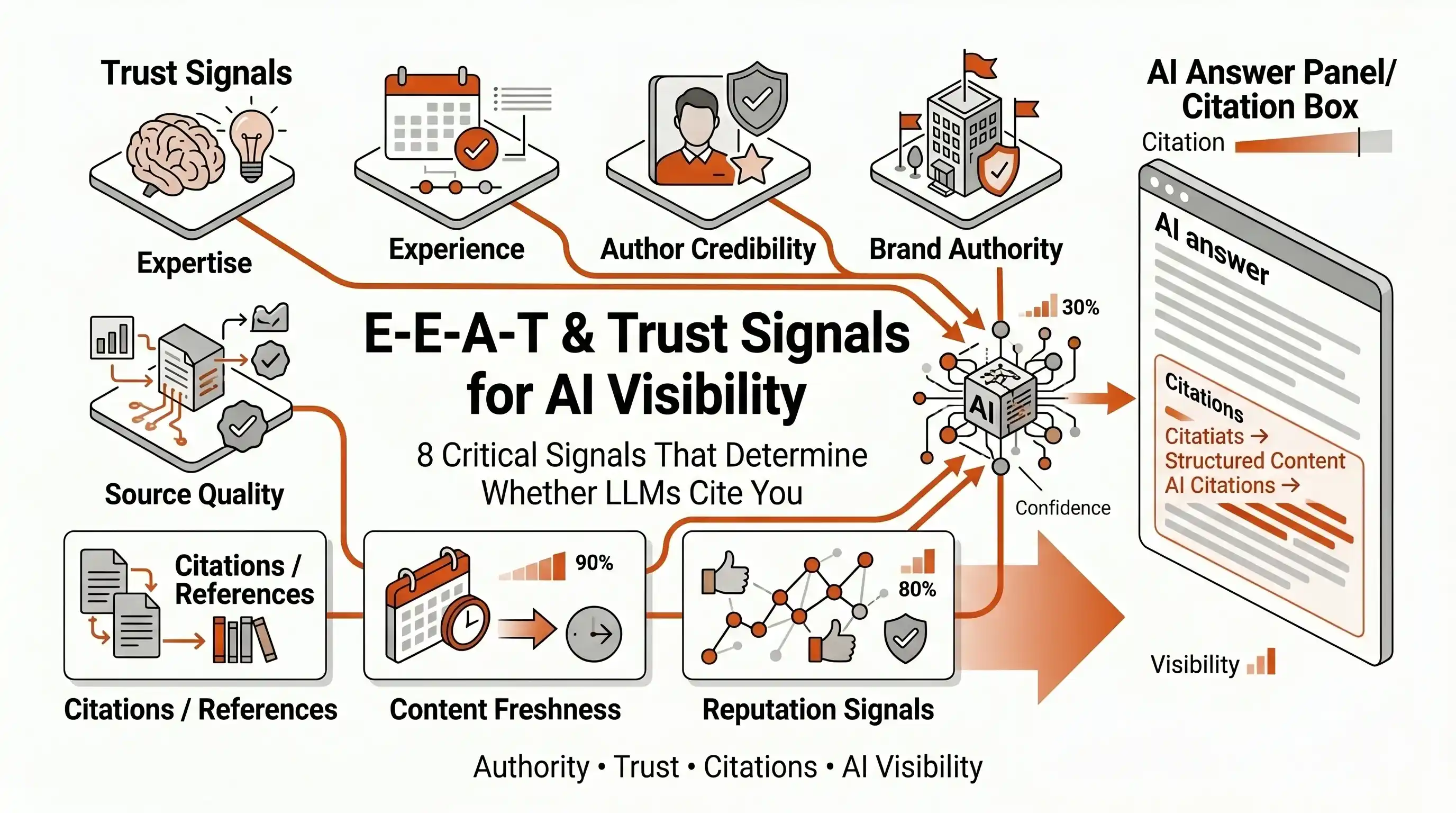


E-E-A-T & trust signals for AI visibility are no longer a background consideration for B2B content teams. They are the primary mechanism deciding which sources get cited, which brands appear inside AI answers, and which companies simply go dark. Across 40 research domains, benchmarking 13 major LLMs, citation hallucination rates range from 14.23% to 94.93%, meaning AI systems that cannot verify trust are defaulting to invention. The brands that win citations are the ones that make trust easy to infer, validate, and act on.
What E-E-A-T & Trust Signals for AI Visibility Actually Mean in 2026
E-E-A-T was built as a quality framework. In AI search, it operates as something closer to a citation eligibility system.
AI engines do not score E-E-A-T directly. They infer trust through observable signals. The closer your content aligns to experience, expertise, authoritativeness, and trustworthiness, the higher the retrieval confidence AI systems assign to your brand.
Here is the critical shift. In traditional search, ranking sixth still meant traffic. In AI search, only a handful of sources appear inside any given answer. No citation means no visibility, period.
The four pillars still apply but with a sharper consequence attached to each one:
- Experience: First-hand, demonstrated knowledge. Original data, real workflows, process evidence.
- Expertise: Subject competence, credentialed authors, topical specialization.
- Authoritativeness: Recognized reputation, brand associations, third-party mentions.
- Trustworthiness: Credibility infrastructure, transparent sourcing, schema, authorship clarity.
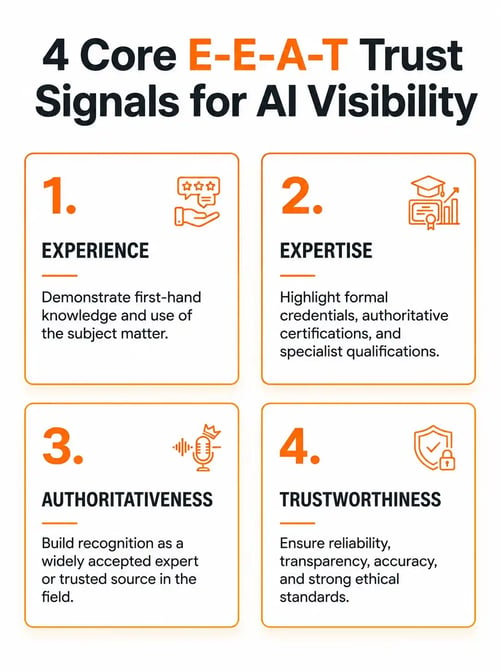
Four core E-E-A-T signals shaping AI visibility. This infographic breaks down expertise, experience, authoritativeness, and trustworthiness.
Trust Signal #1: Author Credibility and Attribution
Anonymous content is a trust signal, just a negative one. AI systems infer credibility partly through whether a real, identifiable person with verifiable expertise stands behind the claims.
This is not about bylines for their own sake. It is about giving the AI enough signal to classify the source as low-risk to cite.
Trust Signal #2: Institutional and Entity Authority
Publisher reputation is a compounding trust asset. When an AI engine encounters a claim from a recognized brand with consistent topical authority, the retrieval confidence increases significantly.
Entity authority is broader than domain authority. It includes:
Most B2B teams optimize pages. AI systems increasingly evaluate entities. That gap is where citation opportunities get lost.
Building institutional authority means earning recognition beyond your own site. Third-party mentions, research citations, expert references, and community credibility all contribute to the entity-level trust profile AI engines build around your brand.
Trust Signal #3: Cross-Source Corroboration (The Most Underrated Signal)
If a single source makes a claim and no other trusted source supports it, AI systems treat that claim as higher-risk. Corroboration is how AI engines reduce hallucination exposure.
This is the trust signal competitors explain least clearly, and it matters enormously for E-E-A-T & trust signals for AI visibility.
Content that exists in isolation, no matter how well-written, carries more citation risk than content embedded in a broader trust ecosystem. AI engines are optimizing for confidence and defensible sourcing. Corroboration delivers both.
Did You Know?
When Google search results include an AI summary, users are less likely to click through to source links, meaning your brand must earn citation placement inside the answer itself, not just proximity to it.
Source: Pew Research Center
Trust Signal #4: Content Structure and Extractability
AI systems do not just evaluate what you say. They evaluate how easily they can extract, attribute, and synthesize it.
Content that buries its primary claim in a wall of contextual padding is harder to cite accurately. Content structured for extraction, with clear answer blocks, modular sections, and strong heading logic, gives AI engines a cleaner path to confident citation.
Evaluate every content piece before it goes live. The question is not just "is this good content?" It is "can an AI engine extract a trustworthy passage from this and cite it with confidence?"
Trust Signal #5: Demonstrated Experience (The Signal Most Teams Miss)
This is where most competitor content fails. They define experience as a concept and move on. In practice, demonstrated experience is one of the highest-leverage trust signals available to B2B content teams.
AI engines increasingly prefer content that shows how something works over content that describes what it is. Proprietary research, real workflows, original observations, and hands-on process evidence all signal that the source has first-hand knowledge, not recycled consensus.
Prompts and content built on a one-time research snapshot stop earning citations. Experience signals need to be continuously refreshed as your market evolves and as new buyer interactions surface new patterns.
Trust Signal #6: Consistent Topical Authority Across Time
One strong piece does not build citation authority. A consistent body of high-trust content around a defined expertise domain does.
AI systems develop an implicit model of which sources own which topics. That model is informed by frequency, consistency, corroboration, and depth across time. A brand that publishes one credible piece per quarter is far less likely to be cited than a brand that has built a dense, consistent knowledge ecosystem around its core topics.
This aligns directly with how connected content workflows function. Every asset you create should build on the previous one, reinforcing the same trust ecosystem rather than starting from zero each time.
Trust Signal #7: Entity Authority vs. Page Authority (The Hidden Layer)
This is the gap most B2B teams are sitting in right now. They optimize pages. AI systems evaluate entities.
An entity in this context means the brand, the company, the individual expert, or the expertise domain as a recognized, stable concept with a consistent web presence and accumulated trust signals. Page authority matters less than the entity behind the page.
Traditional approaches focused on getting a single page to rank. AI visibility increasingly requires that the entity behind the content is recognizable and credible. That is a fundamentally different investment, and most generic content tools are not built to track it.
Did You Know?
Invalid or fabricated citations in LLM-generated content rose 80.9% in 2025 alone, meaning the cost of not being a verifiable, trust-rich source is accelerating fast.
Source: GhostCite, arXiv (Feb 2026)
Trust Signal #8: Trust Infrastructure (Sourcing, Schema, and Transparency)
Trustworthiness is the most foundational E-E-A-T signal, and it is the one most easily damaged by operational shortcuts.
AI engines are optimizing for low hallucination risk. Sources that make it easy to verify claims, trace authorship, and confirm accuracy reduce that risk. Sources that obscure or omit this infrastructure increase it.
Our content audit and optimization system evaluates citation strength and signal gaps before content goes live, so you know exactly where your trust infrastructure is weak before an AI engine makes that judgment for you.
How Omnibound Tracks E-E-A-T & Trust Signals for AI Visibility
Most AI visibility tools guess prompts from keywords and open-source data. That is not how real buyers use AI engines, and it is not how citation behavior actually works.
Omnibound functions as an AI search intelligence layer that continuously analyzes buyer interactions, market signals, and citation behavior to surface where your brand stands and where trust gaps are costing you pipeline.
Feeding a few sales calls into an LLM does not tell the whole story. AI search is deciding B2B pipeline, and most content was never built for AI visibility. The gap between those two facts is where Omnibound operates.
Conclusion
In traditional search, authority improved where you ranked. In AI search, E-E-A-T & trust signals for AI visibility determine whether your brand becomes part of the answer at all.
The eight trust signals in this list are not theoretical. They are the observable patterns AI systems use to evaluate source credibility, reduce citation risk, and decide which brands are worth surfacing inside generated answers.
Content without verifiable trust signals is increasingly invisible to AI engines, regardless of how well-written it is. The brands winning AI search visibility in 2026 are investing in trust infrastructure, entity authority, corroboration ecosystems, and continuous intelligence, not one-time content snapshots.
E-E-A-T & trust signals for AI visibility are the foundation. Building a system that operationalizes them at scale is the competitive advantage. That is exactly what Omnibound is built to deliver.
See how Omnibound approaches AI search visibility and find out where your brand stands in the citation landscape today.
FAQs
Does E-E-A-T affect AI search visibility and LLM citations in 2026?
Yes, significantly. AI engines increasingly infer source credibility from E-E-A-T-aligned signals including author attribution, corroboration, entity authority, and content structure before selecting sources to cite inside generated answers. E-E-A-T & trust signals for AI visibility now function as a citation eligibility layer, not just a content quality measure.
Which trust signals most influence whether an LLM cites your content?
Cross-source corroboration, demonstrated experience signals, and entity authority consistently appear as high-impact factors in AI citation behavior. Content that is validated across multiple trusted environments, produced by identifiable experts, and structured for easy extraction earns significantly stronger citation confidence from AI systems.
How is E-E-A-T different in AI search vs. traditional search?
In traditional search, E-E-A-T influenced ranking quality and page position. In AI search, it influences citation eligibility and answer inclusion. The stakes are higher in AI search because there are far fewer citation slots per answer, meaning a trust gap does not mean a lower position, it means complete invisibility.
Does author expertise actually matter for ChatGPT or Perplexity citations?
It matters as a trust inference signal. AI engines cannot directly verify credentials, but they can infer expertise through consistent author attribution, verifiable professional presence, and the quality of first-hand knowledge signals within the content itself. Weak or absent author signals reduce citation confidence across all major AI engines.
Can AI-written content still earn citations if it has strong trust signals?
AI-generated content is not automatically disqualified from AI citations. The determining factor is the presence of verifiable trust signals including clear authorship, original data, structured sourcing, and third-party validation. Content that lacks those signals struggles regardless of how it was produced.
How do I know if my content is being cited by AI engines or not?
Most teams discover citation gaps only after the fact, through invisible pipeline performance. The more effective approach is to track real buyer prompts across AI engines, analyze which sources are being cited for those prompts, and identify where your content is absent. AI search intelligence tools built for this specific purpose give you that visibility before the pipeline cost becomes visible.
What is the fastest way to improve E-E-A-T and trust signals for AI visibility?
The highest-leverage starting point is strengthening your corroboration ecosystem and experience signals simultaneously. Earning third-party mentions, publishing original research, and ensuring every piece of content has clear author attribution and structured sourcing addresses the most common citation gaps faster than any other intervention. Auditing your existing content against citation strength criteria before publishing new assets is equally important.
.webp?height=245&name=How%20AI%20Builds%20a%20Consistent%20Brand%20Voice%20from%20Real%20Customer%20Signals%20(2).webp)