%20Statistics%20(2026)%2055+%20Data%20Points%20on%20Brand%20Visibility%2c%20Buyer%20Discovery%2c%20and%20Citation%20Rates.webp)


Table Of Contents
Last updated: June 2026. We review and update this page quarterly as new primary research is published.
51% of B2B software buyers now begin their vendor research in an AI chatbot rather than Google — up from 29% in April 2025, a 22-point jump in 12 months on a stable survey instrument (G2, The Answer Economy: 2026 B2B Buyer Behavior Report, n=1,076, March 2026). The moment a buyer asks ChatGPT, Perplexity, or Google AI Mode which vendors solve their problem, your brand either exists in that answer — or it doesn't. Traditional search rankings are irrelevant if the query never reaches a search results page.
Answer Engine Optimization (AEO) is the practice of structuring content so that AI-powered platforms select it as a cited source when generating answers. The academic foundation was established by the Princeton / Georgia Tech / IIT Delhi GEO study (Aggarwal et al., ACM KDD 2024), which tested nine optimization methods across 10,000 queries and found that targeted techniques can boost AI citation visibility by up to 40% (Aggarwal et al., GEO: Generative Engine Optimization, ACM KDD 2024). The commercial urgency is confirmed by the adoption gap: 70% of marketing professionals believe AEO will significantly impact their digital strategy within 1–3 years, but only 20% have begun implementing it (Acquia / Researchscape, 2025, n=500+). That gap is the first-mover opportunity.
We aggregated data from the Princeton GEO study, Acquia/Researchscape, G2, AirOps, HubSpot, On Marketing, Semrush, Gartner, ConvertMate, SparkToro, and Surfer SEO to compile the most rigorously sourced AEO statistics available for 2026.
Key Takeaways
- 51% of B2B buyers now begin research in an AI chatbot — up from 29% in April 2025, a 22-point jump in 12 months (G2, March 2026)
- 70% of marketers believe AEO will significantly impact their strategy — but only 20% have started implementing it (Acquia / Researchscape, 2025, n=500+)
- GEO techniques can boost AI citation visibility by up to 40%; statistics addition alone improves visibility by 41% (Princeton / Georgia Tech / IIT Delhi, ACM KDD 2024)
- Content formatted specifically for LLM extraction is 3x more likely to be cited than unstructured equivalents (Jack Limebear AEO analysis, 2026)
- 44.2% of AI citations come from the first 30% of content — the intro wins (SparkToro, January 2026)
- Pages not refreshed quarterly are 3x more likely to lose AI citations vs. recently updated pages (AirOps, 2026 State of AI Search Report)
- AI-referred visitors convert at 4.4x the rate of traditional organic visitors (Semrush, June 2025)
- HubSpot saw 3x better lead conversion from AEO traffic vs. other sources (HubSpot, AEO Trends 2026)
- 58% of marketers report AI-referred visitors convert at higher rates than traditional organic (HubSpot, State of Marketing 2026)
- Early AEO adopters capture 3.4x more AI visibility than late adopters (RevvGrowth AEO analysis, 2026)
- There is a 0.65 linear correlation (strong) between domain authority and AI citation frequency (Jack Limebear, 2026)
- 37.2% of marketing teams are already actively optimizing for AI search; 83.6% recognize the term "AI SEO" (On Marketing, September 2025, n=250)
The Shift to Answer Engines: Why AEO Matters Now
The shift from search engines to answer engines is not gradual — it is structural and accelerating. The average query length on Google is 3.37 words. The average ChatGPT prompt is 23 words (The Growth Memo, 2025 via HubSpot). Users aren't typing keywords at AI systems — they're asking complete questions, describing problems, requesting comparisons, and expecting synthesized answers. Content built for keyword matching is a different product from content built for conversational extraction.
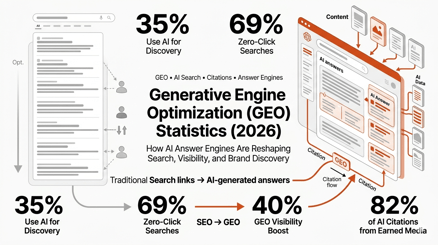
Gartner predicts that by 2026, 25% of organic search traffic will shift to AI chatbots and virtual agents — the most-cited institutional forecast for the pace of the transition. Zero-click rates have risen from 56% to 69% since AI Overviews launched. AI Overviews now trigger on approximately 50% of US queries. The query volume that never creates a click to any website is expanding, and the brands whose content earns citations inside those answers are building influence that never shows up in traditional analytics.
| Metric | Value | Source |
|---|---|---|
| B2B software buyers starting research in AI chatbot | 51% (up from 29% in Apr 2025) | G2, The Answer Economy Mar 2026 |
| B2B buyers using AI tools somewhere in vendor research | 73% | Pedowitz Group AEO analysis, citing citation study 680M |
| ChatGPT appearing at some stage of B2B vendor evaluation | 63% of buyers | Pedowitz Group AEO analysis |
| Gartner forecast: organic search traffic shifting to AI chatbots by 2026 | 25% | Gartner, February 2024 |
| Average Google query length | 3.37 words | The Growth Memo, 2025 via HubSpot |
| Average ChatGPT prompt length | 23 words (max up to 2,717) | The Growth Memo, 2025 via HubSpot |
| AI search visits growth YoY (Q1 2025 → Q1 2026) | +42.8% (15.6B → 27.4B visits) | Contently analysis, 2026 |
| AI queries where AIO triggers: informational intent | 91.3% | Semrush, 10M+ keyword analysis |
| Zero-click rate increase since AI Overviews launched | 56% → 69% (+13 pp) | Similarweb, 2025 |
The 73% of B2B buyers using AI tools somewhere in their research process is the statistic that most directly establishes the commercial stakes. If your brand is absent from AI-generated answers, it is absent from the research process of nearly three-quarters of your potential customers — before they ever reach your website, your ads, or your sales team. That's not a traffic problem. That's a pipeline problem.
The AEO Adoption Gap: First-Mover Opportunity
The gap between awareness and action in AEO is the most commercially significant data point in this article. Acquia's independent survey of 500+ marketing professionals in the US and UK — conducted with Researchscape in 2025 — found that 70% believe AEO will significantly impact their digital strategy within 1–3 years, but only 20% have begun implementing it. In the same survey, 62% had already seen declines in clicks and web traffic from search engines. The problem is being felt. The strategic response has not yet followed.
The On Marketing survey of 250 US marketing professionals (September 2025) confirmed the pattern from a different angle: 83.6% recognize the term "AI SEO," but only 37.2% are actively optimizing for AI search. The terminology familiarity is high. The execution rate is significantly lower. The barriers — cited by the Acquia study — are budget constraints (45%), lack of internal expertise (40%), competing priorities (39%), and unclear ROI (38%).
| Metric | Value | Source |
|---|---|---|
| Marketers who believe AEO will significantly impact strategy (1–3 years) | 70% | Acquia / Researchscape, 2025 |
| Marketers who have actually begun implementing AEO | Only 20% | Acquia / Researchscape, 2025 |
| Marketers who have seen decline in clicks from search engines | 62% | Acquia / Researchscape, 2025 |
| Marketing teams actively optimizing for AI search | 37.2% | On Marketing, September 2025 |
| Marketing professionals who recognize "AI SEO" | 83.6% | On Marketing, September 2025 |
| Recognize "GEO" (generative engine optimization) | 38.8% | On Marketing, September 2025 |
| Recognize "AEO" (answer engine optimization) | Only 19.6% | On Marketing, September 2025 |
| Top AEO adoption barrier: budget constraints | 45% | Acquia / Researchscape, 2025 |
| Early AEO adopters: visibility advantage vs. late adopters | 3.4x more AI visibility | RevvGrowth AEO analysis, 2026 |
The 50-point gap between the 70% who believe AEO matters and the 20% who have started is a compounding first-mover opportunity that is shrinking monthly. Early adopters report 60–80% higher brand mention rates compared to competitors who haven't optimized. When a competitor builds topical authority across 100+ interlinked AEO pages before you do, AI systems develop preferences for citing that source — and reversing that preference requires outbuilding the existing authority, which takes 6–12 months of sustained effort.
Omnibound's AI Search Intelligence tracks where your brand currently appears — and where competitors already appear — across ChatGPT, Perplexity, Gemini, and Google AI Mode, so teams can understand their baseline before the window for first-mover advantage closes.
Citation Signals: What Actually Gets Cited
The Princeton / Georgia Tech / IIT Delhi GEO study (Aggarwal et al., ACM KDD 2024) is the foundational primary research on what causes AI systems to cite content. It introduced GEO-bench — a benchmark of 10,000 diverse queries — and tested nine optimization methods. The top-performing strategies were: cite sources (+40% visibility), statistics addition (+41%), and quotation addition (+28%). These three techniques, applied in combination, produced the largest consistent citation lifts across query types and industries. Stylistic improvements — improving readability and fluency — also boosted visibility by 15–30%.
The AirOps 2026 State of AI Search Report, analyzing citation patterns across ChatGPT, Perplexity, Google AI Overview, and Gemini, confirmed content freshness as a critical independent variable: 83% of AI citations for commercial and evaluation-stage queries come from pages updated within the past 12 months. Pages not refreshed quarterly are 3x more likely to lose AI citations.
| Citation signal | Impact | Source |
|---|---|---|
| Statistics addition | +41% AI visibility | Princeton / Georgia Tech / IIT Delhi, ACM KDD 2024 |
| Cite sources (external references) | +40% AI visibility | Princeton / Georgia Tech / IIT Delhi, ACM KDD 2024 |
| Quotation addition | +28% AI visibility | Princeton / Georgia Tech / IIT Delhi, ACM KDD 2024 |
| Fluency and readability improvement | +15–30% AI visibility | Princeton / Georgia Tech / IIT Delhi, ACM KDD 2024 |
| Sequential heading structure (H2>H3>H4) | 2.8x citation lift vs. unstructured | AirOps, 2026 State of AI Search Report |
| Content updated within past 12 months | 83% of commercial-stage citations | AirOps, 2026 State of AI Search Report |
| Pages not refreshed quarterly: citation loss | 3x more likely to lose citations | AirOps, 2026 State of AI Search Report |
| Citations from first 30% of content | 44.2% of all citations | SparkToro, January 2026 |
| Domain authority: correlation with AI citation frequency | 0.65 linear correlation (strong) | Jack Limebear AEO analysis, 2026 |
The SparkToro finding that 44.2% of citations come from the first 30% of content is the most structurally actionable data point in this table. Most content buries its most citable material — definitions, key statistics, primary claims — in the middle or body of the article. AEO-optimized content reverses this: the most specific, verifiable, extractable content leads. The first 50 words should contain a direct answer. The introduction should carry the highest density of primary data.
Omnibound's Create Citation-Worthy Content builds content around real buyer signals from sales conversations and competitive intelligence — structured from the first sentence to be extractable by AI systems, not just indexable by search engines.
AEO vs. GEO vs. SEO: The Definitional Landscape
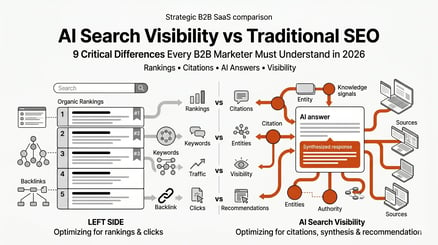
AEO and GEO are closely related and often used interchangeably, but they have distinct technical definitions and strategic scopes that matter for platform-specific optimization. The clearest distinction: AEO primarily targets AI features within Google (AI Overviews, AI Mode) and voice search assistants — systems that surface answers on top of traditional search infrastructure. GEO targets third-party AI models (ChatGPT, Perplexity, Claude, Gemini standalone) that operate outside Google's index.
The overlap between these systems and traditional organic rankings is shrinking. Research by Louise Linehan and Xibeijia Guan (using Ahrefs Brand Radar, 15,000 prompts) found that the overlap between AI citations and Google's top-10 organic results is only 12% for standalone AI models — meaning standard SEO alone addresses only a small fraction of the citation landscape. Perplexity is the partial exception at 28% overlap with Google rankings.
| Comparison | AEO | GEO | Traditional SEO |
|---|---|---|---|
| Primary goal | Be cited in AI answers | Be visible in AI-generated summaries | Rank in search results |
| Target systems | Google AIO, AI Mode, voice search | ChatGPT, Perplexity, Claude, Gemini | Google/Bing organic ranking algorithms |
| Success metric | Citation frequency, brand mentions | Share of voice in AI answers | Rankings, organic clicks, CTR |
| Query type optimized for | Conversational, question-based | Research, comparison, synthesis queries | Keyword-intent matching |
| Overlap with organic rankings (AI citations vs. top-10) | 76% (Google AIO) | 8–28% (ChatGPT/Perplexity) | N/A — is the target |
| Metric | Value | Source |
|---|---|---|
| Overlap: Google AIO citations vs. organic top-10 | 76% (mid-2024) → 17–38% (Feb 2026) | BrightEdge / ALM Corp, 2026 |
| Overlap: ChatGPT citations vs. Google top-10 | Only 8% | Linehan & Guan, Ahrefs Brand Radar, 15,000 prompts |
| Overlap: Perplexity citations vs. Google top-10 | 28% (highest of AI models) | Linehan & Guan, Ahrefs Brand Radar |
| ChatGPT overlap with Bing index | 87% match rate | Surfer SEO, 2026 |
| AI Overviews: % of keywords with 0–40 difficulty triggering AIO | 80% | Jack Limebear, 2026 |
| Marketers aware of GEO as a term | 38.8% | On Marketing, Sep 2025 |
| Marketers aware of AEO as a term | Only 19.6% | On Marketing, Sep 2025 |
The 8% overlap between ChatGPT citations and Google's top-10 organic results is the number that most clearly demonstrates why separate optimization strategies are required. A brand that ranks #1 on Google for its core category query has an 8% chance of appearing in ChatGPT's answer to the same query through SEO alone. Generative AI systems are not primarily drawing from the same sources as Google's ranking algorithm — they're drawing from the broader web, community content, Reddit, Wikipedia, YouTube, and authoritative third-party sources.
AI Traffic Quality and Conversion
The commercial case for AEO is not primarily about traffic volume — the total referral traffic from AI systems remains a small fraction of organic search. It's about traffic quality. Multiple independent studies have found AI-referred visitors convert at materially higher rates than traditional organic visitors. The mechanism is consistent: AI systems pre-qualify queries by synthesizing research before the click occurs, so users who click through have already consumed a detailed answer and are arriving to take a specific action.
Semrush's June 2025 study of 500+ high-value topics found AI search visitors convert at 4.4x the rate of traditional organic visitors. HubSpot reported 3x better lead conversion from AEO traffic versus other sources. ChatGPT referrals specifically convert at 14.2–15.9% compared to Google organic's 1.76% — a 9x differential.
| Metric | Value | Source |
|---|---|---|
| AI-referred visitors vs. organic: conversion rate | 4.4x higher | Semrush, June 2025 |
| HubSpot: lead conversion from AEO vs. other sources | 3x better | HubSpot, AEO Trends 2026 |
| Marketers who report AI visitors convert at higher rates | 58% | HubSpot, State of Marketing 2026 |
| ChatGPT referral conversion rate | 14.2–15.9% | Seer Interactive, June 2025 |
| Google organic conversion rate (comparison) | 1.76% | Seer Interactive, June 2025 |
| AI-referred visitors: time on site vs. organic | +68% more time on site | SE Ranking, 2025 |
| AI referral traffic YoY growth (Jan–May 2024 vs. 2025) | +527% | Previsible/Search Engine Land, August 2025 |
The 58% of marketers who report AI-referred visitors convert at higher rates is a survey finding, while the Semrush 4.4x figure is behavioral measurement from 500+ tracked topics. Both point in the same direction — and together they represent the clearest commercial argument for AEO investment available in 2026. Brands that earn AI citations are not just gaining visibility. They're attracting visitors who have already done their research, already formed a preference, and are arriving to complete an action.
Omnibound's AI Solutions for Demand Generation tracks which content is driving AI citations and connects that citation performance to pipeline outcomes — giving demand generation teams the attribution data needed to demonstrate AEO ROI in the measurement systems their stakeholders trust.
Platform-Level Citation Behavior
Each major AI search platform retrieves and cites content differently, and effective AEO requires understanding these differences rather than treating all AI systems as equivalent. Google AI Overviews draw primarily from Google's own search index; ChatGPT Search uses Bing's index; Perplexity retrieves across multiple sources in real time; Gemini relies heavily on Google's index plus content partnerships.
The citation source concentration is extreme. The top 15 domains capture 68% of all AI citation share across platforms (5WPR, AI Platform Citation Source Index 2026, 680M citations). YouTube accounts for 23–25% of AIO citations for demonstrative and how-to queries — the highest of any single domain — because AI systems treat YouTube as the primary visual authority source.
| Platform | Primary source | Citation behavior | Key stat | Source |
|---|---|---|---|---|
| Google AI Overviews | Google search index | 77–93% from top-10 organic | Structured, answer-ready content | Surfer SEO 2026 |
| ChatGPT Search | Bing index | 87% match with Bing top-20 | Bing authority + Reddit/forum | Surfer SEO 2026 |
| Perplexity | Multiple sources | Real-time retrieval; favors freshness | 28% overlap with Google top-10 | Linehan & Guan via Evergreen Media |
| Gemini | Google index + partners | Strong Google-first | Follows Google ranking signals | Surfer SEO 2026 |
| Metric | Value | Source |
|---|---|---|
| YouTube: share of AIO citations (visual/how-to queries) | 23–25% | Surfer SEO 46M citations; Jack Limebear 2026 |
| Wikipedia: share of ChatGPT referrals | 47.9% | Jack Limebear, 2026 |
| Reddit: frequency in Google AI Overviews | 21% | Jack Limebear, 2026 |
| Content freshness: updated within 30 days vs. older | 3.2x more AI citations | ConvertMate, 80M citations |
| Brand sites: share of AIO citations (rising) | 31% (up from 26% in Q1 2025) | Presenc AI, April 2026, 84K queries |
| Lower-ranked pages (position 5): GEO citation lift | +115% improvement | Princeton / Georgia Tech / IIT Delhi, ACM KDD 2024 |
| Healthcare sector: AI citations from authoritative sources | 82% | O8 Agency AEO guide, 2026 |
The Princeton finding that position-5 pages see 115% citation visibility improvement from GEO optimization — while position-1 pages see minimal change — reveals the most strategically underutilized opportunity in AEO. The brands that benefit most from AEO optimization are not the ones already dominating the first position. They are the second and third tier brands that currently rank but don't get cited. For those brands, targeted content restructuring delivers dramatic, measurable citation improvements with no domain authority uplift required.
Omnibound's AI Search Intelligence provides platform-level citation tracking across Google AI Overviews, ChatGPT, Perplexity, Gemini, and Claude — giving content teams the data to understand not just whether they're being cited, but which platforms they're winning and losing on, and what their competitors are being cited for instead.
AEO Statistics by the Numbers
| Metric | Value | Source |
|---|---|---|
| B2B buyers starting research in AI chatbot | 51% (up from 29%) | G2 March 2026 |
| B2B buyers using AI in vendor research | 73% | Pedowitz Group / 680M citation study |
| ChatGPT in B2B buyer evaluation | 63% of buyers | Pedowitz Group |
| Organic search traffic shifting to AI chatbots (Gartner) | 25% by 2026 | Gartner, February 2024 |
| Average Google query length | 3.37 words | The Growth Memo 2025 |
| Average ChatGPT prompt length | 23 words | The Growth Memo 2025 |
| AI search visits YoY growth | +42.8% | Contently analysis 2026 |
| Marketers who believe AEO will significantly impact strategy | 70% | Acquia/Researchscape 2025 |
| Marketers who have begun implementing AEO | Only 20% | Acquia/Researchscape 2025 |
| Marketing teams actively optimizing for AI search | 37.2% | On Marketing Sep 2025 |
| Recognize "AI SEO" | 83.6% | On Marketing Sep 2025 |
| Recognize "AEO" specifically | Only 19.6% | On Marketing Sep 2025 |
| Top AEO barrier: budget | 45% | Acquia/Researchscape 2025 |
| Early adopter AI visibility advantage | 3.4x more | RevvGrowth AEO analysis 2026 |
| GEO: statistics addition visibility boost | +41% | Princeton/Georgia Tech/IIT Delhi, KDD 2024 |
| GEO: cite sources visibility boost | +40% | Princeton/Georgia Tech/IIT Delhi, KDD 2024 |
| GEO: quotation addition visibility boost | +28% | Princeton/Georgia Tech/IIT Delhi, KDD 2024 |
| Sequential heading structure: citation lift | 2.8x | AirOps 2026 State of AI Search |
| Citations from first 30% of content | 44.2% | SparkToro January 2026 |
| Commercial citations from pages updated within 12 months | 83% | AirOps 2026 |
| Pages not refreshed quarterly: citation loss risk | 3x more likely | AirOps 2026 |
| Domain authority correlation with AI citation frequency | 0.65 (strong) | Jack Limebear 2026 |
| LLM-formatted content citation rate vs. unstructured | 3x more likely to be cited | Jack Limebear 2026 |
| AIO–Google top-10 overlap (Feb 2026) | 17–38% | BrightEdge/ALM Corp Feb–Mar 2026 |
| ChatGPT–Google top-10 citation overlap | Only 8% | Linehan & Guan, Ahrefs Brand Radar |
| Perplexity–Google top-10 citation overlap | 28% | Linehan & Guan, Ahrefs Brand Radar |
| ChatGPT–Bing top-20 match rate | 87% | Surfer SEO 2026 |
| AI-referred visitors: conversion rate vs. organic | 4.4x higher | Semrush June 2025 |
| HubSpot: AEO lead conversion vs. other sources | 3x better | HubSpot AEO Trends 2026 |
| Marketers: AI visitors convert at higher rates | 58% | HubSpot State of Marketing 2026 |
| ChatGPT referral conversion rate | 14.2–15.9% | Seer Interactive June 2025 |
| Google organic conversion rate (baseline) | 1.76% | Seer Interactive June 2025 |
| AI referral traffic YoY growth | +527% | Previsible/Search Engine Land Aug 2025 |
| YouTube: share of AIO citations (how-to queries) | 23–25% | Surfer SEO / Jack Limebear 2026 |
| Wikipedia: share of ChatGPT referrals | 47.9% | Jack Limebear 2026 |
| Reddit: frequency in Google AIO citations | 21% | Jack Limebear 2026 |
| Position-5 pages: GEO citation improvement | +115% | Princeton/Georgia Tech/IIT Delhi, KDD 2024 |
| Content freshness: updated within 30 days | 3.2x more citations | ConvertMate 80M citations |
| Brand sites: share of AIO citations (2026) | 31% (up from 26%) | Presenc AI April 2026 |
Methodology and Sources
This article was compiled from peer-reviewed academic research, named primary surveys, and verified industry studies published between 2024 and 2026. Every statistic was traced to its originating study before inclusion.
Primary sources (Tier 1):
- Princeton / Georgia Tech / IIT Delhi / Allen Institute for AI — GEO: Generative Engine Optimization (Aggarwal et al.; presented at ACM KDD 2024, 30th Annual Conference; peer-reviewed; 10,000 queries on GEO-bench; 9 optimization methods tested). The foundational academic study for AEO/GEO optimization.
- Acquia / Researchscape — AEO vs. SEO: Why Answer Engine Optimization Is the Next Big Thing in Digital Strategy (n=500+ marketing professionals, US and UK, 2025; 70%/20% AEO awareness-to-implementation gap)
- G2 — The Answer Economy: 2026 B2B Buyer Behavior Report (n=1,076 B2B decision-makers, March 2026; 51% begin research in AI chatbot)
- AirOps — 2026 State of AI Search Report (citation pattern analysis across ChatGPT, Perplexity, Google AI Overview, Gemini; structural citation signals; freshness multipliers)
- On Marketing — AEO Trends 2025 (n=250 US marketing professionals, September 2025; AI search optimization adoption survey)
- HubSpot — AEO Trends in 2026; State of Marketing 2026 (n=1,500+ global marketers)
- Semrush — Impact of AI Search on SEO Traffic (June 2025; 4.4x conversion finding; 500+ high-value topics)
- Gartner — Search Engine Volume Will Drop 25% by 2026 (February 2024)
- SparkToro — AI citation position study (January 2026; 44.2% of citations from first 30% of content)
- ConvertMate — AI visibility study (80M citations; 3.2x freshness multiplier for content updated within 30 days)
- The Growth Memo — Query length comparison: Google 3.37 words vs. ChatGPT 23 words (2025 US data)
- Surfer SEO — 46M AIO citation analysis (YouTube 23.3%, Wikipedia 18.4%); AEO guide 2026 (platform citation behavior table)
- Louise Linehan and Xibeijia Guan / Ahrefs Brand Radar — Citation overlap study (15,000 prompts; 8% ChatGPT–Google overlap, 28% Perplexity–Google overlap)
Notes on terminology: The terms AEO (Answer Engine Optimization), GEO (Generative Engine Optimization), and LLMO (Large Language Model Optimization) are used interchangeably by many practitioners and publications. For this article: AEO refers broadly to the practice of optimizing for AI-powered answer systems; GEO refers more specifically to the framework introduced by the Princeton academic study and applied to third-party LLMs; LLMO is not addressed separately. Statistics from studies using "GEO" as their framework are cited in the AEO context where the optimization goals align.
Turn Your Content Into AI-Search Winners
Get cited across ChatGPT, Claude & Perplexity — not just ranked on Google.
- Increase AI citations
- Improve answer visibility
- Track brand mentions in LLMs
%2056+%20Data%20Points%20on%20Coverage%2c%20CTR%20Impact%2c%20Citations%2c%20and%20Industry%20Breakdown.webp?height=245&name=Google%20AI%20Overviews%20Statistics%20(2026)%2056+%20Data%20Points%20on%20Coverage%2c%20CTR%20Impact%2c%20Citations%2c%20and%20Industry%20Breakdown.webp)