


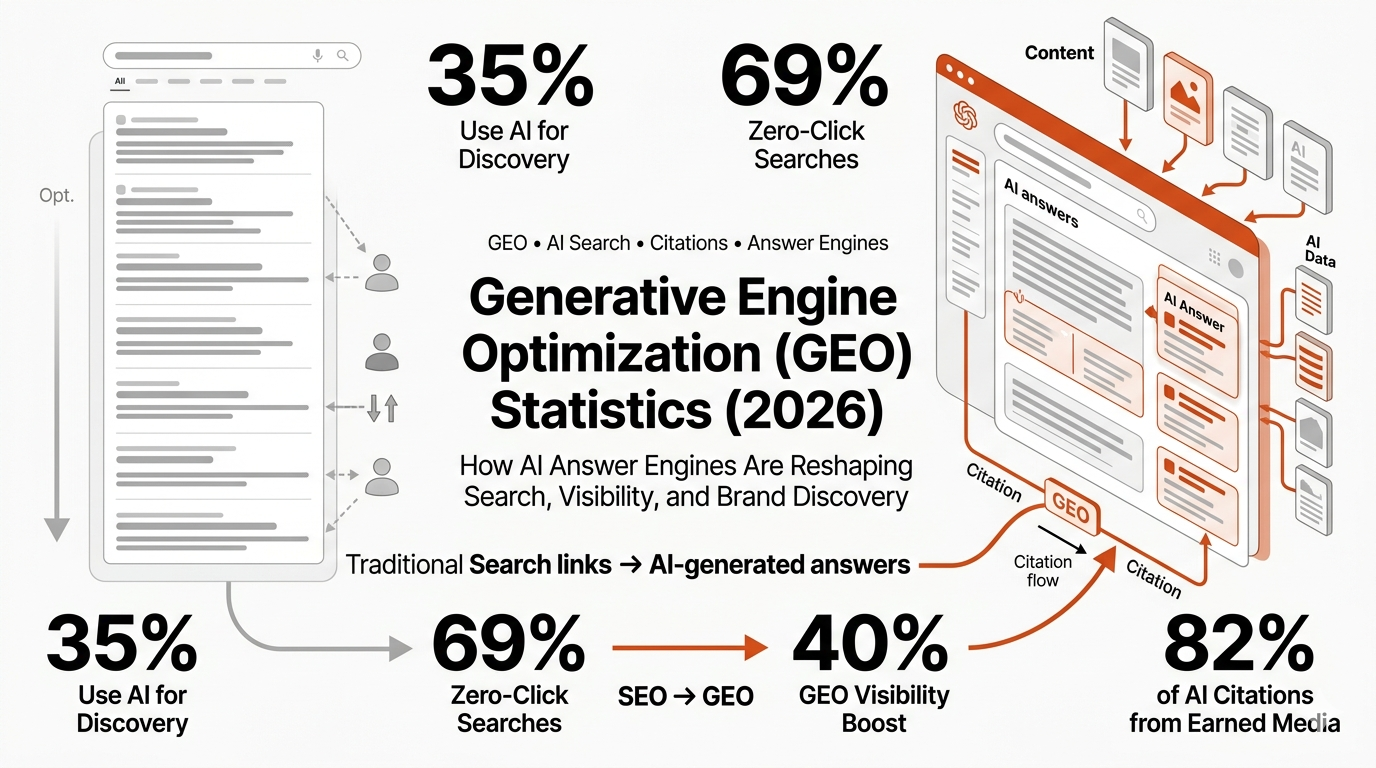


35% of US consumers now use AI tools at the product discovery stage, compared to just 13.6% who use traditional search (Similarweb, 2026 Generative AI Brand Visibility Index). This shift marks the rise of answer engine optimization, where brands must optimize content for AI-powered answer engines like ChatGPT, Perplexity, and Google Gemini, rather than relying solely on traditional search engines. AI-generated summaries and AI summaries are rapidly changing user behavior by providing direct answers, reducing the need for traditional search links, and significantly impacting website traffic and click through rates. As consumers rely more on AI assistants and direct answers, traditional engines and traditional search links see declining engagement, making structured data and technical SEO essential for visibility in generative search results.
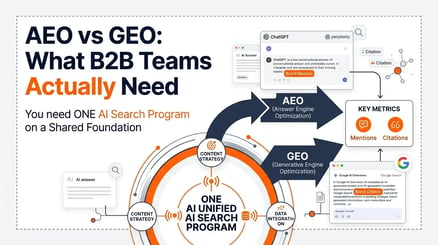
GEO, Generative Engine Optimization, is the discipline of structuring content and brand presence to earn citations inside AI-generated answers from ChatGPT, Google AI Overviews, Perplexity, Gemini, and Claude. The term was formalized by researchers at Princeton University, Georgia Tech, the Allen Institute for AI, and IIT Delhi in a paper presented at KDD 2024, which demonstrated that GEO techniques boost content visibility in AI responses by up to 40% (Princeton/Georgia Tech/IIT Delhi, GEO: Generative Engine Optimization, KDD 2024). Unlike traditional SEO, optimizing for large language models and generative AI platforms requires a focus on structured formats, concise direct answers, and continuous data driven insights. Foundational steps like keyword research and auditing existing content are now paired with E-E-A-T (Experience, Expertise, Authoritativeness, Trustworthiness) and real-time analytics to improve competitive positioning and ensure your brand appears in answer engines.
Digital marketing is a key driver in the adoption of generative engine optimization, integrating with AI-driven platforms, digital advertising, and leveraging AI integration, AI models, and AI agents to adapt to the evolving AI landscape. Early adopters are shaping the market by using generative search, generative search results, and advanced AI capabilities to optimize content for brand visibility and competitive positioning. The U.S. Generative Engine Optimization (GEO) Market is expected to reach USD 365.4 million in 2026, with a CAGR of 42.9% over the forecast period. As generative AI platforms and answer engines become the new frontier for digital marketing and content optimization, tracking how often your brand appears in AI summaries appeared and generative search results is now a critical KPI for success.
Zero-click searches on Google grew from 56% to 69% in a single year following AI Overviews’ rollout (Similarweb, July 2025), and 82% of AI citations come from earned media, not owned content or paid placements (Muck Rack, What Is AI Reading? December 2025). We aggregated data from Princeton/KDD, Ahrefs, Similarweb, Muck Rack, ConvertMate, Seer Interactive, SparkToro, SE Ranking, Semrush, and a dozen other primary and Tier 2 sources to compile the most comprehensive GEO statistics for 2026.
Key Takeaways
- GEO techniques can boost content visibility in AI-generated responses by up to 40% (Princeton/Georgia Tech/IIT Delhi, GEO: Generative Engine Optimization, KDD 2024)
- Adding statistics to content is the single most effective GEO tactic, improving AI visibility by 41% (Princeton/KDD 2024, verified by ZipTie.dev)
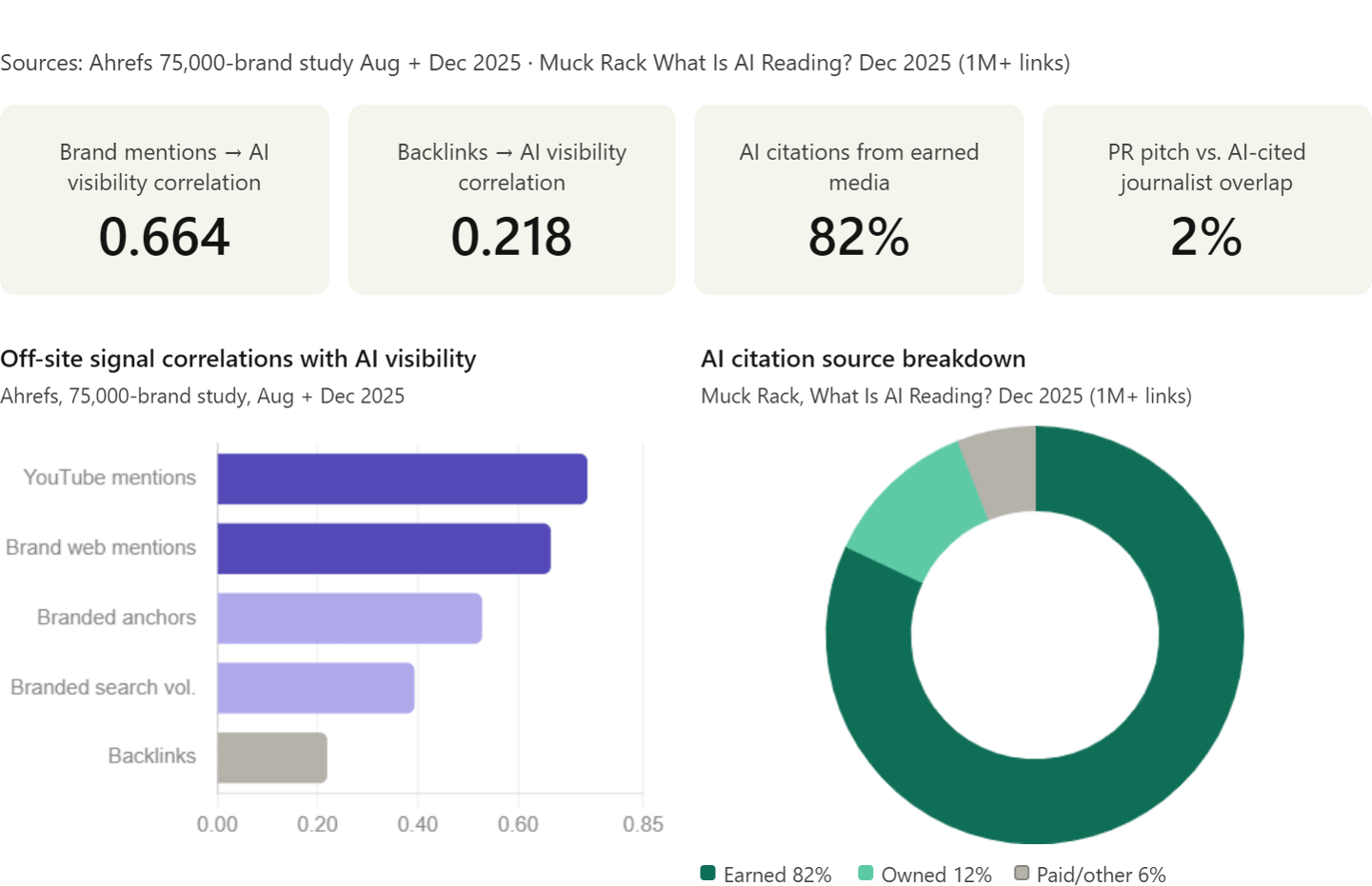
- Brand mentions correlate 3x more strongly with AI visibility than backlinks: 0.664 vs. 0.218 (Ahrefs, 75,000-brand study, August 2025)
- 82% of AI citations come from earned media; only 6% come from paid or owned content (Muck Rack, What Is AI Reading? December 2025)
- Zero-click searches grew from 56% to 69% in the year following Google AI Overviews' launch (Similarweb, July 2025)
- 44.2% of all LLM citations come from the first 30% of content, the introduction (SparkToro, January 2026)
- Pages above 20,000 characters receive 4.3x more AI citations than pages under 500 characters (ConvertMate GEO Benchmark 2026, corroborated by Growth Memo, March 2026)
- 92% of marketers plan to optimize for AI search, but only 40.6% are currently doing so (ConvertMate GEO Benchmark 2026)
- 83% of AI Overview citations come from pages outside the organic top 10 (ConvertMate GEO Benchmark 2026)
- Only 30% of brands maintain consistent visibility across AI answers from one session to the next (AirOps/Kevin Indig, 2026 State of AI Search)
- Distributing content to a wide range of publications increases AI citations by up to 325% compared to publishing only on your own site (Stacker, December 2025)
- 35% of US consumers now use AI at the product discovery stage vs. 13.6% who use traditional search (Similarweb, 2026 Generative AI Brand Visibility Index)
- Princeton University / Georgia Tech / Allen Institute for AI / IIT Delhi, GEO: Generative Engine Optimization, KDD 2024 (peer-reviewed, ACM KDD 2024; 76 citations and 9,106 downloads as of March 2026; 10,000 queries across 10 search engines)
- Ahrefs, 75,000-brand study: Brand Mentions and AI Overview Visibility, August 2025; Extended study: ChatGPT, AI Mode, AI Overviews, December 2025; AI Marketing Statistics, 2025
- Muck Rack / Generative Pulse, What Is AI Reading? July 2025 (initial); What Is AI Reading? December 2025 (updated) (1M+ links cited across ChatGPT, Claude, Gemini, Perplexity, July–December 2025)
- Similarweb, 2026 Generative AI Brand Visibility Index; Zero-Click Research, July 2025; Complete GEO Guide 2026
- Seer Interactive, Google AI Overview Study, June 2025 (LLM conversion rate analysis; AI Overview citation freshness study)
- SparkToro, LLM Citation Position Analysis, January 2026
- Adobe Digital Insights, AI Traffic Surges Across Industries, January 2026 (1 trillion+ US retail site visits)
- Gartner, Predicts 2024: Search Engine Volume Will Drop 25% by 2026, February 2024
- eMarketer, GEO Adoption Survey, January 2026
- BrightEdge, AI Overview Adjacent CTR Study, 2025
- ConvertMate, GEO Benchmark Study 2026 (12,500+ queries across 8,000 domains; corroborated by BrightEdge, Semrush, HubSpot, Princeton framework)
- AirOps / Kevin Indig, The 2026 State of AI Search (45,000 citations analyzed; brand visibility consistency data)
- Semrush, AI SEO Statistics, 2025 (AI Overview content freshness; LLM conversion rate data)
- Foundation Marketing, GEO Analysis, March 2026 (ChatGPT heading hierarchy analysis)
- Growth Memo / Kevin Indig, AI SEO Statistics for 2026, March 2026 (content length citation data)
- Stacker, Content Distribution and AI Citation Study, December 2025, cited by position.digital
- Digital Bloom, 2025 Organic Traffic Crisis Analysis Report
- Dimension Market Research, GEO Market Size Projections, 2025, cited by Superlines
- Incremys, GEO Measurement Survey, 2025, cited by NAV43
The GEO Opportunity: Market Size, Adoption, and the Measurement Gap
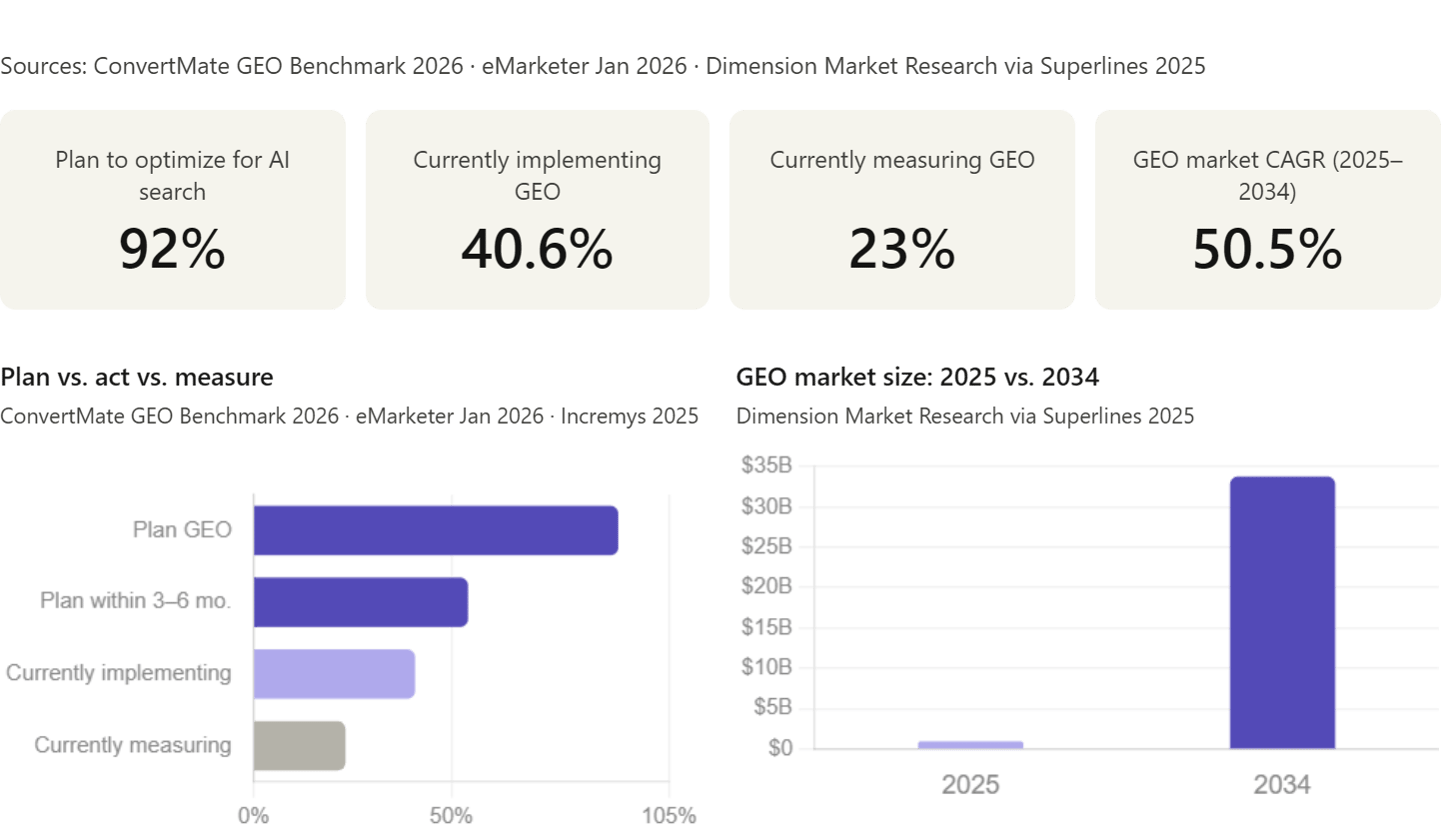
GEO is a first-mover market with documented performance lift and a large execution gap. 92% of marketers plan to optimize for AI search but only 40.6% are currently doing so, and the GEO market itself is projected to grow from $848 million in 2025 to $33.7 billion by 2034 at a 50.5% CAGR, a trajectory consistent with early-stage channel breakout (ConvertMate GEO Benchmark 2026; Dimension Market Research, cited by Superlines, 2025). The discipline was formalized in academic research in 2024 and entered mainstream marketing vocabulary in 2025. By early 2026, most enterprise marketing teams have a GEO initiative. Most SMB and mid-market teams have not started, which represents a compounding first-mover advantage given that citation authority, like domain authority before it, accumulates over time.
|
Metric |
Value |
Source |
|
Marketers planning to optimize for AI search |
92% |
|
|
Marketers currently implementing GEO |
40.6% |
|
|
US marketers planning GEO within 3–6 months |
54% |
|
|
Marketers currently investing in GEO measurement |
23% |
|
|
GEO market size (2025) |
$848 million |
|
|
GEO market projected size (2034) |
$33.7 billion |
|
|
GEO market CAGR (2025–2034) |
50.5% |
|
|
B2B SaaS sites: AI search as share of organic traffic (September 2025) |
~4.5% |
|
|
B2B SaaS sites: AI search traffic growth (3 months to September 2025) |
127% |
|
|
B2B buyers who consider AI search a top research source |
89% |
Context note: The 54% plan vs. 23% measurement gap is the defining GEO maturity challenge in 2026. GEO ROI is structurally harder to measure than SEO because zero-click AI answers generate no referral sessions, and shortlist influence, the most commercially valuable AI impact, happens before any trackable touchpoint. Teams building measurement frameworks now will have compounding data advantages over teams that start later.
Source: ConvertMate GEO Benchmark Study 2026
Omnibound's AI Search tracks brand citation rates across ChatGPT, Perplexity, Google AI Overviews, and AI Mode, connecting GEO execution to measurable citation share before and after content changes.
Zero-Click Search and the Collapse of Organic Traffic
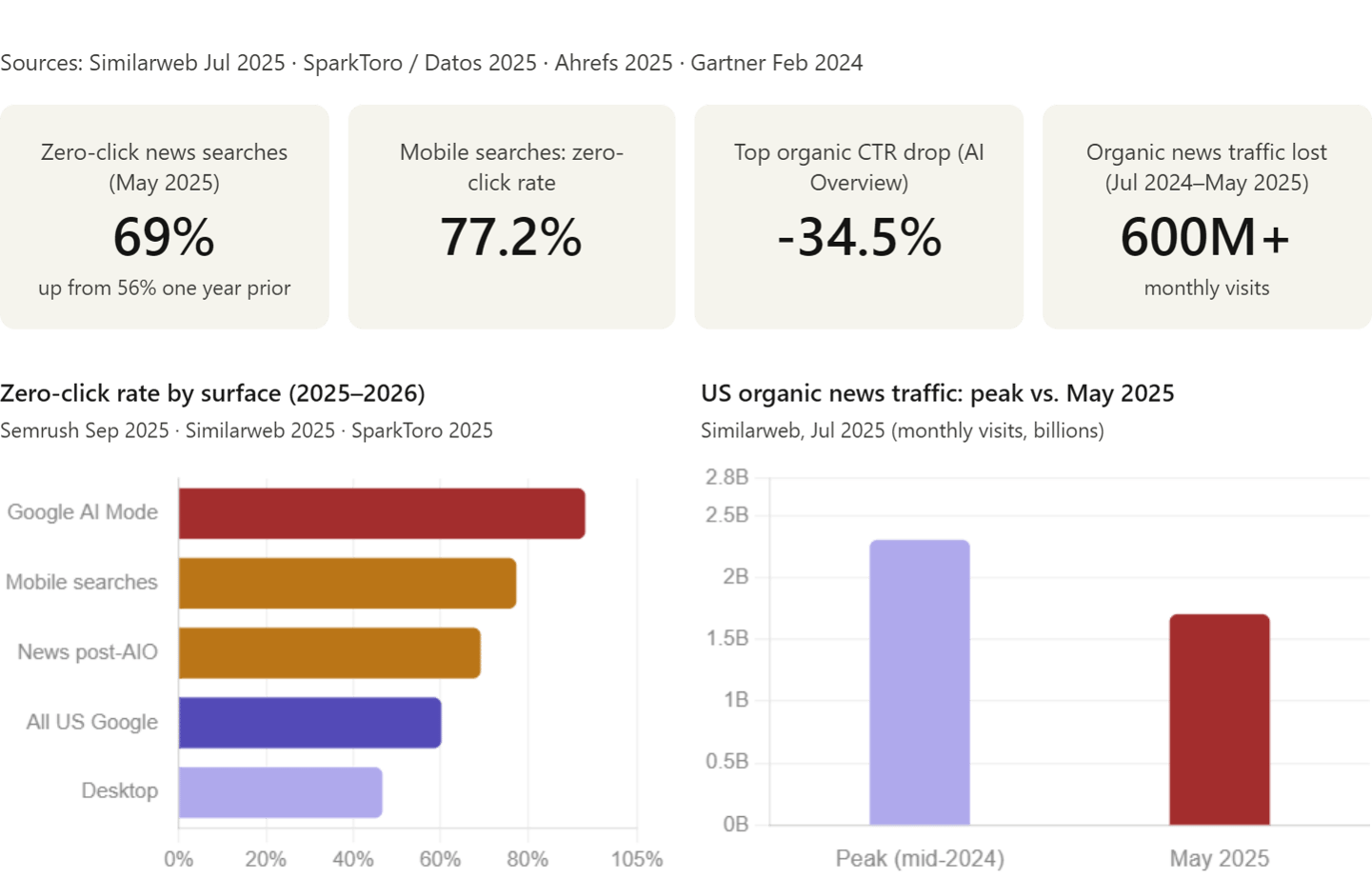
Zero-click search has crossed from trend to structural shift. Zero-click searches on Google grew from 56% to 69% in a single year, a 13-percentage-point increase in the twelve months following Google AI Overviews' launch in May 2024 (Similarweb, July 2025). Organic traffic to news publishers dropped from over 2.3 billion monthly visits in mid-2024 to under 1.7 billion by May 2025, a loss of more than 600 million visits in less than twelve months. The implication for any brand dependent on search-driven content distribution is structural, not cyclical: ranking well is no longer sufficient for visibility when most users get their answer without ever clicking.
|
Metric |
Value |
Source |
|
Zero-click news searches on Google (May 2024, pre-AIO) |
56% |
|
|
Zero-click news searches on Google (May 2025, post-AIO) |
69% |
|
|
All US Google searches ending without a click (2025) |
60% |
|
|
Mobile searches ending without a click |
77.2% |
|
|
US organic traffic to news sites: peak (mid-2024) |
2.3 billion monthly visits |
|
|
US organic traffic to news sites (May 2025) |
Under 1.7 billion monthly visits |
|
|
CTR drop for top organic result when AI Overview is present |
34.5% |
|
|
Gartner prediction: traditional search volume drop by 2026 |
25% |
|
|
HubSpot organic traffic decline (November 2024–early 2025) |
~50–55% |
|
|
Median publisher: YoY traffic decline (H1 2025) |
10% (non-news: 14%) |
ChatGPT referrals to news publishers grew 25x year-over-year in the same period (Similarweb, July 2025). AI is redistributing attention, not destroying it, but the redistribution is concentrated heavily on brands that have earned AI citations. For most publishers, AI referral growth does not offset organic search decline. For the minority with strong citation authority, AI traffic is a measurable new channel.
Source: Similarweb, Zero-Click Research Report, July 2025
Content Optimization Signals: What Princeton's GEO Research Actually Found
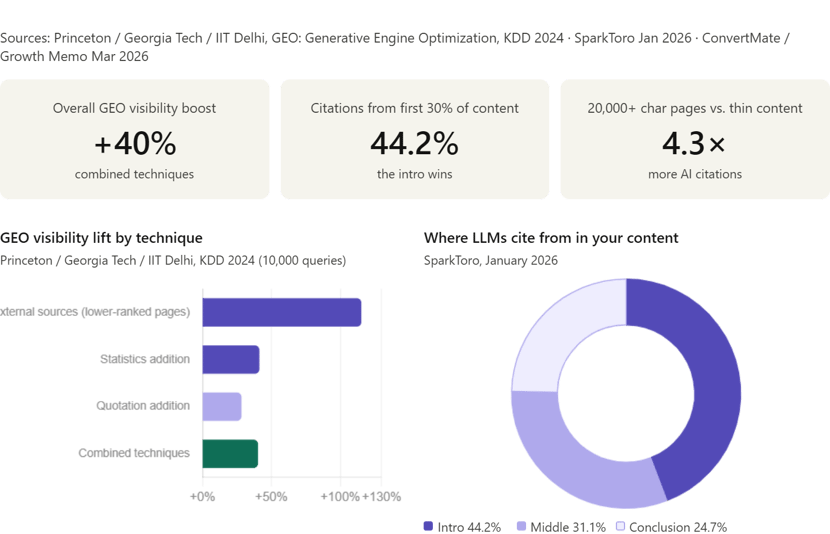
The Princeton/Georgia Tech/IIT Delhi paper presented at KDD 2024 is the only peer-reviewed academic study quantifying which content optimization techniques improve AI visibility. It tested six content modification strategies across 10 search engines using 10,000 queries. Statistics addition improved visibility by 41%, quotation addition improved visibility by 28%, and citing external sources improved visibility by 115% for lower-ranked content, a finding that validates the core mechanic of data-driven content as a GEO strategy (Princeton/Georgia Tech/IIT Delhi, KDD 2024). Importantly, simply adding more words produced no improvement. The signal is data density and source credibility, not volume.
|
Metric |
Value |
Source |
|
GEO visibility boost from statistics addition |
+40% |
Princeton/Georgia Tech/IIT Delhi, GEO: Generative Engine Optimization, KDD 2024 |
|
GEO visibility boost from quotation addition |
+28% |
|
|
GEO visibility boost from citing external sources (lower-ranked pages) |
+115% |
|
|
Overall GEO visibility boost from combined techniques |
Up to 40% |
|
|
Pages above 20,000 characters: avg. AI citations |
10.18 |
|
|
Pages under 500 characters: avg. AI citations |
2.39 |
|
|
Citation rate advantage for content with strict H1→H2→H3 heading structure |
68.7% of ChatGPT-cited pages follow this hierarchy |
|
|
Share of LLM citations from first 30% of content (intro) |
44.2% |
|
|
Share of LLM citations from middle 30–70% of content |
31.1% |
|
|
Share of LLM citations from final 30% of content |
24.7% |
|
|
Stat-dense content visibility advantage over unoptimized content |
30–40% higher |
The Princeton study introduced three metrics that most practitioners still have not adopted: impression score (how much of your source appears in an AI response, weighted by position), citation recall (the proportion of your eligible content that gets cited), and citation precision (the proportion of your citations that are accurate). These are more meaningful GEO performance indicators than referral session counts, which undercount zero-click influence by definition.
Source: Princeton/Georgia Tech/IIT Delhi, GEO: Generative Engine Optimization, KDD 2024
Omnibound's Marketing Context Engine feeds unified buyer intelligence, product data, and competitive signals into every content workflow, ensuring AI-generated content starts with the statistical density and source credibility that the Princeton research identifies as the primary visibility driver.
Brand Visibility Signals: Mentions, Authority, and the Off-Site Imperative
The most important finding in GEO research for brand marketers is one that traditional SEO practitioners find counterintuitive: brand mentions correlate 3x more strongly with AI visibility than backlinks (0.664 vs. 0.218 correlation) (Ahrefs, 75,000-brand study, August 2025). The mechanism is not mysterious. AI language models are trained on raw text, not hyperlink graphs. When independent sources consistently discuss a brand in editorial coverage, analyst reports, industry forums, product comparisons, and review platforms, the model learns that brand is a known, credible entity worth referencing, regardless of whether those mentions include links. The era of off-page SEO has arrived, and it is organized around mention acquisition rather than link acquisition.
|
Metric |
Value |
Source |
|
Brand mentions: correlation with AI Overview visibility |
0.664 |
|
|
Backlinks: correlation with AI Overview visibility |
0.218 |
|
|
Branded anchors: correlation with AI Overview visibility |
0.527 |
|
|
YouTube mentions: correlation with AI visibility (strongest off-site signal) |
~0.737 (ChatGPT, AI Mode, AI Overviews) |
|
|
Brands in top 25% for web mentions: AI Overview citation advantage |
10x more citations than next quartile |
|
|
Top 3 AI Overview correlation factors (all off-site) |
Brand web mentions, branded anchors, branded search volume |
|
|
82% of AI citations are earned media |
82% |
|
|
Non-paid sources: share of all AI citations |
94% |
|
|
Journalism share of AI citations |
20–30% |
|
|
Overlap between journalists PR teams pitch and AI-cited journalists |
2% |
|
|
Press release citations growth (July–December 2025) |
5x increase |
|
|
Distributing content to wide publications vs. owned site only: citation increase |
Up to 325% |
The 2% overlap between the journalists PR teams pitch and the journalists AI actually cites is the most actionable finding for communications professionals in this dataset. It means most PR programs are systematically targeting the wrong reporters for AI visibility. The implication is not to abandon current PR relationships, it is to audit which outlets and journalists AI platforms cite for your specific category and build a parallel outreach track targeting those sources.
Source: Muck Rack, What Is AI Reading? December 2025
Omnibound's AI Search surfaces which third-party domains are being cited most frequently for your category's core buying prompts, directly identifying the off-site publication targets that would most improve citation share.
Content Freshness, Format, and Platform-Specific Citation Patterns
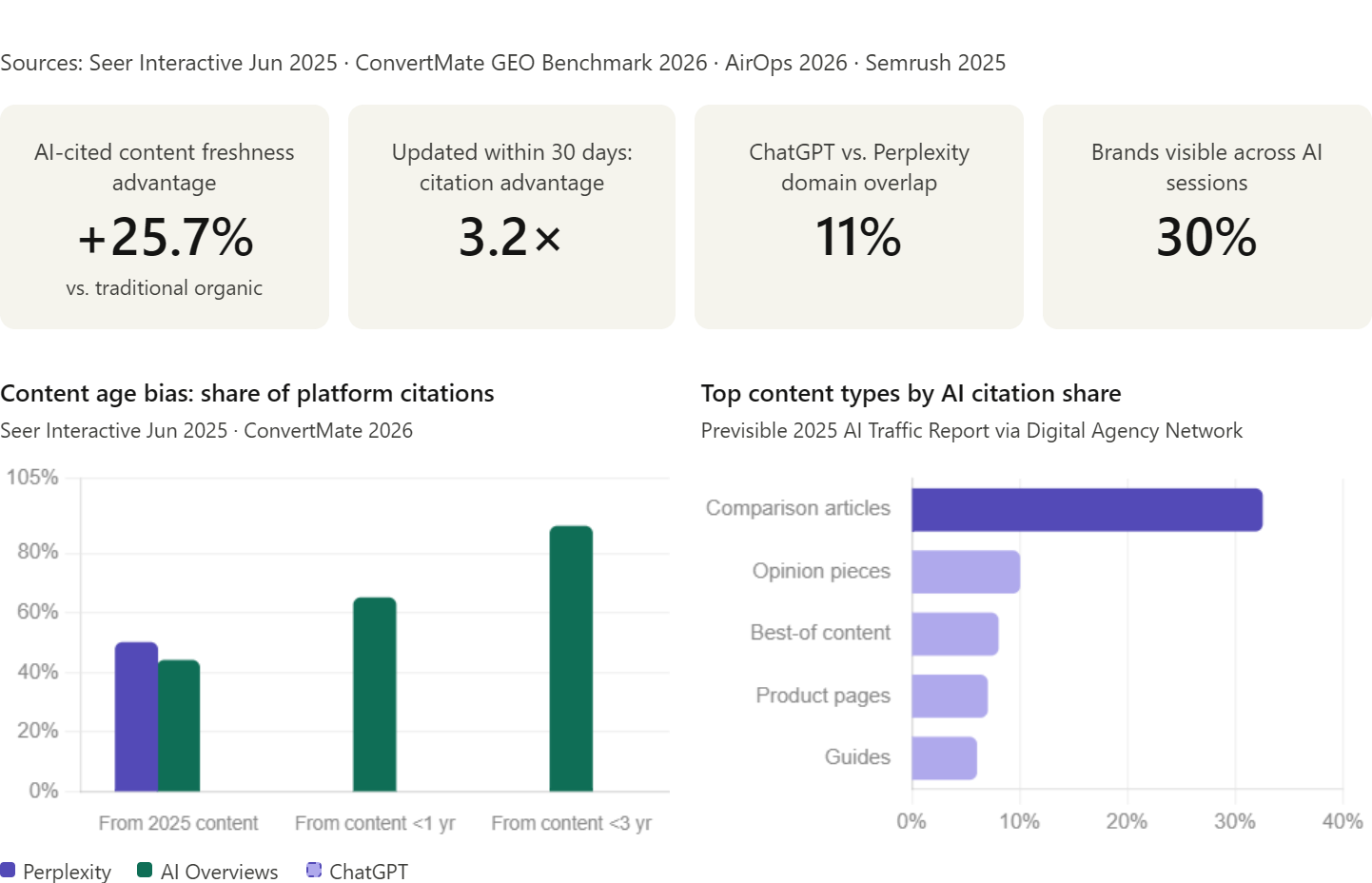
Content freshness is a primary GEO signal that most teams underweight. AI-cited content is 25.7% fresher than content in traditional organic search results, and ChatGPT shows the strongest recency bias with 76.4% of its most-cited pages updated in the last 30 days (getpassionfruit.com, citing SERP analysis data, 2025). Muck Rack's analysis of more than one million citations confirmed that the highest citation rate occurs within just seven days of publication. The implication for content operations is structural: a quarterly update cycle for key content pages is not sufficient for AI visibility. A 30-day refresh cycle for high-priority pages is the new minimum.
|
Metric |
Value |
Source |
|
AI-cited content freshness vs. traditional organic results |
25.7% fresher |
|
|
ChatGPT: share of most-cited pages updated in last 30 days |
76.4% |
|
|
AI Overviews: share of citations from content less than 1 year old |
65% |
|
|
AI Overviews: share of citations from content less than 3 years old |
89% |
|
|
Perplexity citations from 2025 content alone |
50% |
|
|
AI Overviews citations from 2025 content |
44% |
|
|
Content updated within 30 days: citation rate advantage |
3.2x more citations across platforms |
|
|
Pages not updated in 3+ months: citation loss risk |
3x more likely to lose citations |
|
|
Best-performing content type for AI citations |
Comparison articles (32.5% of citations) |
|
|
Second-best content type by AI citation share |
Opinion pieces (10%) |
|
|
Domain overlap between ChatGPT and Perplexity citation sources |
11% |
|
|
Consistency of brand visibility across AI sessions |
Only 30% of brands stay visible |
The 11% domain overlap between ChatGPT and Perplexity citation sources is a critical platform strategy finding. Success on one AI platform does not guarantee visibility on another. ChatGPT uses Bing's search index; Perplexity uses vector indexing; Google AI Overviews draws from Google's own index. Brands need platform-specific citation strategies, not a single unified GEO playbook.
Source: Seer Interactive, Google AI Overview Study, June 2025
GEO Performance: Conversion Quality, Revenue Impact, and the Citation Economy
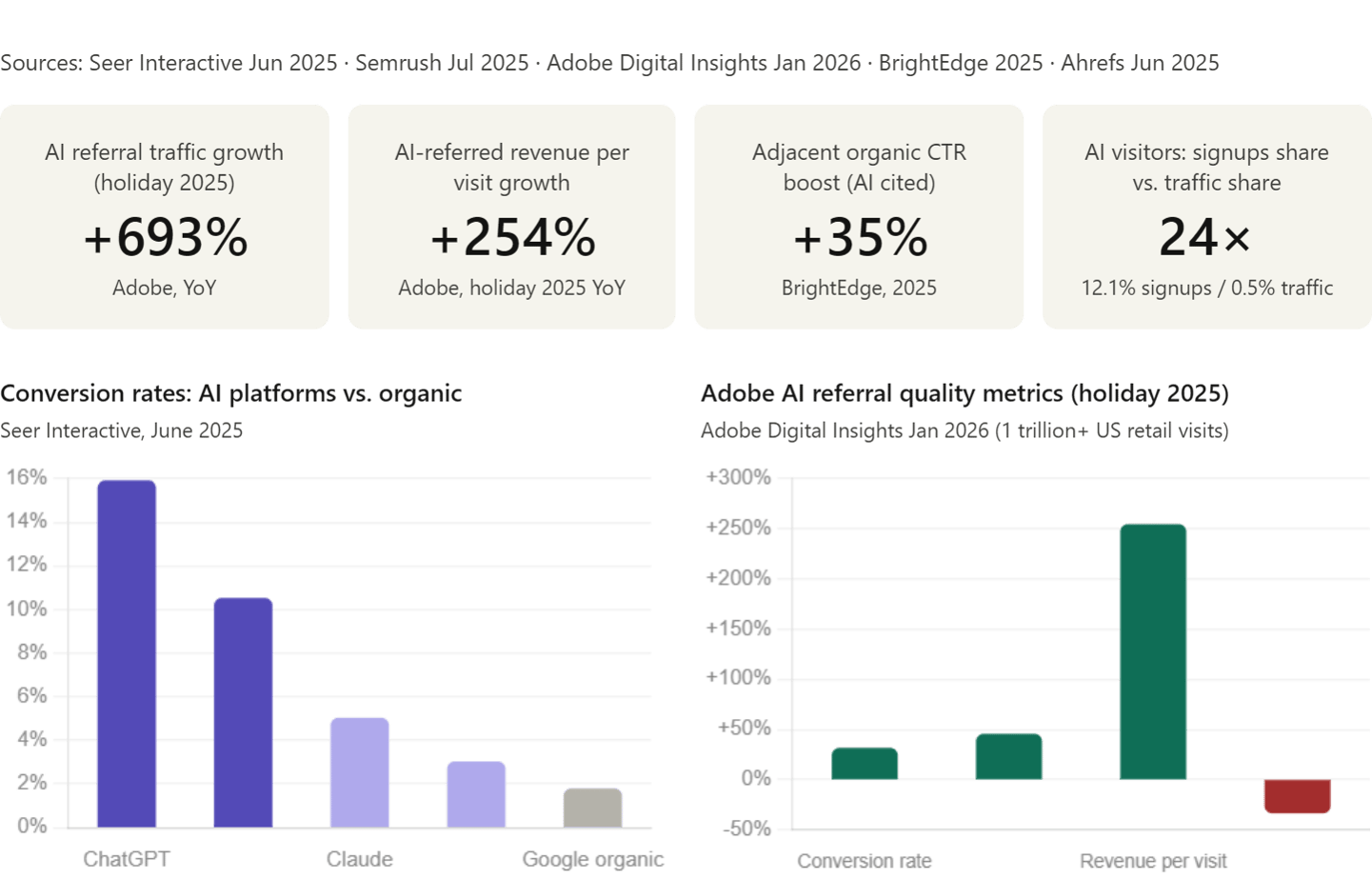
AI-referred traffic converts at rates that make GEO one of the highest-ROI acquisition channels available in 2026. LLM visitors convert at 15.9% from ChatGPT, 10.5% from Perplexity, and 5% from Claude, compared to a 1.76% organic search conversion rate (Seer Interactive, June 2025). Ahrefs found AI search visitors generated 12.1% of signups despite accounting for only 0.5% of total visitors, a 24:1 conversion ratio relative to organic search. The mechanism is intent: AI search users arrive with specific, researched queries and a pre-formed shortlist. Clicking through from an AI answer is not a casual behavior, it is a high-intent action from a buyer already deep in evaluation.
|
Metric |
Value |
Source |
|
ChatGPT conversion rate for LLM-referred visitors |
15.9% |
|
|
Perplexity conversion rate for LLM-referred visitors |
10.5% |
|
|
Claude conversion rate for LLM-referred visitors |
5.0% |
|
|
Google organic search average conversion rate |
1.76% |
|
|
AI search visitors: share of signups vs. share of traffic |
12.1% of signups / 0.5% of traffic |
|
|
LLM visitors conversion rate vs. traditional organic |
4.4x higher |
|
|
Adobe AI referral traffic growth (holiday season 2025, YoY) |
693% |
|
|
AI referral conversion vs. non-AI (holiday season 2025) |
31% higher |
|
|
AI-driven revenue per visit growth (holiday season 2025) |
254% YoY |
|
|
Brands mentioned in Google AI Overviews: adjacent organic CTR increase |
35% higher |
|
|
GEO-optimized content: AI search visibility improvement |
30–40% |
The BrightEdge finding that AI Overview citations increase adjacent organic CTR by 35% resolves the common objection that GEO cannibalizes traditional SEO. Being cited in an AI answer increases the probability that a user will click on your organic listing if it also appears. The two channels compound, not compete, making GEO investment additive to existing SEO performance.
Source: Adobe Digital Insights, AI Traffic Surges Across Industries, January 2026
For B2B teams building the content and brand presence that drives GEO citation authority, Omnibound's AI Content Marketing Platform combines buyer intent research, context-rich content production, and AI search citation tracking into a single workflow.
GEO by the Numbers: Summary Table
|
Metric |
Value |
Source |
|
GEO visibility boost from combined techniques |
Up to 40% |
|
|
GEO visibility boost from statistics addition alone |
+41% |
|
|
GEO visibility boost from citing external sources |
+115% (lower-ranked pages) |
|
|
Marketers planning GEO but not yet implementing |
51.4% (92% plan, 40.6% act) |
|
|
GEO market CAGR (2025–2034) |
50.5% |
|
|
US consumers using AI at product discovery stage |
35% (vs. 13.6% using search) |
|
|
Zero-click news searches on Google (May 2025) |
69% (up from 56% one year prior) |
|
|
AI Overview citations from pages outside organic top 10 |
83% |
|
|
LLM citations from first 30% of content |
44.2% |
|
|
Pages 20,000+ characters: citation advantage |
4.3x vs. thin content |
|
|
Content updated within 30 days: citation advantage |
3.2x more citations |
|
|
Brand mentions: correlation with AI visibility |
0.664 |
|
|
Backlinks: correlation with AI visibility |
0.218 |
|
|
Top 25% brands by mentions: AI Overview citation advantage |
10x more citations |
|
|
Earned media share of all AI citations |
82% |
|
|
Journalism share of all AI citations |
20–30% |
|
|
PR pitching–AI citation journalist overlap |
2% |
|
|
Distribution to wide publications vs. owned site: citation increase |
Up to 325% |
|
|
Brand visibility consistency across AI sessions |
Only 30% |
|
|
ChatGPT conversion rate for AI-referred visitors |
15.9% |
|
|
Google organic average conversion rate (comparison) |
1.76% |
|
|
AI-referred visitors: signups vs. traffic ratio |
12.1% signups / 0.5% traffic |
|
|
Brands cited in AI Overviews: adjacent organic CTR lift |
35% higher |
Methodology and Sources
This article was compiled by aggregating statistics from Tier 1 peer-reviewed research and primary industry studies, and Tier 2 reputable aggregators with disclosed methodology. All statistics were traced to their original named source before inclusion. Blog-to-blog citations without primary attribution were excluded. Figures flagged as Tier 2 are noted where used.
Primary sources (Tier 1):
Tier 2 sources (methodology disclosed):
Last updated: April 2026 We update this page quarterly. If you identify a stat that has been superseded by newer primary research, contact us and we will review and update accordingly.
.webp?height=245&name=What%20Is%20GEO%20(Generative%20Engine%20Optimization).webp)