%2056+%20Data%20Points%20on%20Coverage%2c%20CTR%20Impact%2c%20Citations%2c%20and%20Industry%20Breakdown.webp)


Last updated: June 2026. We review and update this page quarterly as new primary research is published.
Google AI Overviews now appear on approximately 48–50% of all US Google Search queries — up from just 6.49% in January 2025, a near 8x expansion in 15 months (BrightEdge, Generative Parser, February 2026; Google official disclosure, February 2026). Google's own statement — "roughly 50% of US queries" — is the clearest first-party confirmation of how pervasive the feature has become. Across 2 billion monthly users globally, AI Overviews are now the most-encountered AI feature on the internet.
The commercial consequence is documented and significant. Seer Interactive's landmark longitudinal study — tracking 2.43 billion impressions across 53 brands and 5.47 million queries over 14 months — found that organic CTR on AI Overview queries dropped from 1.76% to 0.61% between June 2024 and September 2025 — a 65% collapse. It then rebounded to 2.4% by February 2026 (Seer Interactive, April 2026). But the structural gap remains: queries without an AI Overview generate 33,500 clicks per million impressions; cited brands receive 20,743; uncited brands receive only 9,445 — less than a third of what the same query would have sent before AI Overviews existed.
We aggregated data from Seer Interactive, BrightEdge, Semrush, Ahrefs, Pew Research Center, Alphabet SEC filings, 5WPR, Surfer SEO, Presenc AI, and other primary sources to compile the most rigorously sourced Google AI Overviews statistics available for 2026.
Key Takeaways
- AI Overviews appear on ~48–50% of US Google queries (Feb–Q1 2026) — up from 6.49% in January 2025, a ~7.5x increase in 15 months (BrightEdge Feb 2026; Google official)
- Google AI Overviews reach 2 billion monthly users globally; available in 200+ countries and 40+ languages (Google, May 2025)
- Organic CTR on AIO queries dropped 65% (1.76% → 0.61%); rebounded to 2.4% by Feb 2026 — but the AIO-gap vs. non-AIO queries remains at ~37% (Seer Interactive, April 2026)
- Cited brands earn 120% more organic clicks per impression than uncited brands on the same AI Overview query (Seer Interactive 2026)
- Healthcare: 88% of queries trigger AI Overviews; Education: 83%; B2B Tech: 82%; Restaurants: 78% — e-commerce fell to just ~4% (BrightEdge, Feb 2025–Feb 2026)
- Only 17% of AI Overview citations come from pages ranking in the organic top 10 — down from 76% in mid-2024 (BrightEdge Feb 2026; ALM Corp March 2026)
- YouTube accounts for 23.3% of all AIO citations; Wikipedia 18.4%; Reddit 21% (per different studies with different methodologies — see Section 4) (Surfer SEO, 46M citation analysis)
- Google reported AI Overviews drive +10% search usage for query types where they appear (Google official statement, 2025)
- Total search impressions increased 49% since AI Overviews launch, while click-throughs declined ~30% (BrightEdge 12-month analysis)
- Google Search revenue: $63.07B in Q4 2025 (+17% YoY); GenAI product revenue surged ~400% (Alphabet Q4 2025 Earnings, SEC EDGAR)
- Ads alongside AI Overviews grew from ~3% of SERPs (Jan 2025) to ~40% (Nov 2025) — a 394%+ expansion of monetized AIO SERPs (Semrush, 2025)
- Publishers globally lost ~33% of Google search referral traffic in the year to November 2025 (Press Gazette analysis, 2025)
AI Overview Prevalence and Growth
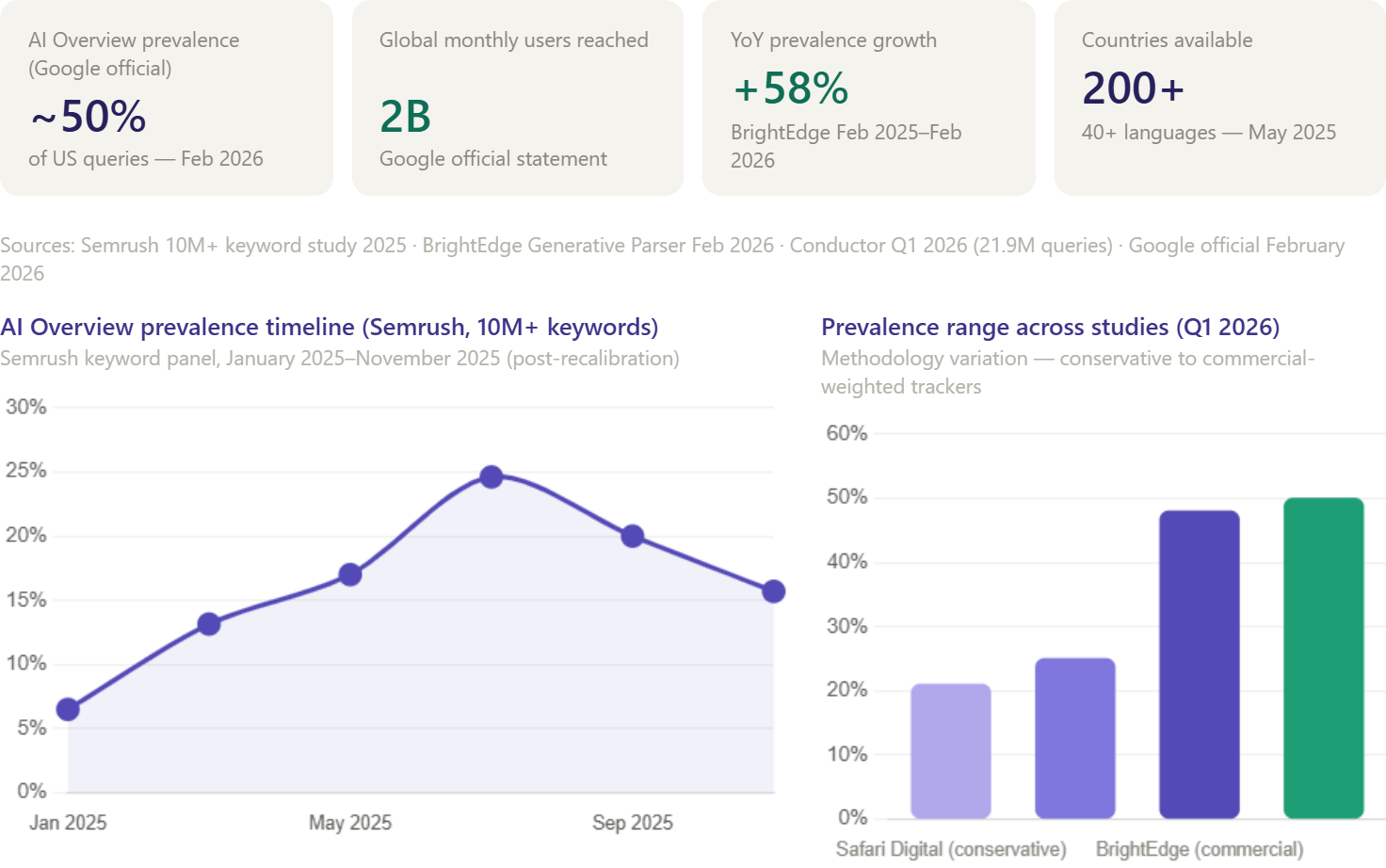
The most important caveat about AI Overview prevalence statistics is that every measurement produces a different number — and they're all correct for their respective methodology. BrightEdge's 9-industry commercial tracker records 48%; Semrush's 10M+ keyword panel showed a peak of 24.61% in July 2025 before dropping to 15.69% in November; Conductor's Q1 2026 benchmark of 21.9 million queries found 25.11%; Google's own disclosure cites "roughly 50%" of US queries. The defensible range is 20–50%, with higher numbers emerging from informational-heavy query sets and lower numbers from mixed or transactional sets.
What is not in dispute: the directional trajectory. AI Overviews have grown approximately 4–9x in 15 months, temporarily peaked and recalibrated, and are on a clear long-term expansion path into commercial and navigational query categories — which previously accounted for almost zero AIO coverage.
| Metric | Value | Source |
|---|---|---|
| AI Overview prevalence (Jan 2025) | 6.49% of queries | Semrush, 10M+ keyword study |
| AI Overview prevalence (Jul 2025 peak) | ~24.61% | Semrush, 10M+ keyword study |
| AI Overview prevalence (Nov 2025, post-recalibration) | ~15.69% | Semrush, 10M+ keyword study |
| AI Overview prevalence (Q1 2026, Conductor) | 25.11% (21.9M query benchmark) | Conductor, Q1 2026 |
| AI Overview prevalence (Feb 2026, BrightEdge commercial tracker) | ~48% | BrightEdge, Generative Parser Feb 2026 |
| Google's own disclosure | "Roughly 50%" of US queries | Google, February 2026 |
| 12-month YoY AIO prevalence growth | +58% | BrightEdge, Feb 2025–Feb 2026 |
| Global monthly users reached by AI Overviews | 2 billion | Google official, 2025 |
| Countries and languages available | 200+ countries; 40+ languages | Google, May 2025 |
The Semrush-vs.-BrightEdge divergence is not a contradiction. Semrush's panel skews toward keyword research-style queries (shorter, mixed intent); BrightEdge tracks commercial verticals with longer, more informational queries. Both are measuring the same feature; they're looking at different slices of the query universe. Teams planning around AI Overviews should calibrate their exposure estimate to their own keyword portfolio, not to any single industry-wide figure.
CTR Impact: The Traffic Equation
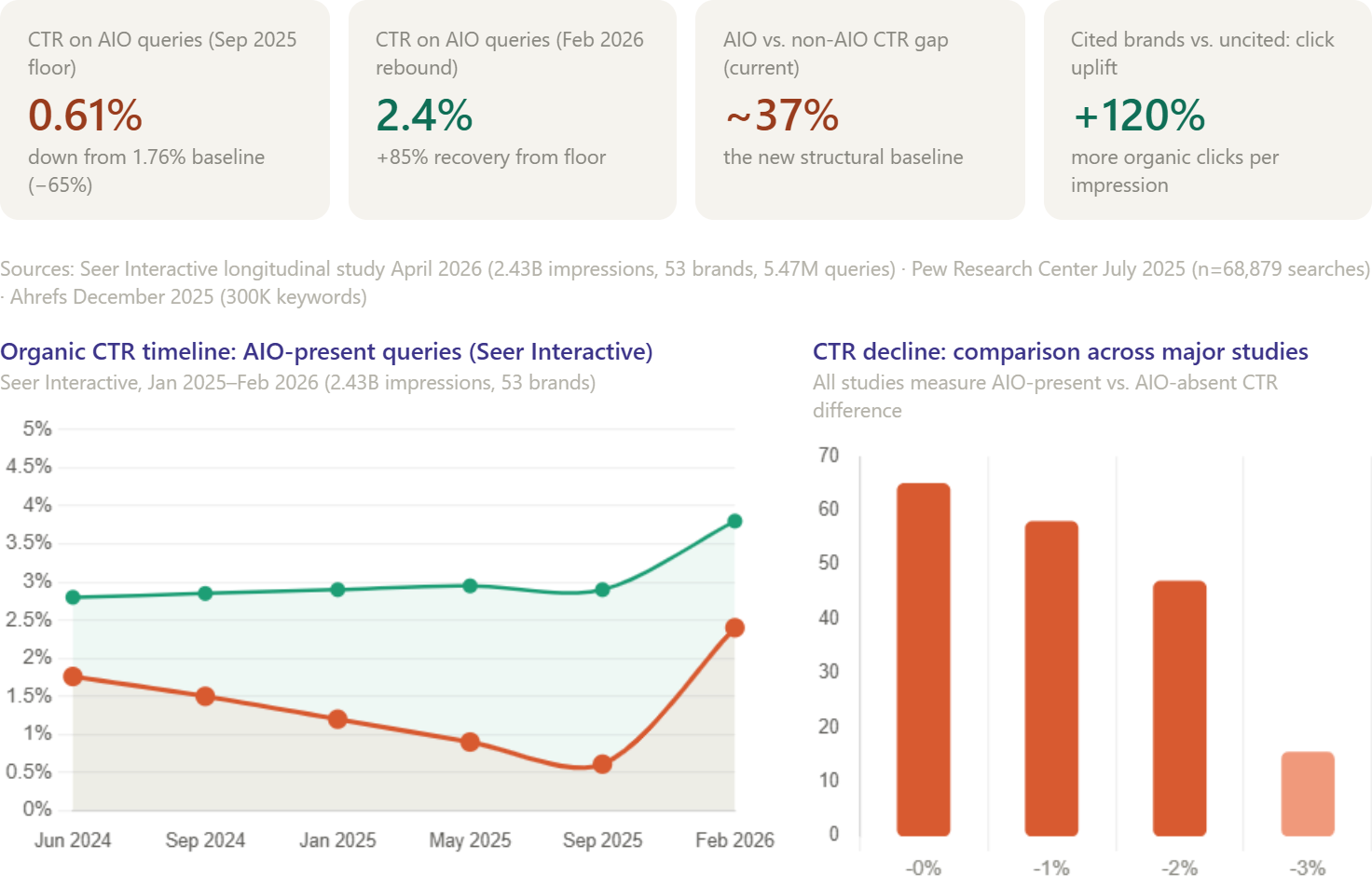
The CTR impact of AI Overviews is the most commercially studied question in SEO in 2025–2026, and the data tells a nuanced story. The direction is unambiguous — CTR declines when AI Overviews are present. The magnitude ranges from −15.5% (Amsive Digital, 700K keywords, most conservative) to −61% (Seer Interactive longitudinal, most rigorous) depending on methodology, time period, and query set. The most important development in 2026 is the Seer rebound: organic CTR on AIO queries recovered from a floor of 0.61% in September 2025 to 2.4% by February 2026 — an 85% recovery. But the gap between AIO-present (2.4%) and AIO-absent (3.8%) queries — approximately 37% — is now the structural baseline SEOs must plan around.
The Pew Research Center behavioral study (July 2025, 900 US adults, 68,879 real Google searches) is the most methodologically rigorous primary source: users click a traditional result only 8% of the time when an AI Overview is present, versus 15% without one — a 47% relative decline. Only 1% clicked a link within the AI Overview itself.
| Metric | Value | Source |
|---|---|---|
| Organic CTR on AIO queries (Jun 2024 baseline) | 1.76% | Seer Interactive, April 2026 |
| Organic CTR on AIO queries (Sep 2025 floor) | 0.61% (−65% from baseline) | Seer Interactive, April 2026 |
| Organic CTR on AIO queries (Feb 2026 rebound) | 2.4% (85% recovery from floor) | Seer Interactive, April 2026 |
| Organic CTR on non-AIO queries (Feb 2026) | 3.8% (rising — was 2.8% at baseline) | Seer Interactive, April 2026 |
| AIO-vs-non-AIO organic CTR gap (current) | ~37% | Seer Interactive, April 2026 |
| CTR with AIO present vs. without (Pew, behavioral) | 8% vs. 15% (−47% relative) | Pew Research Center, July 2025, n=68,879 searches |
| Position-1 CTR reduction from AIO presence | −34.5% (−58% in updated analysis) | Ahrefs, December 2025, 300K keywords |
| Average CTR decline (Amsive, 700K keywords) | −15.49% average; −37.04% with Featured Snippet | Amsive Digital, 2025 |
| Users ending browsing session after seeing AIO | 26% (vs. 16% without AIO) | Pew Research Center, July 2025 |
The 26% session abandonment rate from Pew is the most structural consequence in this dataset. Sessions don't end because the user clicked a competitor — they end because Google answered the query completely. This traffic doesn't redistribute to other sites. It evaporates from the web entirely. That's what makes AI Overviews structurally different from every previous SERP change.
Omnibound's Audit & Optimize identifies which of your content is currently earning AI Overview citations — and which is visible in organic rankings but invisible to AI systems — giving teams the starting point for closing that gap before it compounds further.
AI Overviews by Industry
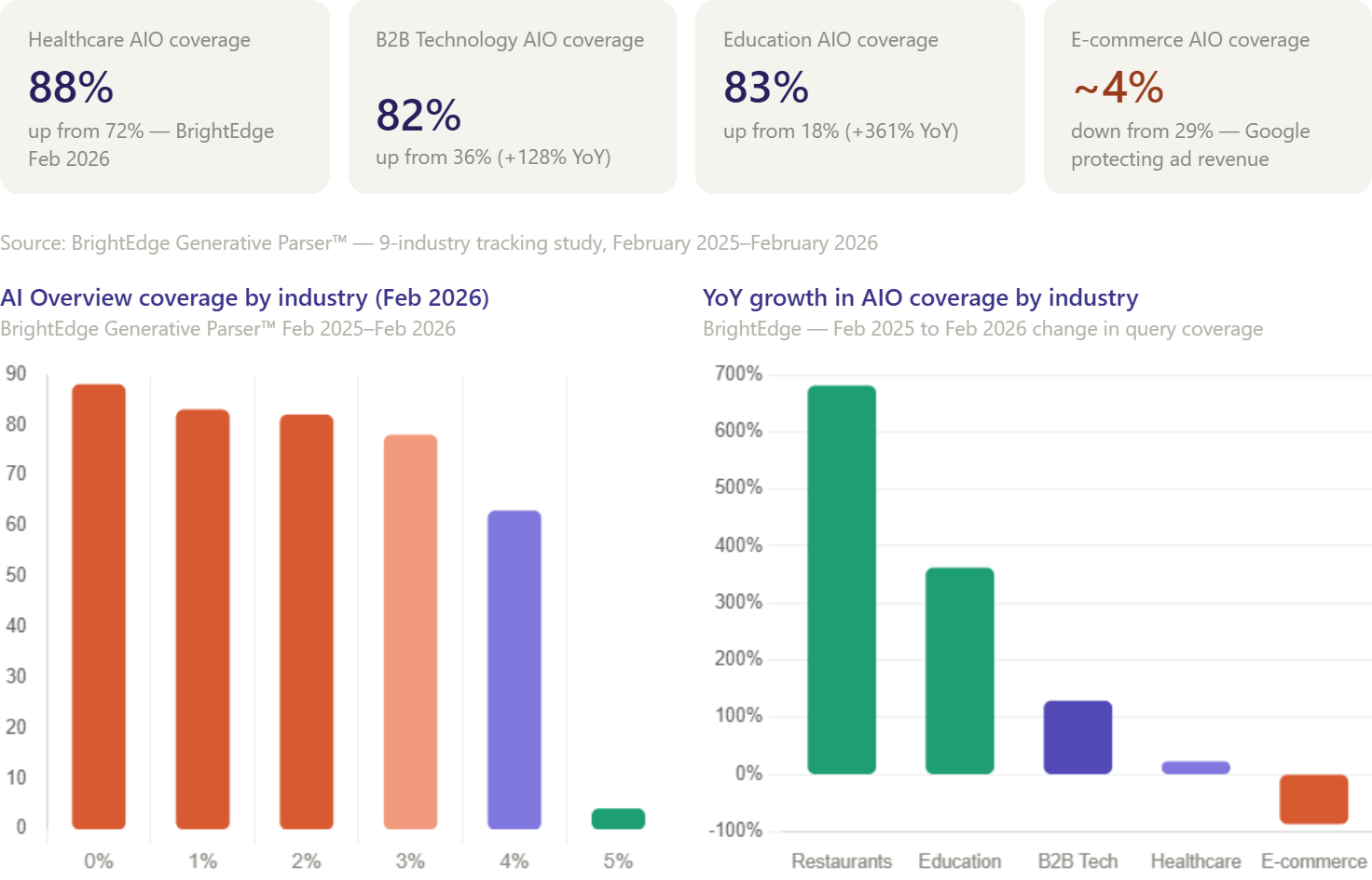
AI Overview coverage is not uniform across industries, and understanding your vertical's exposure is the single most important calibration exercise before setting any AI search strategy. BrightEdge's Generative Parser tracked 9 industries across the full period from February 2025 to February 2026 — the longest and most comprehensive industry-level dataset available. The findings reveal a clear pattern: informational, YMYL (Your Money, Your Life), and guidance-heavy industries face near-total AI Overview saturation. Transactional and e-commerce queries have been deliberately protected.
The most striking year-over-year change is Education — from 18% to 83% AIO coverage in 12 months, a 361% increase. B2B Technology went from 36% to 82%, a 128% increase. E-commerce ran the opposite direction: deliberately scaled back from 29% to ~4% as Google protected its ad revenue on transactional queries.
| Industry | AIO Coverage (Feb 2026) | YoY Change | Source |
|---|---|---|---|
| Healthcare | 88% | Up from 72% | BrightEdge, Feb 2025–Feb 2026 |
| Education | 83% | Up from 18% (+361%) | BrightEdge, Feb 2025–Feb 2026 |
| B2B Technology (incl. SaaS, cybersecurity) | 82% | Up from 36% (+128%) | BrightEdge, Feb 2025–Feb 2026 |
| Restaurants | 78% | Up from 10% (+680%) | BrightEdge, Feb 2025–Feb 2026 |
| Insurance | ~63% | Up significantly | BrightEdge, Feb 2025–Feb 2026 |
| Health queries: AIO–organic citation overlap | 24% | Highest vertical for overlap | BrightEdge, February 2026 |
| Finance: AIO–organic citation overlap | 11% | Low overlap — AI cites non-ranked pages | BrightEdge, February 2026 |
| E-commerce | ~4% (down from 29%) | Google protecting ad revenue on transactional | BrightEdge, February 2026 |
The e-commerce decline — from 29% to 4% — is Google's most commercially strategic decision in the AI Overviews rollout. It preserves Shopping and paid search revenue on high-value transactional queries while saturating the informational and guidance-seeking queries where ad revenue is structurally lower. For B2B marketers specifically: with 82% of B2B technology queries now triggering AI Overviews, the question for B2B SaaS and tech companies is not whether their content will be summarized by AI — it already is. The question is whether they are cited inside the summary or invisible to it.
Citation Patterns: What and Who Google Cites
The collapse of the relationship between organic rankings and AI Overview citations is the most consequential structural finding in AI SEO. In mid-2024, roughly 76% of AIO citations came from pages in the organic top 10. By February 2026, that overlap had fallen to 17% (BrightEdge) or 38% (ALM Corp cross-analysis). Depending on methodology, between 62% and 83% of AI Overview citations now come from pages that don't rank in the top 10 for the same query. Ranking on page one has become a weak predictor of AI Overview citation.
Domain concentration in AIO citations is extreme. The top 15 domains capture 68% of all AI citation share across platforms — a concentration that exceeds the historic PageRank era (5WPR AI Platform Citation Source Index 2026, 680M citations). YouTube holds a 200-fold citation advantage over any competing video source. Content updated within 30 days receives 3.2x more AI citations than older content (ConvertMate, 80M citations).
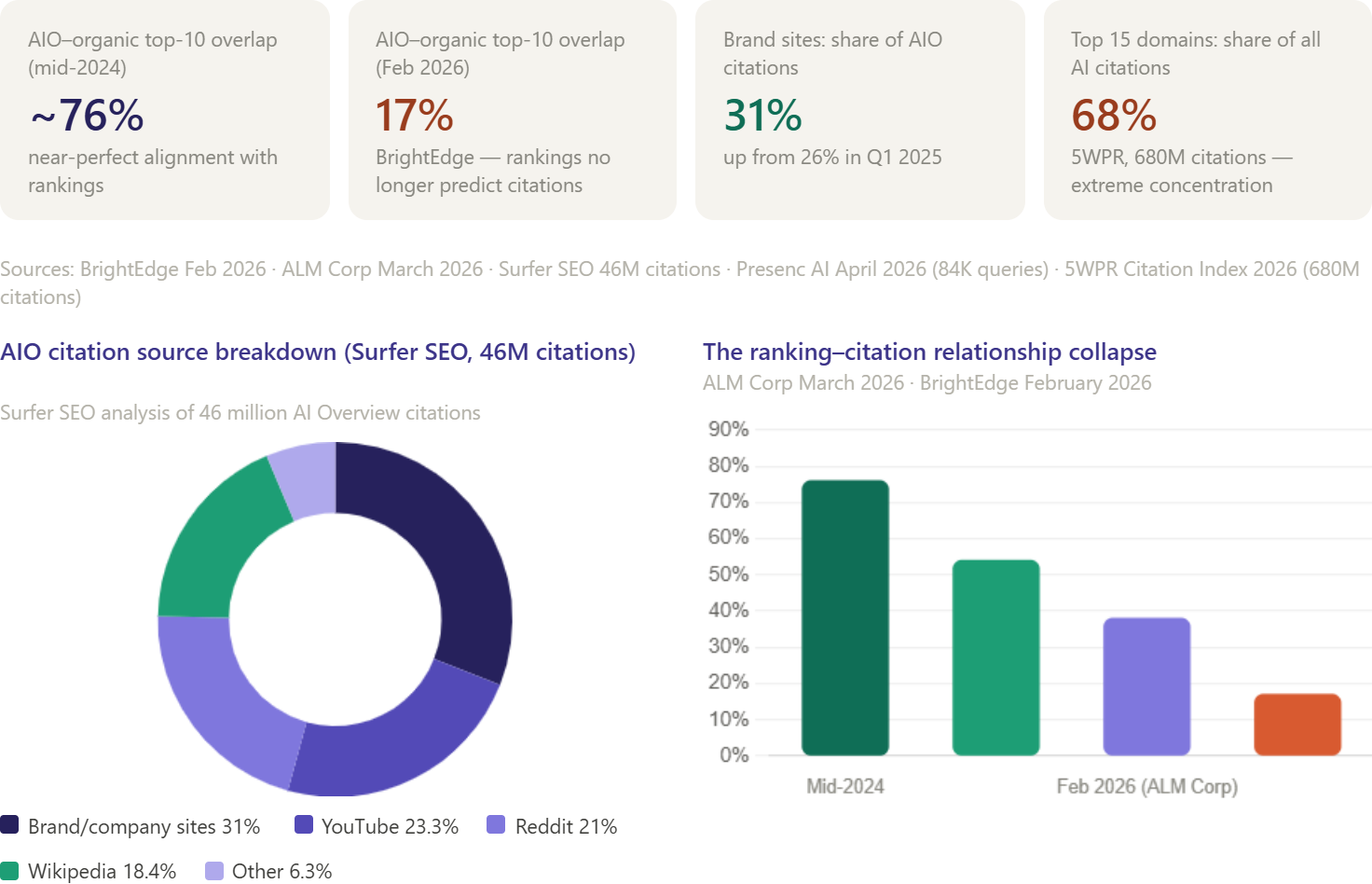
| Metric | Value | Source |
|---|---|---|
| AIO–organic top-10 citation overlap (mid-2024) | ~76% | ALM Corp, March 2026 |
| AIO–organic top-10 citation overlap (Feb 2026) | 17% (BrightEdge); 38% (ALM Corp) | BrightEdge Feb 2026; ALM Corp Mar 2026 |
| YouTube: share of AIO citations (Surfer SEO, 46M) | 23.3% | Surfer SEO, 46M citation analysis |
| Wikipedia: share of AIO citations | 18.4% | Surfer SEO, 46M citation analysis |
| Reddit: share of AIO citations (DemandSage study) | 21% | DemandSage AIO study, 2026 |
| Brand and company websites: share of AIO citations | 31% (up from 26% in Q1 2025) | Presenc AI, April 2026, 84K queries |
| Top 15 domains: share of all AI citation pool | 68% | 5WPR AI Platform Citation Source Index 2026, 680M citations |
| Content updated within 30 days: citation multiplier | 3.2× more citations than older content | ConvertMate AI Visibility Study, 80M citations |
The brand-owned website citation share growing from 26% to 31% in 12 months is the most encouraging trend for SEO practitioners in this dataset. Despite the collapse of the ranking-citation relationship, Google AI Overviews still shows a strong preference (59.8%) for brand-managed sources — higher than ChatGPT (44.7%) or Perplexity (28.9%) per OtterlyAI's 1M+ citation study. The strategic implication: own your brand narrative across multiple authoritative third-party surfaces (YouTube, review platforms, editorial coverage) rather than relying exclusively on your website's organic ranking.
Omnibound's AI Search Intelligence tracks exactly where your brand appears — and where it doesn't — across Google AI Overviews, ChatGPT, Perplexity, and Gemini, giving teams the citation visibility data needed to act on these patterns before competitors do.
User Behavior Inside AI Overviews
The way users actually interact with AI Overviews — versus how SEOs assume they do — is one of the most revealing behavioral findings in recent search research. The dominant user pattern is scan-and-decide: 7 in 10 Google users only read the first few lines of an AI Overview before deciding whether to click, engage deeper, or exit. 88% click "show more" even without intending to read the expanded content. The opening lines of an AI Overview carry a disproportionate share of the influence — which is why research showing that 44.2% of citations come from the first 30% of content (SparkToro, January 2026) has direct implications for content structure.
Trust data presents a nuanced picture. 70% of consumers say they "somewhat trust" Google's AI search results. But 75% simultaneously worry about misinformation — the largest documented tension in AI Overview user perception.
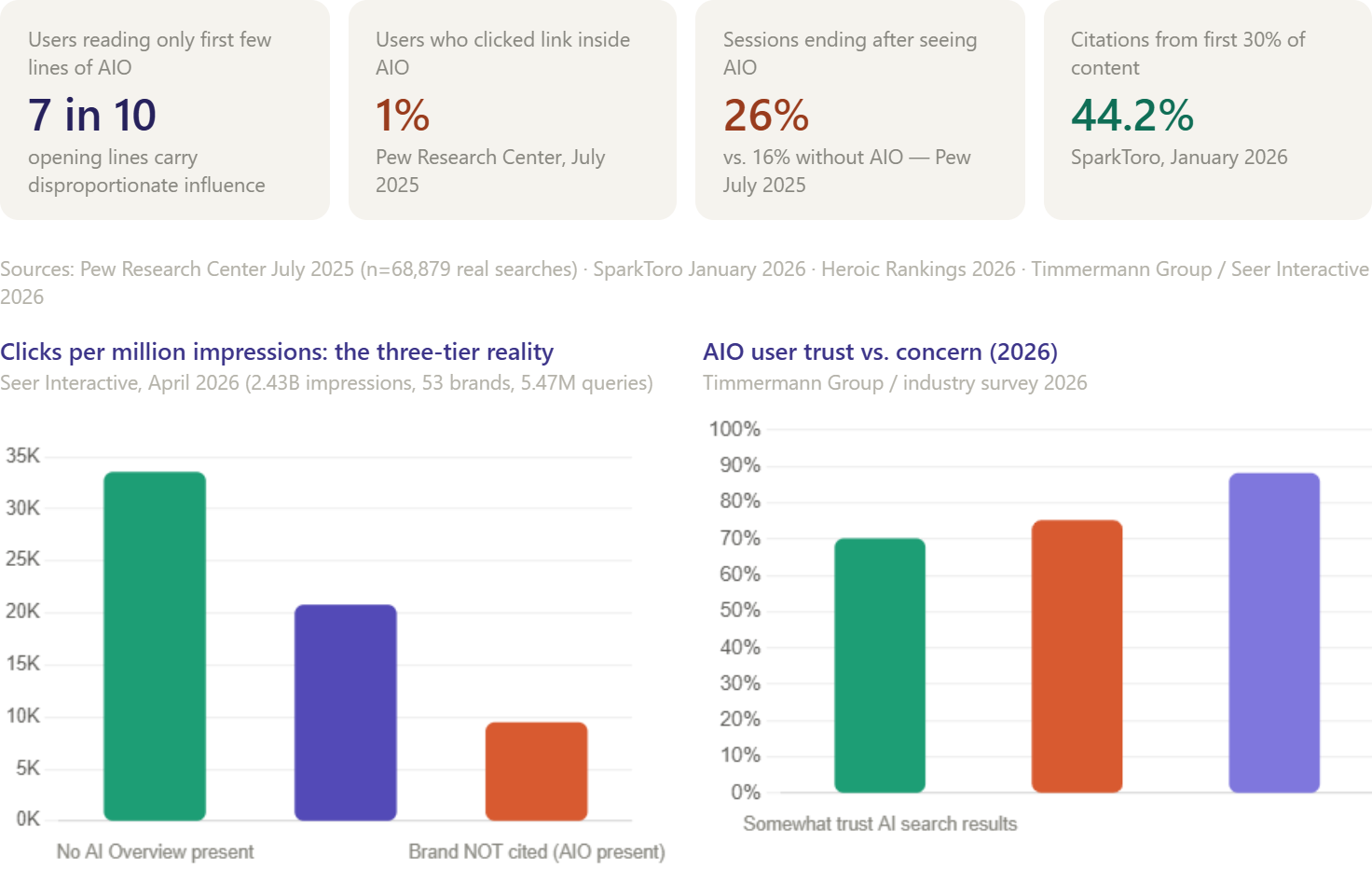
| Metric | Value | Source |
|---|---|---|
| Users who only read first few lines of AIO | 7 in 10 | Heroic Rankings, citing industry behavioral data |
| Users who click "show more" in AIO | 88% (even without intending to read) | Timmermann Group, 2026 |
| Share of citations from first 30% of content | 44.2% | SparkToro, January 2026 |
| Users who clicked link inside an AIO | Only 1% | Pew Research Center, July 2025 |
| Users ending session entirely after seeing AIO | 26% (vs. 16% without) | Pew Research Center, July 2025 |
| Consumers who "somewhat trust" AI search results | 70% | Timmermann Group / industry survey |
| Consumers who worry about misinformation in AI results | 75% | Timmermann Group / industry survey |
| Users who report performing a search in past month that generated AIO | 58% | Heroic Rankings, 2026 |
The trust paradox — 70% trust AI results while 75% simultaneously worry about misinformation — is not contradictory. Users are making pragmatic tradeoffs: they find AI summaries useful for quick answers while remaining appropriately skeptical of them for high-stakes decisions. This pattern has direct implications for content strategy: authoritative, primary-source-backed content that reduces the user's reason to distrust the summary performs significantly better in AI citation selection than opinion-heavy or thin content.
The Revenue Side: Google's Monetization of AI Overviews
Google's financials in 2025 reveal a business that has successfully monetized AI Overviews rather than cannibalizing its own ad revenue. Search revenue hit $63.07 billion in Q4 2025 alone — +17% YoY — and Google's GenAI products (including AI Overview monetization) grew nearly 400% in revenue year-over-year (Alphabet Q4 2025 Earnings Release, SEC EDGAR). The mechanism: ads alongside AI Overviews grew from ~3% of SERPs in January 2025 to ~40% by November 2025, with both formats appearing simultaneously on an increasing share of queries.
The publisher ecosystem tells the opposite story. Press Gazette's analysis of major publishers found global Google search referral traffic fell approximately 33% in the year to November 2025. Traditional news outlets experienced the steepest declines — some major sites lost 26–55% of their search-driven traffic. Wikipedia itself experienced an 8% decline in human pageviews despite being the single most-cited domain in AI Overviews — the clearest example of the new citation-without-click dynamic.
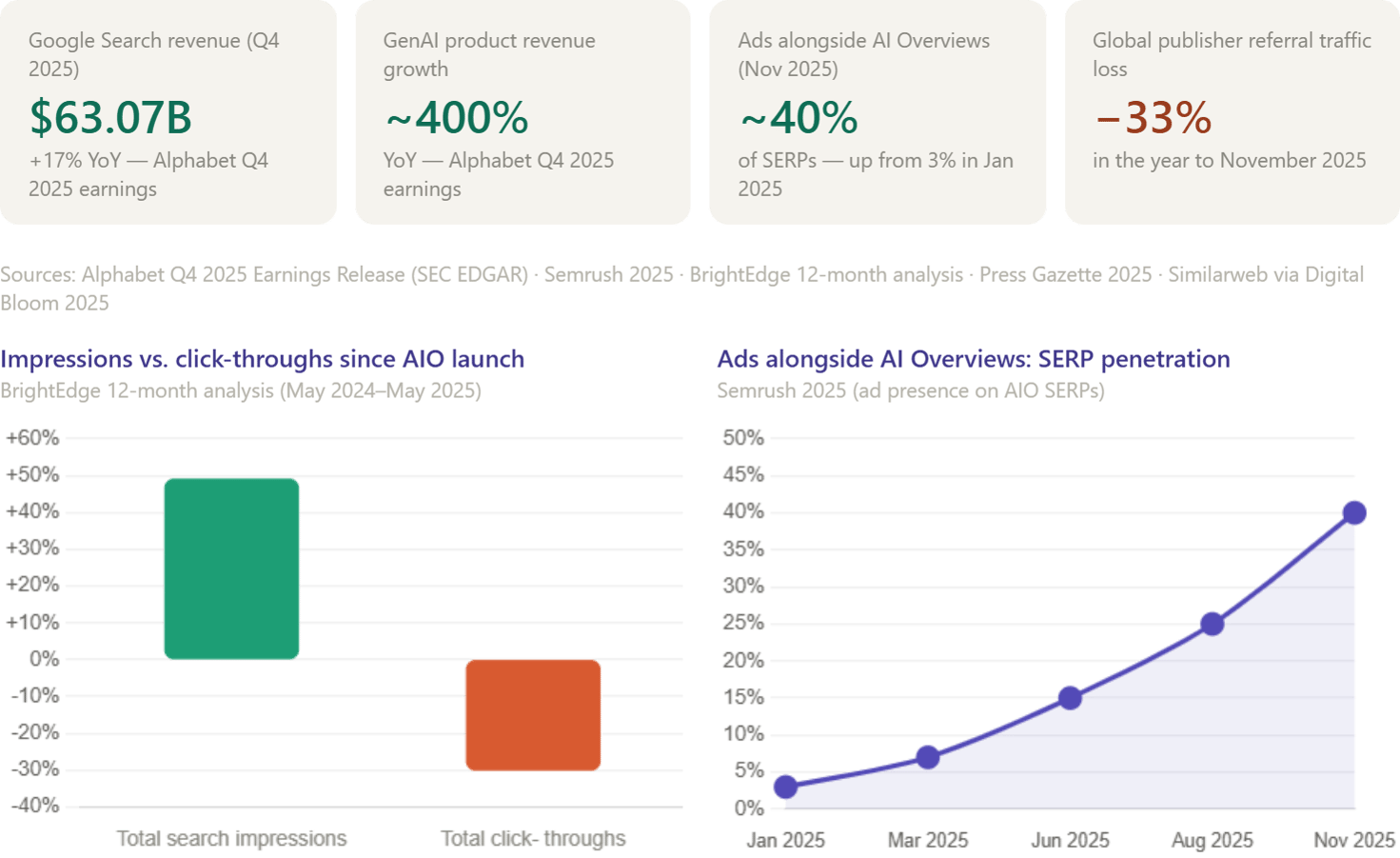
| Metric | Value | Source |
|---|---|---|
| Google Search & Other revenue (Q4 2025) | $63.07 billion (+17% YoY) | Alphabet Q4 2025 Earnings, SEC EDGAR |
| GenAI product revenue growth (FY2025 YoY) | ~400% | Alphabet Q4 2025 Earnings, SEC EDGAR |
| Ads alongside AI Overviews (Jan 2025) | ~3% of SERPs | Semrush, 2025 |
| Ads alongside AI Overviews (Nov 2025) | ~40% of SERPs (+394% growth) | Semrush, 2025 |
| Total search impressions since AIO launch | +49% | BrightEdge 12-month analysis |
| Total click-throughs since AIO launch | −30% | BrightEdge 12-month analysis |
| Global publisher Google referral traffic decline (to Nov 2025) | −33% | Press Gazette, 2025 |
| Major news sites traffic decline (organic search, 2024–2025) | 26–55% YoY | Similarweb, via Digital Bloom, 2025 |
The +49% impressions / −30% clicks divergence is Google's most counterintuitive AI Overview data point. More people are seeing Google search results pages — impressions are up dramatically — but fewer are clicking through to external websites. Google has successfully increased engagement with its own platform while reducing traffic distribution to the web it indexes. For advertisers, this is valuable: more impression inventory. For publishers, it is the central crisis of the AI era.
Omnibound's B2B AI Search Playbook provides a step-by-step framework for B2B teams navigating this environment — covering the content formats, authority signals, and technical optimizations that AI Overview citation systems favor, so your brand appears in the summaries that are replacing the clicks.
Google AI Overviews by the Numbers
| Metric | Value | Source |
|---|---|---|
| AIO prevalence (Jan 2025) | 6.49% | Semrush 10M+ keywords |
| AIO prevalence (Jul 2025 peak) | ~24.61% | Semrush 10M+ keywords |
| AIO prevalence (Q1 2026, Conductor) | 25.11% | Conductor Q1 2026, 21.9M queries |
| AIO prevalence (Feb 2026, BrightEdge commercial) | ~48% | BrightEdge Feb 2026 |
| Google's own disclosure | ~50% US queries | Google, February 2026 |
| YoY AIO prevalence growth | +58% | BrightEdge 12-month study |
| Global monthly users | 2 billion | Google official |
| Countries available | 200+ | Google, May 2025 |
| Organic CTR on AIO queries (baseline Jun 2024) | 1.76% | Seer Interactive Apr 2026 |
| Organic CTR on AIO queries (Sep 2025 floor) | 0.61% (−65%) | Seer Interactive Apr 2026 |
| Organic CTR on AIO queries (Feb 2026 rebound) | 2.4% | Seer Interactive Apr 2026 |
| AIO-vs-non-AIO CTR gap (current) | ~37% | Seer Interactive Apr 2026 |
| Position 1 CTR drop (Pew behavioral) | 8% vs. 15% (−47%) | Pew Research Center Jul 2025 |
| Position 1 CTR drop (Ahrefs 300K keywords) | −34.5% to −58% | Ahrefs Dec 2025 |
| Users ending session after AIO | 26% | Pew Research Center Jul 2025 |
| Cited brands vs. uncited: organic click difference | 120% more for cited | Seer Interactive Apr 2026 |
| Paid CTR uplift for AIO-cited brands | +91% | Seer Interactive Nov 2025 |
| Healthcare: AIO coverage | 88% | BrightEdge Feb 2026 |
| Education: AIO coverage | 83% | BrightEdge Feb 2026 |
| B2B Technology: AIO coverage | 82% | BrightEdge Feb 2026 |
| Restaurants: AIO coverage | 78% | BrightEdge Feb 2026 |
| E-commerce: AIO coverage | ~4% (down from 29%) | BrightEdge Feb 2026 |
| AIO–organic top-10 overlap (mid-2024) | ~76% | ALM Corp Mar 2026 |
| AIO–organic top-10 overlap (Feb 2026) | 17–38% | BrightEdge / ALM Corp 2026 |
| YouTube: AIO citation share | 23.3% | Surfer SEO, 46M citations |
| Wikipedia: AIO citation share | 18.4% | Surfer SEO, 46M citations |
| Reddit: AIO citation share | ~21% | DemandSage 2026 |
| Brand sites: AIO citation share | 31% (up from 26%) | Presenc AI Apr 2026, 84K queries |
| Top 15 domains: share of all AI citations | 68% | 5WPR Citation Index 2026, 680M citations |
| Content freshness: citation multiplier | 3.2× (updated within 30 days) | ConvertMate, 80M citations |
| Users reading only first lines of AIO | 7 in 10 | Heroic Rankings 2026 |
| Citations from first 30% of content | 44.2% | SparkToro, January 2026 |
| Consumers trusting AI search results | 70% | Timmermann Group 2026 |
| Consumers worried about misinformation | 75% | Timmermann Group 2026 |
| Google Search revenue (Q4 2025) | $63.07B (+17% YoY) | Alphabet Q4 2025, SEC EDGAR |
| GenAI product revenue growth YoY | ~400% | Alphabet Q4 2025, SEC EDGAR |
| Ads alongside AI Overviews (Nov 2025) | ~40% of SERPs | Semrush 2025 |
| Total impressions since AIO launch | +49% | BrightEdge 12-month |
| Total click-throughs since AIO launch | −30% | BrightEdge 12-month |
| Global publisher Google referral traffic decline | −33% | Press Gazette 2025 |
Methodology and Sources
This article was compiled from primary research organizations, verified industry studies, and official financial disclosures published between 2024 and 2026. Every statistic was traced to its originating study before inclusion.
A note on prevalence figures: AI Overview prevalence statistics vary significantly across studies due to differences in keyword set composition, device mix, geography, and detection methodology. The figures cited in this article include attribution to specific study methodology wherever available. The defensible 2026 range is 20–50% of queries depending on vertical and query type. Google's own disclosure of "roughly 50%" for US queries represents the most authoritative first-party figure.
Primary sources (Tier 1):
- Seer Interactive — AIO Impact on Google CTR: Longitudinal Study 2025–2026 (April 2026; 2.43 billion impressions, 53 brands, 5.47 million queries, January 2025–February 2026; the most rigorous longitudinal CTR study available)
- BrightEdge — AI Overviews at the One-Year Mark (February 2026; Generative Parser™; 9-industry tracker); 16-month citation overlap study
- Semrush — 10M+ keyword study tracking AIO prevalence throughout 2025 (January 2025 through November 2025 data points)
- Ahrefs — AI Overviews Reduce Clicks (April 2025, updated December 2025; 300,000 keywords, aggregated Google Search Console data)
- Pew Research Center — Google Users Are Less Likely to Click on Links When an AI Summary Appears (July 22, 2025; 900 US adults, 68,879 real Google searches, March 2025)
- Amsive Digital — AIO CTR impact study (700,000 keywords; most conservative major study)
- Alphabet Inc. — Q4 2025 Earnings Release (SEC EDGAR; Search revenue, GenAI revenue, Q4 2025)
- 5WPR — AI Platform Citation Source Index 2026 (680 million citations, ChatGPT, Google AI Overviews, Perplexity, Gemini, and Claude; August 2024–April 2026)
- Surfer SEO — 46 million AIO citation analysis (YouTube 23.3%, Wikipedia 18.4% findings)
- Presenc AI — AI Overviews Usage Statistics (April 2026; 84,000 representative queries, 12 categories, 9 markets; quarterly updates)
- Conductor — Q1 2026 AI Overview benchmark (21.9 million queries; 25.11% prevalence)
- ALM Corp — Google AI Overview Citations Dropped (March 2026; cross-methodology citation overlap analysis)
- Google — Official statements on AIO user reach (2 billion monthly), query coverage ("roughly 50%"), search usage impact (+10%), and global rollout (200+ countries, 40+ languages)
- SparkToro — AI brand recommendation consistency research; content citation position study (January 2026; 44.2% from first 30% of content)
- ConvertMate — AI Visibility Study (80 million citations, 10,000+ domains; 3.2× freshness multiplier)
%20Statistics%20(2026)%2055+%20Data%20Points%20on%20Brand%20Visibility%2c%20Buyer%20Discovery%2c%20and%20Citation%20Rates.webp?height=245&name=Answer%20Engine%20Optimization%20(AEO)%20Statistics%20(2026)%2055+%20Data%20Points%20on%20Brand%20Visibility%2c%20Buyer%20Discovery%2c%20and%20Citation%20Rates.webp)