

Table Of Contents
Last updated: May 2026. We review and update this page quarterly as new primary research is published.
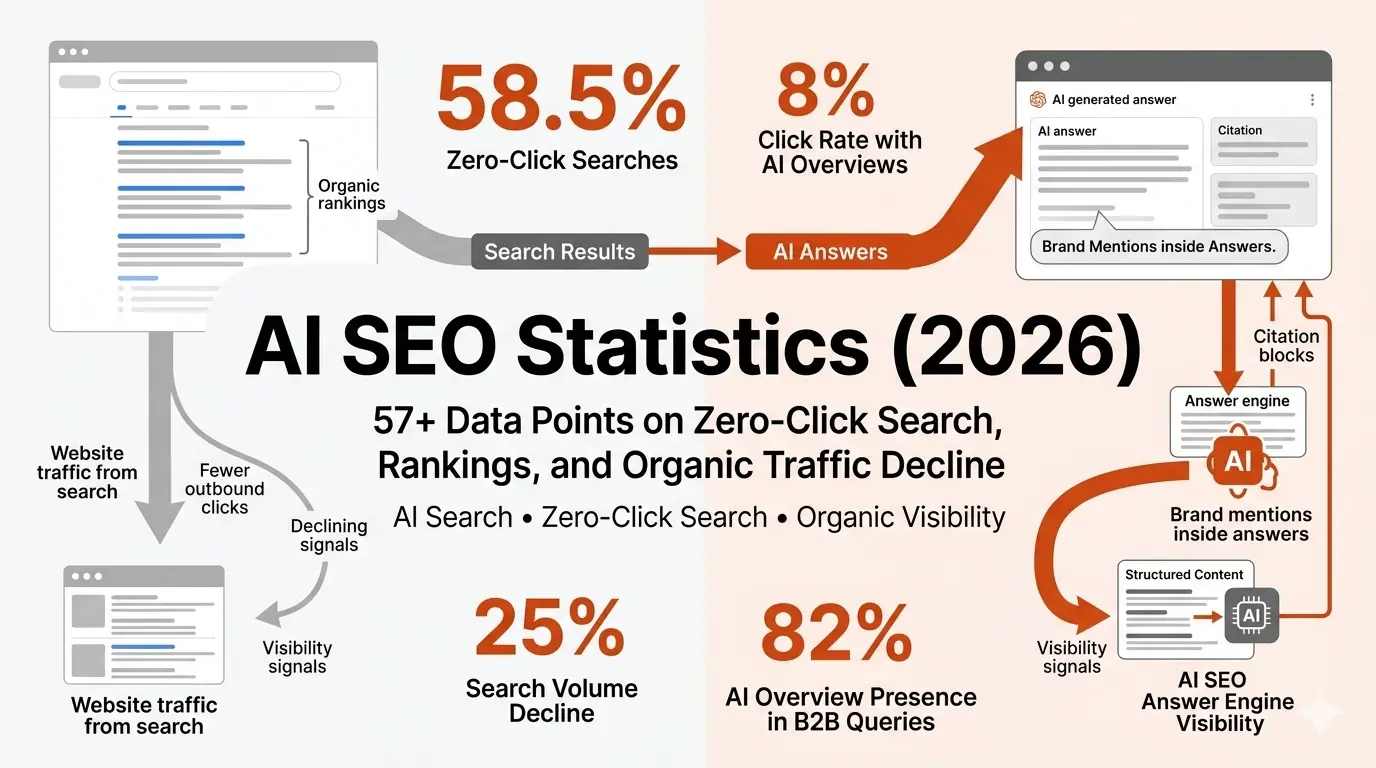
58.5% of all US Google searches end without a single click to an external website — and that was before AI Overviews scaled to nearly half of all queries (SparkToro/Datos, 2024 Zero-Click Search Study, clickstream panel of 5M+ users). When an AI Overview is present, Pew Research Center's behavioral study of 68,879 actual Google searches found that users clicked a traditional result only 8% of the time — compared to 15% without one. That's roughly half the click rate, confirmed by tracking real browsing behavior, not estimated from keyword tools (Pew Research Center, July 22, 2025).
Gartner predicted in February 2024 that traditional search engine volume would drop 25% by 2026 as AI chatbots and virtual agents absorbed query share (Gartner, February 2024). The traffic data being reported from publishers and enterprise sites in 2025–2026 suggests that prediction was not wrong in direction — and may have been conservative for certain verticals. B2B technology queries now trigger AI Overviews 82% of the time. Healthcare queries: 88%. The rules of organic search visibility have changed structurally, not cyclically.
We aggregated data from Pew Research Center, Gartner, SparkToro, Ahrefs, Seer Interactive, BrightEdge, Semrush, ALM Corp, and other primary sources to compile the most rigorously sourced AI SEO statistics available for 2026.
Key Takeaways
- 58.5% of US Google searches end without a click to any external website (SparkToro/Datos, 2024 Zero-Click Search Study)
- When an AI Overview is present, users click a traditional result only 8% of the time vs. 15% without one — a 47% relative CTR drop (Pew Research Center, July 2025, n=68,879 searches)
- Ahrefs found a 58% drop in position-1 organic CTR when an AI Overview is present — updated December 2025 from 300,000 keywords (Ahrefs, December 2025)
- Organic CTR fell 61% on queries with AI Overviews (1.76% → 0.61%); paid CTR fell 68% (19.7% → 6.34%) (Seer Interactive, November 2025)
- Brands cited in AI Overviews earn 35% more organic clicks and 91% more paid clicks than non-cited brands (Seer Interactive, November 2025)
- AI Overviews now trigger on ~48% of all tracked queries — up 58% YoY from 30% a year ago (BrightEdge, February 2026)
- Only 17% of AI Overview citations come from pages ranking in the organic top 10 — flat for months (BrightEdge, February 2026)
- AI Overview coverage by vertical: Healthcare 88%, B2B Technology 82%, Education 83% — all up dramatically YoY (BrightEdge, Feb 2025–Feb 2026)
- AI-referred visitors convert at 4.4x the rate of traditional organic visitors (Semrush, June 2025)
- AI referral traffic grew 527% year-over-year (January–May 2024 vs. January–May 2025) (Previsible/Search Engine Land, August 2025)
- Gartner forecast: traditional search engine volume to drop 25% by 2026 as AI chatbots absorb query share (Gartner, February 2024)
- Only 1% of users clicked a link within an AI Overview itself (Pew Research Center, July 2025)
Zero-Click Search: The Baseline
Zero-click search predates AI Overviews — it started with featured snippets, knowledge panels, and People Also Ask boxes. But the AI layer has dramatically accelerated the trend. The most methodologically rigorous baseline comes from SparkToro and Datos: of every 1,000 Google searches in the US, only 360 result in a click to the open web. The other 640 end without clicking anything, clicking a Google-owned property, or triggering another search. On mobile, the zero-click rate reaches 77%.
What changed with AI Overviews is that queries which previously would have generated clicks — informational and research-intent queries — now resolve on the SERP. Similarweb measured zero-click searches increasing from 56% to 69% between May 2024 and May 2025, a 13-percentage-point acceleration that maps precisely to the AI Overview rollout timeline.
| Metric | Value | Source |
|---|---|---|
| US Google searches ending without any click (2024) | 58.5% | SparkToro/Datos, 2024 Zero-Click Search Study |
| Clicks to open web per 1,000 US Google searches | 360 | SparkToro/Datos, 2024 Zero-Click Search Study |
| Mobile zero-click rate | 77% | SparkToro/Datos, 2024 Zero-Click Search Study |
| Zero-click increase since AI Overviews launched (May 2024–May 2025) | 56% → 69% (+13 pp) | Similarweb, 2025 |
| Searches with AI Overviews: zero-click rate | 83% | Bain–Dynata Generative AI Consumer Survey, December 2024 |
| AI Mode zero-click rate | 93% | Semrush data, September 2025 |
| Traditional queries (no AI Overview) zero-click rate | ~60% | Bain–Dynata, December 2024 |
| Gartner forecast: traditional search volume drop by 2026 | 25% | Gartner, February 2024 |
The 93% zero-click rate in AI Mode is the most commercially significant number in this table. AI Mode doesn't show organic results alongside an AI summary — it replaces them entirely with an AI conversation interface. For queries processed through AI Mode, organic SEO has no reach at all unless your brand earns a citation inside the AI response. This is what makes AI citation the central optimization goal for 2026.
Google AI Overviews: CTR Impact
Every single study measuring CTR impact has found a decline when AI Overviews are present. The magnitude varies by methodology — from 15% (Amsive, 700,000 keywords, average across query types) to 89% (DMG Media, specific navigational queries) — but the direction is unanimous across 12 independent analyses. The most methodologically robust are Pew (actual behavioral tracking of 68,879 searches), Ahrefs (300,000 keywords, GSC aggregate data), and Seer Interactive (25.1 million impressions, 42 organizations).
The Seer Interactive study provides the most operationally useful breakdown: organic CTR on AI Overview queries fell from 1.76% to 0.61% between June 2024 and September 2025 — a 65% collapse. Even queries without an AI Overview experienced a 41% organic CTR decline year-over-year. The SERP disruption extends beyond the queries where AI Overviews appear.
| Metric | Value | Source |
|---|---|---|
| CTR with AI Overview present | 8% (vs. 15% without) | Pew Research Center, July 2025 |
| Relative CTR drop from AI Overview presence | 47% reduction | Pew Research Center, July 2025 |
| Position 1 organic CTR drop when AI Overview present | 58% | Ahrefs, December 2025 |
| Organic CTR drop on AI Overview queries (Jun 2024–Sep 2025) | 61% (1.76% → 0.61%) | Seer Interactive, November 2025 |
| Paid CTR drop on AI Overview queries (same period) | 68% (19.7% → 6.34%) | Seer Interactive, November 2025 |
| Organic CTR drop on non-AI Overview queries (YoY) | 41% | Seer Interactive, November 2025 |
| Users who clicked a link inside an AI Overview | 1% | Pew Research Center, July 2025 |
| Users who ended browsing session after AI Overview | 26% (vs. 16% without) | Pew Research Center, July 2025 |
| AI Overviews presence across all tracked queries | ~48% (up from 30%; +58% YoY) | BrightEdge, February 2026 |
The 26% session abandonment rate is one of the least-discussed findings in Pew's study. When a user sees an AI Overview, roughly 1 in 4 ends their session entirely — their question is answered sufficiently that they stop browsing. This is not traffic that went to a competitor. It evaporated from the web entirely. That's the structural shift that makes this different from any previous SERP change.
Omnibound's Audit & Optimize surfaces which of your content is currently getting cited in AI Overviews vs. which is invisible — the first step to understanding where your organic visibility is actually coming from in 2026.
AI SEO Impact by Industry: Healthcare, SaaS, Real Estate, Cybersecurity, and Energy
AI Overview adoption is not uniform across industries — it's a YMYL (Your Money or Your Life) story. Google has rolled out AI Overviews fastest to industries where informational, consensus-based answers are readily synthesizable and where users are most likely to be searching for guidance rather than transactions. Healthcare and B2B technology are both approaching 90% query coverage. Real estate and cybersecurity tell a more nuanced story: real estate queries have relatively low AI Overview saturation but grew 258% in 2025; cybersecurity falls under the broader technology umbrella where B2B tech queries now trigger AI Overviews 82% of the time.
The industry-level data from BrightEdge's 16-month tracking study (February 2025–February 2026) is the most comprehensive primary dataset available for vertical-specific impact.
| Industry | AI Overview Query Coverage | YoY Change | Source |
|---|---|---|---|
| Healthcare | 88% of queries | Up from 72% | BrightEdge, Feb 2025–Feb 2026 |
| Education | 83% of queries | Up from 18% (+361%) | BrightEdge, Feb 2025–Feb 2026 |
| B2B Technology (incl. SaaS, cybersecurity) | 82% of queries | Up from 36% (+128%) | BrightEdge, Feb 2025–Feb 2026 |
| Insurance | ~63% of queries | Up from 17% | BrightEdge, Feb 2025–Feb 2026 |
| Restaurants | 78% of queries | Up from 10% | BrightEdge, Feb 2025–Feb 2026 |
| Real Estate | 5.8% of queries (low saturation) | +258% growth rate in 2025 | Ahrefs, November 2025 |
| E-commerce | Declined to ~4% | Down from 29% in 2024 | BrightEdge, February 2026 |
| Health queries: AIO citation overlap with organic top 10 | 24% | BrightEdge, February 2026 | |
| Finance: AIO citation overlap with organic top 10 | 11% | BrightEdge, February 2026 |
The e-commerce decline from 29% to 4% is Google's most commercially strategic decision in this dataset. It shows Google deliberately protecting transactional query revenue from AI summarization — preserving the paid search ecosystem on the queries that monetize best. Healthcare and B2B technology, where ad revenue is lower, have been allowed to go almost entirely AI-summarized.
For B2B SaaS and cybersecurity brands specifically: with 82% of B2B tech queries now triggering AI Overviews, the question is no longer whether your content will be summarized by AI — it already is. The question is whether you are cited inside the summary or invisible to it.
Omnibound's AI Search Intelligence tracks where your brand wins or loses AI citations across ChatGPT, Perplexity, Gemini, and Google AI Mode — giving B2B technology and healthcare marketers the vertical-specific visibility data needed to compete in AI-first search.
Citation vs. Ranking: The New Visibility Equation
The most consequential structural finding in AI SEO is the near-collapse of the relationship between organic rankings and AI Overview citations. In late 2024, roughly 76% of AI Overview citations came from pages ranking in the top 10 organic results — meaning traditional SEO and AIO optimization were largely the same exercise. By February 2026, that overlap had fallen to between 17% (BrightEdge) and 38% (ALM Corp), depending on methodology and dataset.
Both figures point in the same direction: ranking on page one is now a weak predictor of AI Overview citation for the same query. Roughly 5 out of 6 AIO citations in BrightEdge's dataset pull from content that doesn't appear in the top 10 at all. The implication is that traditional SEO and AI citation optimization require distinct, parallel strategies.
| Metric | Value | Source |
|---|---|---|
| AIO citation overlap with organic top 10 (late 2024) | ~76% | ALM Corp, March 2026 / Ahrefs July 2025 |
| AIO citation overlap with organic top 10 (February 2026) | 17% (BrightEdge) – 38% (ALM Corp) | BrightEdge, February 2026; ALM Corp, March 2026 |
| AIO citations from pages NOT in top 10 | ~5 in 6 (BrightEdge dataset) | BrightEdge, February 2026 |
| Organic CTR uplift for brands cited in AI Overviews vs. not cited | +35% | Seer Interactive, November 2025 |
| Paid CTR uplift for brands cited in AI Overviews vs. not cited | +91% | Seer Interactive, November 2025 |
| AIO coverage growth (Feb 2025–Feb 2026) | +58% | BrightEdge, February 2026 |
| Average AI Overview pixel height (now exceeds visible desktop viewport) | 1,200+ pixels | BrightEdge, February 2026 |
The citation advantage data from Seer is the strategic punchline: being cited inside an AI Overview is worth 35% more organic clicks and 91% more paid clicks than not being cited — on the same SERP. Citation is the new position zero, and most companies have no explicit strategy for earning it.
Omnibound's B2B AI Search Playbook is a step-by-step guide to earning AI citations at scale — covering the content formats, authority signals, and technical requirements that AI Overview and LLM citation systems favor.
AI Referral Traffic: The Opportunity Side
The CTR decline narrative dominates coverage of AI's SEO impact, but there's a second, underreported story: the visitors arriving via AI citations are dramatically more valuable than organic search visitors. Semrush's June 2025 study of 500+ high-value topics found AI search visitors convert at 4.4x the rate of traditional organic search visitors. The mechanism is straightforward — AI systems pre-qualify intent by synthesizing multiple sources before the user ever clicks, so the clicks that do occur are from users who have already completed their research and are ready to act.
AI referral traffic is still tiny in absolute terms: Conductor's study of 13,770 domains found it averaging just 1.08% of total sessions. But with 527% year-over-year growth and conversion rates that dwarf organic, the economics of AI search visibility are compounding rapidly for the small share of brands that have figured out how to earn citations.
| Metric | Value | Source |
|---|---|---|
| AI search visitor conversion rate vs. organic | 4.4x higher | Semrush, June 2025 |
| AI referral traffic YoY growth (Jan–May 2024 vs. 2025) | 527% | Previsible / Search Engine Land, August 2025 |
| AI referral traffic as share of total web traffic | 1.08% average | Conductor, November 2025 |
| AI referral traffic share from ChatGPT specifically | 87.4% | Conductor, November 2025 |
| Time spent on site: AI visitors vs. organic search visitors | +68% more time | SE Ranking, 2025 |
| LLM traffic conversion by platform: ChatGPT | 15.9% | Seer Interactive, June 2025 |
| Google Organic conversion rate (comparison) | 1.76% | Seer Interactive, June 2025 |
The comparison between ChatGPT referral conversion (15.9%) and Google organic conversion (1.76%) — a 9x gap — is the most commercially urgent data point for B2B marketing teams deciding where to invest their content optimization effort. AI-referred visitors are not just somewhat more likely to convert; they are an entirely different quality of traffic, arriving pre-educated and pre-qualified by the AI's research synthesis.
The Adaptation Imperative: What the Data Says Works
The data on what earns AI Overview citations — and what earns citations in LLMs like ChatGPT and Perplexity — has become specific enough to be actionable. Several patterns are consistent across multiple primary studies.
Domain authority matters more than individual page ranking. SE Ranking found that sites with 32,000+ referring domains are 3.5x more likely to be cited by ChatGPT than sites with 200 or fewer. BrightEdge's 16-month analysis confirms that YMYL sectors (healthcare, insurance, finance) show the highest citation-to-top-10 overlap — 68–75% — specifically because trust signals correlate with both traditional ranking and AI citation selection in those verticals.
Structure and format matter for AI citation separately from ranking. Ahrefs found that 99.2% of keywords triggering AI Overviews are informational in intent, and that long-tail, question-format queries (8+ words) trigger them significantly more often than short-tail queries. Content organized to directly answer specific questions — with clear headers, structured answers, and cited primary data — is what AI systems select for summarization.
| Metric | Value | Source |
|---|---|---|
| AI Overview keywords: share that are informational intent | 99.2% | Ahrefs, November 2025 |
| Long-tail queries (8+ words): more likely to trigger AI Overviews | Yes — confirmed | BrightEdge, 2025 |
| Sites with 32K+ referring domains: 3.5x more likely to be cited by ChatGPT | 3.5x | SE Ranking, November 2025 |
| Domains with G2/Capterra/Trustpilot profiles: citation likelihood vs. those without | 3x higher | SE Ranking, November 2025 |
| Healthcare/Insurance AIO citation overlap with top 10 | 68–75% | BrightEdge, February 2026 |
| SEO professionals with AI integrated into workflow | 86% | Aira, State of SEO Survey 2025, n=2,500 |
| Marketers who have seen traffic drops since AI Overviews launched | 39% | Fractl, 2025 |
| B2B SaaS: AI search traffic growing at avg. 41% month-over-month | 41% MoM | PipeRocket Digital, 2026 |
The gap between the 86% of SEO professionals who have integrated AI into their workflow and the 62% of enterprise brands that are "technically invisible" to generative AI models (Fuel Online, 2026) captures the core problem: teams are using AI tools to produce more content while remaining uncited in the AI responses their buyers are actually reading.
Omnibound's Audit & Optimize identifies specifically which content is earning AI citations, which is visible in traditional organic results but invisible to AI systems, and what needs to change — giving SEO and content teams a concrete starting point for closing the AI visibility gap.
AI SEO by the Numbers
| Metric | Value | Source |
|---|---|---|
| US Google searches ending without a click | 58.5% | SparkToro/Datos 2024 |
| Clicks to open web per 1,000 US Google searches | 360 | SparkToro/Datos 2024 |
| Mobile zero-click rate | 77% | SparkToro/Datos 2024 |
| Zero-click rate with AI Overview present | 83% | Bain–Dynata, December 2024 |
| AI Mode zero-click rate | 93% | Semrush, September 2025 |
| Traditional search volume forecast decline by 2026 | 25% | Gartner, February 2024 |
| CTR with AI Overview: 8% vs 15% without | 47% relative drop | Pew Research Center, July 2025 |
| Position 1 CTR drop when AI Overview present | 58% | Ahrefs, December 2025 |
| Organic CTR drop on AI Overview queries | 61% | Seer Interactive, November 2025 |
| Paid CTR drop on AI Overview queries | 68% | Seer Interactive, November 2025 |
| Users clicking link within AI Overview | 1% | Pew Research Center, July 2025 |
| Users ending session after AI Overview | 26% | Pew Research Center, July 2025 |
| AI Overviews present across all tracked queries | ~48% | BrightEdge, February 2026 |
| Healthcare: AI Overview query coverage | 88% | BrightEdge, Feb 2025–Feb 2026 |
| B2B Technology (SaaS/cybersecurity): AI Overview coverage | 82% | BrightEdge, Feb 2025–Feb 2026 |
| Education: AI Overview coverage | 83% | BrightEdge, Feb 2025–Feb 2026 |
| Real Estate: AI Overview query coverage | 5.8% (low; +258% growth rate) | Ahrefs, November 2025 |
| E-commerce: AI Overview coverage | ~4% (down from 29%) | BrightEdge, February 2026 |
| AIO citation overlap with organic top 10 (late 2024) | ~76% | ALM Corp, March 2026 |
| AIO citation overlap with organic top 10 (Feb 2026) | 17–38% | BrightEdge / ALM Corp, February–March 2026 |
| Organic CTR uplift for AIO-cited brands | +35% | Seer Interactive, November 2025 |
| Paid CTR uplift for AIO-cited brands | +91% | Seer Interactive, November 2025 |
| AI search visitor conversion rate vs. organic | 4.4x higher | Semrush, June 2025 |
| AI referral traffic YoY growth | 527% | Previsible / Search Engine Land, August 2025 |
| AI referral traffic as share of total web traffic | 1.08% | Conductor, November 2025 |
| ChatGPT referral conversion rate | 15.9% | Seer Interactive, June 2025 |
| Sites with 32K+ referring domains: ChatGPT citation likelihood | 3.5x more likely | SE Ranking, November 2025 |
| Review platform profiles (G2, Capterra): citation lift | 3x more likely | SE Ranking, November 2025 |
| SEO professionals with AI integrated into workflow | 86% | Aira State of SEO Survey 2025 |
Methodology and Sources
This article was compiled from primary research organizations and empirical studies published between 2024 and 2026. Every statistic was traced to its originating named study or data source before inclusion. Secondary aggregators and SEO blogs were used only to locate primary sources — never as citations themselves. Estimates and projections are labeled as such throughout.
Primary sources (Tier 1):
- SparkToro / Datos (Semrush) — 2024 Zero-Click Search Study (Rand Fishkin, published June 2024; clickstream panel of tens of millions of users, September 2022–May 2024, US and EU)
- Pew Research Center — Google Users Are Less Likely to Click on Links When an AI Summary Appears in the Results (July 22, 2025; 900 US adults, 68,879 Google searches tracked in real time during March 2025)
- Gartner — Gartner Predicts Search Engine Volume Will Drop 25% by 2026 (press release, February 19, 2024; Alan Antin, VP Analyst)
- Ahrefs — AI Overviews Reduce Clicks by 34.5% (April 2025, updated December 2025; 300,000 keywords, aggregated GSC data comparing March 2024 vs. March 2025 CTR)
- Seer Interactive — AIO Impact on Google CTR: September 2025 Update (published November 4, 2025; 3,119 informational queries, 42 organizations, 25.1M organic + 1.1M paid impressions, June 2024–September 2025)
- BrightEdge — AI Overviews at the One-Year Mark: Presence, Size, and What They're Citing (February 2026; BrightEdge Generative Parser™ tracking AI Overview presence across 9 industries, February 2025–February 2026); 16-Month AIO Citation Overlap Study
- ALM Corp — Google AI Overview Citations From Top-10 Pages Dropped From 76% to 38% (March 2026; cross-methodology analysis of citation overlap data from Ahrefs and BrightEdge)
- Semrush — We Studied the Impact of AI Search on SEO Traffic (June 9, 2025; 500+ high-value digital marketing and SEO topics; Kyle Byers and Rachel Handley)
- Similarweb — Zero-click trend data (2024–2025); zero-click increase from 56% to 69%
- Bain & Company / Dynata — Generative AI Consumer Survey (December 2024; zero-click rate with AI Overviews data)
- SE Ranking — AI Overview and AI Mode overlap analysis; AI referral visitor behavior metrics (2025)
- Conductor — AI referral traffic share and ChatGPT proportion data (November 2025; 13,770 domains, 3.3 billion sessions)
- Aira — State of SEO Survey 2025 (n=2,500 SEO practitioners)
Recency notes:
- All statistics in this article are from 2024–2026 primary research.
- The SparkToro/Datos 2024 zero-click study covers data through May 2024 — before AI Overviews scaled widely. Zero-click rates have increased since; the SparkToro figure represents the most methodologically sound baseline.
- Google disputes the Pew Research Center's methodology (July 2025), claiming the analysis period overlapped with unrelated algorithm testing. The Pew data is the most behaviorally rigorous study available (actual browsing tracking vs. keyword tool estimates) and is presented with this caveat noted.
- CTR decline estimates vary significantly by study methodology: Pew (47% relative decline), Ahrefs (58% position-1 decline), Seer Interactive (61% organic CTR decline for AIO queries). These are not contradictory — they measure different things (user behavior vs. keyword-level CTR vs. query-level CTR over time). All point in the same direction.
Turn Your Content Into AI-Search Winners
Get cited across ChatGPT, Claude & Perplexity — not just ranked on Google.
- Increase AI citations
- Improve answer visibility
- Track brand mentions in LLMs
%2056+%20Data%20Points%20on%20Coverage%2c%20CTR%20Impact%2c%20Citations%2c%20and%20Industry%20Breakdown.webp?height=245&name=Google%20AI%20Overviews%20Statistics%20(2026)%2056+%20Data%20Points%20on%20Coverage%2c%20CTR%20Impact%2c%20Citations%2c%20and%20Industry%20Breakdown.webp)