




Last updated: June 2026. We review and update this page quarterly as new primary research is published.
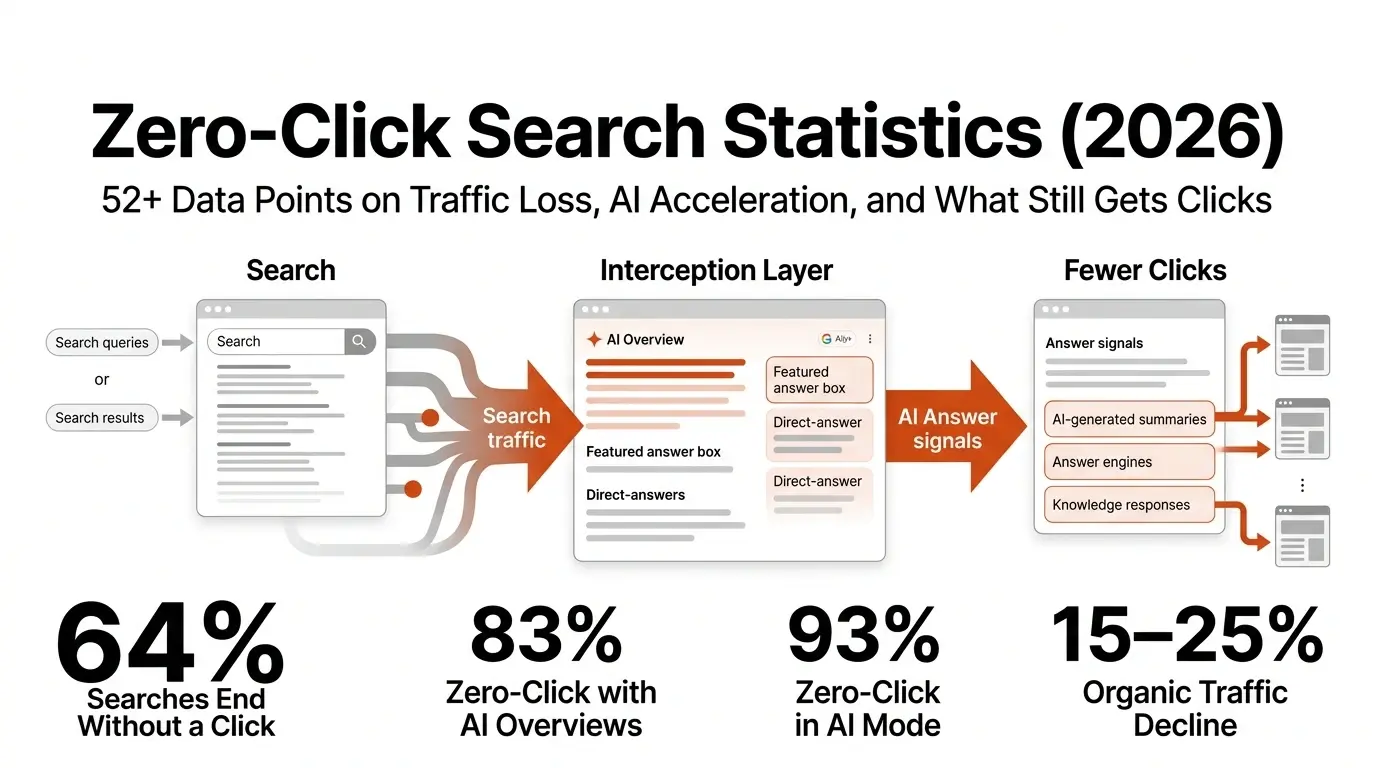
For every 1,000 Google searches in the US, only 360 result in a click to the open web. The other 640 end on the search results page itself — answered by an AI Overview, featured snippet, knowledge panel, People Also Ask box, or simply abandoned (SparkToro/Datos, 2024 Zero-Click Search Study, clickstream panel of millions of users). When an AI Overview is present, that number gets worse: 83% of those queries end without any click at all (Bain & Company / Dynata, Generative AI Consumer Survey, December 2024). In Google's newer AI Mode, the zero-click rate reaches 93% (Semrush, September 2025).
This isn't a recent development. SparkToro's Rand Fishkin first quantified the phenomenon in 2019 at ~50%. What changed in 2024–2026 is the acceleration rate. Google AI Overviews — now triggering on nearly half of all queries — turned a slow structural shift into a structural break. Bain & Company's February 2025 consumer research put the commercial consequence bluntly: 80% of consumers now rely on AI-generated results for at least 40% of their searches, and organic web traffic has declined an estimated 15–25% across many sectors as a direct result (Bain & Company, Goodbye Clicks, Hello AI, February 2025).
We aggregated data from SparkToro, Bain & Company, Pew Research Center, Gartner, Ahrefs, Seer Interactive, BrightEdge, Amsive, and Semrush to compile the most rigorously sourced zero-click search statistics available for 2026.
Key Takeaways
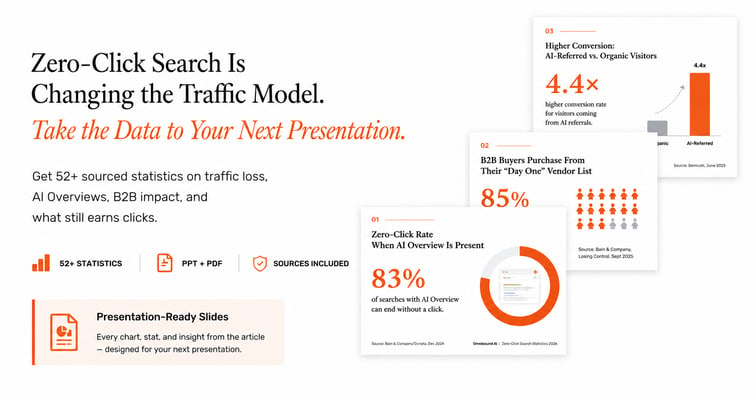
- Of every 1,000 US Google searches, only 360 clicks go to the open web (SparkToro/Datos, 2024)
- The overall US zero-click rate is ~60–65% of all searches (SparkToro 2024; Bain & Company, February 2025)
- With AI Overview present: 83% zero-click rate; in AI Mode: 93% (Bain–Dynata, December 2024; Semrush, September 2025)
- 80% of consumers rely on AI-generated results for at least 40% of their searches; organic traffic down 15–25% across many sectors (Bain & Company, February 2025)
- Mobile zero-click rate: 77%; desktop: 46.5% — a 30+ percentage point gap (SparkToro/Datos, 2024)
- Informational queries: 74% zero-click; transactional queries: only 31% zero-click — intent is the key segmentation (Semrush Intent Study)
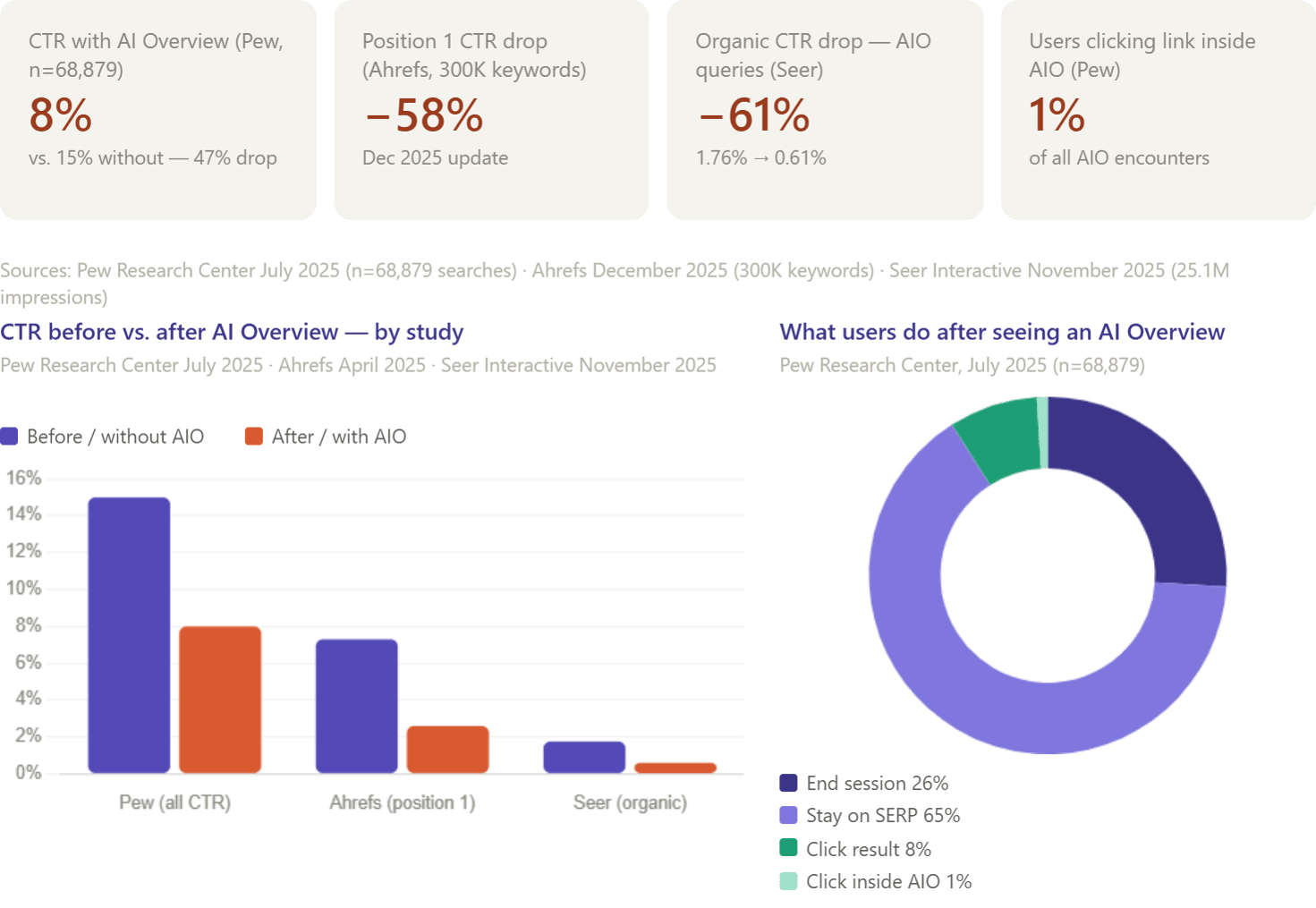
- When AI Overview present: users click a traditional result only 8% of the time vs. 15% without — a 47% relative drop (Pew Research Center, July 2025, n=68,879 searches)
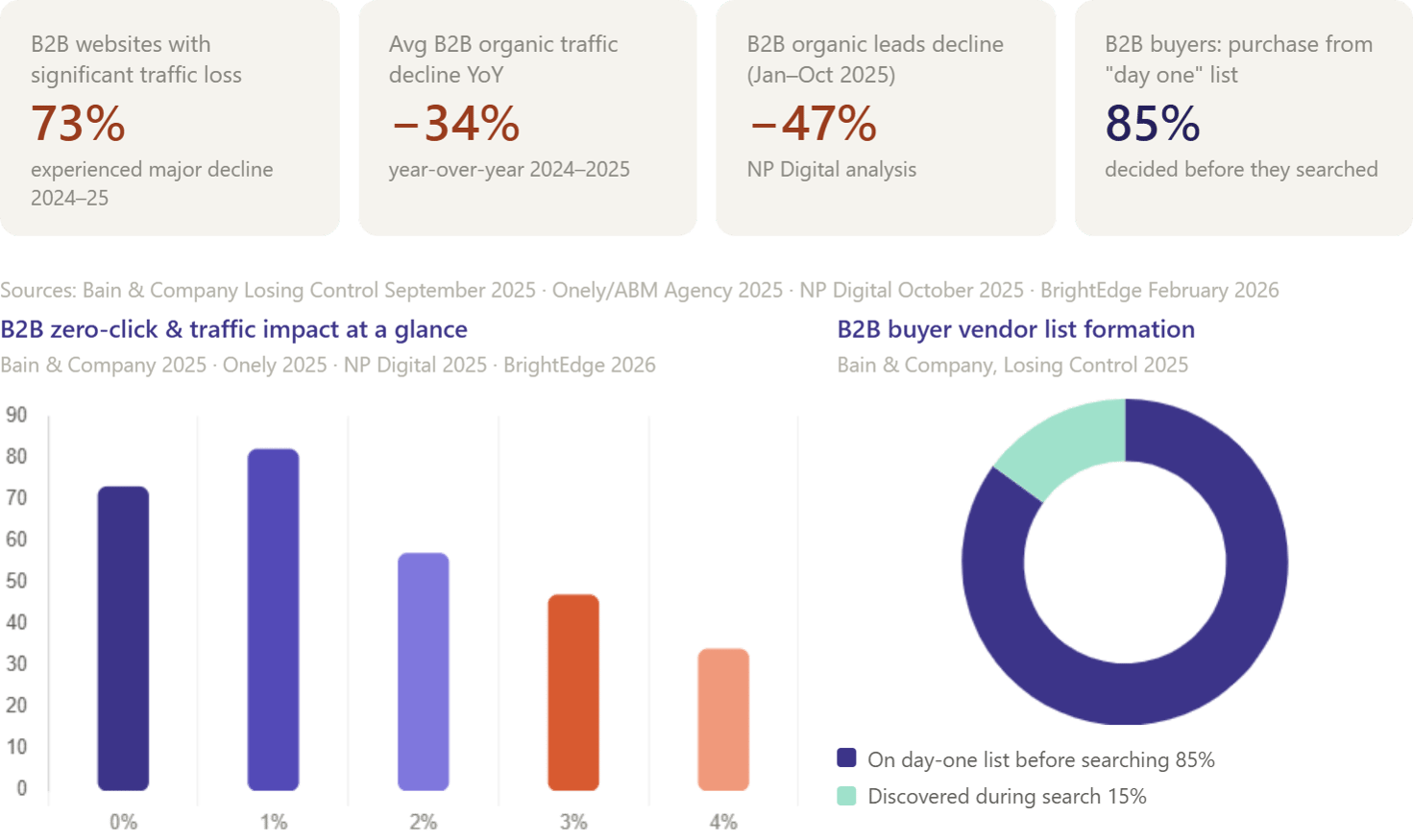
- 73% of B2B websites experienced significant traffic loss between 2024 and 2025; average decline reached 34% YoY (Onely / ABM Agency analysis, 2025)
- B2B software CTR fell by as much as 30% in some categories since AI Overviews launched (Bain & Company, Losing Control, September 2025)
- 85% of B2B buyers purchase from their "day one" vendor list — formed before any search — making pre-search visibility now critical (Bain & Company, Losing Control, September 2025)
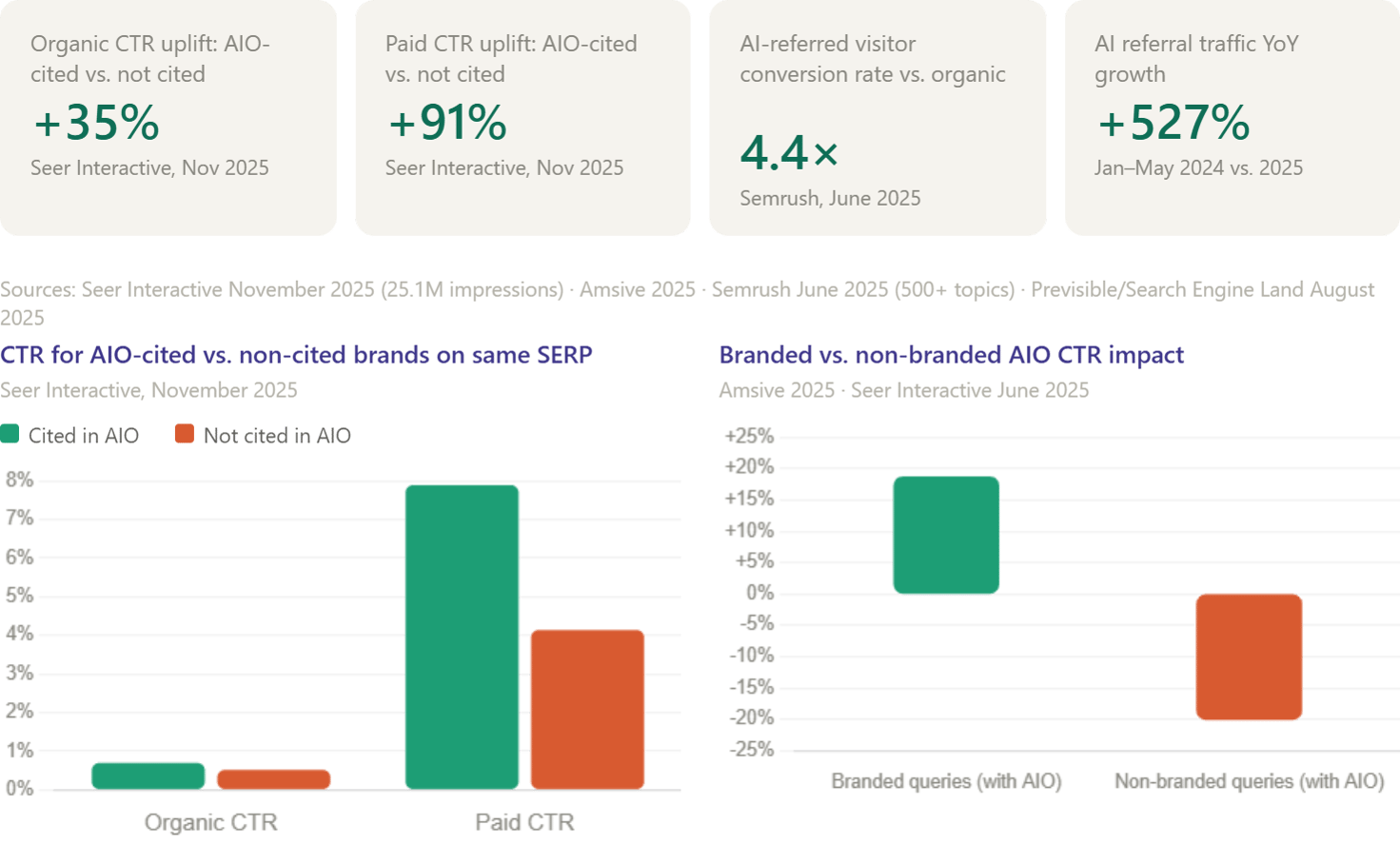
- Brands cited inside AI Overviews earn 35% more organic clicks and 91% more paid clicks than non-cited brands on the same query (Seer Interactive, November 2025)
- Gartner forecast: traditional search volume to drop 25% by 2026 as AI chatbots absorb query share (Gartner, February 2024)
The Numbers: How Large Is the Zero-Click Problem?
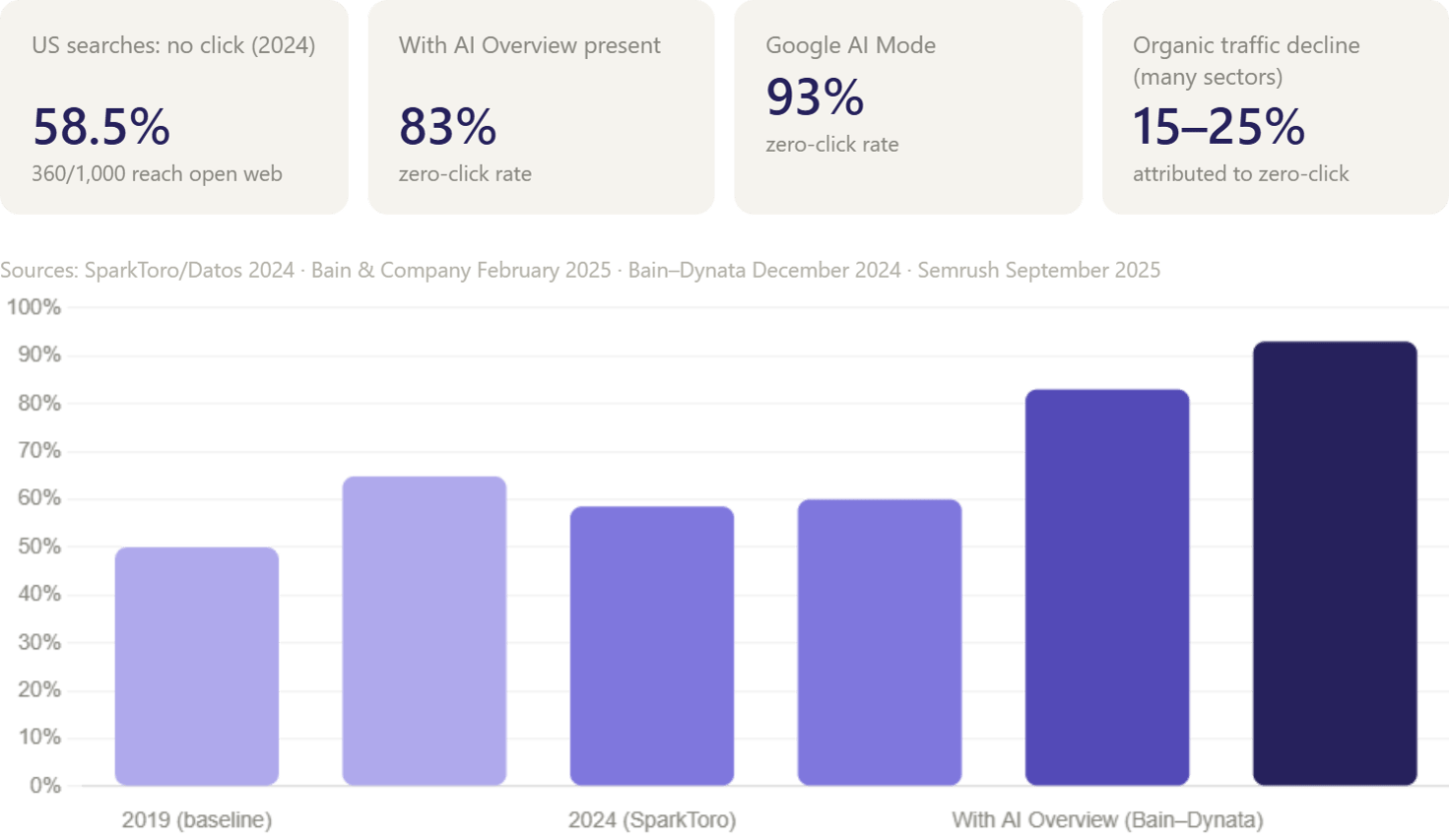
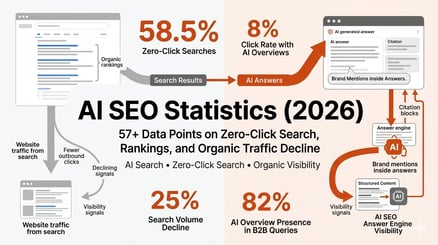
Zero-click search is not a recent anomaly created by AI Overviews — it has been building since Google introduced Knowledge Panels in 2012 and Featured Snippets in 2014. But the trajectory has steepened dramatically. SparkToro's Rand Fishkin first rigorously quantified the phenomenon in 2019 at approximately 50%. By 2021, Datos clickstream data showed it had reached 64.82%. The 2024 study measured 58.5% in the US — a slight methodological revision from the 2021 figure, but consistently in the same structural range. Since AI Overviews scaled in 2024–2025, the rate has climbed again.
Bain & Company's February 2025 primary research of US consumers provides the most commercially useful framing: they find that 60% of searches now terminate without the user clicking through to another website, and that 80% of consumers rely on AI-generated results for at least 40% of their searches. These aren't passive non-clicks — they're satisfied answers. The user got what they needed from Google. That's the structural problem for brands whose visibility model depends on the click.
| Metric | Value | Source |
|---|---|---|
| US Google searches ending without any click (2024 study) | 58.5% | SparkToro/Datos, 2024 Zero-Click Search Study |
| Open-web clicks per 1,000 US Google searches | 360 | SparkToro/Datos, 2024 |
| Bain: share of searches now ending without a click | ~60% | Bain & Company, February 2025 |
| Consumers relying on AI results for at least 40% of searches | 80% | Bain & Company, February 2025 |
| Estimated organic traffic decline across many sectors | 15–25% | Bain & Company, February 2025 |
| Zero-click rate in 2019 (SparkToro baseline) | ~50% | SparkToro, 2019 data via Datos |
| Zero-click rate in 2021 (SparkToro/Datos) | 64.82% | SparkToro/Datos 2021 clickstream data |
| Gartner forecast: traditional search volume drop by 2026 | 25% | Gartner, February 2024 |
| Zero-click searches: share that come from mobile | >60% | Multiple sources, 2025 |
The Bain figure deserves a methodological note: it is based on a consumer survey (self-reported behavior), while SparkToro/Datos uses clickstream behavioral tracking. They measure the same phenomenon from different angles and arrive at consistent conclusions — which makes the ~60% baseline the most credible primary anchor for zero-click statistics in 2026.
Zero-Click by Device: The Mobile Divide
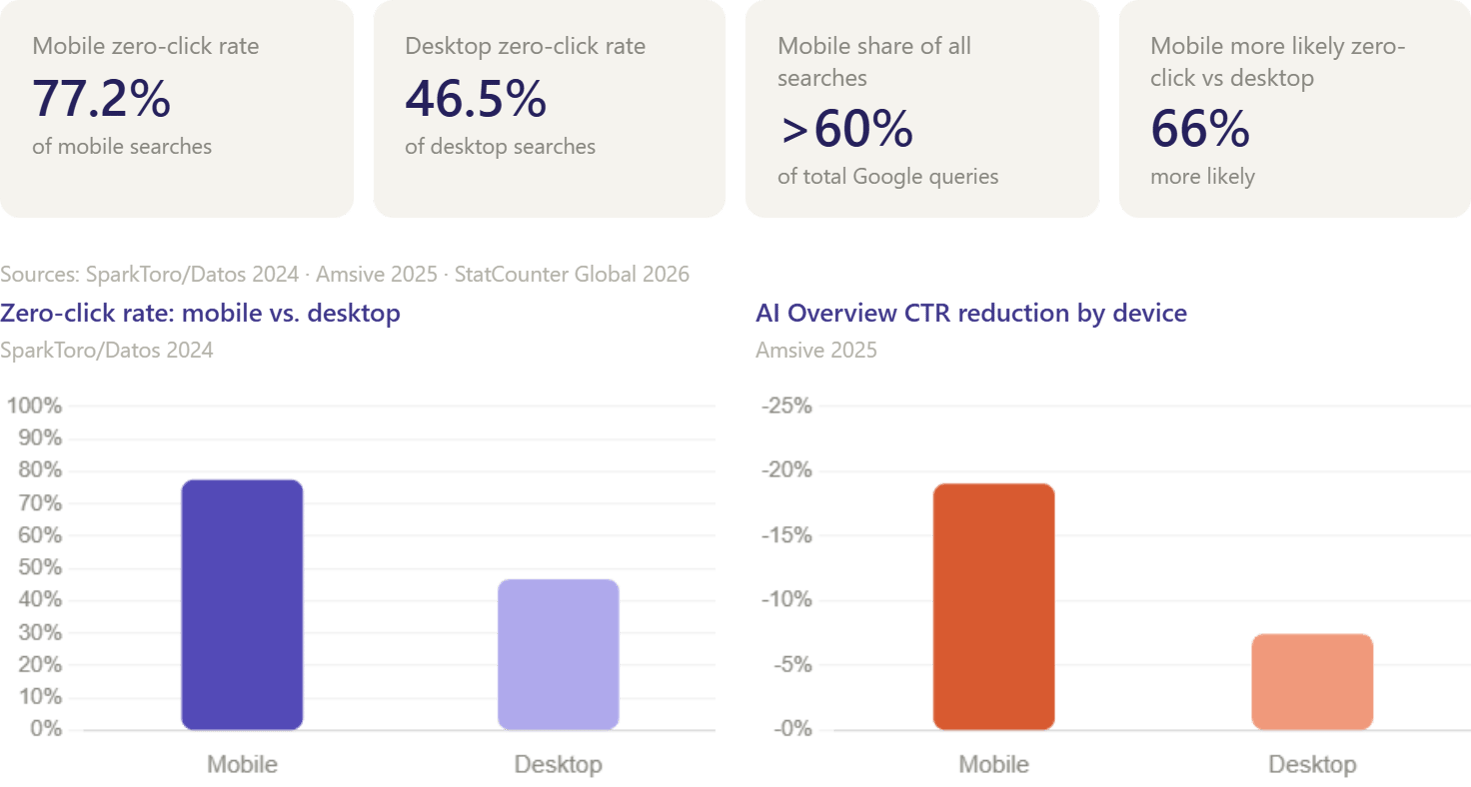
The aggregate zero-click figure masks a dramatic device split that is operationally important. Mobile zero-click rates are not slightly higher than desktop — they are structurally different: 77.2% of mobile searches end without a click to any external website, compared to 46.5% on desktop. Mobile users already show zero-click dominant behavior. Desktop users don't — yet.
This gap exists because mobile SERPs display SERP features more prominently, because mobile users are typically seeking quick answers rather than deep research, and because voice search on mobile resolves queries audibly without requiring any screen interaction. As mobile now accounts for more than 60% of all Google searches globally, the aggregate zero-click rate is pulled heavily upward by mobile behavior.
| Metric | Value | Source |
|---|---|---|
| Mobile zero-click rate | 77.2% | SparkToro/Datos, 2024 |
| Desktop zero-click rate | 46.5% | SparkToro/Datos, 2024 |
| Mobile users: more likely to experience zero-click vs. desktop | 66% more likely | Up and Social analysis, 2025 |
| Mobile share of all Google searches globally | >60% | StatCounter Global 2026 |
| AI Overviews: mobile CTR reduction (vs. desktop) | Desktop −7.4%; Mobile −19% | Amsive, 2025 |
| Zero-click searches: share coming from mobile devices | >60% of all zero-click events | Click-Vision analysis, 2025 |
The Amsive finding — AI Overviews reduce mobile CTR at 2.5x the rate of desktop reduction — is the most underreported data point in this space. B2B brands typically optimize for desktop search performance. But the majority of searches now happen on mobile, where AI Overviews compress click rates even further. A strategy calibrated to desktop CTR benchmarks is already systematically underestimating the zero-click problem.
Query Intent: What Still Gets Clicks
Zero-click search does not affect all queries equally. The single most important segmentation for content strategists is query intent. Informational queries — the "what is," "how does," "definition of" searches — now resolve on the SERP at a 74% rate. Transactional queries — "buy," "order," "sign up," "pricing" — still drive clicks 69% of the time. Intent is the dividing line between content that can still generate traffic and content that has effectively become a citation source for Google's own answers.
This segmentation explains why e-commerce sites have been relatively insulated from zero-click impact while informational content publishers have been devastated. It also explains why branded queries with AI Overviews see a CTR increase of 18.68% (Amsive 2025): when a user searches your brand name, the AI Overview confirms your legitimacy and the user clicks through to complete an action.
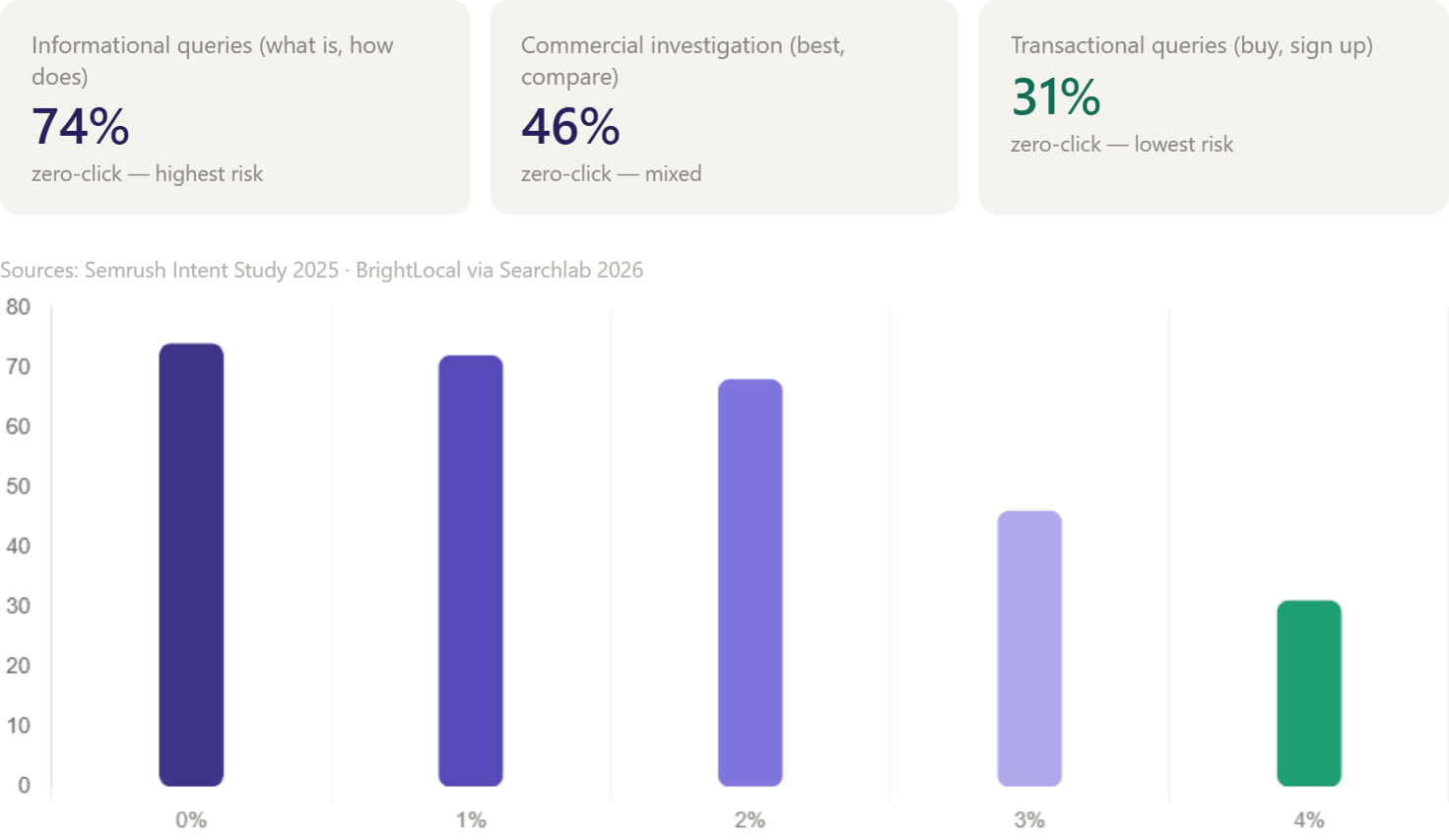
| Query type | Zero-click rate | Source |
|---|---|---|
| Informational (what is, how does, definition) | 74% | Semrush Intent Study |
| Navigational (brand name, website, app) | 68% | Semrush Intent Study |
| Local (near me, address, hours) | 72% | BrightLocal via Searchlab |
| Commercial investigation (best, review, compare) | 46% | Semrush Intent Study |
| Transactional (buy, order, sign up) | 31% | Semrush Intent Study |
| Branded queries WITH AI Overview: CTR change | +18.68% (increase) | Amsive, 2025 |
| Non-branded queries WITH AI Overview: CTR change | −19.98% | Amsive, 2025 |
| E-commerce queries triggering AI Overviews | 3.2–4% | Ahrefs, November 2025 |
The 74% informational query zero-click rate combined with the 31% transactional rate tells content teams exactly where to refocus. Top-of-funnel informational content is now primarily a citation play, not a traffic play. Teams that continue to produce "what is" and "how to" content primarily to drive blog traffic are measuring the wrong outcome. The metric for that content category is now citation frequency and brand recall — not sessions.
AI Overviews as the Zero-Click Accelerant
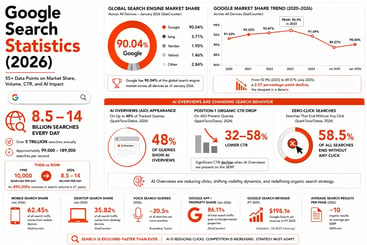
Google AI Overviews launched broadly in the US in May 2024 and have since scaled to trigger on approximately 48% of all tracked queries — a 58% year-over-year increase (BrightEdge, February 2026). Every independent study measuring their CTR impact has found a decline. The magnitude ranges from 15% (Amsive, 700,000 keywords) to 89% (DMG Media, specific navigational queries) depending on methodology, but the direction is unanimous across 12 studies.
The most methodologically rigorous primary data comes from Pew Research Center (actual behavioral tracking of 68,879 real Google searches) and Seer Interactive (longitudinal analysis of 25.1 million organic impressions across 42 organizations). Both point to the same structural outcome: when an AI Overview appears, it doesn't just reduce clicks — it ends browsing sessions entirely for 26% of users.
| Metric | Value | Source |
|---|---|---|
| CTR with AI Overview present | 8% (vs. 15% without) | Pew Research Center, July 2025 |
| Relative CTR reduction: AI Overview vs. no AI Overview | 47% | Pew Research Center, July 2025 |
| Position 1 CTR drop when AI Overview present | 58% | Ahrefs, December 2025 |
| Organic CTR drop on AI Overview queries (Jun 2024–Sep 2025) | 61% (1.76% → 0.61%) | Seer Interactive, November 2025 |
| Paid CTR drop on AI Overview queries (same period) | 68% (19.7% → 6.34%) | Seer Interactive, November 2025 |
| Users clicking a link INSIDE an AI Overview | 1% | Pew Research Center, July 2025 |
| Users ending their browsing session after AI Overview | 26% (vs. 16% without) | Pew Research Center, July 2025 |
| Zero-click increase since AI Overviews launched (May 2024–May 2025) | 56% → 69% (+13 pp) | Similarweb, 2025 |
| AI Overviews now triggering on share of all tracked queries | ~48% (up 58% YoY) | BrightEdge, February 2026 |
The 26% session abandonment figure from Pew is the number that most clearly separates AI Overviews from earlier SERP features. Featured snippets diverted some traffic to competing results. AI Overviews eliminate the need for any further search. That traffic isn't going to a competitor — it simply never enters the web.
Omnibound's Audit & Optimize identifies which of your content is currently being cited in AI Overviews — giving you the citation visibility data needed to act on this, rather than only tracking traffic decline after the fact.
The B2B Impact: A Harder Landing
Zero-click search was first documented as a consumer problem. But Bain & Company's September 2025 analysis — Losing Control: How Zero-Click Search Affects B2B Marketers — brought the first primary data specifically quantifying B2B impact. The findings are structurally alarming for teams whose pipeline depends on organic search discovery.
B2B software categories have seen CTR fall by as much as 30% since AI Overviews launched. 73% of B2B websites experienced significant traffic loss between 2024 and 2025, with average YoY declines reaching 34%. And the most commercially consequential finding: 85% of B2B buyers purchase from their "day one" vendor list — companies they had in mind before they searched. Zero-click search is severing B2B brands' ability to insert themselves into that list formation process, because the discovery moment is now resolved on the SERP before any brand website is visited.
| Metric | Value | Source |
|---|---|---|
| B2B software: CTR decline since AI Overviews launched | Up to 30% in some categories | Bain & Company, Losing Control, September 2025 |
| B2B buyers who purchase from their "day one" vendor list | 85% | Bain & Company, Losing Control, September 2025 |
| B2B websites that experienced significant traffic loss (2024–2025) | 73% | Onely analysis, 2025 |
| Average YoY B2B website traffic decline (2024–2025) | 34% | ABM Agency analysis, 2025 |
| B2B Technology queries now triggering AI Overviews | 82% | BrightEdge, Feb 2025–Feb 2026 |
| B2B searches ending without a website click (2025) | ~57% (up from 35% in 2024) | NP Digital analysis, October 2025 |
| B2B organic leads decline (Jan → Oct 2025) | −47% | NP Digital, October 2025 |
| Bain: share of B2B marketers losing visibility in high-value non-branded searches | Growing majority | Bain & Company, Goodbye Clicks, Hello AI, 2025 |
The "day one" vendor list finding is the most strategically important data point in Bain's B2B research. If 85% of B2B buyers are only seriously considering vendors they thought of before they searched, then the entire content-marketing-as-top-of-funnel model — which assumed organic search discovery could build that list — is being undermined. The list is now formed in AI-generated summaries, not on page one of Google's results.
Omnibound's AI Search Intelligence tracks where your brand appears — or fails to appear — in the AI-generated responses buyers read before they start a formal vendor evaluation. That's the visibility layer that now matters most for B2B.
The Opportunity Side: Visibility Without Clicks
The zero-click narrative is almost universally framed as loss. But the data contains a parallel story. Visitors who do click through in a zero-click environment are demonstrably higher-intent than pre-AI-Overview organic visitors — because AI has already pre-qualified them by synthesizing relevant context before the click. Semrush's June 2025 study found AI-referred visitors convert at 4.4x the rate of traditional organic visitors. AI referral traffic has grown 527% year-over-year.
More immediately actionable: brands cited inside AI Overviews see a 35% organic CTR uplift and 91% paid CTR uplift compared to non-cited brands on the same SERP (Seer Interactive, November 2025). Zero-click is not a uniform outcome — it's a redistribution. Traffic that used to go to many sites now concentrates on the sources AI systems choose to cite.
| Metric | Value | Source |
|---|---|---|
| Organic CTR uplift for AIO-cited brands vs. non-cited | +35% | Seer Interactive, November 2025 |
| Paid CTR uplift for AIO-cited brands vs. non-cited | +91% | Seer Interactive, November 2025 |
| Branded queries WITH AI Overview: CTR increase | +18.68% | Amsive, 2025 |
| AI-referred visitors: conversion rate vs. organic | 4.4x higher | Semrush, June 2025 |
| AI referral traffic YoY growth (Jan–May 2024 vs. 2025) | +527% | Previsible/Search Engine Land, August 2025 |
| Users who clicked through on AI Overview survive click: convert 23% better | 23% higher conversion | DigitalApplied, April 2026 |
| 74% of users satisfied by featured snippet: answer "sufficiently answered" | 74% | Google User Research via Search Engine Journal |
The critical reframe: zero-click search is a redistribution of attention, not a disappearance of it. Users who see an AI Overview featuring your brand — even without clicking — have received a brand impression from a highly trusted source. The click-based traffic model assumed that all search value was captured in the click. In a zero-click world, significant value accumulates at the citation level, even when the click never comes.
Omnibound's B2B AI Search Playbook covers how to build content and optimize technical structure specifically to earn AI citations — the step-by-step framework for converting from the old traffic model to the new visibility model.
Zero-Click Search by the Numbers
| Metric | Value | Source |
|---|---|---|
| US Google searches ending without a click | ~60–65% | SparkToro/Datos 2024 |
| Open-web clicks per 1,000 US searches | 360 | SparkToro/Datos 2024 |
| EU Google searches ending without a click | 59.7% | SparkToro/Datos 2024 |
| Zero-click rate in 2019 (SparkToro baseline) | ~50% | SparkToro 2019 |
| Zero-click rate in 2021 | 64.82% | SparkToro/Datos 2021 |
| Consumers relying on AI results for 40%+ of searches | 80% | Bain & Company, February 2025 |
| Organic web traffic decline across many sectors | 15–25% | Bain & Company, February 2025 |
| Gartner: traditional search volume drop by 2026 | 25% | Gartner, February 2024 |
| Mobile zero-click rate | 77.2% | SparkToro/Datos 2024 |
| Desktop zero-click rate | 46.5% | SparkToro/Datos 2024 |
| AI Overviews: mobile CTR reduction | −19% | Amsive 2025 |
| Informational queries: zero-click rate | 74% | Semrush Intent Study |
| Navigational queries: zero-click rate | 68% | Semrush Intent Study |
| Local queries: zero-click rate | 72% | BrightLocal via Searchlab 2026 |
| Commercial investigation queries: zero-click rate | 46% | Semrush Intent Study |
| Transactional queries: zero-click rate | 31% | Semrush Intent Study |
| CTR with AI Overview present | 8% vs. 15% without | Pew Research Center, July 2025 |
| Relative CTR drop from AI Overview presence | 47% | Pew Research Center, July 2025 |
| Position 1 CTR drop when AI Overview present | 58% | Ahrefs, December 2025 |
| Organic CTR drop on AI Overview queries | 61% | Seer Interactive, November 2025 |
| Paid CTR drop on AI Overview queries | 68% | Seer Interactive, November 2025 |
| Users clicking link inside AI Overview | 1% | Pew Research Center, July 2025 |
| Users ending session entirely after AI Overview | 26% | Pew Research Center, July 2025 |
| AI Overviews present on share of all queries | ~48% | BrightEdge, February 2026 |
| Zero-click with AI Overview | 83% | Bain–Dynata, December 2024 |
| AI Mode zero-click rate | 93% | Semrush, September 2025 |
| B2B software CTR decline since AI Overviews launched | Up to 30% | Bain, Losing Control September 2025 |
| B2B buyers purchasing from "day one" vendor list | 85% | Bain, Losing Control September 2025 |
| B2B websites experiencing significant traffic loss (2024–2025) | 73% | Onely 2025 |
| Average B2B website YoY traffic decline | 34% | ABM Agency analysis 2025 |
| B2B organic leads decline (Jan–Oct 2025) | −47% | NP Digital, October 2025 |
| Branded AIO queries: CTR increase | +18.68% | Amsive 2025 |
| Non-branded AIO queries: CTR decline | −19.98% | Amsive 2025 |
| AIO-cited brands: organic CTR uplift vs. non-cited | +35% | Seer Interactive, November 2025 |
| AIO-cited brands: paid CTR uplift vs. non-cited | +91% | Seer Interactive, November 2025 |
| AI-referred visitors: conversion rate vs. organic | 4.4x higher | Semrush, June 2025 |
| AI referral traffic YoY growth | +527% | Previsible/Search Engine Land 2025 |
Methodology and Sources
This article was compiled from primary research organizations and verified industry studies published between 2019 and 2026. Every statistic was traced to its originating named study before inclusion. Secondary SEO blog aggregators were used only to locate primary sources — never as citations themselves. Statistics older than three years are labeled throughout.
Primary sources (Tier 1):
- SparkToro / Datos (Semrush) — 2024 Zero-Click Search Study (Rand Fishkin; published June 2024; clickstream behavioral panel of millions of users across US and EU, September 2022–May 2024). The 2019 and 2021 figures also sourced from SparkToro's prior releases in this series.
- Bain & Company — Goodbye Clicks, Hello AI: Zero-Click Search Redefines Marketing (September 19, 2025); Press release: Consumer reliance on AI search results signals new era of marketing (February 19, 2025); Losing Control: How Zero-Click Search Affects B2B Marketers (September 19, 2025)
- Bain & Company / Dynata — Generative AI Consumer Survey (December 2024; 1,100+ US consumers; 83% AI Overview zero-click figure)
- Pew Research Center — Google Users Are Less Likely to Click on Links When an AI Summary Appears (July 22, 2025; 900 US adults, 68,879 actual Google searches tracked in real time, March 2025)
- Gartner — Gartner Predicts Search Engine Volume Will Drop 25% by 2026 (February 19, 2024; Alan Antin, VP Analyst)
- Ahrefs — AI Overviews Reduce Clicks by 34.5% (April 2025, updated December 2025; 300,000 keywords, aggregated Google Search Console data)
- Seer Interactive — AIO Impact on Google CTR: September 2025 Update (November 4, 2025; 3,119 queries, 42 organizations, 25.1M organic + 1.1M paid impressions, June 2024–September 2025)
- BrightEdge — AI Overviews at the One-Year Mark (February 2026; BrightEdge Generative Parser™, 9 industries tracked Feb 2025–Feb 2026)
- Amsive — CTR study of 700,000 keywords, 2025. Branded vs. non-branded AI Overview CTR impact.
- Semrush — Query intent zero-click segmentation data (Semrush Intent Study, 2025); AI Overviews presence and AI Mode zero-click data
- Similarweb — Zero-click rate tracking May 2024–May 2025 (56% → 69% increase)
- Semrush — We Studied the Impact of AI Search on SEO Traffic (June 9, 2025; AI visitor conversion rate 4.4x finding)
Recency and methodology notes:
- SparkToro/Datos uses clickstream behavioral tracking (what users actually did) rather than survey methodology. This is the most methodologically sound approach for zero-click measurement, but any panel may slightly over- or under-represent certain demographics.
- The 58.5% US figure (SparkToro 2024) and the ~60% Bain figure (survey, February 2025) are measuring the same phenomenon via different methodologies and arrive at consistent conclusions.
- Pew Research Center's CTR study (July 2025) was disputed by Google on methodology grounds. It remains the most behaviorally rigorous study available (real tracking of 68,879 searches, not keyword tool estimates) and is presented with this caveat.
- Zero-click statistics vary by definition: some studies count all searches not resulting in an external website click; others count only searches not resulting in any click. Where possible, this article uses the "no click to external website" definition for consistency with SparkToro's methodology.
%2056+%20Data%20Points%20on%20Coverage%2c%20CTR%20Impact%2c%20Citations%2c%20and%20Industry%20Breakdown.webp?height=245&name=Google%20AI%20Overviews%20Statistics%20(2026)%2056+%20Data%20Points%20on%20Coverage%2c%20CTR%20Impact%2c%20Citations%2c%20and%20Industry%20Breakdown.webp)