

Table Of Contents
AEO vs SEO is the question every B2B marketing team is now forced to answer, and the honest answer is that you need both. Traditional SEO gets you ranked. Answer engine optimization (AEO) and generative engine optimization (GEO) get you cited inside AI answers. The two are different disciplines with different signals and different metrics, and the gap between them is where 2026 pipeline is being won and lost. AI-referred sessions grew 527% year over year and convert at roughly 4.4x the rate of traditional organic visitors (Semrush, 2026), which means the brands winning AI citations are capturing the highest-intent buyers in the market.
SEO vs AEO vs GEO: The Definitions That Actually Matter
The three terms get used interchangeably, but they describe different work. Getting them straight is the whole point of the comparison.
| Discipline | What it optimizes for | The core question |
|---|---|---|
| SEO (Search Engine Optimization) | Ranking a page on a results page | Can this page rank? |
| AEO (Answer Engine Optimization) | Being cited inside an AI-generated answer | Will an AI select and quote this content? |
| GEO (Generative Engine Optimization) | Being represented across generative AI systems broadly | Do generative engines understand and recommend this brand? |
In practice AEO and GEO overlap heavily and are often used as synonyms. Both are about earning inclusion in the synthesized answer rather than a link on a page. Throughout this guide, "AI search visibility" refers to that combined discipline: being retrieved, trusted, and cited by AI answer systems.
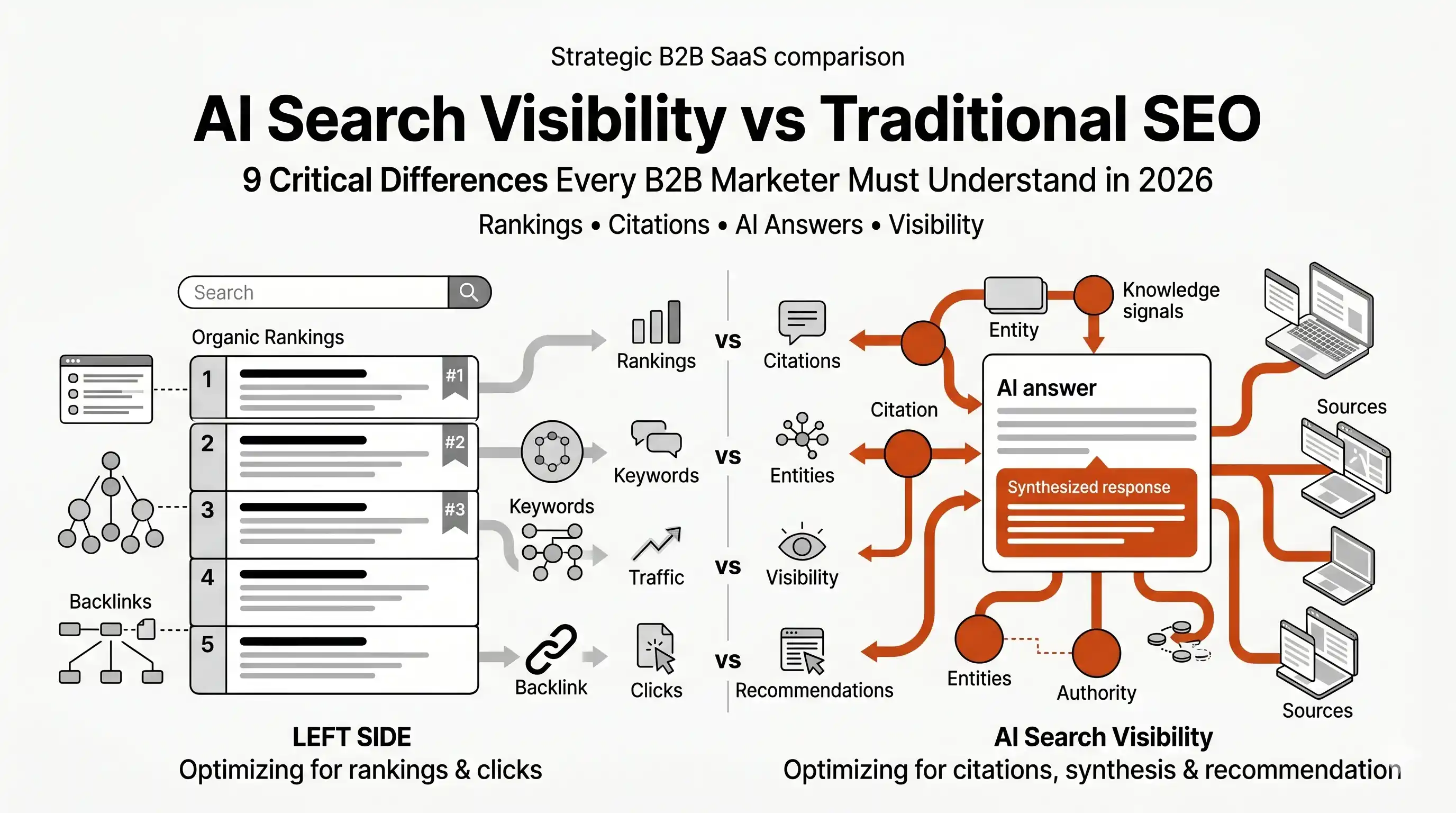
The distinction that matters most: traditional SEO optimizes for pages and positions, while AI search visibility optimizes for trust and citations. You can rank number one on Google and still be completely invisible inside an AI answer, because AI systems select sources on extractability, entity clarity, and trustworthiness, not position alone.
AEO vs SEO: The Nine Differences That Matter
1. Pages vs Trust
Traditional SEO asks whether a page can rank. AEO asks whether the content will be selected and quoted inside a generated answer. SEO signals are backlinks, keyword coverage, page speed, and structured data. AEO signals are trustworthiness as a cited source, entity recognition, and answer-aligned structure. Most teams still optimize only for the first list.
2. Keywords vs Prompts
SEO targets keywords, short phrases typed into a search box. AEO targets prompts, full conversational questions with context and intent baked in.
| Traditional SEO target | AI search prompt target |
|---|---|
| "b2b content marketing platform" | "What is the best platform for B2B content teams that need AI search visibility alongside content production?" |
| "ai search tool" | "Which tools help B2B teams track where their brand appears in ChatGPT and Perplexity answers?" |
| "content marketing roi" | "How do enterprise teams measure content ROI when buyers discover vendors through AI answers, not Google?" |
Optimizing for one does not automatically cover the other.
3. Clicks vs Citations
SEO measures clicks. AEO measures citations. This matters because most AI answers never produce a click. Around 93% of Google AI Mode searches end without one (Semrush, 2025), so presence inside the answer becomes the unit of visibility. And being cited is not neutral to your other channels: brands cited as a source in an AI Overview earn 35% more organic clicks and 91% more paid clicks than brands that are not (Seer Interactive, 2026).
4. Position vs Selection
A top ranking does not guarantee AI inclusion. In fact, 40% of the sources cited in Google AI Overviews would rank in positions 11 to 20 on a traditional results page, not the top 10 (WordStream, 2026). AI systems select for answer-fit, not rank.
5. Static vs Recalibrating
SEO rankings, once earned, tend to hold. AI systems continuously recalibrate which sources they trust. Content built on a one-time research snapshot stops earning citations as buyer language and competitive narratives shift. Freshness is a standing obligation, not a one-time task.
6. One Engine vs Many
Google was effectively the single surface for SEO. AI search is fragmented across ChatGPT, Perplexity, Gemini, and Google AI Mode, and they cite differently. Only about 11% of domains are cited by both ChatGPT and Perplexity for the same queries (Averi, 2026, analysis of 680M citations). A single-engine strategy leaves most of your visibility gaps unaddressed.
7. Traffic Metrics vs Citation Metrics
SEO dashboards report position, impressions, CTR, and organic traffic. AI visibility introduces a different measurement layer: citation frequency, answer share, entity inclusion, and cross-engine consistency. These are not variations of SEO metrics. For the full set, see the seven AI search visibility metrics that move pipeline.
8. Page Authority vs Entity Authority
SEO builds page-level authority through links. AI search builds entity-level authority: consistent brand facts across your site, Wikipedia, Wikidata, LinkedIn, and review platforms, plus corroboration from sources the model already trusts. When independent sources agree on who you are, the model cites you with confidence.
9. Own Site vs Trust Graph
SEO is largely about your own domain. AI citations are earned as much off it, on Reddit, G2, Capterra, YouTube, and industry publications, the trust graph engines cross-check against. A brand that manages only its own website leaves most of its citation surface uncontrolled.
Traditional SEO Is Not Dead (And Anyone Saying Otherwise Is Wrong)
Here is what the "SEO is dead" crowd gets wrong. Traditional SEO remains the foundation of AI discoverability, because AI systems pull from sources they have already determined to be credible, and that credibility is built through the same signals SEO has always valued.
What SEO still drives in 2026:
- Direct traffic acquisition and demand capture
- Authority signals AI systems use to evaluate trustworthiness
- Backlink ecosystems that reinforce entity recognition
- Indexed content AI crawlers pull from when generating answers
The problem is not that SEO stopped working. It is that teams optimizing only for SEO are building half a discoverability strategy. This is the same conclusion reached in why SEO fundamentals still power AI search citations. The other half is citation-based, prompt-driven, and answer-oriented.
The Citation Gap: Where AEO vs SEO Creates Blind Spots
Most teams still optimize only for positions, impressions, and CTR. Those metrics do not tell you whether your brand appears inside an AI answer when a buyer asks about your category. That missing layer is the citation gap: the difference between brands referenced in AI answers and brands ignored entirely, even when they rank on page one.
The citation gap shows up in three ways:
- Missing prompt coverage: your content does not address the specific questions buyers type into AI engines.
- Entity ambiguity: AI systems are unclear about what your brand does, who it serves, and why it is credible.
- Staleness: once-citable content has not been refreshed to reflect current buyer context.
To put a number on your own gap, start with an AI search visibility score and gap analysis.
GEO vs SEO: How to Prioritize Based on Your Goals
The wrong answer is "AI search replaces SEO." The right answer is that priority depends on what your team is trying to accomplish, and in most cases you run both in parallel.
| Your goal | Primary priority | Secondary priority |
|---|---|---|
| Organic traffic acquisition | Traditional SEO | AI visibility (improves referral quality) |
| Brand citations in AI answers | AI search visibility (AEO/GEO) | Authority-building through SEO |
| Demand capture from active buyers | Both, equally | Prompt-level content strategy |
| Long-term market presence | AI search visibility | Continuous content refresh |
| Future-proofing discoverability | AI search visibility | SEO as the foundation |
For the tactic-by-tactic build, see how to improve AI search visibility, and for the tooling landscape, the best answer engine optimization tools.
How Omnibound Closes the Gap Between SEO and AI Search Visibility
Traditional SEO stacks show rankings, keywords, and traffic. That is a partial view of discoverability in 2026. It does not tell you whether your brand is cited in AI answers, which prompts your buyers use, or where your content fails to earn inclusion.
Omnibound is an AI search growth platform, not another dashboard. It connects buyer signals, market signals, competitive positioning, and content execution into one continuous workflow:
- AI Search Intelligence tracks your citations, share of voice, and competitor presence prompt by prompt across ChatGPT, Perplexity, Gemini, Claude, and Google AI Mode.
- Buyer context, not keyword lists. Living ICPs and personas built from real conversations, CRM signals, and market data through the B2B Marketing Context Engine.
- Content built to be cited. That context becomes structured, extractable content designed for AI selection, then connected through to pipeline so visibility becomes a number leadership can act on.
The point is not more reporting. It is turning the AEO-vs-SEO question into a plan that keeps content citation-worthy and positioning sharp.
Conclusion
AEO vs SEO does not have a binary answer, and any team treating it as one is making a strategic mistake. Rankings still matter. Traffic still matters. But rankings are no longer the only measure of discoverability. Visibility increasingly means being selected, synthesized, and cited by AI systems, and buyers are receiving those answers before they ever visit a vendor site.
The path forward is not SEO or AI search visibility. It is both, run from a unified context layer that keeps content citation-worthy, buyer intelligence current, and positioning sharp. See exactly where your brand stands with the AI search visibility diagnostic.
FAQs
What is the difference between AEO and SEO? SEO (search engine optimization) optimizes a page to rank on a results page through crawling, indexing, and keyword coverage. AEO (answer engine optimization) optimizes content to be selected and cited inside an AI-generated answer on systems like ChatGPT and Perplexity. SEO targets position; AEO targets citation inclusion, and the two use different signals and metrics.
What is the difference between GEO and SEO? GEO (generative engine optimization) is the practice of making a brand understood and recommended across generative AI systems, closely related to AEO. SEO ranks pages on search results; GEO earns representation inside generative answers. In practice most B2B teams treat AEO and GEO as the same discipline, AI search visibility, and run it alongside SEO rather than instead of it.
Can you rank number one on Google but still be invisible in AI search? Yes. AI systems select sources on trustworthiness, entity clarity, and answer relevance, not page position. A brand ranked first on a traditional results page can be absent from AI answers if its content is not structured, authoritative, or contextually aligned for AI selection. Around 40% of AI Overview citations come from sources that would rank outside the top 10.
Is SEO still worth investing in during 2026? Yes. SEO remains essential for traffic, authority, and demand capture, and strong SEO signals feed AI discoverability by building the trust AI systems evaluate. The correct position is not SEO or AI visibility, it is both, from a unified strategy.
What metrics should teams track for AI search visibility? Citation frequency, answer share, entity inclusion, and cross-engine consistency across ChatGPT, Perplexity, Gemini, and Google AI Mode. These sit alongside traditional SEO metrics, not instead of them.
Which AI search engines should B2B marketers prioritize? Buying committees use ChatGPT, Perplexity, Gemini, and Google AI Mode before visiting vendor sites, and they cite differently, so coverage across all four matters. Most teams start with ChatGPT and Perplexity, then layer in Google AI Mode given its overlap with organic search behavior.
Turn Your Content Into AI-Search Winners
Get cited across ChatGPT, Claude & Perplexity — not just ranked on Google.
- Increase AI citations
- Improve answer visibility
- Track brand mentions in LLMs