

Most brand guidelines are outdated within months of being published. In 2026, that gap matters more than ever because buyers are forming opinions about your company before a salesperson ever gets on a call, often through AI-generated answers that summarize your positioning alongside your competitors'.
This is not an argument for letting AI rewrite your brand book on its own. It's an argument for treating brand guidelines as a living strategic asset, one that marketing leaders continuously refine using customer intelligence, market intelligence, competitive positioning, and AI Search visibility, while a human team stays firmly in control of what actually ships.
Key Takeaways
- Static brand guidelines fail because markets, buyers, products, and AI Search all move faster than an annual review cycle.
- Customer intelligence from sales calls, support tickets, reviews, and buyer questions should directly inform messaging updates.
- AI Search is becoming a common way buyers discover and evaluate vendors, which raises the cost of inconsistent brand language.
- Competitive positioning reviews help teams stay differentiated without copying rivals.
- Market shifts usually call for messaging refinement, not a full rebrand.
- Marketing leaders, not automation, should own every decision to update brand guidance.
The rest of this playbook breaks down why the old model no longer holds up, and what a repeatable process for continuous brand improvement actually looks like inside a modern brand marketing function.
Why Static Brand Guidelines No Longer Work
Brand guidelines were built for a world that moved on a yearly cadence. A design team would publish a PDF with approved colors, a tone-of-voice section, and a handful of messaging pillars, and that document would guide campaigns until the next refresh cycle. That approach made sense when markets, products, and buyer behavior changed slowly enough for an annual review to keep pace.
That world doesn't exist anymore. Five forces are moving faster than any static document can track.
-
Markets evolve continuously. Pricing models shift, new entrants appear, and established competitors reposition without warning. A brand guideline written in January can misrepresent your value proposition by the following quarter.
-
Buyers evolve. The vocabulary your ideal customers use to describe their problems changes as their own priorities shift, whether that's a new compliance requirement, a budget freeze, or a shift toward a different category of solution entirely.
-
AI Search evolves. The way large language models summarize and compare vendors is not static. As these systems update how they synthesize information, brands that maintained fixed messaging for years can suddenly find themselves described inaccurately or left out of comparisons altogether.
-
Products evolve. Feature releases, new use cases, and expanded integrations change what a product actually does for a customer, but brand guidelines often lag behind the roadmap by two or three release cycles.
-
Competitors evolve. Rivals adopt new language, claim differentiators that used to be uniquely yours, and shift their own narrative in response to the same market pressures you're facing.
When any one of these forces moves and the brand guidelines stay frozen, the result is a widening gap between what your materials say and what your buyers actually experience. Sales teams start improvising their own language. Content teams write copy that technically follows the old rules but no longer resonates. Product marketing produces positioning that contradicts what customer-facing teams are saying on calls.
None of this means brand identity should change constantly. A living approach to brand guidance is not about reinventing your logo, your color palette, or your core values every quarter. It's about keeping the messaging layer, proof points, and market context current while protecting the identity elements that make your brand recognizable over time.
The practical fix is a repeatable review process instead of a fixed publication date. Guidelines become guidance that gets revisited whenever meaningful customer, market, or competitive signals accumulate, rather than whenever the calendar says it's time.
Brand Guidelines Should Become Living Strategic Assets
The traditional lifecycle for brand documentation looks like this: a document gets published, it sits untouched for a year, and by the time the next review happens, it's already describing a market that no longer exists.
A modern approach replaces that lifecycle with something closer to an ongoing discipline:
Continuous Customer Intelligence → Messaging Review → Brand Guidance → Campaign Execution
The difference isn't just speed, it's structure. Brand governance stops being a project with a start and end date and becomes a standing function, similar to how finance teams treat forecasting or how product teams treat roadmap planning. Someone owns it. It runs on a cadence. It has defined inputs and defined outputs.
This shift matters most for organizations selling into markets where buyer expectations move quickly, competitive intensity is high, or where the sales cycle spans months and multiple stakeholders. In those environments, a brand document that's stale by six months creates real friction between what marketing promises and what sales and customer success actually deliver.
Customer Intelligence Should Shape Brand Messaging
The strongest input for keeping brand messaging accurate isn't a brainstorm session or an executive opinion. It's what customers are actually saying, in their own words, across every touchpoint where they interact with your company.
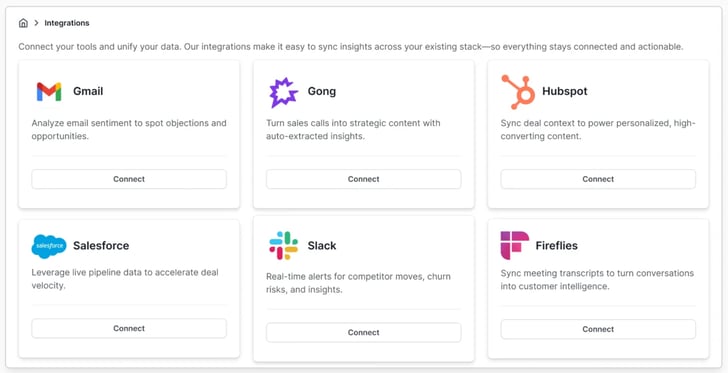
That includes:
- Sales conversations, where prospects describe their problems before they've been coached into your vocabulary
- Customer interviews, which reveal how buyers actually justified the purchase internally
- CRM notes and deal history, which show which messages correlated with wins and which correlated with stalled deals
- Support tickets, which surface the gap between what marketing promised and what customers experienced
- Reviews on third-party sites, where language is unfiltered and often more candid than anything said directly to your team
- Implementation feedback, which tells you whether your onboarding narrative matches reality
- Recurring buyer questions, which point to messaging gaps your current guidelines don't address
The workflow looks like this:
Customer Signals → Messaging Review → Brand Guidelines → Campaigns
None of this requires guessing. It requires a consistent process for pulling these signals together, spotting patterns, and bringing recommendations to the people who own brand decisions. Our work on how AI builds brand voice from real customer signals goes deeper into what that pattern-recognition process looks like in practice.
Marketing teams that build this habit stop asking "what do we think our customers care about" and start answering with evidence. That's a meaningfully different, and more defensible, way to run brand governance.
AI Search Is Changing Brand Consistency
Buyers increasingly form their first impression of a vendor through an AI-generated answer, not a homepage visit. Independent industry analysis points to a growing share of B2B research happening through conversational AI tools, and that shift changes what "consistent brand messaging" actually requires.
When a buyer asks an AI Search tool to compare vendors in your category, the response is a synthesis of whatever content exists across your website, documentation, review sites, and third-party coverage. If your positioning language, proof points, and terminology vary from page to page, the summary that gets generated will reflect that inconsistency, sometimes in ways that undersell your actual differentiation.
Four qualities matter more than ever in this environment:
- Consistency across every asset, so an AI system doesn't have to reconcile conflicting descriptions of what you do
- Evidence in the form of specific proof points rather than vague claims, since AI systems tend to favor content with concrete detail
- Educational depth that answers the actual questions buyers are asking, not just the questions your last campaign was built around
- Trustworthiness, meaning claims that hold up when compared against reviews, case studies, and independent sources
Inconsistent messaging doesn't just confuse readers, it reduces the odds that AI Search tools cite your brand accurately, and it erodes buyer trust when the summary they see doesn't match what they find when they click through. Broader industry analysis of AI-driven discovery consistently points to the same conclusion: brands with a stable, well-supported narrative earn better visibility than brands with fragmented messaging, regardless of how much content volume they produce.
Reviewing AI Search visibility alongside your regular brand messaging review gives marketing teams a concrete way to check whether the story your content tells is the story AI systems are actually repeating.
Competitive Positioning Should Influence Brand Reviews
Brand guidelines rarely go stale in isolation. More often, a competitor makes a move, whether that's a repositioning campaign, a pricing change, or a new category claim, and your existing differentiation quietly becomes less distinct without anyone noticing right away.
A regular competitive review should look at:
- How competitors are currently positioning themselves, not just how they positioned themselves last year
- Recent messaging changes, including new taglines, value propositions, or narrative shifts
- How category language is evolving across the space you compete in
- Whether your stated value propositions still hold up against what competitors are now claiming
- How buyer expectations for your category have shifted based on what they're seeing from every vendor, not just yours
The goal of this review is never to copy what a competitor is doing. It's to notice when the market has moved around you, and to make a deliberate decision about whether your positioning still holds its ground or needs sharper differentiation. Teams that skip this step often discover the gap only after a sales rep reports losing a deal to a competitor who's suddenly using very similar language to describe a very different offering.
Market Shifts Require Messaging Reviews, Not Rebrands
One of the most costly mistakes in brand governance is treating every market shift as a signal that the whole brand needs to change. In practice, most shifts call for something far more targeted: a refinement of messaging, proof points, and examples, while the actual brand identity stays fixed.
Here are the five shift types that B2B marketing teams must respond to in 2026:
|
Shift Type |
What Changes |
Brand Impact |
|---|---|---|
|
Competitor repositioning |
Rival claims your differentiators |
Your positioning becomes generic |
|
Pricing changes |
Value narrative shifts |
Messaging misaligns with buyer ROI expectations |
|
New product categories |
Category language evolves |
Brand appears outdated in AI search results |
|
Buyer expectations |
Purchase criteria change |
Content stops resonating with ICP |
|
Industry narratives |
Analyst and media framing shifts |
Brand voice sounds out of step with market |
A full rebrand is expensive, slow, and disruptive to buyer recognition. It should be reserved for genuine strategic pivots, like a merger, a fundamental change in target market, or a category redefinition. Everything short of that is better served by continuous refinement:
- Updating the messaging that describes your value proposition as buyer priorities shift
- Replacing outdated proof points with current customer results
- Swapping stale examples for ones that reflect how customers are actually using your product today
- Adjusting customer language to match the vocabulary buyers are currently using
- Refreshing product narratives as new capabilities ship
Protecting the core brand identity while continuously refining these supporting elements is what allows a company to stay relevant without confusing the market with a new look every year. Buyers build trust through recognition over time. A living approach to brand guidance respects that while still keeping the substance of the message current.
Build a Continuous Brand Intelligence Process
Turning this into an operating model requires a defined loop that connects research to execution and back again. The structure looks like this:
Customer Conversations → Market Research → Competitive Intelligence → Messaging Review → Brand Guideline Updates → Content → AI Search Visibility → Repeat
Each stage feeds the next, and the loop is designed to run continuously rather than as a one-time project:
- Customer conversations supply the raw language and unfiltered concerns coming from real buyers and users
- Market research adds context on industry trends, analyst commentary, and shifting buyer priorities
- Competitive intelligence shows where positioning overlaps or gaps have opened up relative to rivals
- Messaging review is where a marketing or brand team evaluates these inputs against current guidelines and decides what, if anything, needs to change
- Brand guideline updates capture those decisions in a form the rest of the organization can reference
- Content gets produced and revised according to the updated guidance
- AI Search visibility becomes a feedback signal, showing whether the updated messaging is actually being reflected accurately where buyers are researching
The loop then repeats. This is the operational core of what it means to run brand governance as a living discipline rather than a periodic event. AI-assisted research can accelerate several of these stages, particularly signal collection and pattern detection, but the review and decision points stay with the marketing and brand team.
Brand Consistency Across AI Search
Because AI Search tools synthesize information from many different sources into a single answer, brand consistency now needs to extend across every asset a buyer or an AI system might encounter, not just the ones a marketing team considers "brand" content.
That means aligning:
- The main website and product pages
- Technical documentation
- Thought leadership content and long-form articles
- Frequently asked questions
- Sales enablement materials that reps use in live conversations
When these assets tell slightly different versions of the same story, an AI system doing the synthesizing has to reconcile the differences, and the resulting summary often ends up vaguer or less favorable than any single asset on its own. When these assets are aligned, the synthesized answer tends to reflect your intended positioning far more accurately.
A recurring content review, checking each asset type against the current messaging guidance, is a practical way to close this gap. Our breakdown of building content that earns AI citations covers what that review process looks like in more detail.
Brand Guidelines Should Support Every Marketing Team
When brand guidance stays current, it stops functioning as a design reference and starts functioning as a shared operating document for the entire marketing organization.
Product Marketing uses updated guidance to keep positioning aligned with what the product actually does and what buyers currently care about.
Demand Generation relies on current messaging to write campaigns that reflect real buyer language instead of language that felt current two quarters ago.
Content Marketing depends on consistent guidance to produce material that reinforces the same narrative across every published piece, which matters both for readers and for how AI Search tools interpret the brand.
Sales Enablement needs brand guidance that matches what reps are actually hearing on calls, so marketing materials don't contradict the conversations happening in the pipeline.
Customer Marketing uses current messaging to keep expansion and advocacy campaigns aligned with how existing customers actually describe their experience.
Executive Communications benefits from guidance that reflects the current market narrative, so leadership commentary doesn't sound out of step with what the rest of the company is saying externally.
Common Mistakes
Several patterns show up repeatedly in organizations that struggle with brand consistency:
- Treating brand guidelines as a static PDF rather than a document that gets revisited on a defined cadence
- Updating messaging too infrequently, often only when a rebrand project happens to be scheduled
- Inconsistent customer language across teams, where sales, marketing, and customer success each describe the product differently
- Disconnected positioning, where product marketing's narrative doesn't match what demand generation is running in active campaigns
- Ignoring AI Search entirely, and only checking how the brand appears on the company's own website
- Relying only on internal opinions about what customers care about, instead of grounding decisions in actual customer conversations
- Confusing brand identity with campaign messaging, which leads teams to either avoid necessary messaging updates for fear of "breaking the brand," or to change core identity elements far more often than necessary
Most of these mistakes stem from the same root cause: brand governance without a repeatable process. A defined cadence, clear ownership, and a consistent set of inputs solve for nearly all of them. Enterprise governance also benefits from clear compliance and security standards around how customer data feeds into this process, particularly for organizations operating under strict data handling requirements.
Measuring Success
Traditional brand metrics, like guideline downloads or general brand awareness scores, don't tell you whether your messaging is actually working in a world where buyers research through AI Search tools and compare vendors in real time.
A more useful set of metrics includes:
- Messaging consistency across web, documentation, and sales materials
- AI Search visibility, meaning how accurately and how often your brand shows up in AI-generated comparisons and summaries
- Customer understanding, measured through how accurately prospects describe your value proposition in early sales conversations
- Positioning clarity, assessed through whether buyers can articulate your differentiation without prompting
- Campaign alignment, checking whether demand generation, product marketing, and sales enablement are all pulling from the same current narrative
- Brand trust, reflected in review sentiment and the language customers use when describing their experience
These metrics matter more because they connect brand work directly to pipeline and revenue outcomes, rather than treating brand as a separate, harder-to-justify line item.
How Omnibound Helps Marketing Teams Keep Brand Messaging Aligned
Omnibound is built as an AI Search Marketing platform, designed to help B2B marketing teams unify customer intelligence, market intelligence, competitive intelligence, and AI Search insights into one place, so brand decisions are grounded in evidence rather than opinion.
In practice, that means Omnibound helps teams:
- Understand the actual language customers use, pulled from conversations, support interactions, and reviews
- Monitor market shifts and emerging narratives relevant to their category
- Identify when competitor messaging changes in ways that affect differentiation
- Track how the brand shows up across AI Search results and where inconsistencies exist
- Surface strategic recommendations for strengthening positioning
- Maintain messaging consistency across content, campaigns, and sales materials
- Support continuous, structured brand improvement rather than one-off refresh projects
Omnibound doesn't rewrite or publish brand guidelines on its own. It surfaces the customer signals, market shifts, and competitive changes that matter, and puts strategic recommendations in front of the marketing and brand team who make the final call. Human judgment stays central to every decision, with AI-assisted research doing the heavy lifting on collecting and synthesizing the underlying evidence.
Teams exploring how this connects to broader content operations can also look at our content marketing solutions for how continuous brand intelligence feeds directly into campaign production.
Conclusion
Brand guidelines should no longer be treated as static documents updated once a year. As customer expectations, competitive positioning, and AI-powered discovery continue to evolve, marketing teams need a repeatable process for reviewing messaging against real customer conversations, market trends, and AI Search visibility.
By combining customer intelligence, competitive intelligence, and structured brand governance, organizations can maintain a consistent identity while continuously refining positioning, proof points, and messaging to stay relevant wherever buyers research and evaluate vendors. This is the shift toward living brand systems, and it's the model Omnibound was built to support: helping marketing teams make better-informed brand decisions, backed by evidence, without ever taking the decision out of their hands.
FAQ
What are living brand guidelines?
Living brand guidelines are brand documentation that gets reviewed and refined on an ongoing basis using customer intelligence, market intelligence, and competitive signals, rather than being published once a year and left unchanged until the next scheduled refresh.
Why do static brand guidelines become outdated?
Markets, buyers, products, competitors, and the way buyers discover vendors through AI Search all change faster than an annual review cycle can track, which means a fixed document is almost always describing a slightly outdated version of reality.
How can customer intelligence improve brand messaging?
Sales conversations, support tickets, reviews, and customer interviews reveal the actual language buyers use to describe their problems, which helps marketing teams close the gap between what guidelines say and what resonates with real customers.
How does AI Search affect brand consistency?
AI Search tools synthesize content from across a company's website, documentation, and third-party sources into a single answer, so inconsistent messaging across those assets can produce an inaccurate or less compelling summary of the brand.
How often should marketing teams review brand guidelines?
Rather than a fixed annual date, most teams benefit from a defined but ongoing cadence, reviewing messaging whenever meaningful customer, market, or competitive signals accumulate, often on a quarterly rhythm with the option to move faster when needed.
What signals should influence messaging updates?
Customer conversations, support and review feedback, competitive positioning changes, shifts in market or category language, and how the brand appears in AI Search summaries all provide useful signals for a messaging review.
How do you maintain consistency while adapting to market shifts?
Keep core brand identity elements, like values, visual identity, and overall narrative, stable, while continuously refining messaging, proof points, and examples to reflect current buyer language and market conditions.
How does Omnibound help marketing teams keep brand messaging aligned?
Omnibound brings customer intelligence, market intelligence, competitive intelligence, and AI Search insights into one place, surfacing strategic recommendations that help marketing and brand teams make informed decisions, while keeping final judgment and execution in human hands.
.webp?height=245&name=How%20AI%20Builds%20a%20Consistent%20Brand%20Voice%20from%20Real%20Customer%20Signals%20(2).webp)