

AI search engines do not hold an opinion about your brand. They run a pipeline. At each stage, search activation, retrieval, reranking, generation, citation, a different filter decides whether your pages survive, and "trust" is the cumulative result of surviving all of them. A brand can be well known, well linked and well written, and still be absent from an answer because the engine never issued a sub-query that matched its pages, or because its retrieval bot was blocked in robots.txt eleven months ago.
That framing matters because the published evidence does not support the popular model of a single AI authority score. What it supports is narrower and more useful: engines reward brands that are mentioned independently across the web, consistent about what they are, technically reachable by each specific bot, and quotable at the passage level. Everything else in the current advice market is either unproven, platform-specific, or actively contradicted by benchmark results.
This guide covers what the platforms document themselves, what the peer-reviewed and large-sample studies show, where the evidence conflicts, and what a B2B team can act on in 2026. It deliberately separates sourced fact from vendor claim from our own interpretation.
Key takeaways
- Eligibility is mechanical, not reputational. Google states that to appear in its generative AI features, "a page must be indexed and eligible to be shown in Google Search with a snippet." No separate AI index, no special markup (Google Search Central).
- Independent mentions correlate with AI visibility more than links do. Across 75,000 brands, branded web mentions showed the strongest rank correlation with AI Overview visibility (Spearman 0.664), ahead of Domain Rating (0.326) and backlinks (0.218) — though every factor sat in the moderate-to-weak band (Ahrefs).
- AI citations and search rankings have largely decoupled. Across 15,000 long-tail queries, only about 12% of AI-cited URLs also ranked in Google's top 10 for the same query; roughly 80% did not rank in the top 100 at all (Ahrefs).
- Each engine trusts a different shape of source. Wikipedia dominates ChatGPT's educational answers, YouTube anchors Perplexity's and Gemini's, and across 16 tracked citation slots in early 2026 Claude surfaced none of YouTube, Wikipedia or Reddit (Conductor).
- In B2B software answers, most of the evidence is third-party. Across 233 ChatGPT software recommendations, 87.4% of citations pointed somewhere other than the recommended vendor's site, and review platforms supplied just 0.9% (DerivateX).
- Buyers and engines disagree about what counts as proof. 45% of 1,076 B2B decision-makers named review-site citations as the signal that most increases their confidence in an AI answer — the source type engines cite least in that category (G2).
- Most "AI-specific" content tactics fail under controlled testing. In C-SEO Bench, only 3 of 54 method–domain combinations produced a significant positive effect, and gains shrank as more competitors adopted the same tactics (Puerto et al., NeurIPS 2025).
- Answers are unstable, so single checks are not measurement. Repeated runs across four engines over 45 days produced daily source-level Jaccard overlap of roughly 0.34–0.42, and temperature-zero reruns changed decisions in 9–28% of trials (Martinez, arXiv 2026).
What "trust" means to an AI search engine
In an AI search system, trust is not a stored score attached to a brand. It is the observable outcome of a source being retrieved, ranked into the context window, used to compose an answer, and named as a citation. Different engines apply different criteria at each of those steps, which is why the same brand can be recommended by one assistant and omitted by another on the same day.
Three distinctions do real work here, and most competing articles blur them.
Mention vs. citation. A mention is your brand name appearing in the answer text. A citation is a link to a page as the evidence for a claim. They are produced by different mechanisms: a mention can come from model memory, while a citation requires a retrieved document. A brand can be mentioned with zero citations, or cited without being recommended. The 2026 arXiv survey of the field formalises this by proposing a visibility vector rather than a single rank — retrieval probability, exposure in context, citation probability, prominence, absorption, fidelity, and downstream behaviour — and argues that "a scalar score is defensible only when the weights correspond to an explicit objective."
Owned vs. third-party evidence. Engines routinely answer questions about a vendor without citing the vendor. In the DerivateX study of ChatGPT software recommendations, only 11.6% of citations pointed at the recommended tool's own website. Your site is a source of claims; the rest of the web is the source of corroboration.
Recognition vs. discovery. These come apart sharply. The arXiv survey reports a case where ChatGPT recognised 99.4% of products when named directly but surfaced them in only 3.32% of organic discovery queries. Being known is not the same as being retrievable, and the second problem is the one most B2B brands actually have.
This is the practical definition we use for AI search visibility: the degree to which a brand is retrieved, used and cited by answer systems — measured per platform, per intent, over repeated runs.
The seven stages where trust is decided
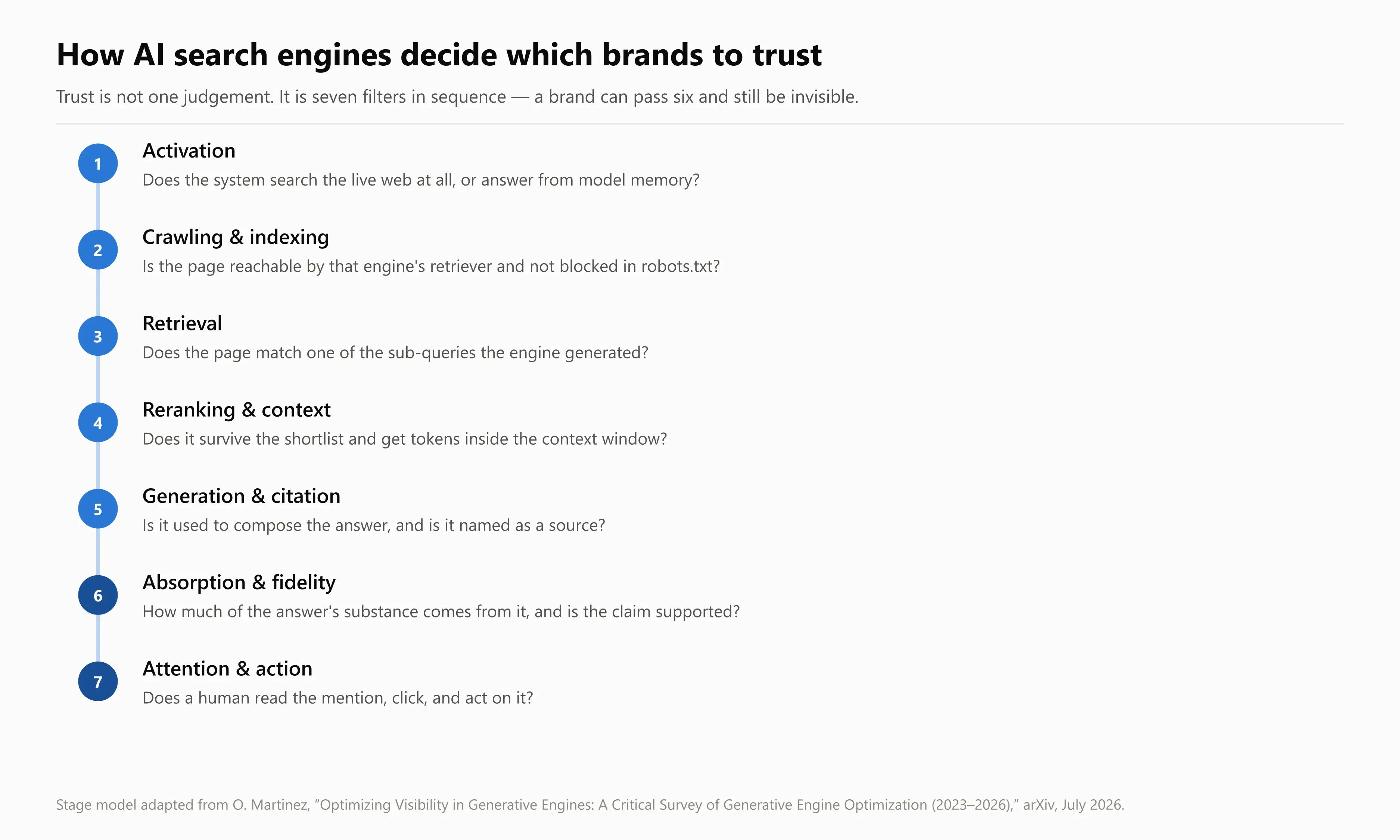
An AI answer is produced by a staged pipeline, and a brand must pass every stage to appear. The 2026 survey of 45 GEO studies models it as: activation → crawling/indexing → retrieval → reranking/context → generation/citation → absorption/fidelity → attention and action.
Reading your absence through these stages is more diagnostic than any single "AI visibility score," because the fix is different at each one.
| Stage | The decision made | What failure looks like | Where to look |
|---|---|---|---|
| 1. Activation | Does the assistant search the live web, or answer from memory? | Your category is answered from stale model knowledge | Whether the answer shows sources at all |
| 2. Crawling & indexing | Is the page reachable by that engine's retriever? | Cited nowhere, on any prompt | robots.txt, server logs, index coverage |
| 3. Retrieval | Does the page match one of the generated sub-queries? | Cited on brand-name prompts only | Sub-query/fan-out coverage of buyer language |
| 4. Reranking & context | Does the page survive the shortlist and get tokens? | Retrieved but never cited | Competing pages that occupy the slot |
| 5. Generation & citation | Is the page used and named? | Brand mentioned, competitor cited | Passage-level quotability |
| 6. Absorption & fidelity | How much of the answer comes from you, and is it accurate? | Cited but misdescribed | Claim-to-source checks |
| 7. Attention & action | Does a human read, click, and act? | Visible but no pipeline effect | Referral and assisted-conversion data |
Stage 1 is not hypothetical. The survey documents that in one measurement, ChatGPT search failed to activate a web search in 57.8% of repetitions of the same prompt. Stage 3 is where Google's query fan-out operates: Google describes AI Mode as issuing "multiple related searches concurrently across subtopics and multiple data sources" before assembling a response. Your page is not competing against the head query; it is competing against a set of sub-queries you never see.
Stage 7 is where most reporting stops too early. Pew Research Center's clickstream study of 900 US adults (68,879 Google searches, March 2025) found that when an AI summary appeared, users clicked a traditional result in 8% of visits versus 15% without one, and clicked a link inside the summary in just 1% of visits. Visibility inside the answer and traffic from the answer are different outcomes — a distinction we cover in more depth in our zero-click search statistics roundup.
What the platforms actually say
No major platform publishes ranking factors for AI answers. Three of the four publish eligibility requirements and content guidance, and those documents agree on less than the advice market implies.
| Platform | Documented eligibility | Documented guidance | What is not documented |
|---|---|---|---|
| Google (AI Overviews, AI Mode) | Page must be indexed and eligible for a snippet; standard technical requirements apply | Unique, non-commodity, people-first content; "don't just recycle what others have already said" | Any AI-specific ranking factor. Google states structured data "isn't required for generative AI search" and calls AEO/GEO "still SEO" |
| Microsoft (Copilot, Bing) | Standard Bing indexing; AI Performance reporting in Bing Webmaster Tools (public preview, Feb 2026) | Clear headings, tables and FAQ sections; depth in a topic; examples, data and cited sources; regular updates; consistency across text, image and video; IndexNow for freshness | Weighting between those factors |
| OpenAI (ChatGPT search) | "Any public website can appear in ChatGPT search"; requires OAI-SearchBot access; noindex suppresses surfacing |
Crawler separation: OAI-SearchBot for search surfacing, GPTBot for training | Ranking method, or any statement on paid placement |
| Anthropic (Claude) | — | Published Citations API grounds claims in supplied documents by extracting exact cited_text spans, chunked to sentence level |
How Claude's consumer web search selects sources |
First, the highest-authority guidance available is deflationary. Google's own guide carries a "what you don't need to do" section covering machine-readable AI text files, special markup, "chunking" content into tiny pieces and AI-specific writing styles — and it adds that "seeking inauthentic 'mentions' across the web isn't as helpful as it might seem." Google's John Mueller has separately said that "no AI system currently uses llms.txt". If a tactic is contradicted by the platform's own documentation, treat vendor claims about it as unproven.
Second, Microsoft's guidance is the most structurally specific, and it is the only one that names format features — headings, tables, FAQs, cited data. That is a company claim about its own system, not an independent finding, but it is consistent with the format patterns observed in cited pages (see the SaaS section below).
Editorial interpretation: the gap between Google's "this is just SEO" and Microsoft's "structure it this way" is not a contradiction so much as a difference in what each company is willing to commit to publicly. Neither should be read as a complete ranking specification.
What correlates with being trusted — and what does not
The largest published brand-level analysis found that independent mentions of a brand across the web correlate with AI Overview visibility more strongly than any link or traffic metric — but all correlations were moderate to weak, and correlation here is not evidence of a causal ranking factor.
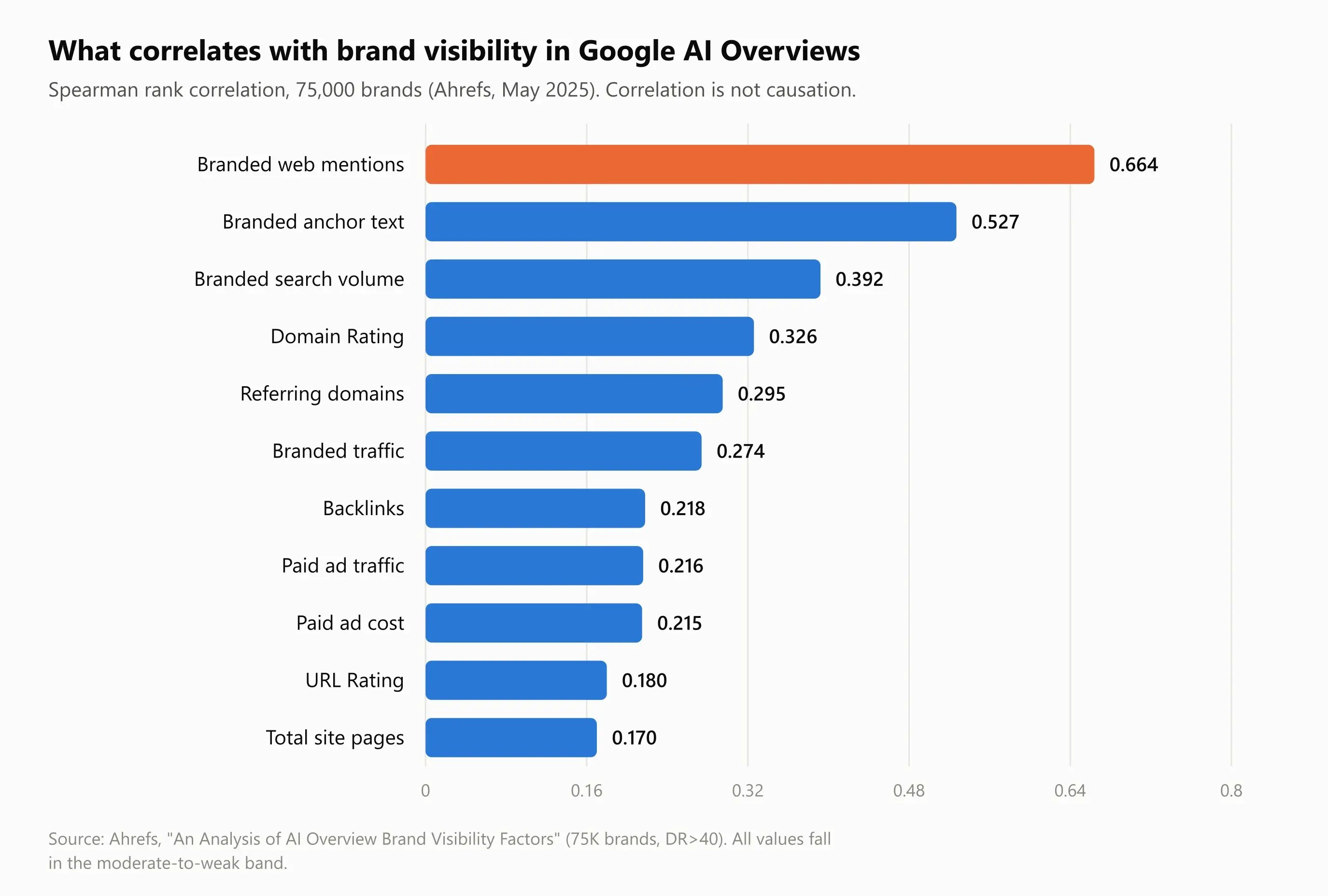
Ahrefs analysed 75,000 brands (domains with Domain Rating above 40, each with a keyword above 800 monthly searches) against millions of AI Overview responses in May 2025. Branded web mentions led at 0.664, branded anchors at 0.527, branded search volume at 0.392. Classic link metrics trailed: Domain Rating 0.326, referring domains 0.295, backlinks 0.218. About 74% of the brands appeared in at least one AI Overview; 26% appeared in none.
Spearman values in the 0.2–0.7 band across a heterogeneous 75,000-brand sample tell you which signals travel together, not which ones an engine reads. Branded mentions, branded search and brand size are all downstream of the same thing — the brand being genuinely well known — so the correlation is at least as consistent with "big brands get mentioned everywhere, including in AI answers" as with "mentions cause citations."
Surfer reports the opposite conclusion at the page level, stating that across 20,000 prompts and 9 million citations "the strongest correlation any off-page metric produced was 0.02," and that structural optimisation alone improved citation performance by 17.3%. This is proprietary vendor research and the methodology is not independently reproducible. The two findings are not necessarily incompatible — Ahrefs measured brand-level mention frequency, Surfer measured page-level citation selection — but anyone claiming that "domain authority is dead" or that "brand mentions are the ranking factor" is over-reading one of them. Treat both as directional.
Our interpretation: mentions matter, but mainly as a proxy for whether independent sources exist that an engine can retrieve and quote. That reading is testable, and it points at a different action than "build more links" — it points at whether third parties are describing your product in the language buyers use. We examine that relationship specifically in AI search visibility and link building impact.
Why AI citations diverge from search rankings
Ranking well in Google is a weak predictor of being cited by AI assistants, and the overlap has been shrinking. Across 15,000 long-tail queries in July 2025, roughly 12% of AI-cited URLs also ranked in Google's top 10 for the same query, and about 80% did not rank in the top 100 at all.
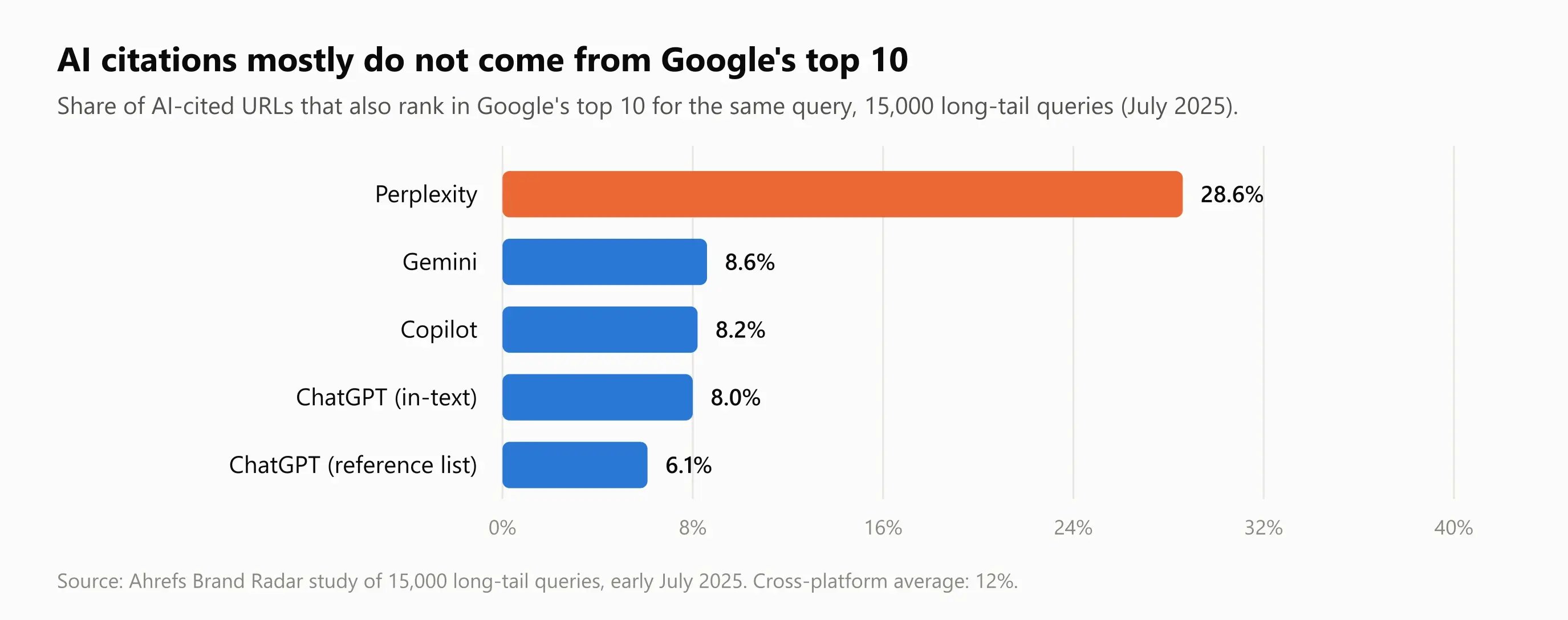
Perplexity is the outlier at 28.6% — consistent with it running its own retrieval over a broadly search-like index — while ChatGPT, Gemini and Copilot cluster between 6% and 9%.
Within Google's own surface the picture is moving fast, and the measurements disagree:
| Measurement | Sample | Top-10 overlap | Note |
|---|---|---|---|
| Ahrefs, July 2025 | AI Overview URLs | 76% | Superseded by the same team's later run |
| Ahrefs, 2026 | 863,000 keywords, 4M AI Overview URLs | 38% | Team attributes part of the drop to improved citation parsing |
| BrightEdge, Feb 2026 | Not directly comparable | ~17% | Different methodology and dataset |
The direction is consistent — decoupling — but the magnitude is contested, and at least part of the Ahrefs shift is a measurement artefact by the authors' own account. Anyone quoting "citations from top-10 pages fell from 76% to 38%" without that caveat is misreporting it.
Why the decoupling happens. Query fan-out is the most credible published explanation: if the engine answers a head question by issuing many narrower sub-queries, the winning documents are the ones that best answer those, which are frequently not the pages optimised for the head term. The arXiv survey adds a related finding — URL-level Jaccard similarity among Google organic results, AI Overviews and Gemini measured only 0.11–0.18, and only 26% of domains cited by Bing Chat were also cited by Perplexity.
Practical implication: page-one rankings are neither necessary nor sufficient. Coverage of the sub-questions inside a buying decision — pricing mechanics, integration constraints, migration steps, category definitions — is what puts a page in the retrieval set. Structuring content around that decomposition is the core of AI search visibility optimization.
Which sources engines actually rely on
Every major assistant leans on a small set of high-coverage domains, but the composition differs sharply by platform and by query intent, and it changes month to month.
Semrush tracked 230,000+ prompts and over 100 million citations across ChatGPT Search, Google AI Mode and Perplexity for 13 weeks (14 July – 12 October 2025). Reddit, Wikipedia, LinkedIn, YouTube and Google ranked among the most-cited domains overall — but the stability varied enormously. On ChatGPT, Reddit's citation frequency fell from roughly 60% in early August to about 10% by mid-September, and Wikipedia from about 55% to under 20%. Google AI Mode cited Wikipedia in only about 2% of responses while favouring Google-owned properties. Perplexity was the most stable of the three.
Conductor's seven-month study (1,056 data points, seven engines, September 2025 – March 2026) found intent-specific patterns that persisted every month:
| Engine | Persistent top-cited source | Intent where it held |
|---|---|---|
| ChatGPT Search | Wikipedia | Education (top-cited every month) |
| Perplexity | YouTube | Education and Recommendations |
| Google AI Overviews | YouTube | Purchase (top-cited every month) |
| Google AI Mode | Google properties | Purchase — diverging from AI Overviews |
| Gemini | YouTube | Support |
| Claude | Brand domains and institutional sources | Across 16 tracked slots, never surfaced YouTube, Wikipedia or Reddit |
The Claude finding carries a caveat the study states plainly: only two months of Claude data (February–March 2026) were available, versus seven for the others.
Pew's independent clickstream data supports the concentration picture from the user side: Wikipedia, YouTube and Reddit together accounted for 15% of the links shown in Google AI summaries, and government sites appeared at 6% in AI summaries versus 2% in standard results.
Interpretation: the operative question is not "how do I get cited by AI" but "which corpus does each engine reach for in my category, and am I in it." For a B2B software brand, presence in Reddit threads, YouTube explainers and independent comparison content is a distribution decision, not a content-format decision.
The corroboration gap: what buyers trust vs. what engines cite
B2B buyers say review-site citations make them most confident in an AI answer. In the same category of query, review platforms supply a fraction of a percent of ChatGPT's citations. That mismatch is the single clearest actionable gap in the 2026 data.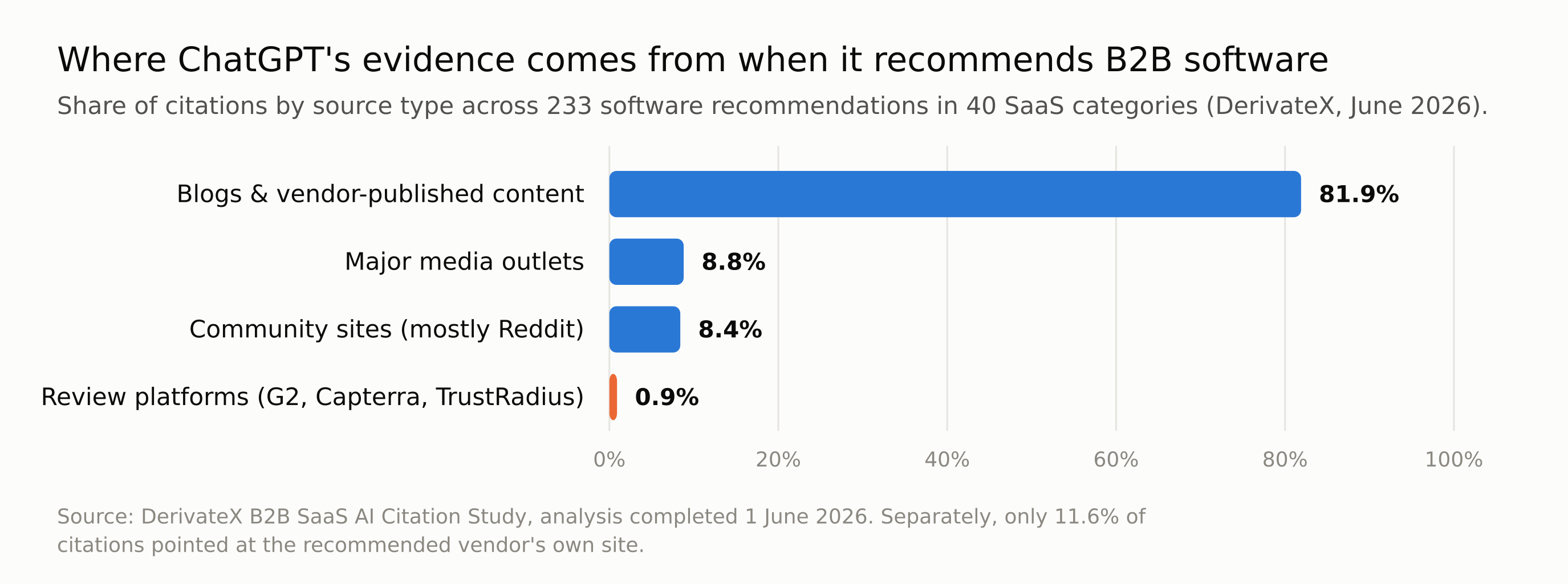
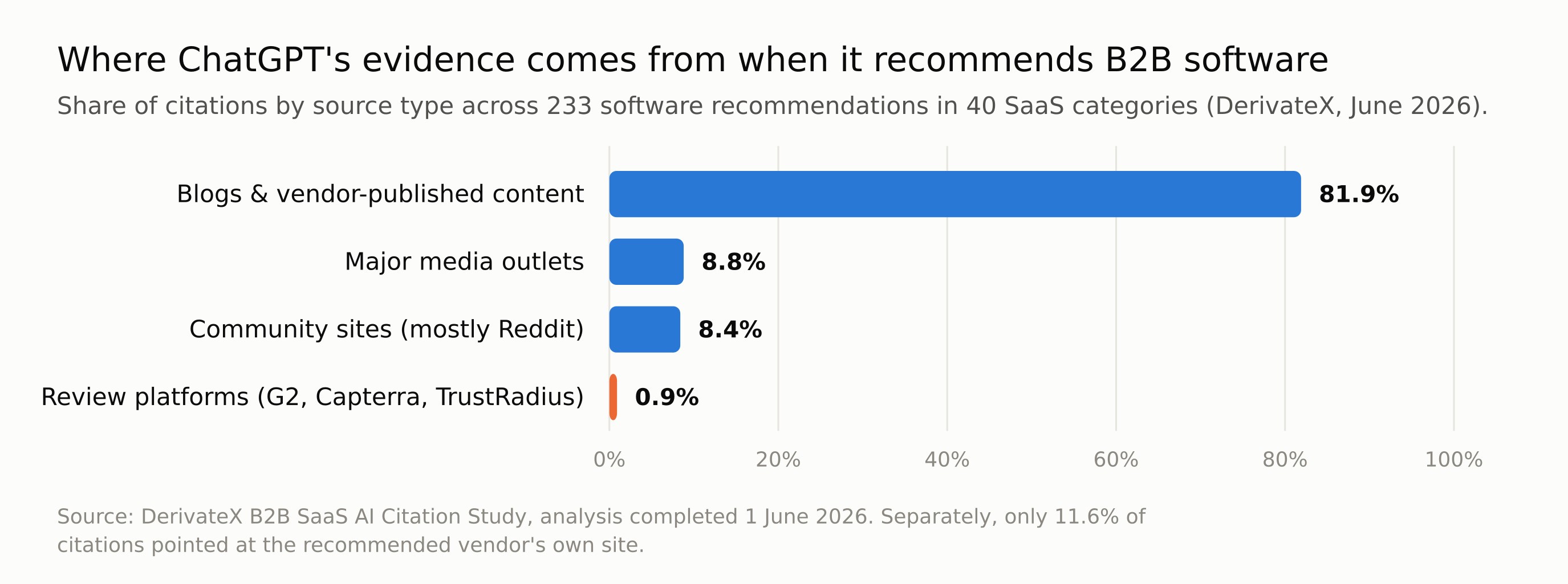
DerivateX posed one buyer-style question per category across 40 B2B SaaS categories, repeating each ten times with ChatGPT's web search enabled (analysis completed 1 June 2026, 233 recommendations across 219 tools). ChatGPT attached sources to 92.3% of named tools. Of those citations, 87.4% pointed to third parties; blogs and vendor-published content accounted for 81.9%; major media 8.8%; community sites, predominantly Reddit, 8.4%; and G2, Capterra and TrustRadius combined just 0.9%.
The cited pages shared a recognisable shape: 100% used list structure, 78% carried the current year in the title, 68% included comparison tables, 56% included an FAQ section. That is a description of the pages that won, not proof that those features caused the win — but it aligns with Microsoft's published guidance and is cheap to act on.
Now the buyer side.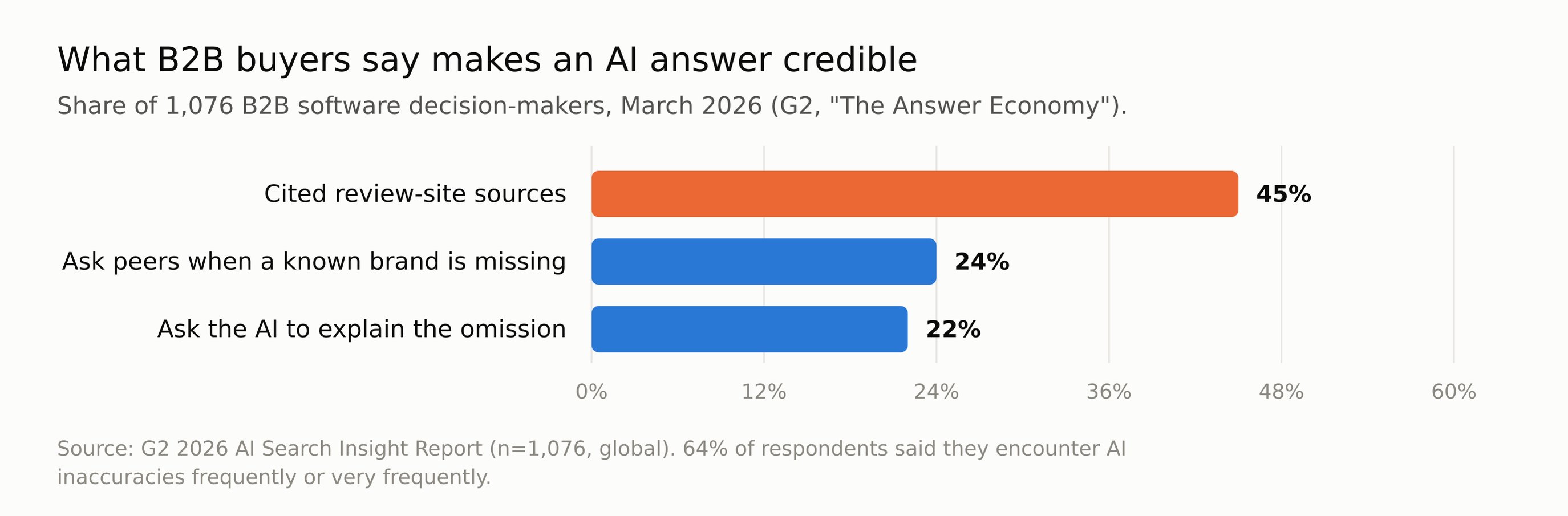
G2 surveyed 1,076 B2B software decision-makers in March 2026 (plus 39 marketer interviews). 51% now start research with AI chatbots more often than with Google; 71% use them somewhere in the process; 54% rank chatbots as the number-one influence on their shortlist, ahead of review sites at 43% and vendor sites at 36%. 69% chose a different vendor than they expected because of chatbot guidance and 33% bought from a vendor they had not previously known. 85% view a vendor more favourably when an AI mentions it. And 64% say they encounter AI inaccuracies frequently or very frequently — which is why 45% treat review-site citations as their strongest confidence signal, 24% ask peers when a brand they trust is missing, and 22% ask the assistant to explain the omission.
Buyers verify against review sites; engines cite comparison and community content. Both matter, at different stages: the engine decides whether you enter the consideration set, the review profile decides whether the buyer believes the engine. Optimising only for one leaves the other exposed. Note also a conflicting vendor claim in circulation — that ~85% of B2B AI citations come from review sites — which we could not reconcile with any primary dataset and would not rely on.
A compliance note that is easy to miss. Because corroboration now feeds machine recommendations, manipulating it carries statutory risk. The FTC's final rule on fake reviews and testimonials, announced 14 August 2024, bans reviews from non-existent people including AI-generated fakes, undisclosed insider reviews, company-controlled "independent" review sites, and review suppression — with civil penalty authority for knowing violations. Seeding third-party corroboration is a legitimate strategy; fabricating it is now an enforcement matter.
Buying-committee behaviour is shifting underneath all of this; our B2B buying statistics page tracks the broader dataset.
Access is a trust signal: crawlers, blocking and permission
Before any content judgement happens, each engine must be able to fetch your pages with its own named bot. Bot permissions are now fragmented enough that a site can be fully open to one assistant and invisible to another.
OpenAI separates crawlers by purpose: OAI-SearchBot surfaces content in ChatGPT search; GPTBot is used for model training; ChatGPT-User fetches pages on a user's behalf. Blocking the training bot does not block the search bot, and vice versa — but many robots.txt files written in 2023–2024 do not make that distinction.
The blocking data shows how uneven this has become. BuzzStream analysed robots.txt on 100 top US and UK news sites (published December 2025, updated April 2026):
| Bot | Purpose | Share of sites blocking |
|---|---|---|
| CCBot | Training | 75% |
| Anthropic-ai | Training | 72% |
| ClaudeBot | Training | 69% |
| PerplexityBot | Indexing | 67% |
| GPTBot | Training | 62% |
| OAI-SearchBot | Retrieval | 49% |
| Google-Extended | Training | 46% |
| ChatGPT-User | Retrieval | 40% |
| Perplexity-User | Retrieval | 17% |
Overall, 79% blocked at least one training bot and 71% blocked at least one retrieval bot; 14% blocked all examined AI bots and 18% blocked none. That is a news-publisher sample and should not be generalised to B2B sites, but it explains why some categories return thin, repetitive AI answers: much of the best source material is unreachable.
The economics behind those decisions are documented by Cloudflare, which measured crawl-to-refer ratios across its network from January to July 2025. In July, Anthropic crawled roughly 38,065 pages per referred visitor (down from 286,930:1 in January), OpenAI 1,091:1, Perplexity 194:1, and Google 5:1. Publishers are not blocking out of confusion; they are responding to a traffic exchange that does not pay.
For a B2B brand the practical checks are narrow and worth doing quarterly: confirm each retrieval bot is permitted separately from training bots; confirm the substantive answer exists in server-rendered HTML rather than only after client-side JavaScript; and confirm you are not noindex-ing pages you want surfaced, since OpenAI documents that noindex suppresses ChatGPT search surfacing.
The AI trust stack: a working framework
Treat trust as four gating layers. Each one must hold before the one above it can produce anything. Most brands invest at the top of the stack while failing at the bottom.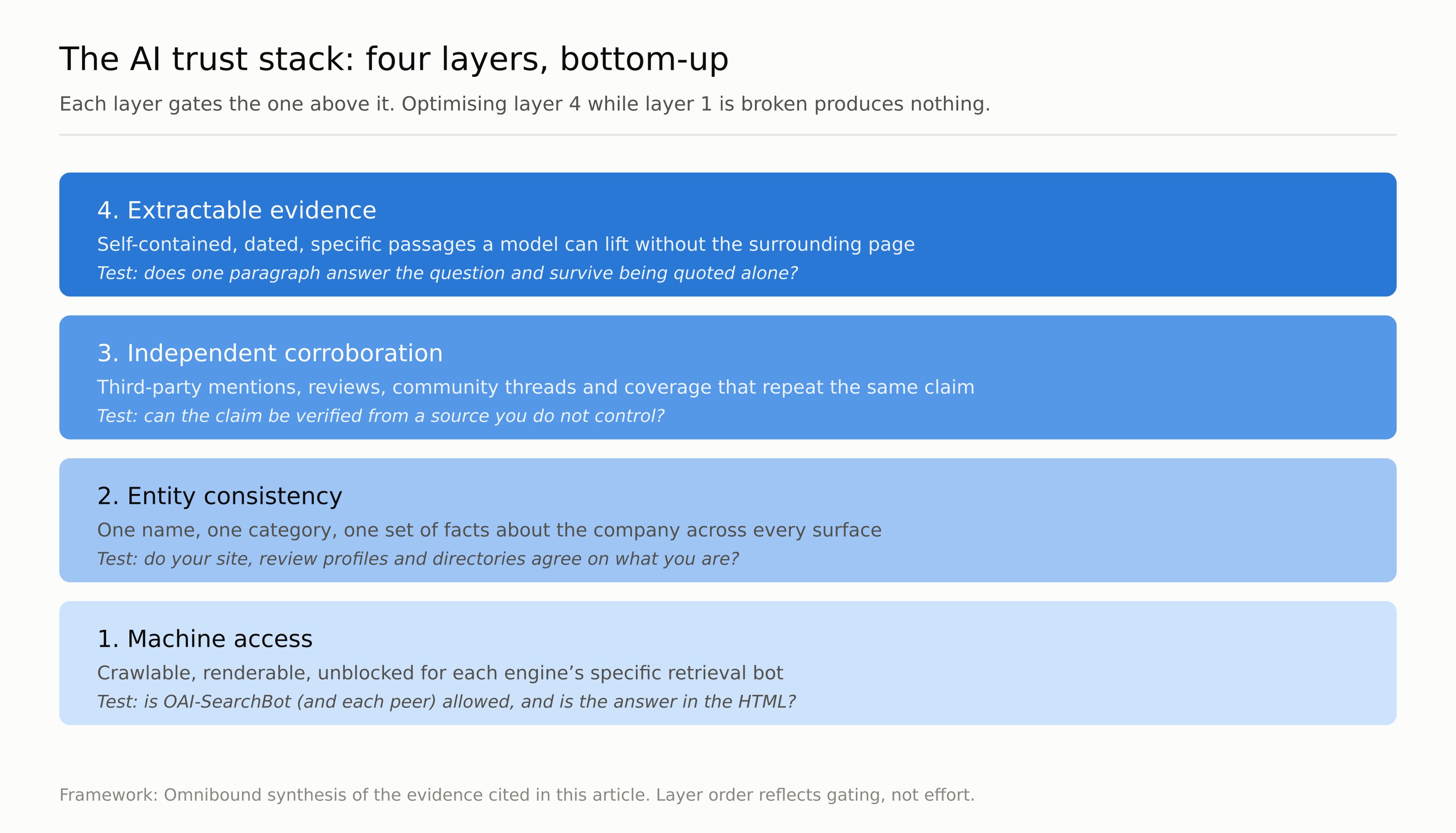
Layer 1 — Machine access. Crawlable, renderable, unblocked, per bot. Test: is OAI-SearchBot (and each peer) allowed, and is the answer present in the HTML?
Layer 2 — Entity consistency. One name, one category, one set of facts across your site, review profiles, directories and social properties. Test: if three independent sources describe your category differently, an engine has no stable claim to repeat. This is the cheapest fix in the stack and the one most often skipped.
Layer 3 — Independent corroboration. Third-party pages that state the same facts you state. Given that 87.4% of ChatGPT's B2B software citations were third-party, this is where retrieval-eligible evidence actually lives. Test: can a factual claim about your product be verified from a source you do not control?
Layer 4 — Extractable evidence. Passages that survive being quoted alone: a direct answer near the heading, a specific number with a date and a source, a comparison table, a definition that does not depend on the paragraph before it. Test: cut one paragraph out of context — does it still answer the question?
Tactics the evidence does not support
Be equally clear about what does not work, because a large share of 2026 advice rests on findings that have not replicated.
- The "40% visibility boost" claim. The original GEO paper (Aggarwal et al., KDD 2024) reported that its methods could "boost visibility by up to 40%." The 2026 survey reviewing 45 studies explicitly rejects generalising this, noting it is "a relative maximum on one metric under specific configuration," and that the gains are conditional on a source already being present in the context window — they establish neither discoverability nor traffic.
- Generic AI-writing tweaks. In C-SEO Bench (NeurIPS Datasets & Benchmarks 2025), most conversational-SEO methods were "not only largely ineffective but also frequently have a negative impact on document ranking," while traditional SEO proved significantly more effective. Gains also decayed as more actors adopted the same methods — a competitive dynamic, not a durable advantage.
- Body-copy-only optimisation. The survey cites an end-to-end test in which body-only optimisation reduced average top-20 presence by roughly 9%.
- Prompt-style manipulation. Pfrommer et al. (EMNLP 2024) showed that adversarial prompt injection in page content can reliably promote low-ranked products, with attacks transferring to production systems including Perplexity. This is a security finding, not a strategy: it is the exact behaviour Bing's updated guidelines and Google's spam policies target, and it is trivially detectable once known.
llms.txtas a visibility lever. Google's optimisation guide treats machine-readable "AI text files" as unnecessary andllms.txtspecifically as optional, and Mueller has said no AI system currently uses it. It costs little to publish; it should not be a line item in a visibility plan.
Measuring trust without fooling yourself
A single prompt check is not a measurement. AI answers vary run to run, day to day, and by phrasing, so any credible measurement uses repeated sampling across paraphrases and platforms — and separates citation from mention from downstream effect.
The instability is documented, not anecdotal. The 2026 survey reports daily source-level Jaccard overlap of approximately 0.34–0.42 across four engines over 45 days, decisions changing in 9–28% of temperature-zero reruns, and a case where ChatGPT search did not activate at all in 57.8% of repetitions. Accuracy is a separate problem: the Tow Center tested 1,600 queries across eight AI search tools in February 2025 and found incorrect answers in more than 60% of cases, ranging from 37% (Perplexity) to 94% (Grok 3), with more than half of Gemini and Grok 3 responses citing fabricated or broken URLs. On fidelity, Liu et al. (EMNLP Findings 2023 — the oldest figure used in this article, and the most-cited baseline) found only 51.5% of generated sentences were fully supported by their citations.
A defensible measurement protocol:
- Fix a prompt set that mirrors real buying language, including paraphrases of the same intent, not keyword variants.
- Repeat each prompt on a schedule — the run-to-run variance above means a single observation carries almost no information.
- Record separately: was the brand mentioned; was a page cited; whose page was cited; what position/prominence; was the claim accurate.
- Segment by platform and intent — the Conductor data shows the same brand can face entirely different source competition on Education vs. Purchase prompts.
- Reconcile with first-party data. Google added generative AI performance reports to Search Console on 3 June 2026, covering AI Overviews, AI Mode and generative features in Discover, with impressions, pages, countries, devices and dates — initially to a subset of sites, and without click data for AI features. Microsoft's Bing Webmaster Tools AI Performance report (public preview, February 2026) exposes total citations, average cited pages per day, grounding queries and page-level citation counts.
Grounding queries are the most underrated field in either tool: they show the phrasing the system used to retrieve your content, which is the closest public proxy for the sub-queries in stage 3.
For the scoring side, we use a weighted model across citation frequency, prompt coverage, entity authority, answer prominence and cross-platform consistency, described in AI search visibility score and gap analysis. If you are evaluating vendors for this, the criteria for AI search tools that deliver citation intelligence matter more than dashboard breadth — specifically whether the tool samples repeatedly and reports variance rather than a single daily snapshot.
Where this goes next
Three trends in the current evidence are worth planning against, stated with the confidence the data supports.
Well supported: the click is decoupling from the impression. SparkToro's analysis of Similarweb clickstream data (US, January–April 2026) put zero-click Google searches at 68.01%, up from 60.45% in 2024, with AI Overviews appearing on more than 20% of searches and cutting click-through by nearly 60% where they appear. Whatever else changes, the ratio of answer-visibility to site-visits will keep moving in one direction.
Moderately supported: measurement is becoming first-party. Google and Microsoft both shipped AI-citation reporting within four months of each other in 2026. Third-party estimation will remain necessary for competitor visibility, but the authoritative numbers for your own site are moving in-platform.
Contested: how much any of this can be optimised at all. The most rigorous review of the field concludes that "already-retrieved content can causally alter its citation or use, but no reviewed technique shows a stable, longitudinal, cross-platform causal effect on organic discoverability or downstream behaviour." That is a strong claim from a survey of 45 studies, and it should temper any vendor promise of a repeatable visibility lift — including ours.
Editorial position: the durable work is not AI-specific. Being reachable, being described consistently, being talked about by independent sources, and writing passages that survive extraction are all things that were valuable before generative search and remain valuable if the interfaces change again. The tactics with the shortest half-life are the ones aimed at a specific model's current quirks.
What to do next
A short, ordered plan derived from the evidence above:
- Audit bot access this week. Check
robots.txtfor each retrieval bot separately (OAI-SearchBot, PerplexityBot, ChatGPT-User, Google-Extended, ClaudeBot) and confirm your key pages render server-side. - Fix entity inconsistency before creating content. Align category, positioning and core facts across your site, G2/Capterra profiles, LinkedIn and any directory listing.
- Map the sub-questions, not the keywords. Decompose each buying decision into the narrow questions a fan-out would generate, and check whether any page answers each one directly under its own heading.
- Build third-party corroboration deliberately. Independent comparison content and community presence carry more of the citation load in B2B software than your own site does.
- Make pages quotable. Direct answer under the heading, dated figures with sources, comparison tables, a real FAQ. These are also the features observed in cited pages.
- Instrument measurement properly. Repeated prompt sampling plus Search Console and Bing Webmaster Tools AI reporting; report variance, not a single check.
- Re-audit quarterly. Given the documented month-to-month swings in source preference, an annual audit is a stale audit.
Methodology and sources
We prioritised primary sources in this order: platform documentation and official announcements; peer-reviewed papers (KDD, EMNLP, NeurIPS Datasets & Benchmarks) and arXiv surveys; large-sample industry studies that disclose sample size, dates and method; and regulatory documents. Vendor studies are labelled as such and used only where they disclose methodology; where a vendor finding conflicts with another dataset, both are shown. Figures are dated because this field moves quarterly.
No platform publishes its ranking method, so every causal statement about "why" a source was chosen is inference. Several key datasets are proprietary and not independently reproducible. The Claude citation data covers two months, not seven. The robots.txt blocking data is a 100-site news sample. The 51.5% citation-fidelity figure dates to 2023 and is the oldest evidence used here; we include it because it remains the most-cited controlled measurement of its kind, and newer commercial audits report broadly similar fidelity gaps.
Primary and platform sources
- Google Search Central — Guide to optimizing for generative AI features on Google Search and AI Features and Your Website
- Google Search Central Blog — Introducing Search generative AI performance reports in Search Console (3 June 2026)
- Google — Expanding AI Overviews and introducing AI Mode (query fan-out)
- Microsoft Bing Webmaster Blog — Introducing AI Performance in Bing Webmaster Tools (public preview)
- OpenAI Help Center — Publishers and Developers FAQ and ChatGPT Search
- Anthropic — Citations, Claude Platform Docs
- US Federal Trade Commission — Final Rule Banning Fake Reviews and Testimonials (14 August 2024)
Academic sources
- O. Martinez — Optimizing Visibility in Generative Engines: A Critical Survey of Generative Engine Optimization (2023–2026), arXiv, July 2026
- P. Aggarwal, V. Murahari, T. Rajpurohit, A. Kalyan, K. Narasimhan, A. Deshpande — GEO: Generative Engine Optimization, KDD 2024
- H. Puerto, M. Gubri, T. Green, S. J. Oh, S. Yun — C-SEO Bench: Does Conversational SEO Work?, NeurIPS Datasets & Benchmarks 2025
- S. Pfrommer, Y. Bai, T. Gautam, S. Sojoudi — Ranking Manipulation for Conversational Search Engines, EMNLP 2024
- N. Liu, T. Zhang, P. Liang — Evaluating Verifiability in Generative Search Engines, Findings of EMNLP 2023
Independent and industry research
- Columbia Journalism Review, Tow Center — AI Search Has a Citation Problem (1,600 queries, February 2025)
- Pew Research Center — Google users are less likely to click on links when an AI summary appears (68,879 searches, March 2025)
- Cloudflare — The crawl-to-click gap: AI bots, training, and referrals
- Ahrefs — An Analysis of AI Overview Brand Visibility Factors (75,000 brands) and Only 12% of AI-cited URLs rank in Google's top 10 (15,000 queries)
- Semrush — The Most-Cited Domains in AI: A 3-Month Study (230,000+ prompts, 100M+ citations)
- Conductor — How AI Engines Choose and Cite Sources: A 7-Month Analysis
- G2 — The Answer Economy: G2's 2026 AI Search Insight Report (n=1,076, March 2026)
- DerivateX — B2B SaaS AI Citation Study (40 categories, June 2026)
- BuzzStream — Which News Sites Block AI Crawlers (100 sites)
- SparkToro / Similarweb — Google zero-click searches reach 68% in early 2026
- Search Engine Journal — Google AI Overview citations from top-ranking pages drop sharply (reporting Ahrefs, with BrightEdge comparison)
- Surfer — How AI search engines find, summarize, and cite content (proprietary vendor research, cited here as a contrasting claim)
.webp?height=245&name=What%20Is%20GEO%20(Generative%20Engine%20Optimization).webp)