

Table Of Contents
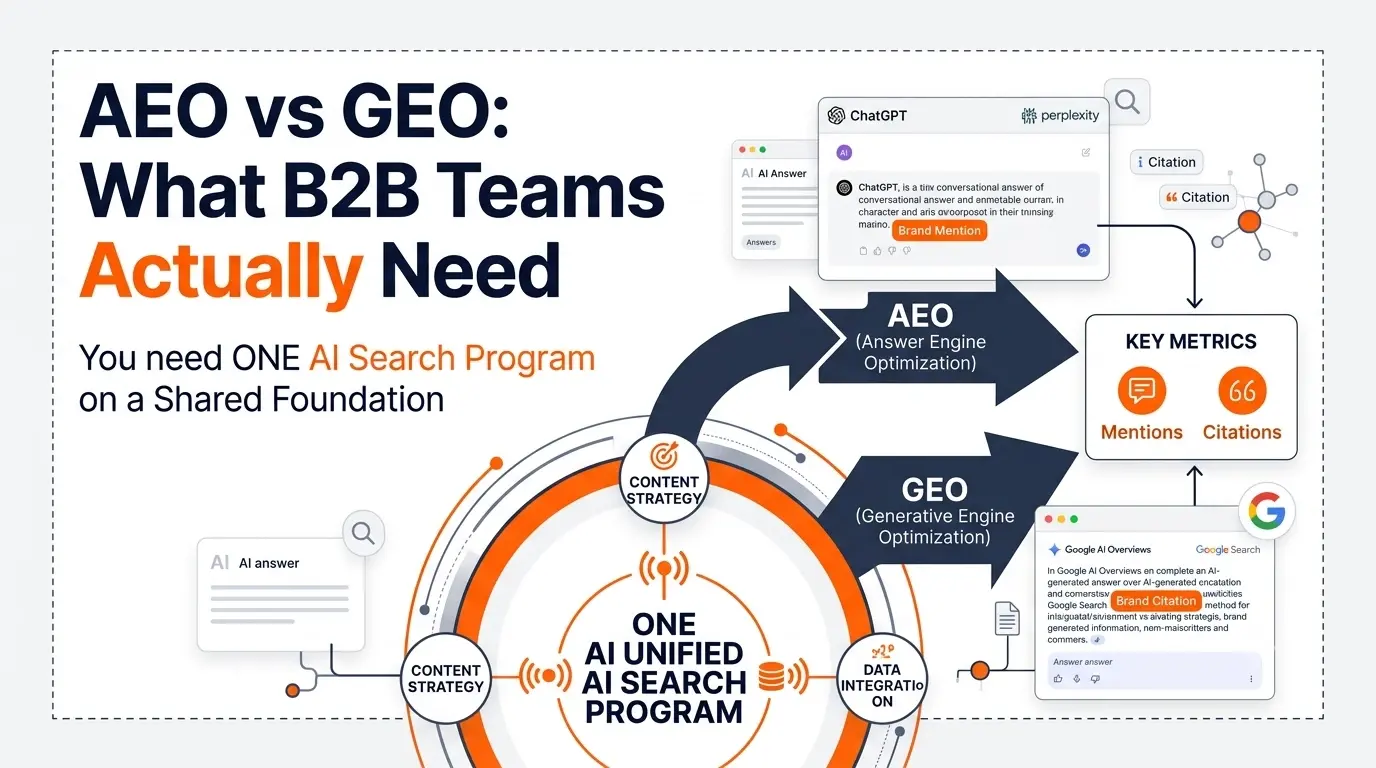
AEO and GEO describe almost the same work: getting your brand mentioned and cited inside AI-generated answers. The label difference is mostly about emphasis. AEO (answer engine optimization) is usually framed around answer engines such as ChatGPT and Perplexity. GEO (generative engine optimization) is usually framed around generative results broadly, including Google's AI surfaces. For a B2B team, the practical takeaway is simple: you do not need to choose between them, and you do not need two separate programs. You need one AI search program built on shared foundations, measured by mentions and citations.
If you want the deeper definitions first, see what is GEO and answer engine optimization explained.
Quick definitions
SEO (search engine optimization): earning ranked links for your pages in a traditional results page. The goal is a click.
AEO (answer engine optimization): earning mentions and citations inside answer engines. The goal is to be part of the answer, whether or not the buyer clicks.
GEO (generative engine optimization): the same goal as AEO, with the term applied most often to generative search results, including Google AI Overviews and AI Mode. The term comes from a 2023 research paper by researchers at Princeton, IIT Delhi and Georgia Tech, later presented at KDD 2024 (Aggarwal et al., 2023).
AEO vs GEO vs SEO at a glance
| Dimension | SEO | AEO | GEO |
|---|---|---|---|
| Primary goal | Rank a URL | Get mentioned or cited in an answer | Get mentioned or cited in a generated answer |
| Unit of visibility | Link position | Brand mention and citation | Brand mention and citation |
| Main surfaces | Google, Bing results pages | ChatGPT, Perplexity, Claude, Copilot | Google AI Overviews and AI Mode, plus assistants |
| Success metric | Rankings, organic clicks | Mention rate, citation share | Mention rate, citation share |
| Core levers | Content, links, technical SEO | Answer-ready content, authority, retrievability | Same as AEO, with generative-surface tuning |
| How buyers use it | Click a result | Read a synthesized answer | Read a synthesized answer |
The rows for AEO and GEO are nearly identical. That is the point.
Why the AEO vs GEO debate is mostly semantic
Both practices answer the same question: how do you become a source that AI engines reuse when a buyer asks about your category? Both depend on the same inputs. A page that is well-structured, authoritative, current and retrievable performs across ChatGPT, Perplexity, Gemini and Google's AI surfaces alike. The engine changes; the fundamentals do not.
The distinction people draw is one of emphasis, not method:
- People who say AEO tend to focus on standalone assistants and the mechanics of being cited in a chat answer.
- People who say GEO tend to include Google's generative results and the broader shift from links to answers.
Neither excludes the other. Spending energy on which acronym is "correct" is time not spent getting cited. For how engines actually pick sources across all of these surfaces, see how AI search engines determine which brands to cite.
What B2B teams actually need
One program, not three acronyms. Here is what that program rests on.
A shared content foundation. Answer-first pages, descriptive headings and self-contained sections are what let any engine retrieve and quote you. See content formats that win AI search visibility.
Authority and trust. Engines favour sources with clear expertise, authorship and third-party validation. See AI search authority and E-E-A-T and trust signals for AI visibility.
Technical retrievability. If AI crawlers cannot reach or parse your pages, you are invisible to every engine at once. This is the fastest thing to check and fix.
Third-party presence. For B2B queries, engines often cite publications, communities and review sites over your own pages, so your offsite footprint feeds every acronym.
Freshness. Current sources win. Keeping key pages updated protects your citations. See content refresh.
Measurement. Track mentions, citation share and share of voice across engines, not rankings alone. See AI search visibility metrics and KPIs.
Everything above serves SEO, AEO and GEO at the same time. That is why one program is enough. For the discipline that ties it together, see AI search optimization.
Where AEO and GEO do diverge in practice
The small, real differences are tactical, not strategic:
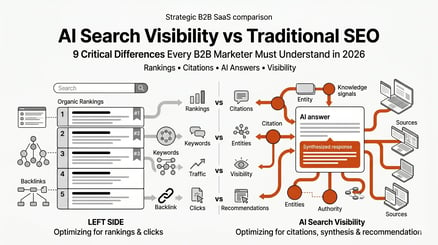
- Google's generative surfaces (AI Overviews and AI Mode) still lean on classic search signals, so strong SEO feeds GEO results more directly there. See SEO vs GEO for SaaS and AI search visibility vs traditional SEO.
- Standalone assistants each behave a little differently, so engine-specific tuning helps. See getting cited in ChatGPT and increasing Perplexity visibility.
- Tactic depth lives in the playbooks: 15 best GEO techniques and top 5 GEO strategies.
These are refinements you layer on after the shared foundation is in place, not reasons to run separate programs.
How to run it as one motion
- Baseline. See where you appear today across engines and priority buyer prompts with the free AI Search Visibility Checker, then a fuller visibility audit.
- Prioritise. Find the buyer prompts where competitors are cited and you are not.
- Fix the foundation. Make high-intent pages answer-ready and retrievable.
- Build authority. Strengthen expertise signals and third-party presence for those topics.
- Measure across engines. Track mentions, citation share and share of voice, then refresh what slips. The AI search optimization checklist covers the full loop.
Frequently asked questions
Is AEO the same as GEO? Nearly. Both aim to get your brand mentioned and cited in AI answers. AEO emphasises answer engines such as ChatGPT and Perplexity; GEO emphasises generative results broadly, including Google's AI surfaces. The underlying work is the same.
Do B2B teams need to choose between AEO and GEO? No. Run one AI search program on shared foundations (content, authority, retrievability, freshness, measurement) and apply engine-specific tuning on top.
Is SEO dead? No. SEO fundamentals feed AEO and GEO, and they feed Google's generative surfaces most directly. The goal shifts from ranking links to earning mentions and citations, but the foundation carries over.
Which matters more for B2B, AEO or GEO? Whichever engines your buyers use. Most B2B buyers move across ChatGPT, Perplexity and Google's AI surfaces, so a single program that covers all of them beats optimising for one label.
How do you measure AEO and GEO? With the same metrics: mention rate, citation share, share of voice and sentiment across engines, tracked over time. See AI search visibility metrics.
See where your brand stands
The acronym matters less than whether AI engines cite you. Find out where you appear today with the AI Search Visibility Checker, or see how continuous tracking and optimization work with AI Search Intelligence.
Turn Your Content Into AI-Search Winners
Get cited across ChatGPT, Claude & Perplexity — not just ranked on Google.
- Increase AI citations
- Improve answer visibility
- Track brand mentions in LLMs
.webp?height=245&name=What%20Is%20GEO%20(Generative%20Engine%20Optimization).webp)