Scrunch's positioning is that AI is now your most important visitor — and their AXP optimizes your site so AI bots can read it perfectly. Omnibound's answer: the bot isn't making the purchase. The buyer the bot is answering for is. Omnibound connects to your CRM, learns from your actual buyer conversations, and builds the content that earns citations from the buyers who matter, not just the bots that crawl you.
CRM integrations in Scrunch, no connection to your buyer conversations, deal stages, or pipeline
Of B2B buyers begin vendor research in AI engines, asking questions your CRM already holds the answers to
Of B2B companies are invisible in AI-generated answers, bot optimization gets you crawled, not cited
Scrunch's AXP sits between your website and AI agents, serving a clean, bot-friendly version of your content at the edge of your network. That's genuinely useful infrastructure. But whether an AI engine cites your content depends almost entirely on what that content says — whether it directly answers the question a real buyer just typed. Delivery optimization can't fix a content relevance problem.
Here's the connection that changes everything: the language your buyers use on discovery calls — their exact words, objections, and questions — is the same language AI engines scan when deciding what content to cite. A buyer asks an AI engine "which platform connects AI search to pipeline for B2B teams?" and the AI looks for content that reflects that language. Your CRM holds that language. Connecting your CRM to your AI search strategy is what turns GEO monitoring into actual pipeline. Scrunch doesn't have that connection. Omnibound is built around it.
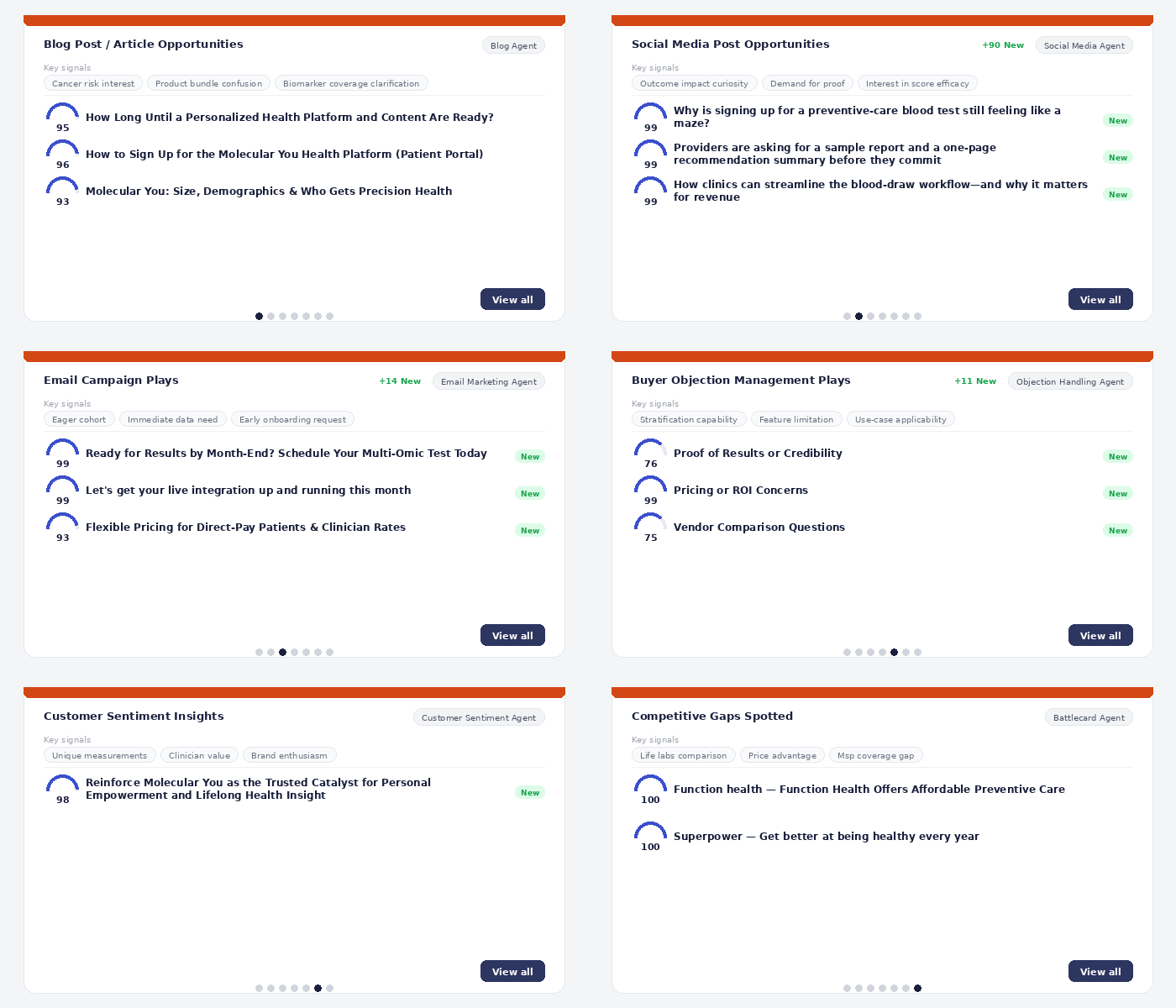
Scrunch's core product is monitoring — tracking how AI engines represent your brand, what they say, and where gaps exist. That produces useful intelligence. Omnibound takes that intelligence and acts on it across seven dedicated content formats simultaneously: blog opportunities, social content, email plays, FAQ content, objection handling plays, competitive battlecards, and customer sentiment insights, all grounded in real buyer conversations, all scored by importance, all continuously refreshing.
When your CMO asks what your AI search investment contributed to revenue last quarter, "our bot crawlability score improved" is not the answer. Scrunch's reporting tracks AI visibility — citations, share of voice, brand sentiment. Omnibound's reporting tracks pipeline impact, which AI citations appeared in active deals, which buyer personas engaged, and how AI search performance connects to closed revenue. That's the report that gets your budget renewed.
| Feature |
Omnibound AI |
Scrunch AI Visibility & Agent Experience Platform |
| Prompt Intelligence | ||
|
Buyer-conversation-derived prompts
|
✓ Auto-surfaced from CRM, calls, tickets | ✗ Market monitoring signals only |
| Contextual prompts (from real buyer data) | ✓ Continuously surfaced, importance-scored | ✗ Manual prompt entry only |
| ICP & persona-mapped prompts | ✓ CMO, IT, Finance, Procurement — from real buyer profiles | ✗ Not available |
|
Deal-stage prompt segmentation
|
✓ Awareness through to Decision | ✗ Not available |
|
Prompt importance scoring by pipeline relevance
|
✓ Every prompt scored, prioritized by revenue impact | ✗ Not available |
|
Multi-engine prompt tracking
|
✓ ChatGPT, Gemini, Claude, Perplexity, Google AI Mode | ✓ ChatGPT, Gemini, Perplexity, Claude, Meta AI, Google AI Mode, Google AI Overviews |
|
AI Search Monitoring
|
||
|
Brand mention & citation tracking
|
✓ Pipeline-contextualized | ✓ Full monitoring suite |
|
Share of voice & competitive monitoring
|
✓ Tied to buyer-relevant prompts | ✓ Available |
|
Citation tracking by persona
|
✓ ICP & persona attribution | ✗ Aggregate brand-level only |
|
AI bot traffic analytics (CDN)
|
~ Signal layer above CRM | ✓ Native CDN integration (Cloudflare, Vercel) |
|
Agent Experience Platform (AXP)
|
~ Content serves AI natively | ✓ Enterprise add-on only |
|
Real-time competitive alerts
|
✓ On pipeline-relevant prompts | ✓ Available |
|
Content Generation
|
||
|
Buyer-intelligence-driven content
|
✓ Blog, social, email plays, FAQ, objection handling, battlecards, sentiment — grounded in real buyer conversations | ✗ Monitoring focus, minimal native content creation |
|
Content format types
|
✓ 7 simultaneous types: Blog, Social, Email Plays, FAQ, Objection Handling, Competitive Battlecards, Customer Sentiment | ✗ Not a primary feature |
|
Dedicated AI agent per content format
|
✓ Blog Agent, Social Agent, Email Agent, FAQ Agent, Objection Agent, Battlecard Agent, Sentiment Agent | ✗ Not available |
|
Continuous scored content opportunities
|
✓ New opportunities surface daily as buyer context evolves | ✗ On-demand insights only |
|
Persona & deal-stage–specific content
|
✓ 6–10 buying committee roles — from real buyer profiles | ✗ Not available |
|
Pre-publish citation readiness scoring
|
✓ Know if your content will earn citations before it goes live | ~ Insight-based recommendations |
|
Pipeline & Integrations
|
||
|
CRM integration (HubSpot, Salesforce)
|
✓ Native, live — powers the entire intelligence layer | ✗ API only — no native CRM integration |
|
Call recording integration (Gong, Chorus)
|
✓ Native ingestion — buyer language from every call | ✗ Not available |
|
Revenue & pipeline attribution
|
✓ AI citations mapped to active deals and stages | ✗ Visibility metrics only |
|
Free trial
|
✓ Available — see pipeline impact before committing | ✗ Paid plans from $250/month |
|
AXP / bot infrastructure optimization
|
~ Content serves AI natively via quality layer | ✓ Enterprise add-on (not in base plan) |
|
SOC 2 Type II compliance
|
✓ Certified | ~ Not confirmed |
Scrunch solves for bot readability. Omnibound solves for buyer relevance. These are different problems — and for pipeline, only one of them matters.
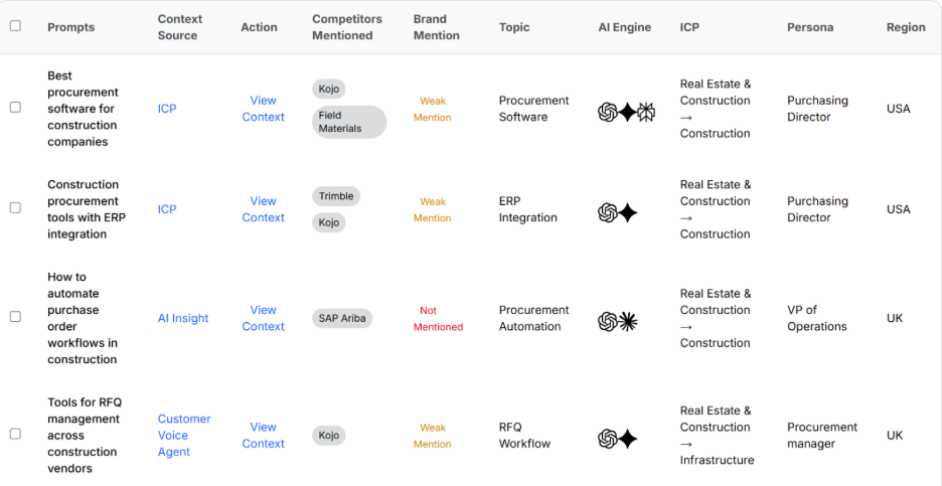
Scrunch's core insight is that AI is now your most important visitor — so you should optimise your site for how bots read it. Omnibound's counter: the bot is a messenger. The buyer it's answering for is the one making the purchase decision. And the specific questions that buyer types into ChatGPT during a live evaluation? Those live in your CRM, your call recordings, your support tickets — not in CDN logs. Omnibound automatically surfaces those prompts, categorises them by theme (Top Role-Level Pains, Top Objections, Questions Asked), and scores them by pipeline importance. You see exactly where you're mentioned, where you're getting a weak mention, and where you're invisible — for the questions your buyers are actually asking.
Here's what most teams using agentic SEO and LLM SEO tools miss: your CRM isn't just a sales database — it's the richest source of buyer language you have. The specific words your buyers use to describe their problems, the objections they raise, the questions they ask your sales team — that language is what AI engines look for when deciding what to cite. Omnibound connects directly to HubSpot and Salesforce, ingests that language, and uses it to build the content that earns citations from the right buyers at the right deal stage. Scrunch doesn't have that connection. Without it, your GEO strategy optimises for what the market says — not what your buyers ask.
When Scrunch's monitoring surfaces a citation gap, you need a separate content strategy to close it. Omnibound closes that loop inside the same platform. The moment a buyer signal surfaces — a recurring objection on sales calls, a competitor gaining ground on a key prompt, a cluster of buyers asking the same question — Omnibound's seven content engines activate simultaneously. Blog Agent surfaces article opportunities. Social Agent surfaces posts. Email Campaign Agent builds plays. FAQ Agent extracts answerable questions. Objection Handling Agent creates battlecard content. Competitive Battlecard Agent flags competitive gaps. Customer Sentiment Agent surfaces positioning opportunities. Every item is importance-scored. New ones surface daily. The strategy doesn't go stale — it sharpens as your buyer base grows.
From identifying a citation gap to publishing the content that closes it — in one platform.
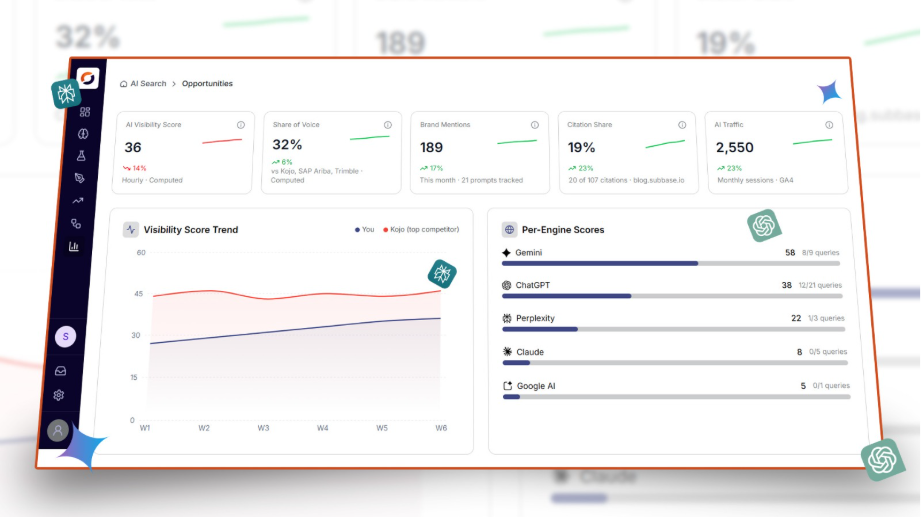
Scrunch tells you how many times your brand appeared in AI answers, how your sentiment tracks, and where your share of voice stands. Those are useful brand signals. What they can't tell you is whether the buyers finding you in AI search are in active deals, what stage those deals are at, or whether the citation influenced the purchase. Omnibound connects every AI search metric directly to your CRM — so you can see which citations are appearing in active evaluations, which buyer personas are engaging, and how AI search performance maps to closed revenue.
Citations mapped to active CRM deals and buying stages — not just impression counts
Persona-level attribution: which roles are finding you, on which engine, at which stage
Revenue contribution dashboard — report AI search ROI in language your CFO understands
Move from brand monitoring to pipeline proof.
Scrunch's CDN analytics show you which AI bots visited your site, how often, and which pages they crawled. That's infrastructure-level data. What it can't show you is what your specific buyers typed into Perplexity last Wednesday while shortlisting vendors in your category — because that lives in your CRM and call recordings, not in a CDN log. Omnibound automatically surfaces those prompts, categorises them by theme (Top Role-Level Pains, Top Objections, Top Questions Asked), and scores them by pipeline importance. When you see a prompt with an importance score of 100 where your brand is getting a weak mention — and your top competitor is being cited — you know exactly where the deal is being lost before it shows up in your close rate.
✔ Contextual prompts auto-surfaced from real buyer conversations — no keyword guessing
✔ Importance scores prioritise which gaps are costing the most pipeline
✔ See Mentioned / Weak Mention / Not Mentioned per engine, per buyer prompt, per persona
Scrunch surfaces insights about where your brand stands in AI search. Omnibound turns those insights into content — across seven formats simultaneously — grounded in real buyer language. The moment a signal surfaces from your buyer data, seven dedicated AI agents activate: Blog Agent, Social Media Agent, Email Campaign Agent, FAQ Agent, Objection Handling Agent, Competitive Battlecard Agent, and Customer Sentiment Agent. Each surfaces opportunities scored by importance. A competitor mentioned by name on three discovery calls this week? That becomes a battlecard opportunity scored 100. A cluster of buyers asking the same integration question? That surfaces as four blog opportunities, three FAQ items, and two email plays — all written in the language your buyers actually use. This isn't a one-time content audit. It's a continuously running intelligence layer that produces more as your buyer base grows.
✔ 7 simultaneous content format types — blog, social, email plays, FAQ, objection handling, battlecards, sentiment
✔ Every opportunity is importance-scored — your team always knows what to create first
✔ Continuously refreshed — new opportunities surface daily as buyer conversations evolve
When your CFO asks what your AI search investment returned last quarter, you need an answer in pipeline language — not bot traffic reports. Omnibound connects directly to HubSpot and Salesforce, mapping AI citations to active deals, buying stages, and closed revenue. You can see which buyer personas are finding you in AI search, which content is being cited in active evaluations, and which deals closed faster because of AI search attribution. Scrunch's reporting is designed for brand teams tracking GEO performance. Omnibound's reporting is designed for revenue teams who need to justify AI search budget in a board meeting.
✔ Pipeline attribution: AI search citations mapped to active CRM deals and stages
✔ Persona-level tracking: which buying roles are finding you, on which AI engine
✔ Revenue contribution dashboard — report AI search ROI in language your CFO understands
Scrunch starts at $250/month for their core monitoring plan. AXP (their Agent Experience Platform) is only available as an Enterprise add-on at custom pricing. Omnibound is priced for B2B revenue teams and offers a free trial — so you can connect your CRM, see your buyer-derived prompts, and watch content opportunities surface before committing. Scrunch's pricing covers GEO monitoring and bot analytics. Omnibound's pricing covers buyer intelligence, 7-format content creation, and pipeline attribution on top of AI search tracking.
Scrunch's AXP is a middleware layer that serves a clean, AI-optimized version of your website to bots at the CDN edge — solving a technical delivery problem. Omnibound focuses on the content itself: what it says, whether it reflects real buyer language, and whether it earns citations from the buyers who matter. Technical delivery and content relevance are different layers. Omnibound operates at the layer that determines citation rate.
Scrunch does not offer native CRM integration — it provides API access for connecting to existing tools. Omnibound's CRM integration is central to the platform — it's what enables buyer-derived prompt intelligence, persona-specific content, and pipeline attribution. If CRM connectivity and revenue attribution are requirements, Omnibound is the platform built for it.
Omnibound tracks ChatGPT, Gemini, Claude, Perplexity, and Google AI Mode — the five engines B2B buyers primarily use during vendor evaluation. Scrunch additionally covers Meta AI and Google AI Overviews. Both platforms have strong engine coverage. The differentiator is what you do with the data — Omnibound applies buyer intelligence and deal-stage context to every engine's results, so you're acting on pipeline-relevant insights rather than aggregate brand metrics.
No — Scrunch's AXP is an Enterprise-only add-on. The base plan at $250/month covers monitoring, citation tracking, and AI traffic analytics. AXP (the bot delivery optimization layer) requires an Enterprise plan with custom pricing and CDN integration (Cloudflare or Vercel). Most teams comparing Scrunch to Omnibound are on the base monitoring plan, where the AXP differentiator doesn't apply.
Most CRM integrations are live within 24–48 hours. Native support for HubSpot, Salesforce, Gong, and Chorus. Your onboarding team walks you through connection, ICP configuration, and your first buyer-derived prompt discovery in your first session — so you're seeing real buyer prompts and content opportunities within days, not weeks.
See how Omnibound's buyer prompt intelligence, 7-format content engine, and CRM pipeline attribution turn AI search visibility into a revenue channel, in a live demo built around your ICP, your buyer conversations, and your pipeline stage.
SOC 2 Type II Compliant