


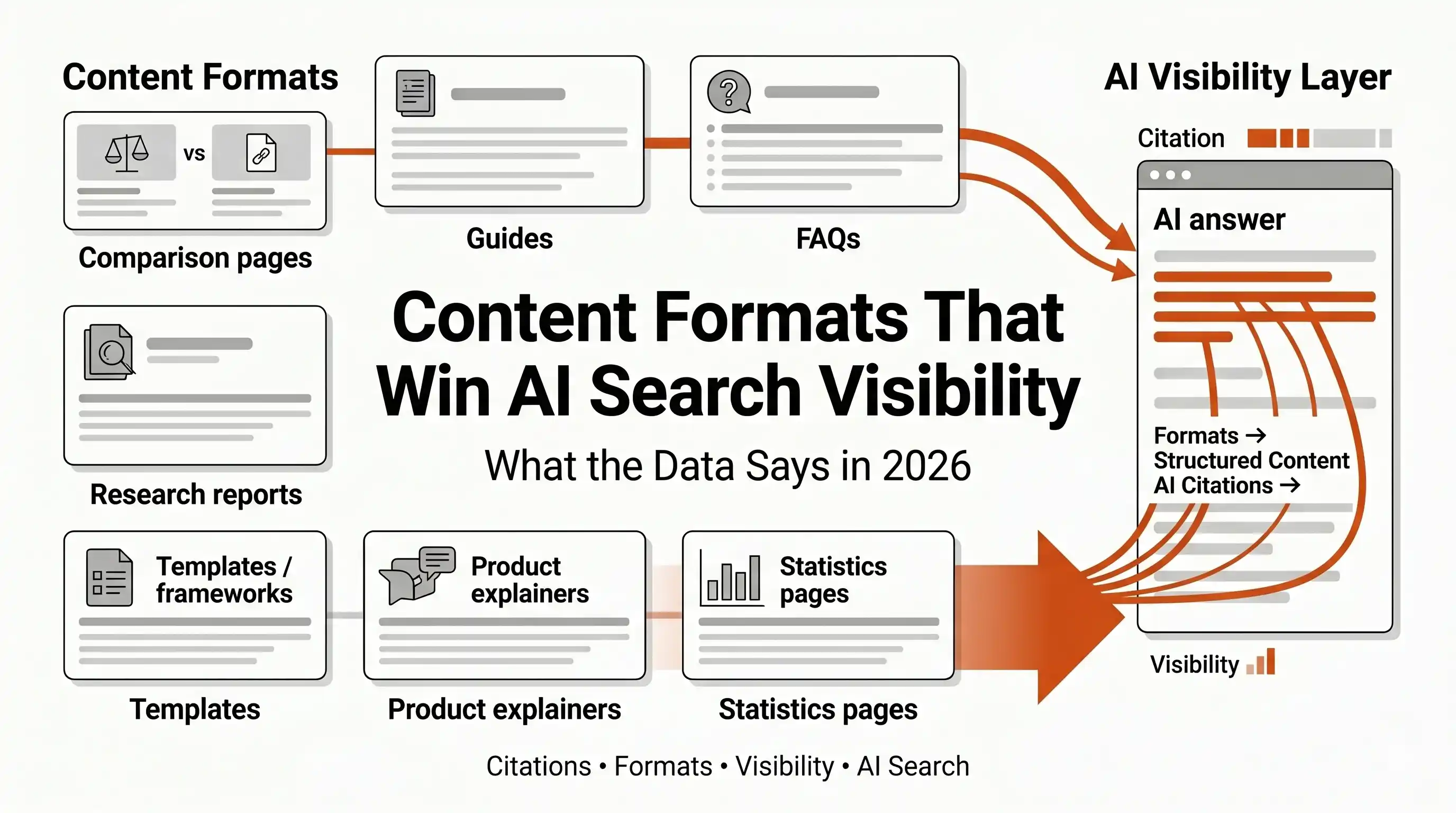


A smart content strategy for AI search visibility is no longer optional for B2B marketing teams that want pipeline. Here is the reality that changes everything: when a Google AI Overview is present, users click a traditional search result link in just 8% of visits, compared to 15% without one. That shift is not a trend to monitor. It is a structural change that demands a completely different approach to what you publish, how you structure it, and why certain formats get cited while others get ignored entirely.
Why Your Content Strategy for AI Search Visibility Starts With Format
Most B2B marketing teams are still asking the wrong question. The question used to be: "How much content should we publish?" The question in 2026 is: "What formats does AI actually choose?"
AI engines do not treat all content equally. They pull from formats that are structured, extractable, and directly aligned to the intent behind a query. Publish the wrong format for the wrong prompt, and even excellent content disappears. Publish the right format, and you get cited, recommended, and surfaced inside the answers your buyers are already reading.
This is the foundational shift every serious content strategy for AI search visibility must account for. Not word count. Not volume. Format, structure, and intent alignment.
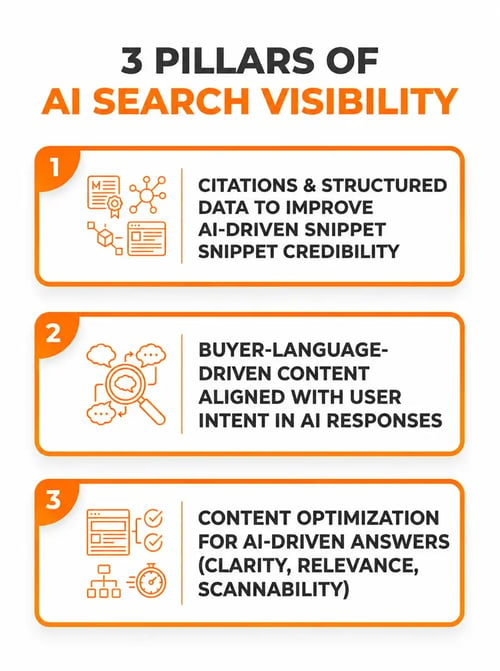
Explore how three core pillars shape AI-driven search visibility and guide your content strategy. Learn practical steps to optimize content for AI-powered search and improve visibility.
What the Citation Data Actually Says
Large-scale studies analyzing 75,000+ AI answers and over one million citations reveal a clear pattern. A small number of formats drive a disproportionately large share of citations across ChatGPT, Perplexity, and Google AI Overviews.
The top three formats by citation share look like this:
- Listicles: 21.9% of AI citations
- Informational articles: 16.7% of AI citations
- Product pages: 13.7% of AI citations
Combined, those three formats account for 52% of all AI citations studied. That is not a coincidence. It reflects the structural preferences AI engines have built into their citation behavior.
The critical nuance that most teams miss: intent matters more than industry. Informational prompts favor articles. Commercial prompts favor listicles. Vendor evaluation prompts favor comparison pages. Publish the right content in the wrong format for the wrong intent stage, and you leave citations on the table.
Did You Know?
44% of ChatGPT citations come from the first third of a webpage's content.
Source: Search Engine Land
7 Content Formats That Consistently Win AI Search Visibility
This is not a list of generic best practices. Each format below wins in AI citation systems for specific structural and intent-driven reasons. Know which one fits your buyer's decision stage, and you move from guessing to a repeatable content strategy for AI search visibility.
1. Listicles
Listicles are the single largest citation format in AI answer systems. Roughly 22% of all AI citations in large-scale studies trace back to list-format content. That number is not arbitrary.
AI engines love listicles because they are inherently modular. Each item is a self-contained, extractable unit. The AI can pull item three from a ten-item list without needing the rest of the page.
Where listicles dominate:
- Commercial research queries
- Software and tool evaluation ("best tools for X")
- Category comparisons
- Vendor shortlisting
What makes a listicle citation-ready:
- Clear ranking or grouping logic, not arbitrary ordering
- Short summaries under each item, not long prose blocks
- Structured comparison tables where applicable
- Framing that signals evaluation, not just description
2. Informational Articles
For educational and awareness-stage intent, informational articles outperform every other format. They account for 16.7% of AI citations in major studies and are the format AI most trusts to answer definitional and explanatory queries.
The winning structure is not complicated. Answer first. Define the concept in the opening paragraph. Use clean H2 and H3 hierarchy. Avoid burying the core answer inside long introductions.
Ideal use cases:
- Definitions and explainers
- Frameworks and methodology content
- Category education for buyers at the awareness stage
- Strategy content that positions your brand as the authority
3. How-To Guides
AI engines are built to answer questions. How-to guides map directly to the procedural, action-oriented questions that dominate AI query behavior. When a buyer types "how do I implement X" into ChatGPT or Perplexity, step-by-step content is what gets pulled.
Citation-winning structure:
- Numbered steps that are scannable and extractable individually
- Concise instructions, not padded explanations
- Clear process blocks that can stand alone
- Implementation-focused language, not theoretical framing
How-to guides are particularly powerful for implementation-stage buyers who have already made a category decision and are evaluating execution path. This is a stage most B2B content strategies underserve.
4. Comparison Pages
Comparison content is massively underused in B2B content systems, and that gap is widening. AI search behavior for commercial intent is heavily comparison-driven. Buyers ask "Platform A vs Platform B" and "which vendor is best for X use case" more than almost any other query type at the evaluation stage.
AI citation systems frequently pull comparison-style reasoning to answer these prompts. If you do not have structured comparison content, a competitor's comparison page about your category gets cited instead.
High-value comparison formats:
- Named product-vs-product pages
- Platform comparison tables with structured criteria
- Methodology and approach comparisons
- Category vs category comparisons for buyers earlier in the funnel
5. FAQs and Question-Driven Pages
AI search is fundamentally question-based. Buyers type full questions into ChatGPT, Perplexity, and Google AI. FAQ-format content maps directly to that behavior.
The winning structure for FAQ pages is specific. Short answer first. Direct. Extractable. Then deeper context below for buyers who want more. AI systems can surface the short answer in a zero-click environment and cite the page as the source.
Optimization checklist:
- Question headings written as buyers actually type them
- Answers that open with a direct 1-2 sentence response
- High FAQ density throughout core content pages, not just standalone FAQ pages
- Questions tied to each decision stage, not just surface-level definitions
6. Original Research and Data Reports
This is one of the highest-trust formats in AI citation systems. AI engines are built to cite authoritative sources, and original data is among the most authoritative signals available.
When your content contains proprietary benchmarks, survey findings, or longitudinal data, AI systems treat it as a primary source. They cite it. They summarize it. They reuse it across multiple queries. One well-structured research report can drive citations across dozens of related prompts your buyers are typing right now.
What AI engines pull from research content:
- Specific statistics and percentages
- Named benchmarks and comparison data
- Survey findings with attributed methodology
- Industry-specific datasets that are hard to find elsewhere
For B2B marketing teams with access to CRM data, customer conversation insights, or proprietary performance data, this format is a direct path from competitive blind spot to citation advantage.
7. Product and Solution Pages
This is the format that surprises most teams. Product pages are not just for conversion. In AI citation studies, product and solution pages account for a meaningful share of commercial-intent citations, landing at 13.7% of the citation pool in major datasets.
The reason is simple. When a buyer asks an AI engine "what is the best solution for X," the AI needs to recommend something. Structured, well-organized product pages give it the answer in an extractable format.
What makes product pages citation-ready:
- Feature descriptions written in buyer language, not internal marketing-speak
- Clear use case framing tied to specific job roles or company situations
- Structured comparison against alternatives
- FAQ sections embedded within the page
- Outcome-focused language that maps to buyer decision criteria
The Hidden Pattern Behind a Winning Content Strategy for AI Search Visibility
Most teams ask: "What is the best content format?" That is the wrong question entirely.
The better question is: "Which format matches where my buyer is in their decision?"
Research consistently shows that intent predicts citation likelihood more strongly than industry or platform. The format that wins an awareness-stage query will not win a vendor evaluation query. The format that drives citations for "what is X" will not drive citations for "X vs Y."
|
Query Type |
Decision Stage |
Winning Format |
|
Informational ("What is X?") |
Awareness |
Informational Articles |
|
Commercial ("Best tools for X") |
Evaluation |
Listicles |
|
Implementation ("How do I do X?") |
Decision / Execution |
How-To Guides |
|
Vendor research ("X vs Y") |
Evaluation |
Comparison Pages |
|
Product evaluation ("Is X right for me?") |
Decision |
Product / Solution Pages |
Did You Know?
Listicles, informational articles, and product pages together account for 52% of all AI citations in large-scale analysis, making format selection one of the highest-leverage decisions in B2B content strategy.
Source: Hashmeta AI Citation Study
How Omnibound Operationalizes Content Strategy for AI Search Visibility
Traditional marketing asks: "What keywords should we target?" That question belongs to a different era.
Modern AI visibility requires knowing which prompts your buyers are actually typing into ChatGPT and Perplexity, which formats competitors are winning those prompts with, where your citation gaps exist, and how to close them faster than the market moves.
Omnibound gives you two intelligence layers working together: AI search competitive intelligence that shows you where the battle is happening, and buyer and market context that tells you how to win it.
Know whether your content will get cited before you hit publish. That is the standard Omnibound holds every content decision to.
Conclusion
In AI search, the best content is not simply the longest or most optimized. It is the format that AI can understand, trust, and confidently reuse.
A winning content strategy for AI search visibility is built on four things: the right format for the right intent stage, structure that makes content extractable, authority signals that build trust at the domain level, and intelligence that tells you where your citation gaps are before a competitor claims them.
Publishing more is not the answer. Publishing citation-ready content architectures is. The teams that move fastest on that shift will own the AI search answers their buyers are reading right now.
From competitive blind spot to citation advantage: that is the move that matters in 2026.
FAQs
Which content formats get cited most by AI search engines in 2026?
Listicles, informational articles, and product pages are the three highest-citation formats in large-scale AI citation studies, together accounting for 52% of all citations. A strong content strategy for AI search visibility builds all three into the content mix, matched to the appropriate buyer intent stage.
Are listicles actually good for AI search visibility, or is that outdated advice?
Listicles remain the single highest-citation format in AI answer systems as of 2026, capturing roughly 22% of citations in major studies. The key is structure: each list item must be independently extractable, with short summaries and clear evaluation logic, not long paragraphs that AI cannot cleanly pull.
Do product pages matter for getting cited by ChatGPT or Perplexity?
Yes. Product and solution pages account for 13.7% of AI citations in large-scale datasets, particularly for commercial and vendor evaluation prompts. Pages that combine feature clarity, use case framing, comparison logic, and embedded FAQs are the strongest performers for product-level citation.
How do AI engines decide which content formats to cite?
AI engines prioritize content that is extractable, structured, intent-aligned, and evidence-rich. Research consistently shows that earlier content placement matters significantly, with 44% of ChatGPT citations pulling from the first third of a page. Format is the entry point, but authority signals and entity consistency also shape citation decisions.
What is the best content format for getting cited by ChatGPT for B2B queries?
For informational B2B queries, structured articles with answer-first openings perform best. For commercial and evaluation queries, listicles and comparison pages dominate. A citation-driven content strategy for AI search visibility maps each format to the specific buyer intent stage it serves most effectively.
Is content format alone enough to win AI search citations in 2026?
No. Format improves extractability and citation readiness, but AI engines also weigh domain authority, entity consistency, external validation, and market positioning. The highest-performing B2B teams combine citation-ready formats with a unified intelligence system that tracks prompt behavior, competitor citation patterns, and content gaps in real time.
How does the Omnibound Content Refresh Grid help with AI visibility?
The Content Refresh Grid audits every live page against 10 key factors for buyer relevance and AI citability, then drives prioritized rewrites that close citation gaps. It turns audit intelligence directly into execution, giving B2B marketing teams a signal-to-execution workflow that keeps content current as AI citation behavior evolves.
.png?height=245&name=ChatGPT%20Image%20Aug%2024%2c%202026%2c%2008_29_17%20AM%20(2).png)
.png?height=245&name=Why%20B2B%20AI%20Search%20Requires%20More%20Than%20a%20CMS%20(And%20What%20Modern%20Marketing%20Stacks%20Must%20Do%20Instead).png)