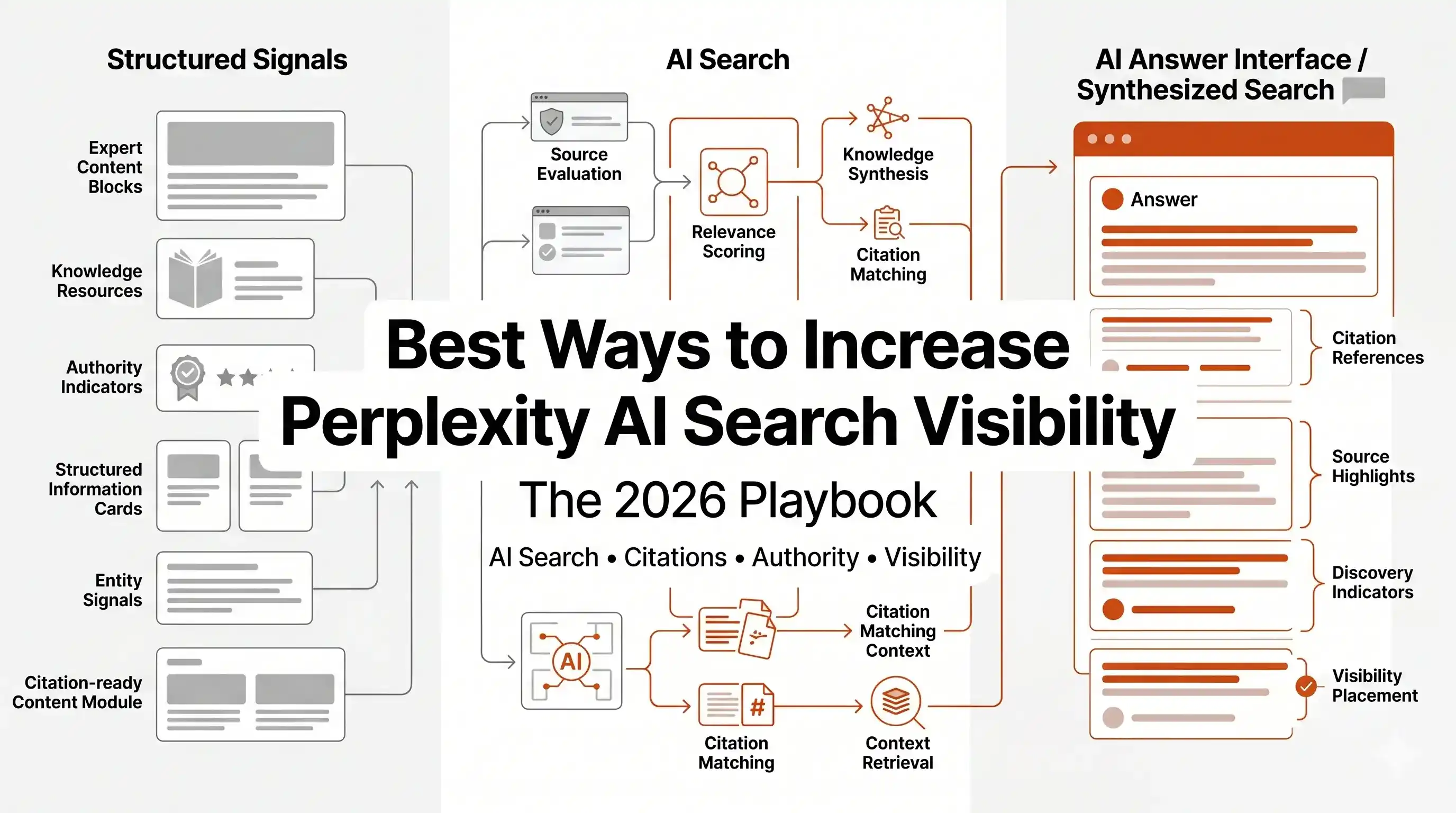


Perplexity AI search visibility is no longer a niche concern for forward-thinking brands. It is quickly becoming one of the most important discovery channels in B2B marketing, and here is the number that makes this urgent: Perplexity evaluates roughly 10 sources per query but cites only 3 to 4 of them, meaning the vast majority of available content never earns a single mention. If your brand is not optimized to win one of those citation slots, you are invisible inside the answer itself.
How Perplexity AI Search Works (And Why It Is Different)
Perplexity is not a traditional search engine, and it is not a static language model like many assume. It retrieves live web information in real time, synthesizes a conversational answer, and surfaces explicit source citations as clickable references directly inside the response.
This makes it fundamentally different from Google AI Overviews, ChatGPT, or Gemini. Perplexity does not simply echo Google's top results. Its citation selection is driven by retrieval quality, freshness, and content structure rather than domain authority or historical link signals alone.
Did You Know?
The average number of citations per Perplexity response rose to 5.8 sources in 2026, up from 4.2 in 2024, meaning there are more citation slots available now than ever before for brands that optimize correctly. (Presenc AI, Perplexity Citation Patterns 2026)
The 7 Best Ways to Improve Your Perplexity AI Search Visibility
Winning consistent Perplexity citations is not accidental. It requires a deliberate, platform-specific approach. Below we break down the seven most effective strategies our team recommends for building strong, sustainable Perplexity AI search visibility.
1. Build Citation-Ready Content From the Ground Up
Perplexity's retrieval system favors content that is easy to extract and directly answers specific questions. Generic long-form content that buries its core point inside extended introductions rarely earns citations.
Practically, this means writing fact-dense sentences, using named entities, backing claims with evidence, and keeping key answers in short, self-contained paragraphs rather than buried deep inside long sections.
- Lead every major section with a direct answer
- Use TL;DR summaries and answer boxes at the top of long pages
- Include FAQ blocks with question-based headings throughout content
- Reference specific data points, study names, and named entities to signal factual credibility
- Keep key answer passages under 100 words so they are cleanly extractable
Our citation-worthy content creation service is built specifically around this principle, helping brands produce content that earns AI citations rather than simply existing online.
2. Treat Content Freshness as a Non-Negotiable Signal
Freshness matters more for Perplexity than for almost any other major platform. Because Perplexity performs real-time retrieval, stale content with outdated statistics, old benchmarks, or obsolete examples is far less likely to be selected over recently updated pages.
Our content refresh solution helps teams identify which pages need updates most urgently based on citability potential and current performance gaps.
3. Build Deep Topic Authority and Entity Clarity
Perplexity favors sources with genuine topical depth. A brand that publishes one broad overview article is far less likely to be cited than a brand with a deep cluster of interconnected, expert-level content on a specific topic.
Brand positioning matters here too. When your brand name and domain are consistently associated with a specific topical area across multiple high-quality pages, Perplexity is more likely to treat your content as an authoritative source for questions within that domain.
4. Engineer Your Content Structure for AI Retrieval
Structure optimization for Perplexity AI search visibility operates at three levels: macro (overall article architecture), passage (retrievable content blocks), and micro (lists, headings, and summaries).
At the macro level, articles should follow a clear logical hierarchy with question-based H2 headings, a strong direct-answer introduction, and a conclusion that reinforces key points. At the passage level, each major section should function as a self-contained answer unit. At the micro level, every list, table, and numbered framework increases the probability that Perplexity can extract a precise answer.
Recommended structural formats for high Perplexity citability include:
- Question-based H2 and H3 headings that mirror real user queries
- Numbered step frameworks for procedural content
- Comparison tables with clear column headers and factual entries
- Short, direct answer paragraphs at the start of each major section
- Highlighted summary callouts for key statistics and definitions
5. Earn Third-Party Authority Signals Consistently
AI retrieval systems, including Perplexity, are strongly influenced by earned external signals. When industry publications, review platforms, expert communities, and editorial sources mention and link to your brand, those signals reinforce your authority as a trustworthy source.
This is not simply about building backlinks. It is about establishing a visible presence across the ecosystem where your buyers and your topic community live. That includes industry newsletters, comparison and review sites, community forums, and partner content ecosystems.
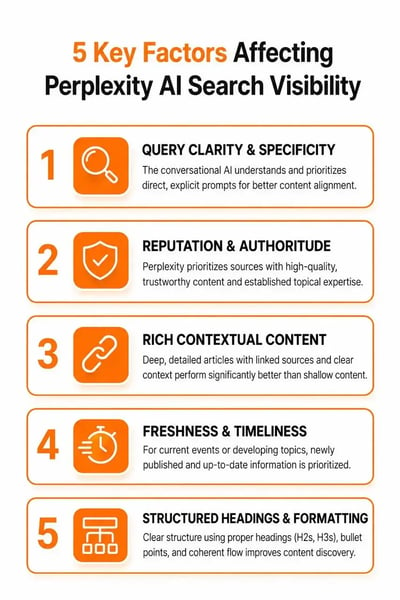
This infographic breaks down the five factors that influence Perplexity AI search visibility. Learn how indexing, rankings, content quality, and user signals affect performance.
6. Remove Every Technical Barrier to Retrieval
Even perfectly structured, highly fresh, and deeply authoritative content will not earn Perplexity citations if retrieval systems cannot access it. Technical accessibility is a baseline requirement, not an advanced optimization.
We recommend checking the following for every high-priority page:
- Crawl permissions are open and robots.txt is not blocking important pages
- Structured metadata is accurate and descriptive
- Site architecture is clean, with clear URL structures and minimal redirect chains
- Page load speed is optimized for fast retrieval
- Schema markup supports content interpretation where relevant
7. Measure Perplexity Visibility Systematically
Most teams drastically underinvest in Perplexity visibility measurement. Running a single prompt check occasionally gives you a snapshot, but not a strategy. Perplexity citation results fluctuate across runs, time periods, query phrasings, and user modes.
Our AI search visibility diagnostic gives teams a structured starting point, surfacing where Perplexity is already citing competitors over your brand and identifying the highest-priority gaps to close first.
Perplexity vs Google AI Overviews vs ChatGPT: A Perplexity AI Search Visibility Comparison
Each major AI search platform operates differently, and treating them as interchangeable leads to weak results across all of them. Here is how Perplexity compares for optimization purposes.
|
Platform |
Primary Optimization Focus |
Citation Behavior |
Freshness Weight |
|
Perplexity AI |
Freshness, citations, real-time retrieval |
Explicit clickable citations in every answer |
Very High |
|
Google AI Overviews |
Domain authority, SERP proximity |
Source attribution, often overlapping with top results |
Moderate |
|
ChatGPT (Web) |
Broader retrieval ecosystem |
Less consistent citation behavior |
Moderate to High |
How Omnibound Helps You Win Perplexity AI Search Visibility
Traditional monitoring tools were built for a world of positions and traffic metrics. They are not equipped to track citation share, prompt-level performance, or competitive AI visibility. That is the gap we built Omnibound to fill.
Our platform gives B2B marketing teams the specific capabilities needed to measure and improve Perplexity AI search visibility at scale. This includes tracking which prompts your brand appears in, identifying which competitors are being cited over you, and surfacing the content gaps that are costing you citation opportunities.
Here is how our capabilities compare to standard monitoring approaches:
|
Capability |
Standard SEO Tools |
Omnibound |
|
AI Citation Tracking |
Not available |
Yes |
|
Perplexity-Specific Visibility |
Not available |
Yes |
|
Competitor Citation Benchmarking |
Partial |
Full |
|
Prompt-Level Analysis |
Not available |
Yes |
|
Customer Context Insights |
Not available |
Yes |
You can explore our competitor intelligence tools to see exactly where rivals are outperforming you in AI citations, and use our AI search diagnostic to get an immediate read on your current visibility gaps. For teams unsure how we stack up against other options in the market, our Omnibound vs AIrops comparison lays out the differences clearly.
Start by running an AI search visibility diagnostic to find out where your brand stands right now, or explore our full solutions suite to see how we can help you build sustained Perplexity citation authority at scale.
FAQs
- How do you increase visibility on Perplexity AI?
Increase Perplexity visibility with citation-ready, structured, fresh, and authority-driven content. - How does Perplexity AI choose which sources to cite?
Perplexity selects citations based on freshness, retrievability, topical relevance, and clear structure. - What is Perplexity SEO and how is it different from traditional approaches?
Perplexity SEO focuses on becoming a citable, machine-readable source rather than chasing traditional rankings. - Why does freshness matter so much for Perplexity AI visibility?
Freshness matters because Perplexity prioritizes recently updated content in its real-time retrieval process. - How can brands track their Perplexity citation performance?
Track Perplexity performance through prompt testing, citation monitoring, and competitive benchmarking. - Is investing in Perplexity visibility worth it for B2B brands in 2026?
Yes, Perplexity visibility drives B2B brand discovery, citation traffic, and competitive positioning. - What content types earn the most Perplexity citations?
Direct answers, FAQs, comparison tables, frameworks, and refreshed data earn the strongest Perplexity citations.