

If your SaaS company is still treating SEO vs GEO as an either/or question, you are already behind the fastest-growing teams in your category. In 2026, winning SaaS brands do not choose between ranking in Google and showing up in ChatGPT answers. They build strategies that capture both.
Here's an example. A VP of Sales at an enterprise SaaS company opens Google and types: "best revenue intelligence platform." Ten minutes later, their CFO opens ChatGPT and asks: "Which revenue intelligence platforms are best for enterprise SaaS teams?"
Those two queries flow through entirely different systems with entirely different visibility mechanics. One returns a ranked list of web pages. The other synthesizes an answer from trusted sources and recommends specific brands by name.
That is the SEO vs GEO for SaaS challenge in a single real-world moment.
What SEO Means for SaaS Companies
SEO helps SaaS companies grow by earning visibility in traditional search results. When buyers type a query into Google or Bing, your product pages, comparison content, and solution pages compete for position.
For high-growth SaaS teams, SEO drives organic acquisition across the full funnel. It captures category demand, surfaces comparison traffic, supports product education, and generates inbound pipeline at scale.
The core pillars of SaaS SEO include:
- Product and solution pages optimized for category keywords
- Comparison content targeting buyers evaluating alternatives
- Bottom-funnel keywords with clear purchase intent
- Topical authority built through deep, interconnected content clusters
- Technical foundations that support fast, crawlable, structured pages
One thing we want to be absolutely clear about: SEO remains foundational in 2026. GEO does not replace it. Every SaaS company still needs strong SEO coverage. What has changed is that SEO alone is no longer sufficient.
What GEO Means for SaaS Companies
GEO stands for Generative Engine Optimization. It is the discipline of optimizing your brand, content, and entity presence so that AI answer engines select, cite, and recommend you inside their synthesized responses.
The AI ecosystems that matter most for SaaS GEO in 2026 include ChatGPT, Gemini, Perplexity, and Google's AI Overviews. Each of these platforms forms answers differently from traditional search, pulling from trusted sources, third-party citations, and brand authority signals.
The key shift GEO introduces for SaaS teams is this: visibility moves from ranking pages toward being selected, cited, and recommended.
A buyer who asks ChatGPT "What is the best sales enablement platform for a Series B SaaS company?" does not see ten blue links. They see a synthesized answer that names two or three platforms. If your brand is not in that answer, you do not exist in that buyer's research process.
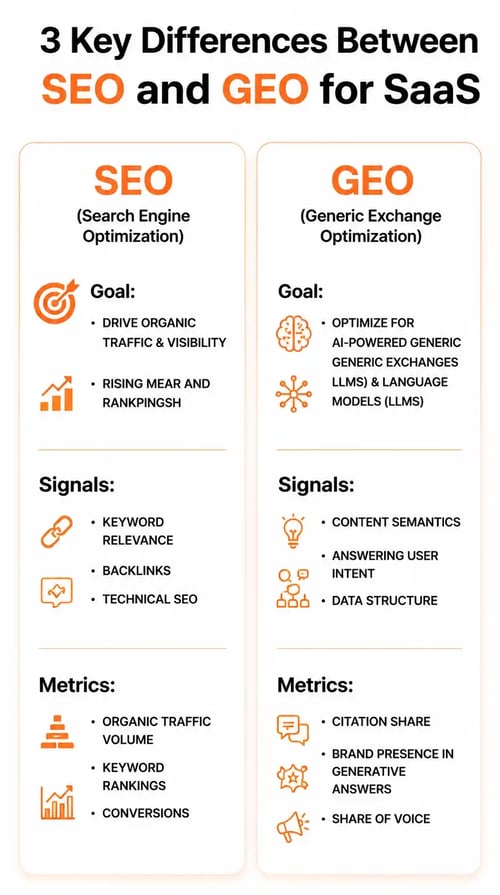
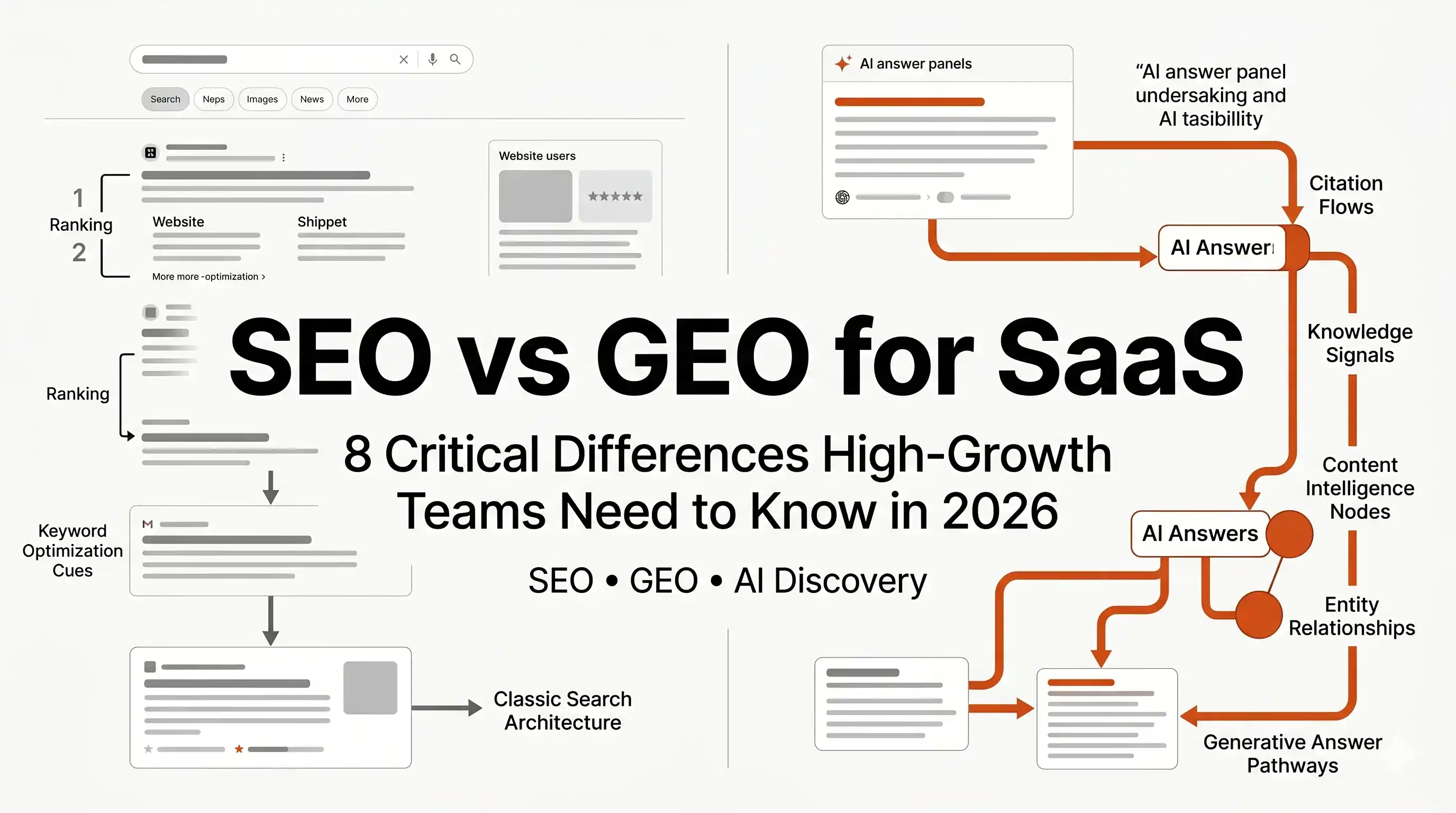
This infographic visualizes the three key differences between SEO and GEO strategies for SaaS. Use it to compare approaches and prioritize where to invest your growth efforts.
SEO vs GEO for SaaS: The 8 Biggest Differences High-Growth Teams Must Understand
This is where the SEO vs GEO for SaaS conversation gets practical. These eight distinctions define how your growth strategy, content roadmap, and measurement framework need to evolve in an AI-first discovery environment.
1. Traffic vs Citation Visibility
The primary goal of SEO is to earn clicks. A high-ranking page drives visitors to your site where the buying journey continues.
The primary goal of GEO is to earn inclusion inside AI-generated answers. That inclusion may generate less direct traffic, but it creates powerful assisted discovery. A buyer who sees your brand cited in a ChatGPT answer during research is far more likely to seek you out directly later in the buying process.
2. Keywords vs Buyer Prompts
SEO targets keywords: short, structured phrases people type into a search bar. GEO targets buyer prompts: the natural-language questions people ask AI assistants in full conversational sentences.
Compare these two:
- SEO target: "sales enablement software"
- GEO target: "What sales enablement platform is best for mid-market SaaS teams scaling from 50 to 200 reps?"
3. Rankings vs Retrieval and Citation
SEO success is measured by SERP position. Page one, position one, featured snippet. GEO success is measured by how frequently your content is retrieved and cited when AI engines form answers relevant to your category.
Retrieval frequency, citation presence, and recommendation probability become the metrics that matter for GEO performance. These require entirely different tracking infrastructure than traditional rank monitoring.
4. Website Authority vs Entity Authority
SEO has long rewarded domain authority: the aggregate trust and link equity your website accumulates over time. GEO rewards something broader and more nuanced: entity authority.
AI systems need to understand what your SaaS product does, who it serves, what category it belongs to, and how it fits into the competitive landscape. If your brand lacks clear entity definition across the web, AI engines struggle to confidently include you in their answers.
5. Content Depth vs Content Extractability
SEO has always rewarded comprehensive, in-depth content that demonstrates topical authority. That remains true for GEO as well, but GEO adds an additional requirement: extractability.
AI engines do not simply reward length. They reward content structured so that specific answers, definitions, comparisons, and frameworks can be pulled out cleanly and inserted into a synthesized response.
6. Backlinks vs Trust Ecosystems
Backlinks remain important for SEO. They signal authority and help pages rank. But GEO operates on a broader concept of trust that backlinks alone cannot fully supply.
7. Search Funnel vs AI Discovery Journey
The traditional SEO buyer journey follows a predictable path: query, SERP, click, website. Each step is measurable and attributable.
The GEO discovery journey looks fundamentally different:
- Buyer forms a prompt in ChatGPT or Perplexity
- AI synthesizes an answer and includes brand citations
- Buyer notes your brand as a credible option
- Assisted evaluation begins, often outside your website
- Direct brand search or referral eventually reaches your pipeline
8. Performance Metrics Change Completely
Perhaps the most operational difference in the SEO vs GEO for SaaS debate is how you measure performance.
|
SEO Metrics |
GEO Metrics |
|
Keyword rankings |
Citation frequency |
|
Organic traffic volume |
Answer share-of-voice |
|
Click-through rate |
Prompt visibility score |
|
Page authority |
AI mention frequency |
|
Conversions from organic |
Assisted pipeline from AI discovery |
Why SaaS Companies Need an SEO and GEO Strategy, Not Either/Or
The most important thing we want to communicate about SEO vs GEO for SaaS is this: the question itself is the wrong framing.
Modern SaaS growth in 2026 requires both simultaneously.
SEO captures intent-driven traffic from buyers who know what they are looking for. GEO influences AI discovery for buyers who are still forming their understanding of the category, the problem, and the solution space.
"The winning SaaS strategy layers GEO onto existing SEO foundations. You do not tear down what works. You build the AI visibility layer on top of it."
How Omnibound Helps SaaS Teams Navigate SEO and GEO
At Omnibound, we built our platform specifically to help high-growth SaaS companies operationalize the integrated SEO and GEO strategy we have outlined here.
Our AI Search Intelligence capability gives your team full visibility into how AI engines form answers in your category, where your brand earns citations, where it does not, and what specific buyer prompts are driving competitive visibility.
We also provide unified customer and market intelligence that keeps your entity clarity sharp. As your product evolves and your market shifts, our platform ensures AI systems always have an accurate, current understanding of what your SaaS company does and who it serves.
Critically, we do not position Omnibound as a replacement for your existing SEO stack. We are the complementary AI visibility layer that sits alongside it, measuring what your current tools cannot see and acting on opportunities before your competitors do.
Explore how buyer-focused AI search optimization translates into revenue through our on-demand webinar, where we walk through citation quality, prompt mapping, and how to present AI visibility as a pipeline leading indicator to leadership.
The SaaS brands that figure this out in 2026 will be the ones that own their categories in 2027 and beyond. We built Omnibound to help you get there faster. Learn more about how we approach AI-first growth for B2B SaaS teams.