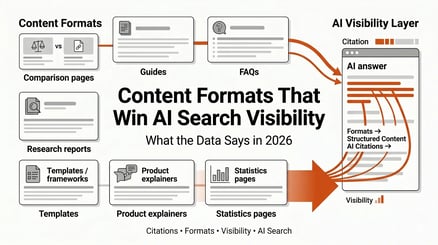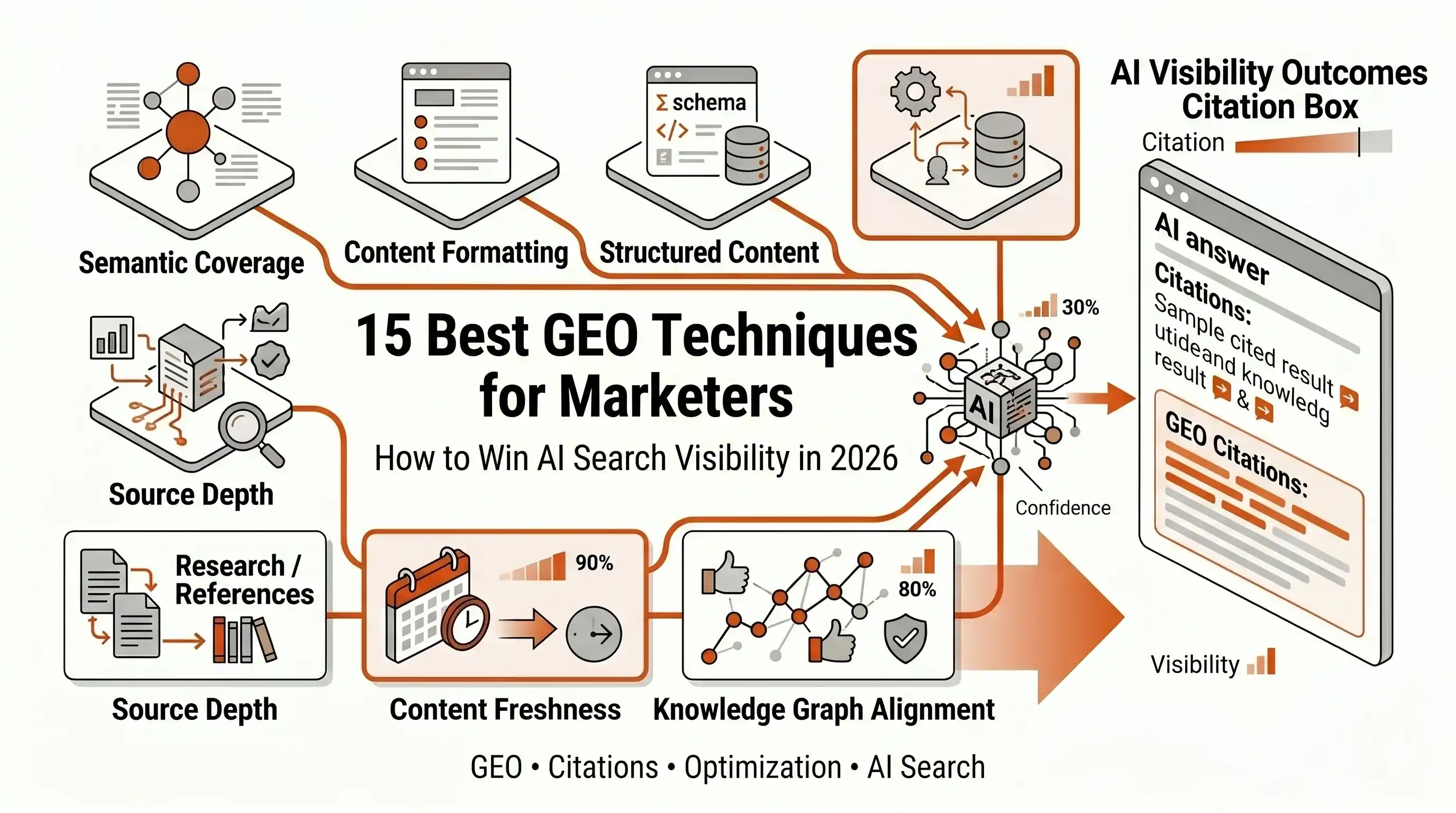


The most powerful GEO techniques for marketers are no longer optional in 2026 because an astonishing 83% of citations in AI Overviews come from pages that do not rank in the traditional Google organic Top 10, meaning the rules of visibility have fundamentally changed. Modern marketers now compete for citations, inclusion, and presence inside ChatGPT, Google AI Overviews, Gemini, Perplexity, and Claude rather than simply chasing clicks from a list of blue links.
What Is Generative Engine Optimization (GEO)?
Generative Engine Optimization, or GEO, is the discipline of optimizing your content, brand signals, and information architecture so AI systems actively cite and recommend your brand inside generated responses.
Where traditional optimization focused on getting a page to appear in a results list, GEO focuses on getting your content woven into the actual answer an AI produces for a buyer.
Here is how the three modern search disciplines compare:
|
SEO |
AEO |
GEO |
|---|---|---|
|
Rankings |
Answers |
AI Visibility |
|
Keywords |
Questions |
Entities |
|
Traffic |
Snippets |
Citations |
|
SERPs |
Answer Boxes |
AI Ecosystems |
Why GEO Techniques for Marketers Are Critical in 2026
Buyer discovery has moved inside AI interfaces. Your buyers no longer start their research with a list of links. They ask ChatGPT, Gemini, or Perplexity a direct question and act on whatever answer they receive.
If your brand is not cited inside that answer, you effectively do not exist for that buyer at that moment. That is the core commercial pressure driving the urgency around generative engine optimization techniques in 2026.
- Zero-click discovery is now the default behavior across AI-powered interfaces
- Conversational prompts have replaced keyword-style queries for a growing share of buyers
- AI buying research happens before buyers ever reach a vendor website
- Trusted entities and structured information determine whose brand gets cited
Did You Know?
Zero-click searches reach 93% in "Google AI Mode," meaning only 7% of queries result in a click to an external website. (Semrush / QuickSEO, March 2026)
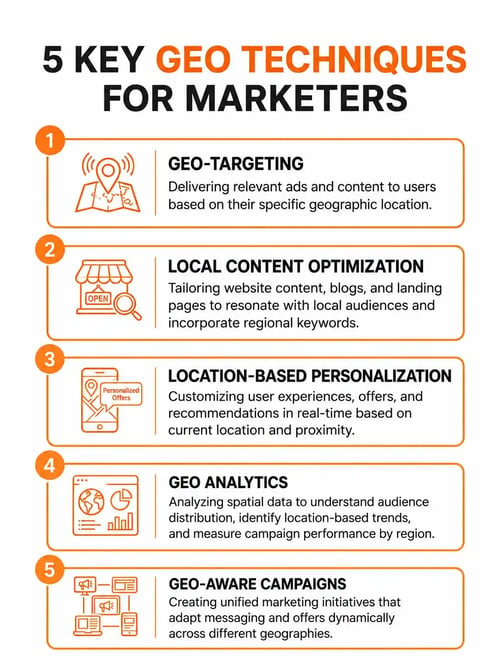
Five key GEO techniques for marketers are visualized to help target local audiences and optimize campaigns. Use this infographic to boost location-based marketing and measure impact.
The 15 Best GEO Techniques for Marketers
These 15 GEO optimization strategies cover the full spectrum of what modern marketing teams need to build sustainable AI visibility. Work through each one systematically to build a compounding advantage across AI ecosystems.
1. Optimize for Questions, Not Keywords
Modern AI interfaces are prompt-driven, so your content needs to anticipate the natural questions buyers ask rather than the isolated keywords they once typed.
Build content around full, conversational buyer prompts like "best CRM for SaaS startups" or "how does AI search optimization work" rather than fragmented keyword phrases.
2. Build Citation-Ready Content
AI systems extract and cite content that is concise, structured, and factually dense. Fluency, clarity, and accurate citations significantly influence which pages generative models surface.
Use definitions, numbered lists, comparison tables, and frameworks throughout your content to make it easy for AI systems to extract and attribute.
3. Strengthen Entity Authority
GEO is increasingly entity-driven, which means AI systems recognize and cite brands, executives, products, and category concepts as distinct entities rather than just matching text.
Optimize your brand consistency across every channel, build executive expertise signals, and own clear category definitions that AI systems can reliably associate with your entity.
4. Use Structured Content Architecture
Content structure directly affects how AI models parse and cite your pages. Semantic heading hierarchies, FAQ schema markup, logical section flow, and modular answer blocks all improve citation behavior.
Design every piece of content as if you are building a structured knowledge resource, not just a narrative article.
5. Create AI-Friendly Comparison Content
Comparison content is one of the highest-performing formats for GEO because buyers actively use AI to evaluate alternatives before making decisions.
Build alternatives pages, competitor comparison guides, vendor evaluation frameworks, and buying guides that AI systems can directly extract when responding to evaluation-stage prompts.
6. Improve Information Density
Thin, vague, or story-heavy copy rarely earns AI citations. AI systems favor content that packs real insight, verified statistics, clear takeaways, and concise expertise into every section.
Audit your existing content for information density and replace narrative filler with substantive, extractable knowledge.
7. Develop Topic Cluster Ecosystems
Isolated pages rarely build the kind of topical authority that AI systems trust. Instead, build interconnected clusters of content around use cases, buyer journeys, category education, and implementation problems.
A well-structured topic cluster signals deep domain expertise to AI models and increases the chances that multiple related prompts surface your brand. We support this approach through our content marketing use case, which grounds clusters in real buyer and market signals.
8. Earn Third-Party Validation Signals
AI systems weight external authority heavily when deciding which sources to cite. Your brand being mentioned, analyzed, or reviewed by trusted industry sources carries significant weight in AI-generated responses.
Invest actively in analyst coverage, earned media, community conversations, review ecosystems, and industry publication mentions to build the external signal layer that GEO requires.
9. Refresh Content Continuously
AI systems favor current, accurate information. Content with outdated statistics, stale product details, or language that no longer reflects how the market speaks will steadily lose AI citation share.
Build a content refresh workflow that updates statistics, product information, competitor references, and evolving market terminology on a regular cadence.
10. Design Content for Retrieval and Generation
Advanced GEO separates two distinct optimization layers: the retrieval layer, where your content must be crawlable, accessible, and clearly structured, and the generation layer, where your content must be synthesis-ready with modular answers and extractable language.
Both layers require distinct attention, and the best-performing GEO content is specifically designed to satisfy both simultaneously.
11. Track Competitive AI Visibility
Most marketing teams have no idea which competitors are being cited by AI systems in response to their target prompts. This represents a significant blind spot that gives an advantage to the teams who do monitor it.
We built our AI search intelligence capability specifically to help marketers visualize prompt-level citation data, track competitor presence, and identify answer ownership opportunities before competitors do.
12. Integrate Customer Intelligence Into GEO
The most effective AI search optimization techniques for marketers are grounded in real buyer language, not internal assumptions. Customer interviews, sales call recordings, support conversations, and review data all surface the exact phrases buyers use when describing problems and evaluating solutions.
We unify these signals through our intelligent research layer, which converts live customer conversations into living intelligence that directly informs GEO content strategy.
13. Measure GEO Performance Differently
Traditional click and traffic metrics do not capture AI visibility. Marketing teams that only measure what they have always measured will systematically underestimate both their GEO gains and their competitive exposure.
The right GEO KPIs include AI citation frequency, answer inclusion rate by prompt cluster, AI share of voice by competitor, and visibility movement across specific buyer questions over time.
14. Align GEO With Modern Buying Journeys
GEO content must cover every stage of the buying journey because buyers use AI prompts differently depending on where they are in the decision process. Awareness prompts look different from evaluation prompts, which look different from implementation prompts.
Map your GEO content strategy across Awareness, Evaluation, Selection, and Implementation stages to ensure AI systems can cite you at every critical moment in the buyer journey.
15. Build AI-First Content Operations
The most advanced GEO optimization strategies for marketers are not just about content, they are about operational maturity. Teams that win AI visibility in 2026 have built repeatable workflows for AI monitoring, content refreshes, citation analysis, prompt testing, and visibility reporting.
Our context engine supports exactly this kind of AI-first content operation by unifying customer signals, market signals, and AI search data into a single actionable layer for marketing teams.
How to Measure GEO Performance as a Marketer
Measuring GEO requires an entirely new set of KPIs compared to what most marketing teams have historically tracked. The goal is no longer just driving traffic. The goal is owning the narrative inside AI-generated answers.
Here are the core GEO measurement dimensions every marketing team should track in 2026:
- AI Citation Frequency: How often your brand or content is cited in response to target prompts
- Answer Inclusion Rate: The percentage of monitored prompts where your content appears in the AI-generated answer
- AI Share of Voice: Your citation presence relative to competitors across tracked prompt clusters
- Prompt Cluster Visibility: Citation coverage mapped across awareness, evaluation, and selection prompt categories
- Gap Score: The number of high-value prompts where competitors are cited but your brand is absent
Did You Know?
Comprehensive content with over 20,000 characters earns 4.3x more AI citations than shorter, thin content. (Growth Memo / ConvertMate, March 2026)
How Omnibound Supports Your GEO Strategy
We built Omnibound specifically to give marketing teams the AI search intelligence and content execution infrastructure they need to compete and win in generative AI ecosystems.
Our platform delivers the capabilities that make GEO techniques for marketers actually executable at scale, not just theoretically sound.
- AI Visibility Tracking: Monitor citation frequency and answer inclusion across ChatGPT, Google AI Overviews, Gemini, Perplexity, and more
- Competitive Positioning Intelligence: See exactly which competitors own the prompts you care about and identify where you have a clear path to citation
- Customer Signal Analysis: Ground your GEO content in real buyer language extracted from calls, reviews, and market conversations
- Market Context Monitoring: Stay aligned with how your market language and buyer prompts are evolving in real time
- Actionable Optimization Insights: Move from raw data to prioritized content actions that directly improve AI citation share
Our product marketing use case shows specifically how we help product marketing teams align messaging with the prompts AI systems respond to, building citation-rich product pages and buyer-language-grounded campaigns.
Conclusion
The 15 GEO techniques for marketers we have covered in this guide represent the full practical playbook for building AI visibility in 2026. From citation-ready content structure and entity authority to competitive AI monitoring and customer intelligence integration, each technique addresses a distinct lever that determines whether your brand appears inside the AI-generated answers your buyers rely on.
GEO optimization strategies for marketers are not a future consideration. They are a present competitive requirement. The brands investing in structured content, entity authority, measurement frameworks, and AI-first content operations right now are building citation advantages that compound over time.
We are here to help your team execute every stage of this framework with precision. If you are ready to build a serious GEO strategy backed by real AI search intelligence, we have the tools and expertise to get you there.
FAQs
What is generative engine optimization and why does it matter for marketers in 2026?
Generative engine optimization is the practice of structuring content, brand signals, and authority indicators so that AI platforms like ChatGPT and Google AI Overviews actively cite and recommend your brand in generated answers. It matters in 2026 because buyers are increasingly using AI interfaces to research and make decisions before ever visiting a vendor website, making AI citation presence a direct commercial advantage for marketing teams.
How is GEO different from SEO for B2B marketing teams?
SEO focuses on gaining positions in traditional results lists and driving clicks to your website, while GEO focuses on earning citations and inclusion inside AI-generated answers across platforms like ChatGPT, Gemini, and Perplexity. The most effective generative engine optimization techniques for B2B marketers require different content architecture, entity authority signals, and measurement frameworks than traditional approaches.
What are the best GEO techniques for marketers to start with today?
The highest-impact GEO techniques for marketers to prioritize immediately are building citation-ready content with clear structure and information density, strengthening entity authority across brand and executive channels, and implementing an AI visibility measurement layer to track citation frequency. These three foundations create the infrastructure that makes every other GEO optimization strategy more effective over time.
How do you improve AI search visibility without starting from scratch?
Improving AI search visibility typically starts with auditing your existing content for information density, structural clarity, and alignment with real buyer prompt language rather than rebuilding everything from the ground up. Adding structured elements like definitions, comparison tables, FAQ sections, and numbered frameworks to existing high-value pages can meaningfully increase citation eligibility with relatively low content production investment.
Which AI platforms should marketers focus on for GEO in 2026?
ChatGPT, Google AI Overviews, Gemini, Perplexity, and Claude are the five core platforms where GEO techniques for marketers generate the most commercial impact in 2026, with ChatGPT currently driving the largest share of AI referral traffic. A platform-agnostic GEO strategy that optimizes for citation-readiness across all five ecosystems produces the most durable visibility advantage rather than optimizing for any single system.
How do marketers measure GEO performance and AI citation success?
The most important GEO performance metrics are AI citation frequency, answer inclusion rate by prompt cluster, and AI share of voice relative to competitors rather than the click and traffic metrics most teams default to. Building a prompt monitoring workflow that tracks citation presence across your target buyer questions at least weekly gives marketing teams the intelligence needed to identify gaps and prioritize the GEO optimization strategies with the highest return.
Is GEO worth investing in for small and mid-size B2B marketing teams?
GEO is particularly high-value for small and mid-size B2B marketing teams because AI citation does not automatically favor large brand budgets the way traditional paid visibility does. Structured, information-dense, citation-ready content from a well-positioned brand with genuine entity authority can earn consistent AI visibility that competes directly with much larger organizations, making generative engine optimization techniques a strong equalizer for focused marketing teams in 2026.

.webp?height=245&name=How%20Search%20Intent%20Shapes%20Your%20AI%20Citation%20Strategy%20vs%20Labs%2c%20Docs%20%26%20SEO%20(2).webp)