

Your AI Search Visibility Score & Gap Analysis is no longer optional information for B2B marketers: it is the definitive measure of whether your brand exists inside the answers that buyers actually see. A staggering 73% of brands have zero mentions in AI-generated responses despite appearing on the first page of traditional results, meaning the gap between where you think you are and where buyers actually find you has never been wider.
What Is an AI Search Visibility Score & Gap Analysis?
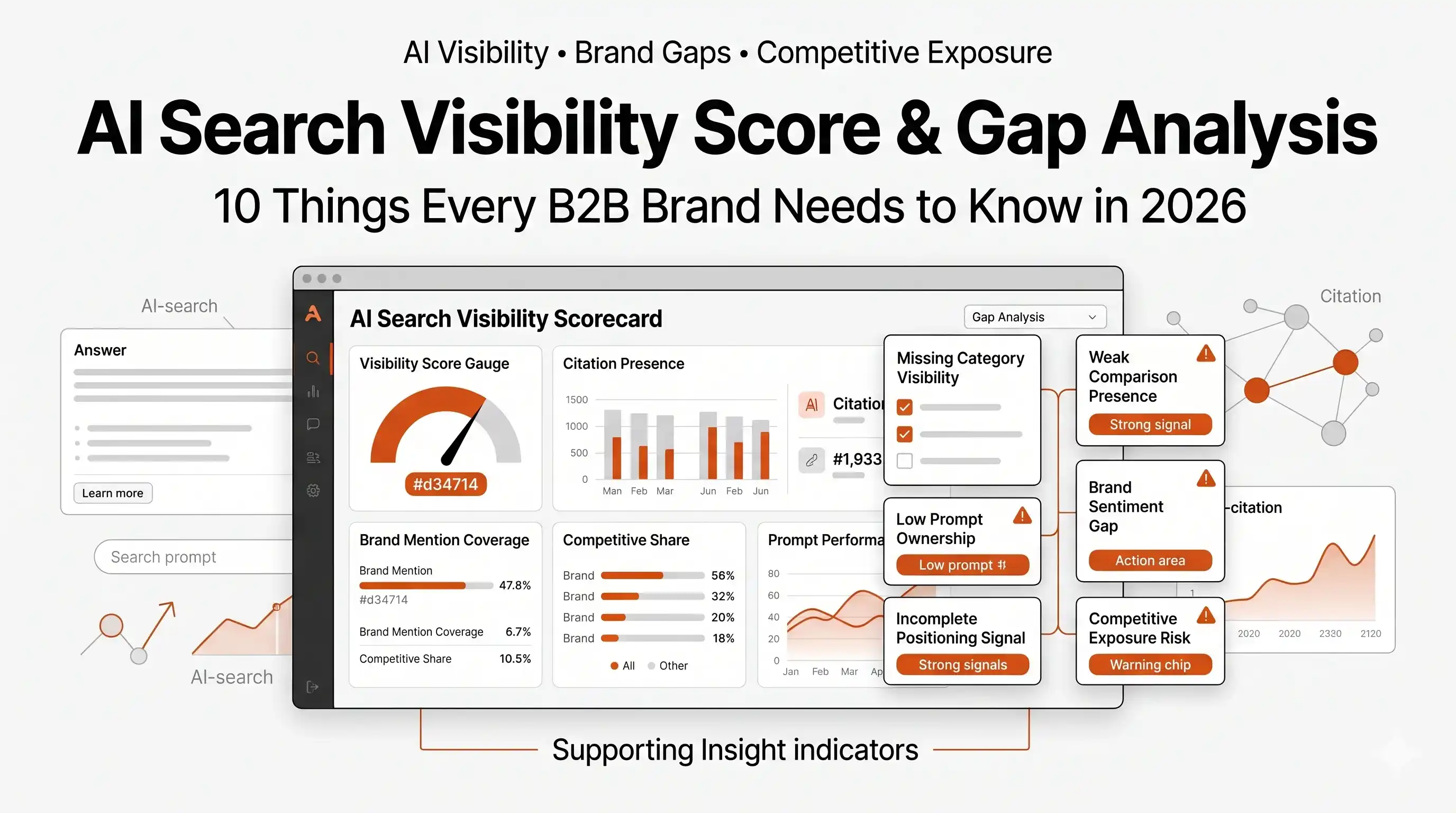
An AI Search Visibility Score measures how frequently, prominently, and accurately your brand appears across AI-generated search responses. Think of it as your brand's share of voice inside the answers that ChatGPT, Perplexity, Gemini, and Google AI Overviews deliver to buyers every day.
A Gap Analysis is the diagnostic companion: it maps every buyer prompt relevant to your business against every prompt where your brand currently appears, revealing exactly where your content is invisible. Together, the AI Search Visibility Score & Gap Analysis gives you a complete picture of both your current standing and the specific opportunities you are missing.
Unlike a single performance number, this framework is probabilistic. Your visibility changes based on query wording, platform context, content freshness, and model behavior, which is why continuous monitoring matters far more than a one-time audit.
The components that make up a complete AI Search Visibility Score & Gap Analysis include:
- Citation frequency across prompt clusters
- Answer inclusion rate by intent category
- Entity recognition and brand clarity signals
- Brand prominence within individual responses
- Topical authority depth and breadth
- Prompt coverage across informational, comparison, and purchase-intent queries
- Cross-platform consistency between AI engines
The 5-Component AI Visibility Score Formula
The most valuable thing we can give you is a real scoring framework, not a vague list of tips. Here is how a rigorous AI Search Visibility Score & Gap Analysis breaks down into five weighted components.
Component 1: Citation Frequency (30%)
Citation frequency is the single heaviest signal in the formula, measuring how often your brand appears when a cluster of related buyer prompts is run. We track mentions per prompt cluster, source inclusion rate, and repeated answer presence to build this score.
Component 2: Prompt Coverage (20%)
Prompt coverage measures how many relevant prompts actually trigger your brand's appearance in AI answers. We map four intent categories: informational prompts, comparison prompts, purchase-intent prompts, and solution queries, then score coverage across each.
Component 3: Entity Authority (20%)
Entity authority reflects how clearly and consistently AI models recognize and trust your brand. Strong signals include a consistent brand identity, structured knowledge presence, volume of web mentions, and clear topical associations across authoritative sources.
Component 4: Answer Prominence (15%)
Not all citations carry equal weight. A brand mentioned as the primary recommendation scores significantly higher than one listed as a supporting reference. We evaluate first-mention position, primary recommendation status, and depth of description within AI-generated responses.
Component 5: Cross-Platform Consistency (15%)
Consistency measures how stable your visibility remains across ChatGPT, Perplexity, Gemini, and Google AI Overviews. Brands that appear reliably on one platform but not others carry a significant gap risk, since buyers are spread across all four environments.
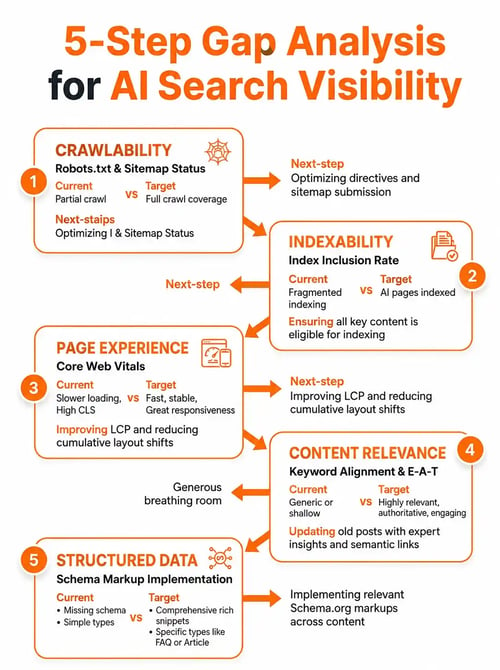
Visual guide to AI search visibility. Learn a 5-step gap analysis to close gaps and improve visibility.
How to Conduct a Proper AI Search Visibility Gap Analysis
A proper AI Search Visibility Gap Analysis is a five-step process that moves from discovery to action. Here is exactly how we approach it for B2B brands.
- Map your prompt universe.
- Run systematic prompt testing.
- Score your current visibility.
- Identify gap categories.
- Build a gap closure playbook.
Did You Know?
Around 93% of AI search sessions now end without a click to a website, making brand presence within the answer itself the primary measure of visibility in 2026.
How to Track Your AI Search Visibility Score Across Platforms
Tracking your AI Search Visibility Score & Gap Analysis across multiple AI platforms requires a disciplined, repeatable monitoring process. The four platforms you must cover in 2026 are ChatGPT, Perplexity, Google AI Overviews, and Gemini.
For each platform, your monitoring program should capture:
- Citation rate per prompt cluster (how often your brand appears)
- Citation position within responses (first mention vs. supporting reference)
- Competitor citation frequency (where competitors are winning against you)
- Uncited prompt categories (whitespace opportunities in your gap map)
- Content page performance (which specific pages earn citations and which are invisible)
Did You Know?
Visitors arriving via AI search convert at a rate 4.4x higher than traditional organic search users, proving that AI citation quality far outweighs the volume-based metrics of the past.
How Omnibound Measures and Improves AI Search Visibility Score & Gap Analysis Results
Most platforms stop at reporting. They show you a dashboard of citations and leave you to figure out what to do next. Omnibound's AI Search Intelligence goes substantially further, transforming raw visibility data into a complete optimization engine.
Here is exactly what sets Omnibound apart from standard monitoring tools:
|
Standard Monitoring Tools |
Omnibound AI Search Intelligence |
|
Dashboard reporting |
Actionable optimization insights |
|
Passive citation monitoring |
Active gap identification with prioritized actions |
|
Isolated metrics |
Unified context engine connecting buyer signals to visibility data |
|
Single-platform tracking |
Cross-platform visibility scoring across ChatGPT, Perplexity, Gemini, and Google AI |
|
Reporting what happened |
Explaining why scores changed and prescribing what to do next |
Omnibound tracks buyer prompts, competitor visibility shifts, customer intent signals, entity positioning, and AI search performance simultaneously. It then converts that intelligence into specific content recommendations, optimization priorities, and strategy decisions, not just a score.
The Competitor Intelligence module identifies where competitors are being cited instead of your brand, revealing the specific whitespace your gap analysis should target first. The B2B Marketing Context Engine unifies customer and market signals into a single, verifiable foundation that keeps your AI Search Visibility Score & Gap Analysis grounded in real buyer behavior rather than assumptions.
The result is not just measurement. It is a continuous improvement system that compounds your AI visibility advantage over time.
Building Your AI Visibility Improvement Workflow
A strong AI Search Visibility Score & Gap Analysis only creates value when it feeds a repeatable, structured workflow that closes gaps faster than competitors can open new ones.
The workflow we recommend for B2B brands in 2026 follows this sequence:
- Prompt Coverage Audit
- Content Optimization Sprint
- Entity Strength Review
- External Validation Campaign
- Score Tracking and Iteration
Each cycle of this workflow should produce a measurable improvement in your AI visibility score and a reduction in your gap count. Intelligent research tools that keep your buyer and market understanding current are essential to keeping the workflow grounded in real-world signals rather than static assumptions.
Conclusion
We built Omnibound to make that process rigorous, repeatable, and scalable. From AI Search Intelligence that tracks every prompt, citation, and gap, to AI marketing solutions that turn those insights into pipeline-driving content, we give B2B marketing teams the infrastructure they need to compete where buyers are actually making decisions: inside AI-generated answers.
Your AI Search Visibility Score & Gap Analysis baseline starts with measurement. Start measuring today.
FAQs
What exactly is an AI Search Visibility Score and how is it different from a traditional performance score?
An AI Search Visibility Score measures how frequently, prominently, and accurately your brand appears inside AI-generated answers across platforms like ChatGPT, Perplexity, Gemini, and Google AI Overviews. Unlike traditional performance scores that measure clicks and impressions, the AI visibility score measures citation frequency, answer inclusion rate, entity recognition, and cross-platform consistency, reflecting where buyers actually encounter your brand in 2026.
How do I calculate my AI Search Visibility Score in 2026?
A complete AI Search Visibility Score combines five weighted components: citation frequency (30%), prompt coverage (20%), entity authority (20%), answer prominence (15%), and cross-platform consistency (15%). You calculate each component by running systematic prompt tests across major AI engines, recording citation presence, position, and frequency, then applying the weighted formula to produce a composite score.
What is an AI visibility gap and how do I find mine?
An AI visibility gap is the measurable difference between the buyer prompts relevant to your business and the prompts where your brand actually appears in AI-generated responses. You find yours by mapping your full prompt universe, running those prompts across AI platforms, and comparing which prompts trigger competitor citations without triggering yours.
Is it possible to improve AI search visibility without producing massive amounts of new content?
Yes. Some of the highest-impact improvements come from restructuring existing content for answer extractability, strengthening entity signals for consistency, and building third-party validation through analyst citations and PR coverage. Adding clear definitions, FAQ blocks, and citation-friendly formatting to existing pages often produces measurable score improvements faster than publishing new content.
Which AI platform should I prioritize for visibility improvement in 2026?
All four major platforms (ChatGPT, Perplexity, Gemini, and Google AI Overviews) require independent optimization because they use fundamentally different citation models. Since only 11% of domains are cited by both ChatGPT and Perplexity for the same queries, a single-platform strategy leaves most of your gaps unaddressed. We recommend tracking all four and prioritizing gap closure on the platform where your buyers are most active.
How often should I run an AI Search Visibility Gap Analysis?
Monthly gap analysis cycles are the minimum standard for competitive B2B markets in 2026. AI model behavior, competitor content activity, and buyer prompt patterns all shift frequently enough that a quarterly audit will leave you reacting to shifts rather than anticipating them. Real-time monitoring tools that alert you to sudden citation changes are the most effective way to stay ahead.
What is the fastest way to close a large AI visibility gap?
The fastest gap-closure tactic is combining two actions simultaneously: restructuring your most relevant existing pages for answer extractability and launching a targeted third-party validation campaign to generate analyst citations and editorial references. Together, these two moves improve both your content's citation eligibility and your entity authority score, which are the two highest-leverage signals in the AI Search Visibility Score & Gap Analysis framework.