

Getting cited in ChatGPT responses is quickly becoming one of the most important visibility challenges for B2B brands in 2026. Here is the sobering reality: ChatGPT leaves 85% of retrieved pages uncited, meaning only 15% of sources it actually retrieves end up appearing in a final answer. Your content might already be in the retrieval pool without your brand ever receiving credit.
How ChatGPT Actually Chooses Sources (And Why Getting Cited in ChatGPT Is Not Automatic)
ChatGPT does not simply mirror a popularity contest. It evaluates sources across several distinct mechanisms before deciding what gets cited.
Understanding these mechanisms is the foundation of any serious citation strategy.
- Training knowledge
- Live retrieval
- Source prioritization
The critical insight is this: ChatGPT does not simply take what appears at the top of a web search and paste it in. It actively selects which retrieved sources are worth surfacing to the reader.
Your content must pass through all three filters, not just one, to earn a citation.
|
Traditional Visibility |
ChatGPT Citation Visibility |
|
Ranking in results |
Citation in synthesized answers |
|
SERP position |
Inclusion inside the response |
|
Keyword matching |
Prompt relevance and trust |
|
Click-through rate |
Extractability and credibility |
Why Most Brands Never Succeed at Getting Cited in ChatGPT
Most brands optimize for page visits. Very few optimize for citation eligibility, and that gap is exactly why so many brands are invisible in AI-generated answers.
Here are the six most common reasons brands fail at getting cited in ChatGPT responses:
- Weak entity definition
- Vague positioning
- Poor content structure
- Zero third-party validation
- Invisible outside owned channels
- No measurement in place
The good news is that every one of these is fixable with the right strategy and tools.
Did You Know?
Earned media drives 84% of AI citations across ChatGPT, Claude, and Gemini, based on an analysis of more than 25 million links. Paid placements and owned content alone cannot build the citation authority AI systems reward.
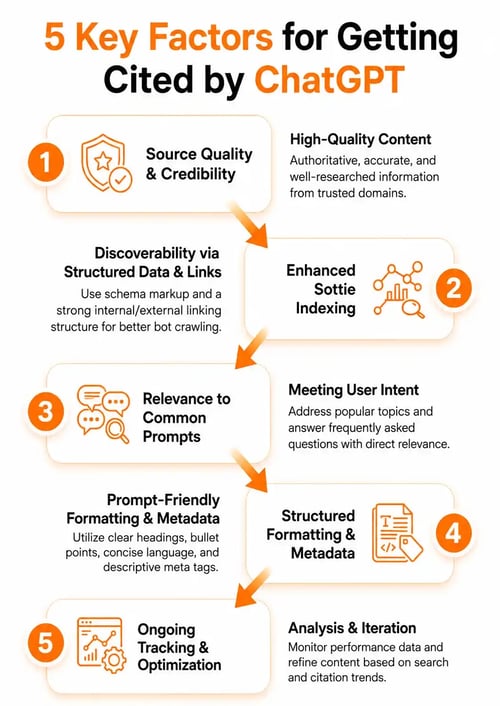
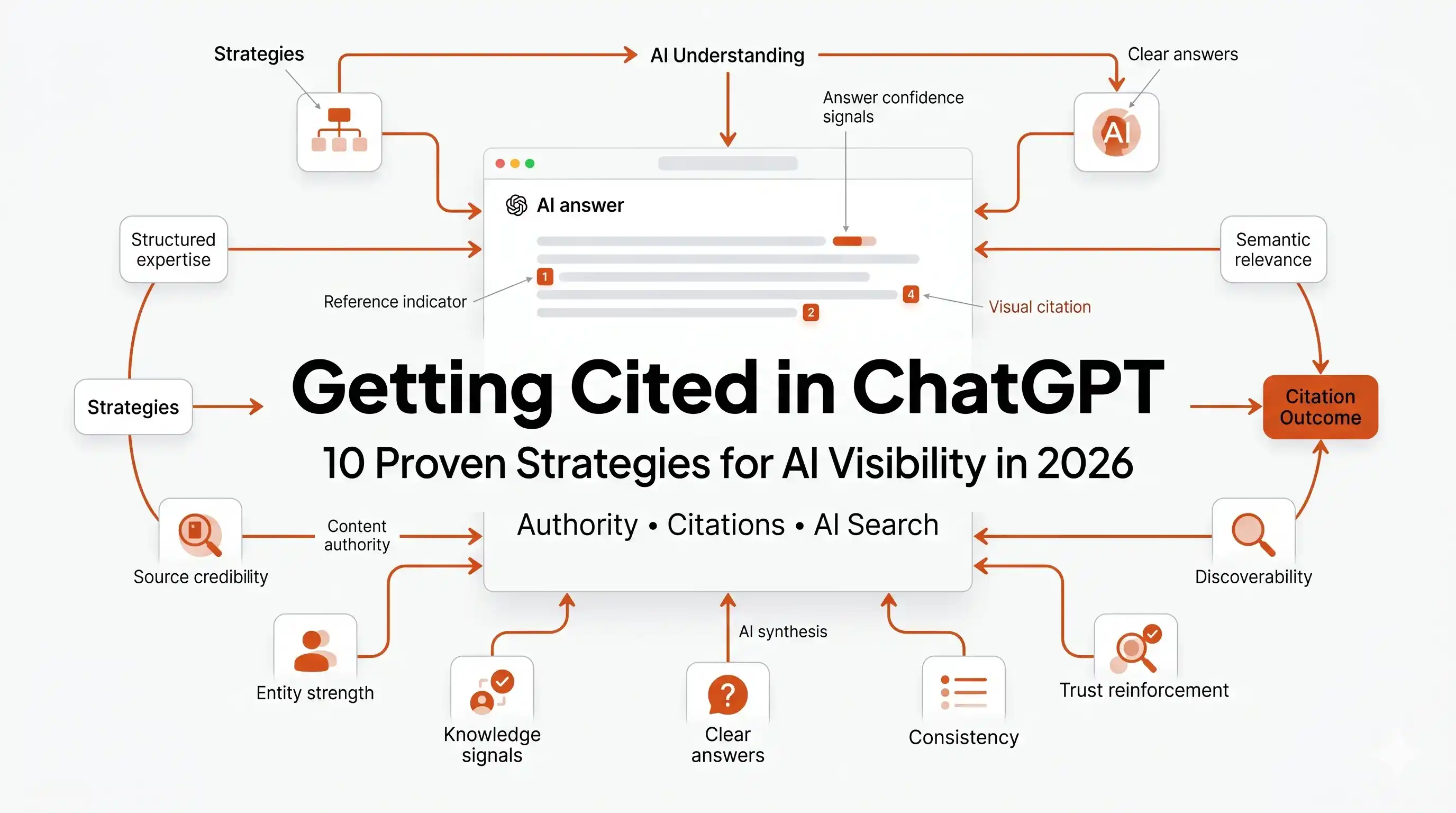
An infographic outlining the five factors that influence whether ChatGPT cites sources. It offers practical tips to improve credibility and citability.
10 Proven Strategies for Getting Cited in ChatGPT Responses
These ten strategies represent the most effective and actionable approaches we recommend for improving AI citation visibility in 2026. Each one addresses a distinct layer of how ChatGPT evaluates, retrieves, and cites sources.
1. Make Your Brand Easy for AI Systems to Understand
AI citation starts with clarity. ChatGPT favors content that is structured, explicit, and written in ways that make extraction effortless.
Use direct answers, concise definitions, comparison tables, and modular sections. Write as if you are answering a specific question, not writing an essay.
2. Build a Strong Entity Definition for Your Brand
Entity authority is one of the most consistently under-optimized factors in AI visibility. ChatGPT needs to clearly understand what you do, who you serve, and what category you own before it will confidently cite you.
Compare these two descriptions:
- Weak: "An AI-powered growth solution for modern teams."
- Strong: "An AI search visibility platform for B2B marketing teams that tracks buyer prompts and citation gaps across AI engines."
3. Get Your Brand Mentioned Beyond Your Own Website
This is one of the single biggest drivers of getting cited in ChatGPT. AI systems heavily weight third-party sources when selecting what to cite.
Focus on earning mentions in:
The broader your external mention ecosystem, the more citation-eligible your brand becomes.
4. Structure Content Specifically for AI Extraction
Write for retrieval and summarization, not just human scanning. AI systems prefer clear headings, definition-first writing, numbered lists, short explanatory blocks, and comparison tables.
Every page on your site should be able to answer a specific question quickly, completely, and without requiring the reader to hunt through paragraphs of background context first.
5. Create Citation-Worthy Content Assets
Original research, proprietary benchmarks, frameworks, and data studies give AI systems specific evidence to extract and cite. Generic opinion content rarely earns citations because it lacks the specificity that makes attribution meaningful.
6. Ensure Technical Accessibility for AI Crawlers
Your content cannot be cited if it cannot be retrieved. Verify that your site is fully crawlable, that your robots configuration does not block AI crawlers like GPTBot, and that your page architecture is clean and indexable.
7. Build Third-Party Trust Signals Across Multiple Channels
Reviews, citations, community reputation, and analyst references collectively form the trust ecosystem that AI systems draw on when evaluating source credibility. A brand that exists only on its own website is effectively unknown to the citation selection process.
8. Optimize Content Around the Prompts Buyers Actually Use
Getting cited in ChatGPT requires understanding what prompts are driving AI-generated answers in your category. Instead of generic topic coverage, build content specifically around prompts like:
When your content directly addresses these prompts, ChatGPT is far more likely to retrieve and cite it. Our B2B Marketing Context Engine helps teams map real buyer language to content priorities, so every asset you produce is built around the prompts that actually drive decisions.
9. Track Citation Visibility Systematically and Regularly
You cannot improve what you do not measure. Systematically testing buyer prompts across AI engines is the only reliable way to understand where your brand stands, where competitors are winning, and which content gaps need to be closed.
We recommend building a regular testing cadence that measures brand presence, competitor share of voice, citation frequency, sentiment, and source patterns. Our AI Search Intelligence platform is built specifically for this purpose, giving teams full visibility into every prompt, every citation, and every gap.
10. Maintain Content Freshness and Consistent Positioning
AI systems reward updated information and reinforced messaging. Content that was accurate six months ago but has not been revisited sends weak recency signals during live retrieval.
Build a regular content refresh process to ensure that your most important pages stay current, that your brand positioning remains consistent across all assets, and that new developments in your category are captured quickly. Our Content Refresh tool audits every asset against real buyer context and AI search readiness factors, identifying exactly which pages need attention and what to fix.
Did You Know?
Only 25% of pages are cited every time they appear in ChatGPT's web search results, while 58% of pages are never cited in queries where they already appear. Being retrieved is not the same as being cited.
How Omnibound Helps B2B Teams Improve ChatGPT Citation Visibility
We built Omnibound specifically to help B2B marketing teams understand and systematically improve their AI search presence. This means measuring where you stand today, identifying why competitors appear and you do not, and giving you the content and prompt intelligence to close those gaps deliberately.
Here is what the Omnibound platform delivers for teams working on getting cited in ChatGPT:
We connect to your existing stack through our platform integrations, ingesting signals from CRM data, call transcripts, review platforms, and more to build a complete picture of buyer intent and citation opportunity.
We built Omnibound to make that process systematic, measurable, and competitive. If getting cited in ChatGPT responses is a priority for your team in 2026, we invite you to explore our AI Search Intelligence platform and see exactly where your brand stands today.
FAQs
- How do you get your brand cited in ChatGPT responses?
Build structured, trustworthy, and contextually relevant content aligned with real buyer prompts. - Does ChatGPT use the same sources as Google?
No - ChatGPT prioritizes usefulness, trust, and extractable content over traditional web popularity. - What content types work best for ChatGPT citations in 2026?
Original research, benchmarks, comparison guides, and definition-first content earn the strongest citation visibility. - How can I track whether ChatGPT is citing my brand?
Test buyer prompts across AI engines and monitor citation frequency, competitors, and source patterns. - Why does ChatGPT cite competitors but not my brand?
Competitors often have stronger entity signals, third-party mentions, and more AI-friendly content structures. - Is investing in AI citation visibility worth it in 2026?
Yes - brands building citation authority now gain a long-term advantage in AI-driven discovery. - Do paid placements help with ChatGPT citations?
Rarely - editorial credibility and organic mentions drive most AI citations, not paid visibility.