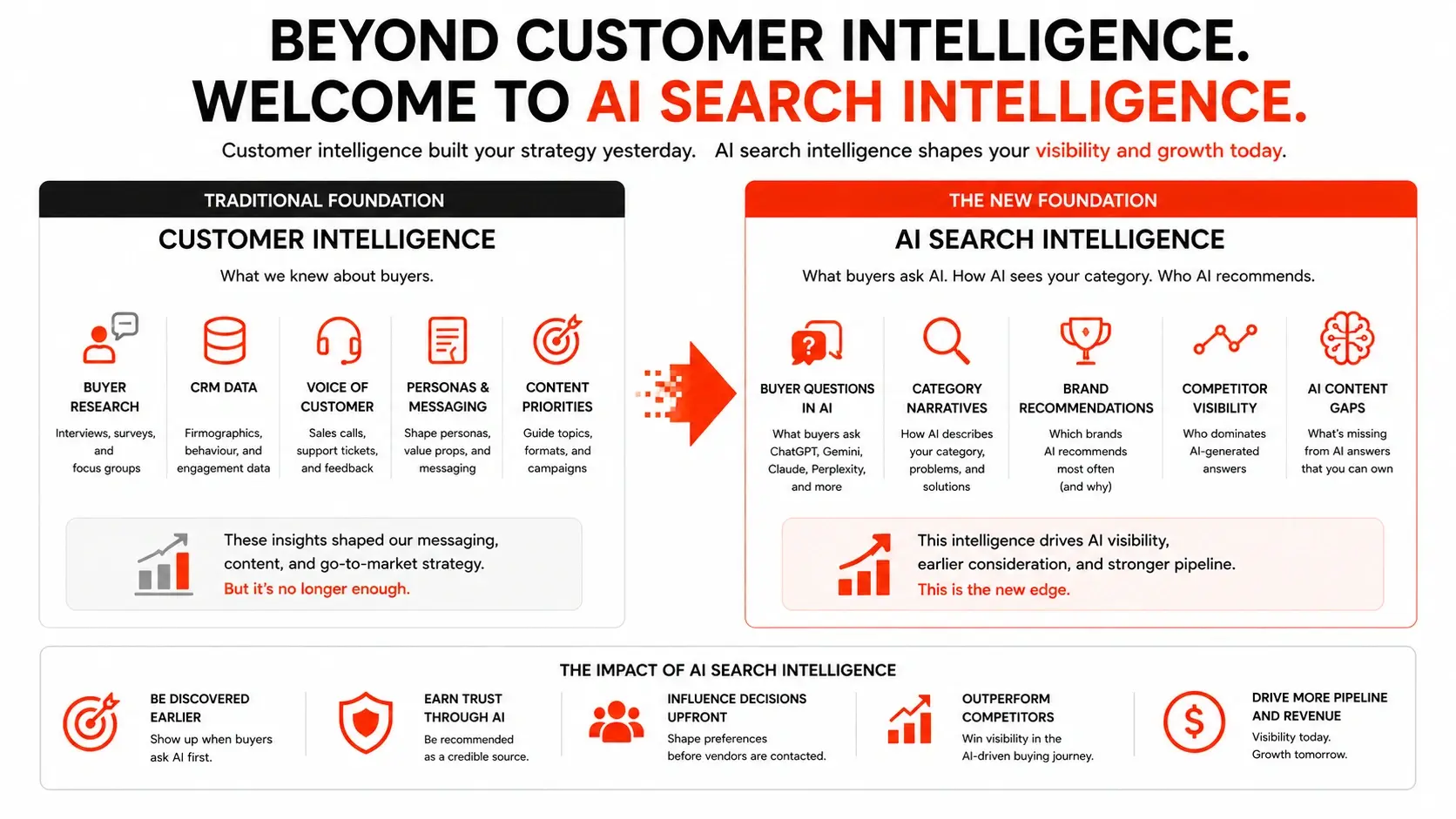


For years, B2B marketing teams built their content strategies on a single foundation: customer intelligence. They conducted buyer research, mined CRM data, ran surveys, and gathered voice of customer insights from sales calls and support tickets. These inputs shaped messaging, guided persona development, and informed content priorities. That work still matters. But it is no longer sufficient on its own.
Today, buyers discover solutions through a new channel that traditional customer intelligence cannot capture. When a procurement leader asks ChatGPT to compare vendors in a category, or when a technical director consults Google AI Overviews for implementation guidance, a different intelligence layer comes into play. Marketing teams now need to understand what buyers ask AI platforms, how AI describes their category, which brands AI recommends, and which competitors dominate AI-generated answers.

Customer intelligence explains what buyers need. AI Search Intelligence explains how buyers discover answers. Modern B2B marketing leaders require both to create content that earns buyer trust and AI recommendations simultaneously. This dual-layer approach represents the next evolution of B2B content intelligence, and it is reshaping how leading teams plan, produce, and measure their content investments.
What Is AI Search Intelligence?
AI Search Intelligence is the practice of understanding how AI-powered search platforms interpret your market, recommend brands, answer buyer questions, and surface trusted sources. It encompasses monitoring the prompts buyers use across platforms like ChatGPT, Google AI Overviews, Gemini, Claude, and Perplexity, then analyzing which brands appear in the answers, which sources earn citations, and where your category presence is weak or absent.
This discipline matters because AI-powered discovery is now a primary entry point in the B2B buying journey. Research shows that 84% of marketers acknowledge running generic campaigns despite using AI tools, which signals a significant gap between current practices and what the market demands. Buyers no longer start with a list of vendor websites. They start with a question directed at an AI platform, and the platform determines which brands enter the consideration set.
For B2B marketers, AI Search Visibility has become as strategically important as brand awareness was in the previous decade. If your brand does not appear in AI-generated answers when buyers ask category-relevant questions, you are invisible at the moment of highest intent. AI Search Intelligence closes that visibility gap by giving marketing teams a systematic way to monitor, measure, and improve their presence across AI platforms.
Customer Intelligence vs AI Search Intelligence
These two intelligence layers are complementary, not competitive. Each answers a different strategic question, and together they provide a complete picture of the buyer's journey. The framework below illustrates how they differ and where they connect.
|
Customer Intelligence |
AI Search Intelligence |
|---|---|
|
Customer interviews |
AI search behavior |
|
Voice of Customer |
AI-generated answers |
|
CRM insights |
AI visibility |
|
Buyer pain points |
AI recommendations |
|
Customer feedback |
Citation opportunities |
Customer intelligence tells you why a prospect chose your product, what objections they raised, and what language resonated during the sales conversation. AI Search Intelligence tells you what happened when that same prospect asked an AI platform for a category recommendation before they ever reached your website. Without both layers, your content strategy operates with blind spots in either understanding or discovery.
The New Content Intelligence Framework
Most content intelligence discussions focus narrowly on analytics and performance reporting. They track page views, time on page, and conversion rates, then report on what already happened. This rearview approach does not help teams decide what to create next or whether their content will be visible in the channels where buyers actually look.
The modern content intelligence framework integrates four intelligence streams into a unified content strategy that drives measurable revenue outcomes. This model connects inputs that most platforms treat as separate disciplines.
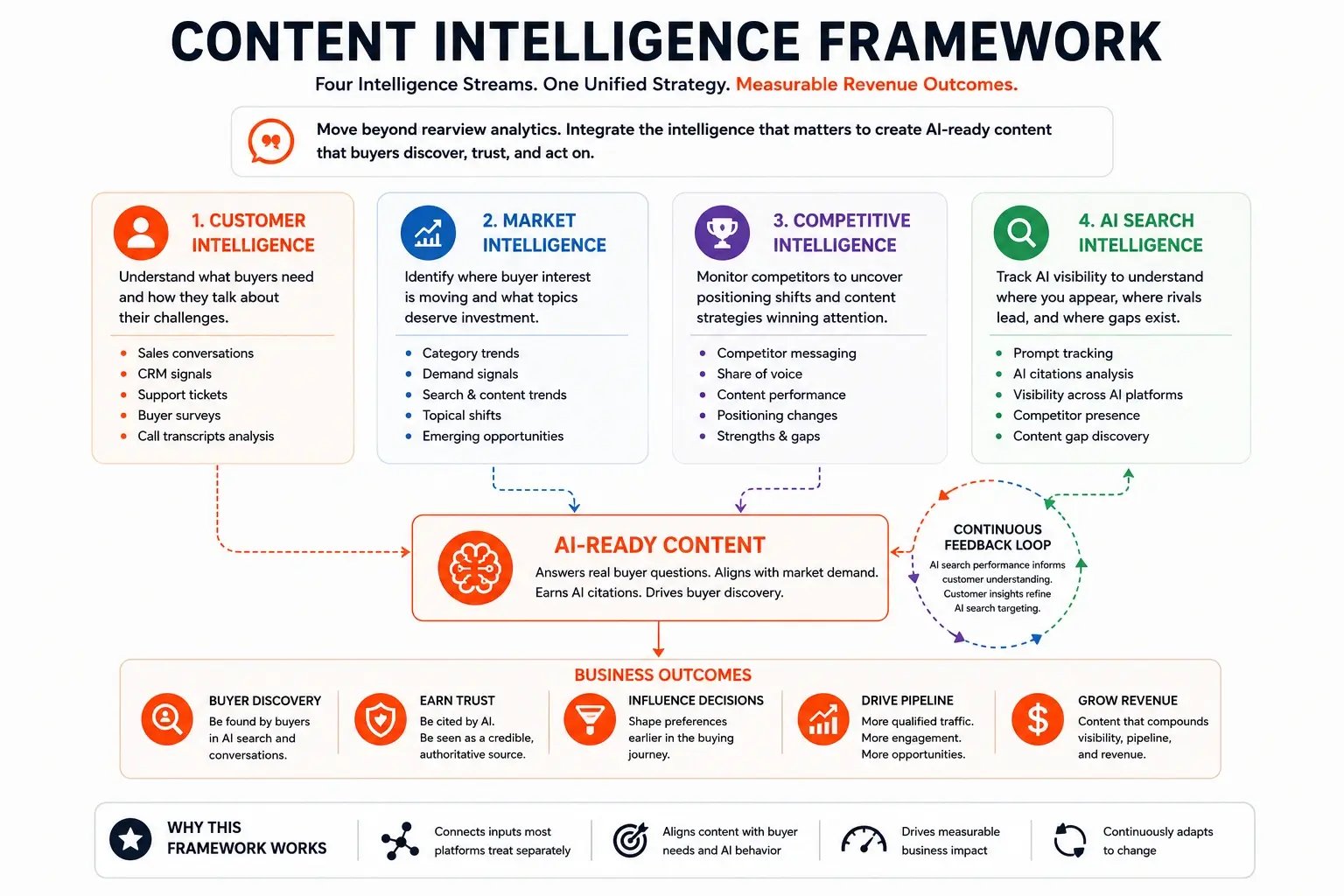
- Customer Intelligence: Real buyer conversations, CRM signals, support tickets, and sales call analysis that reveal what buyers need and the language they use to describe their problems.
- Market Intelligence: Category trends, demand signals, and topical shifts that indicate where buyer interest is moving and which subjects warrant content investment.
- Competitive Intelligence: Continuous monitoring of competitor messaging, positioning shifts, and content strategies that reveal where rivals are gaining share of voice.
- AI Search Intelligence: Prompt tracking, citation analysis, and visibility measurement across AI platforms that reveal where your brand appears, where competitors dominate, and where content gaps exist.
These four streams converge into a single output: AI-ready content that answers real buyer questions, aligns with market demand, and earns AI citations. That content drives buyer discovery, which feeds pipeline and revenue growth. The framework is not linear. It is a continuous feedback loop where AI search performance informs customer understanding, and customer insights refine AI search targeting.
Why AI Search Is Changing Content Intelligence
AI systems increasingly influence vendor discovery, solution research, product comparisons, and category education. When a B2B buyer types a question into an AI platform, the response shapes their shortlist before any sales conversation begins. This shift means content intelligence now requires monitoring both what buyers say directly and what AI platforms say on your behalf.
Consider a common scenario. A VP of Engineering asks an AI assistant to recommend platforms for cloud infrastructure monitoring. The AI generates a response that names three vendors, summarizes their strengths, and cites specific sources. If your company is not in that response, you have lost the opportunity before the buyer visits a single website. Traditional content analytics would never surface this gap because the interaction happened outside your owned channels.
This is why B2B content production must evolve beyond producing content for human readers alone. Content must also be structured, sourced, and written in ways that AI platforms can interpret, trust, and recommend. That requires a fundamentally different approach to content planning, one that treats AI platforms as a distinct audience with specific requirements for clarity, authority, and evidence.
How B2B Teams Build AI Search-Ready Content
Building AI-ready content requires a structured workflow that integrates customer understanding with AI search monitoring at every stage. The process below connects intelligence gathering to content production to visibility measurement in a single, repeatable cycle.
- Customer Conversations: Start with real buyer language from sales calls, support interactions, and CRM notes. These conversations reveal the actual questions buyers ask, not the questions marketing assumes they ask.
- Buyer Questions: Extract and categorize the specific questions buyers raise at each stage of the journey. These questions become the foundation for content topics.
- Market Trends: Layer in market intelligence to identify which topics are gaining momentum and which are declining in relevance. Prioritize content that addresses both buyer needs and emerging demand.
- AI Search Intelligence: Map buyer questions to actual AI prompts and monitor which brands currently appear in the answers. Identify citation gaps where your brand is absent and competitors are present.
- Content Brief: Create a brief that combines buyer language, market context, and AI search gaps into a single document. The brief should specify the question being answered, the audience segment, and the AI citation opportunity.
- Expert Content: Produce content that directly answers the target question with depth, evidence, and clarity. Include original data, expert perspectives, and specific examples that AI platforms can reference and cite.
- AI Visibility Monitoring: After publication, track whether the content appears in AI-generated answers for the target prompts. Measure citation frequency, monitor competitor movement, and refine the content as needed.
This workflow ties together multiple pillars of content production into a system that produces content designed for both human readers and AI platforms. It replaces guesswork with evidence and replaces volume with precision.
Measuring Modern Content Intelligence
Traditional content metrics still have a place, but they no longer capture the full picture of content performance. Engagement, clicks, and downloads tell you what happened after buyers reached your content. They do not tell you whether buyers found your brand through AI platforms in the first place.
Modern content intelligence requires a different set of metrics that reflect how buyers discover and evaluate solutions in an AI-mediated environment.
|
Traditional Metrics |
Modern Metrics |
|---|---|
| Engagement (time on page, scroll depth) |
AI visibility across platforms |
|
Clicks and sessions |
AI citations earned |
|
Downloads and form fills |
Recommendation frequency |
|
Bounce rate |
Topical authority and AI share of voice |
AI visibility measures whether your brand appears in AI-generated answers for the prompts your buyers use. AI citations track how often AI platforms reference your content as a source. Recommendation frequency reveals how consistently AI systems include your brand in vendor comparisons. Topical authority indicates whether AI platforms consider your brand a trusted source within a specific subject area. Together, these metrics provide a forward-looking view of content performance that traditional analytics cannot deliver.
Why AI Search Intelligence Improves Customer Intelligence
AI Search Intelligence does not replace customer intelligence. It strengthens it by revealing what buyers ask before they engage with your brand directly. When you monitor AI prompts in your category, you gain access to a continuous stream of buyer questions that may never surface in sales calls or support tickets.
Specifically, AI Search reveals five categories of insight that enrich customer understanding:
Recurring buyer questions: The prompts buyers use most frequently indicate which problems are top of mind and which topics deserve content investment.
Emerging terminology: The language buyers use in AI prompts often differs from the language marketing teams use internally. Tracking these terms helps align content with how buyers actually describe their needs.
Competitor positioning: When AI platforms recommend competitors, the answers reveal how rivals position themselves and which messages resonate with AI systems.
Content gaps: Prompts where no brand earns a citation indicate topics where authoritative content is scarce and where your brand can establish early presence.
Category narratives: The way AI platforms describe your market reveals the dominant narrative shaping buyer understanding, whether it aligns with your positioning or contradicts it.
This creates a continuous feedback loop. AI search insights inform customer research priorities, which refine content strategy, which improves AI visibility, which generates new insights. The loop accelerates as teams publish more AI-ready content and monitor its performance across platforms. Over time, the Marketing Living Research Engine becomes self-reinforcing, with each content asset producing intelligence that guides the next.
How Omnibound Combines Customer Intelligence with AI Search Intelligence
Omnibound operates as an AI Search Intelligence and content intelligence platform that helps marketing teams connect customer understanding, market context, competitive intelligence, and AI search visibility in a single system. The platform is not a customer analytics tool or a content analytics dashboard. It is a strategic decision platform that guides what content to create, why it matters, and how it will perform across both human and AI audiences.
With Omnibound, marketing teams can:
Understand customer questions by analyzing real buyer conversations, CRM signals, and voice of customer data from sales calls and support interactions.
Monitor AI Search visibility by tracking the prompts buyers use across ChatGPT, Google AI Overviews, Gemini, Claude, and Perplexity, then measuring which brands earn citations.
Identify competitor messaging shifts through continuous monitoring of how rivals appear in AI-generated answers and which positioning changes gain traction.
Prioritize high-impact content by connecting buyer demand, market trends, and AI citation gaps to identify where content investment will produce the greatest visibility return.
Improve AI discoverability by producing content structured to answer real buyer questions with the evidence and clarity AI platforms require for citation.
Strengthen category authority by building topical depth across the subjects that matter most to buyers and that AI platforms prioritize in their responses.
The emphasis is on creating strategic content decisions, not simply reporting metrics. Omnibound helps teams answer the question of what to create next, not just what performed last quarter. This forward-looking approach is what separates leading brand marketing teams from those still relying on retrospective dashboards.
For teams focused on customer persona research and turning marketing data into actionable insights, the platform provides the connective tissue between what buyers say, what AI platforms recommend, and what content will drive pipeline. It is built for CMOs, product marketing leaders, content marketing teams, demand generation teams, and GTM leaders who need to make content decisions grounded in evidence rather than assumption.
Conclusion
Customer intelligence alone no longer provides a complete picture of the B2B buying journey. Modern marketing leaders need to understand what customers are asking, what competitors are saying, and how AI search platforms interpret and recommend information. Combining customer intelligence with AI Search Intelligence creates a stronger strategic foundation for content decisions than either discipline can deliver independently.
The teams that adopt this dual-intelligence approach will create content that buyers trust and AI platforms recommend. They will identify opportunities before competitors do, close visibility gaps before they impact pipeline, and build category authority that compounds over time. In 2026 and beyond, B2B content intelligence means understanding both the questions buyers ask and the answers AI platforms give. Teams that master both will own the conversation. Teams that do not will wonder why their content stopped working.
Frequently Asked Questions
How should senior B2B marketing leaders evolve their AI marketing strategy to support cross-functional growth?
Senior B2B marketing leaders should combine customer, market, competitive, and AI Search Intelligence to align marketing, sales, product, and GTM teams around shared buyer insights. Platforms like Omnibound help unify these signals, enabling smarter content decisions, stronger collaboration, and sustainable pipeline growth.
How can B2B marketing leaders use AI to analyze GTM performance and identify what drives pipeline impact?
B2B marketing leaders should use AI to combine CRM data, buyer behavior, AI visibility, citation frequency, and competitive insights. Omnibound connects these signals to reveal which content, topics, and messaging influence buyer discovery and contribute most to pipeline growth.
How should B2B sales leaders phase agentic workflows into existing motions while avoiding slowing team rollout?
B2B sales leaders should introduce agentic workflows gradually, starting with buyer research, content planning, and intelligence gathering before expanding automation. Omnibound integrates AI Search and customer intelligence into existing GTM workflows, enabling adoption without disrupting established sales processes.
Which tools are best for implementing content intelligence in a business?
Content intelligence works best when organizations combine customer, market, competitive, and AI Search Intelligence rather than relying on standalone analytics tools. Platforms like Omnibound help unify buyer insights, AI Search visibility, citation tracking, competitor monitoring, and content planning into a single workflow, enabling teams to prioritize high-impact content, improve AI discoverability, and make strategic content decisions based on measurable business outcomes rather than historical reporting alone.
What is B2B content intelligence?
B2B content intelligence is the practice of combining customer intelligence, market intelligence, competitive intelligence, and AI Search Intelligence to guide content strategy and production. It goes beyond content analytics to help teams decide what to create, which topics to prioritize, and how to ensure that content reaches buyers through both traditional channels and AI-powered discovery platforms.
What is AI Search Intelligence?
AI Search Intelligence is the practice of understanding how AI-powered search platforms interpret your market, recommend brands, answer buyer questions, and surface trusted sources. It involves tracking the prompts buyers use, monitoring which brands earn citations, identifying visibility gaps, and using those insights to create content that AI platforms will reference and recommend.
How does AI Search Intelligence improve content strategy?
AI Search Intelligence reveals which questions buyers actually ask AI platforms, which brands appear in the answers, and where content gaps exist. This information helps teams prioritize topics that align with real demand, create content structured for AI citation, and measure visibility outcomes that traditional analytics cannot capture.
What is the difference between customer intelligence and AI Search Intelligence?
Customer intelligence focuses on what buyers need based on direct interactions like interviews, CRM data, and voice of customer analysis. AI Search Intelligence focuses on how buyers discover answers through AI-powered platforms, including what they ask, which brands AI recommends, and which sources earn citations. Customer intelligence explains buyer needs, while AI Search Intelligence explains buyer discovery.
How do AI platforms influence B2B buying decisions?
AI platforms influence B2B buying decisions by serving as a primary discovery channel where buyers ask questions, compare vendors, and research solutions. When a buyer asks an AI platform for a category recommendation, the response shapes their shortlist before they visit any vendor website. Brands that appear in AI-generated answers gain early consideration, while absent brands lose the opportunity entirely.
How do marketers improve AI Search visibility?
Marketers improve AI Search visibility by creating content that directly answers the questions buyers ask AI platforms, structuring that content with clear evidence and authoritative sourcing, and monitoring whether it earns citations over time. Consistent tracking of prompts, citations, and competitor presence allows teams to identify gaps and refine their content to strengthen AI discoverability.
Why should B2B teams combine customer intelligence with AI Search Intelligence?
Combining customer intelligence with AI Search Intelligence gives teams a complete view of both buyer needs and buyer discovery. Customer intelligence ensures content addresses real problems with the right language. AI Search Intelligence ensures that content reaches buyers at the moment of discovery. Together, they create content that buyers trust and AI platforms recommend, which drives both engagement and pipeline.
What metrics matter for modern content intelligence?
Modern content intelligence metrics include AI visibility across platforms, AI citations earned, recommendation frequency in AI-generated answers, topical authority within a category, and AI share of voice relative to competitors. Traditional metrics like engagement, clicks, and downloads remain useful but do not capture whether buyers discovered your brand through AI-mediated channels before reaching your content.