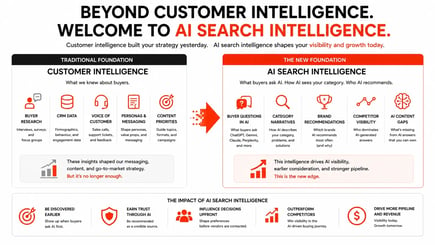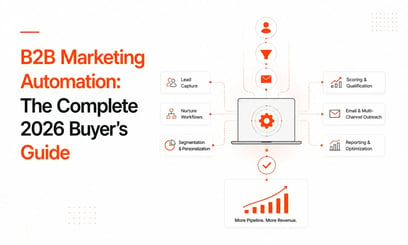


In 2026, the digital landscape has shifted toward self-serve validation where 39% of B2B buyers are now willing to spend over $500,000 through a purely digital, self-serve process without speaking to a sales representative. We see that effective AI marketing content production must now focus on providing the clarity and confidence required to move these high-stakes deals forward without human intervention.
Key Takeaways
|
Focus Area |
2026 Insight |
|---|---|
|
Core Strategy |
Move beyond top-of-funnel traffic and focus on content that accelerates pipeline velocity and sales conversations. |
|
Platform Integration |
Utilize a comprehensive AI content marketing platform for B2B teams to unify signals and content execution. |
|
Content Purpose |
Shift from general education to specific validation through use-case explainers and comparison narratives. |
|
Solution Synergy |
Implement AI solutions for content marketing that ground production in real customer signals rather than generic prompts. |
|
Measuring Success |
Prioritize pipeline influence and conversion velocity over vanity metrics like clicks or page views. |
What is mid-funnel content?
It is content designed for the consideration and validation stages of the buyer journey, focusing on differentiation and proof rather than awareness.
How does AI support demand gen?
AI processes massive volumes of customer and market signals to create highly personalized narratives that resonate with specific account pain points.
What content drives pipeline?
Content that handles objections, compares solutions, and provides specific use-case validation drives the highest progression in the sales funnel.
Why Most AI Content Fails in the Mid-Funnel?
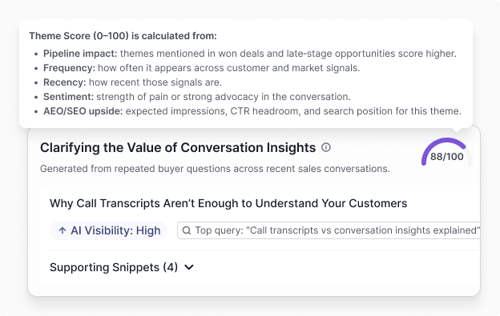
Most AI-generated content today focuses on volume rather than value, leading to a surplus of top-of-funnel noise that buyers ignore. In 2026, we find that buyers are looking for depth and specific answers to complex business problems during their research phase. Generic AI tools often fail because they lack the context of your specific market and customer conversations. For mid-funnel success, content must be grounded in reality rather than hallucinated or generalized training data.
Mid-funnel buyers do not need more education on the problem they already know they have. They require clarity on why your specific solution is the best fit for their unique environment and constraints. We treat AI as a decision-stage engine that synthesizes intelligence to create content that accelerates the deal. This approach moves the needle from generating traffic to generating actual revenue and pipeline for the organization.
What is Mid-Funnel & Demand Gen Content (Really)?
Mid-funnel content serves as the bridge between initial interest and a final purchasing decision. It is designed to handle the heavy lifting of validation and technical consideration that modern B2B buyers perform independently.
Demand generation content is specifically engineered to create sales conversations by highlighting the cost of inaction and the benefits of your unique approach. By implementing AI solutions for demand generation, we can map content directly to buyer intent signals. Common examples include deep-dive use-case explainers that show your product in action within a specific industry. Comparison narratives also play a vital role by helping buyers understand your differentiation against competitors or the status quo.
This stage also requires sales enablement assets that your internal champions can use to convince other stakeholders. Our goal is to provide enough proof and validation that the buyer feels confident moving to a contract or demo phase.
Why AI is Perfectly Suited for Mid-Funnel Content?
AI excels at recognizing patterns across thousands of customer interactions and successful deal cycles. By leveraging an AI content marketing platform, we can extract what actually resonates with buyers and scale that narrative. Speed and consistency are critical when targeting multiple accounts simultaneously in a mid-funnel strategy. AI allows us to maintain a uniform brand voice while adjusting the technical depth of the content based on the reader's role.
We use AI to adapt messaging to buyer readiness in real time based on their engagement with previous assets. This ensures that a technical lead receives deep documentation while an executive receives a high-level value narrative. The ability to reuse core narratives across different formats (like turning a case study into a sequence of social posts) is a major advantage. This creates a cohesive experience for the buyer regardless of where they interact with our brand.
Did You Know?
81% of frequent AI users in sales and marketing reported shorter deal cycles, enabling significantly faster pipeline velocity in 2026.
Core Mid-Funnel Content Types AI Can Create
We focus on creating diverse assets through AI content production that cater to different buyer personas within a single account. This variety ensures that every stakeholder finds the validation they need to support the purchase.
Value narratives by buying stage are essential for moving prospects from general interest to specific intent. AI can generate these narratives by analyzing successful historical deals and identifying the key value drivers for each stage.
- Use-case driven content: Deep dives into how the solution solves specific industry challenges.
- Competitive framing: Comparison charts and articles that highlight your unique advantages.
- Objection-handling narratives: Pre-emptive answers to common technical or security concerns.
- Proof & validation: Data-backed whitepapers and case studies tailored to specific market segments.
While AI handles the heavy lifting of drafting and structuring, humans still need to guide the strategic direction. We ensure that the final output aligns with the nuances of our specific brand identity and market positioning.
How AI Creates Demand Gen Content (Step-by-Step Framework)
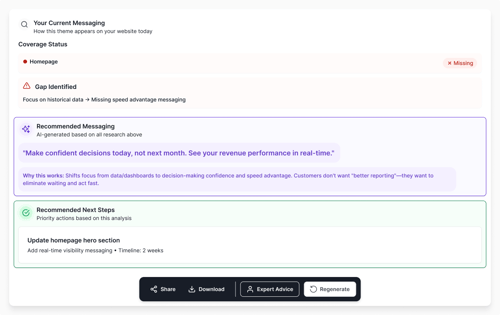
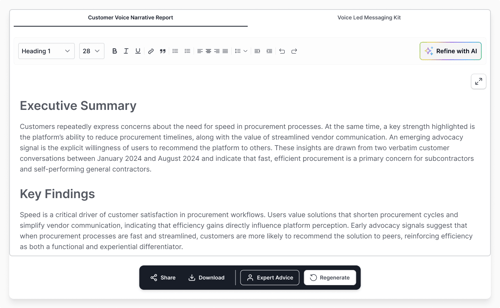
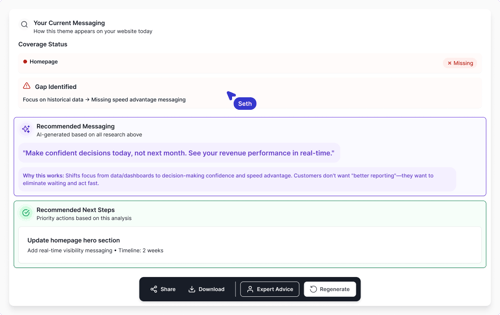
Our framework begins by identifying buying-stage signals through marketing strategy alignment. We track how accounts interact with our site and third-party data to determine their current level of readiness.
Once we map intent to a specific narrative, the AI generates stage-aware content that addresses the buyer's current questions. This ensures that we are always providing the right information at the right time to move the deal forward.
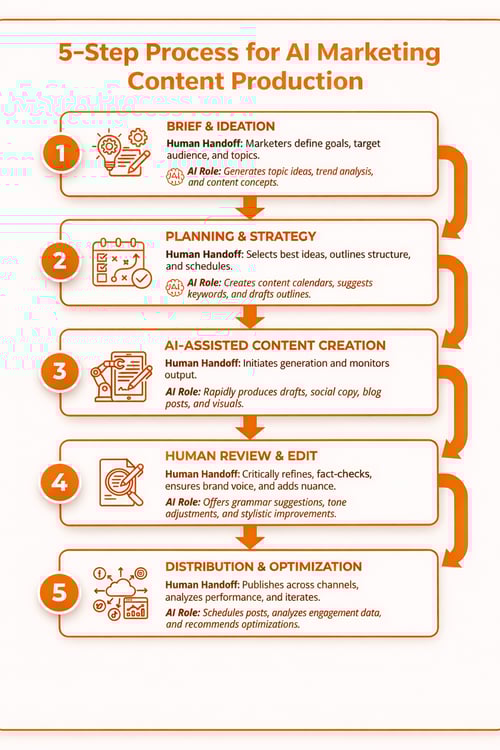
A concise visual guide to the 5-step AI marketing content production process, from ideation to distribution and measurement.
After generation, we personalize the content by account or segment to increase its relevance and impact. This granular approach is what differentiates high-performing demand gen from generic marketing efforts.
The final step involves optimizing the content based on real-time engagement signals. If a particular narrative isn't converting, we can quickly iterate and deploy a new version based on updated AI insights.
Mapping AI Mid-Funnel Content to GTM Channels
A successful GTM strategy ensures that the same core narrative is distributed across multiple formats and channels. We use intelligent research to identify which channels are most effective for specific buyer segments.
Website solution and comparison pages serve as the foundation for our mid-funnel digital presence. These pages must be constantly updated with the latest competitive intelligence and customer success data to remain effective.
For sales teams, AI generates updated decks and email nurtures that are tailored to the specific pains of a target account. This alignment between marketing and sales ensures a seamless transition for the buyer as they move through the funnel.
In paid demand generation and ABM campaigns, AI allows us to run hundreds of variations of the same ad narrative. This high-frequency testing helps us identify the exact messaging that triggers a demo request or a meeting.
What AI Demand Gen Content is NOT
It is crucial to distinguish high-quality demand generation content from low-value SEO spam. We do not use AI to churn out generic articles designed solely for search engines without regard for the buyer's actual needs.
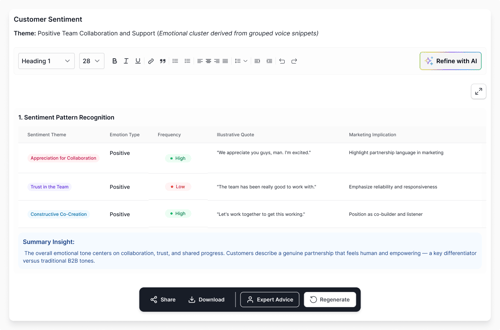
Effective content is grounded in our B2B marketing context engine, which ensures every piece is based on verified signals. This prevents the generic, "one-size-fits-all" feel that plagues many automated marketing efforts in 2026.
"Mid-funnel content isn't about volume, it is about accuracy. If your AI isn't grounded in your customer's voice, it is just noise."
We also avoid using top-of-funnel logic for mid-funnel assets, as this often leads to shallow content that doesn't build trust. Mid-funnel buyers can sense when they are being "educated" vs when they are being "helped," and we strive for the latter.
Measuring Impact: Mid-Funnel Content KPIs
Success in the middle of the funnel is measured by how quickly and effectively content moves prospects toward a closed deal. We look at conversion velocity as a primary indicator of content health and narrative resonance.
Pipeline influenced is another critical metric that tracks which assets were consumed before an opportunity was created or progressed. This data helps us understand the ROI of our AI content efforts beyond simple traffic numbers.
Did You Know?
Landing pages optimized with AI-driven personalization see a 36% higher conversion rate compared to static versions.
We also monitor sales engagement with marketing assets to ensure our enablement strategy is working. When sales reps frequently share AI-generated content with their prospects, it indicates the content is genuinely useful in the field. Our goal is to build a bridge from content engagement to revenue impact by observing how specific pieces correlate with higher deal sizes. We use secure AI solutions to analyze this data without compromising customer privacy.
Common Mistakes Teams Make Using AI for Demand Gen
Many teams treat AI like a simple copywriter rather than a strategic GTM partner. This leads to high volumes of content that lack a cohesive narrative and fail to address the actual concerns of the buyer. Ignoring buyer signals is another major pitfall that results in irrelevant content distribution. We prioritize using content marketing solutions that integrate intent data directly into the production workflow.
- Over-automating without human narrative control.
- Using top-of-funnel educational logic in consideration-stage assets.
- Failing to personalize content for different stakeholders in a buying committee.
- Neglecting to update content based on changing market signals.
Relying solely on AI without a strategic framework often results in "brand drift" where the messaging becomes inconsistent. We maintain a central brand voice guide within our AI platform to ensure every piece of content remains on-brand.
The Future: AI as a Living Demand Gen Engine
In the coming years, we expect AI to move beyond static asset generation and toward real-time narrative updates. Content will automatically shift its focus as new market trends or competitive threats emerge in the buyer's landscape. We are already seeing the benefits of AI-driven brief generation that speeds up the entire GTM planning process. This allows marketing teams to be more agile and responsive to the needs of the sales organization.
The alignment between marketing and sales will become even more automated through signal-driven content orchestration. AI will know exactly when to trigger a specific sales enablement asset based on a prospect's behavior on the website. Ultimately, AI will serve as a living demand generation engine that continuously learns from every deal, win, and loss. This virtuous cycle ensures that our mid-funnel content is always becoming more effective and precise over time.
Final Playbook: Using AI to Power Mid-Funnel Demand Gen
To successfully implement AI in your mid-funnel strategy, you must start with a foundation of high-quality customer and market data. We recommend a phased approach that focuses on one or two key buyer personas before scaling across the entire organization.
Our final playbook for 2026 focuses on the synergy between human strategy and AI execution. By following this actionable checklist, your team can start driving more pipeline through intelligent content production immediately.
- Audit your current mid-funnel assets and identify gaps in validation and proof.
- Integrate your customer conversation data into your AI platform to ground the production process.
- Create a set of signal-driven playbooks that map specific buyer actions to content responses.
- Develop a feedback loop between sales and marketing to continuously improve asset quality.
- Monitor conversion velocity as your primary KPI to track the impact on pipeline growth.
Conclusion
The role of AI in marketing content production has evolved from a simple drafting tool into a sophisticated pipeline accelerator. By focusing on the mid-funnel needs of modern B2B buyers, we can use AI to build the clarity and confidence required for high-stakes decisions. As we move through 2026, the teams that successfully align their AI content strategy with real customer signals will be the ones that dominate their markets and drive consistent revenue growth.
.jpg?height=245&name=unnamed%20(6).jpg)