

Early AI deployments in sales have boosted win rates by more than 30%, proving that organizations using AI for data‑driven sales enablement and objection handling gain measurable revenue advantages in 2026.
Key Takeaways
|
Key Question |
Short Answer |
|---|---|
|
What is AI for data‑driven sales enablement? |
It uses conversation intelligence, CRM signals, and buyer data to guide messaging, objection responses, and sales strategy. |
|
How does AI identify buyer objections? |
AI analyzes transcripts, emails, CRM notes, and product feedback to detect patterns in pricing concerns, feature gaps, and competitive comparisons. |
|
Why do marketing teams benefit from sales conversation intelligence? |
Insights from conversations help refine positioning, messaging, and campaign strategies based on real buyer language. |
|
What platform capabilities enable this intelligence? |
Tools like the B2B Marketing Context Engine unify signals from CRM, calls, and market data into strategic insight. |
|
How do teams operationalize these insights? |
Many companies build playbooks, campaigns, and messaging using Intelligent Research and AI-driven market analysis. |
|
Where does AI drive the most impact? |
Revenue leaders often see results in campaign execution, especially with AI solutions for demand generation that align sales insights with marketing campaigns. |
Why Traditional Sales Enablement Is No Longer Enough
Traditional sales enablement relies heavily on training sessions, static playbooks, and limited feedback loops.
In 2026, revenue teams face more complex buyer journeys and far more digital touchpoints.
Most organizations still lack visibility into what prospects actually say during sales calls.
This disconnect leads to reactive objection handling and inconsistent messaging.
- Sales conversations rarely feed back into marketing strategy
- Objection handling varies widely across reps
- Messaging gaps persist across campaigns and calls
- Leadership lacks real visibility into buyer concerns
AI product marketing systems now close this gap by analyzing conversations and turning them into structured insights.
What AI‑Driven Sales Enablement Actually Looks Like
AI-driven sales enablement replaces intuition with structured intelligence derived from real buyer conversations.
Instead of relying on occasional deal reviews, AI continuously analyzes calls, transcripts, emails, and CRM activity.
This analysis identifies messaging performance, objection trends, and buyer intent signals.
Sales and marketing teams then convert these insights into new messaging, campaigns, and playbooks.
|
Traditional Enablement |
AI‑Driven Enablement |
|---|---|
|
Training sessions |
Continuous conversation intelligence |
|
Static sales scripts |
Adaptive playbooks based on data |
|
Manager‑led coaching |
Real‑time AI recommendations |
|
Limited buyer insight |
Voice‑of‑customer intelligence |
How AI Identifies Buyer Objections at Scale
AI systems analyze thousands of sales conversations simultaneously.
This includes call transcripts, recorded meetings, sales emails, CRM notes, and product feedback.
Machine learning models detect patterns across these signals.
These patterns reveal recurring objections that individual sales reps may never notice.
- Pricing resistance
- Competitor comparisons
- Feature gaps
- Integration concerns
- Implementation risks
Once patterns appear across multiple deals, leaders gain early warning signals about positioning gaps or product misunderstandings.
Turning Objection Insights Into Sales Enablement Assets
Conversation intelligence becomes valuable when teams operationalize it.
Modern AI product marketing systems convert objection insights into practical enablement resources.
These insights shape sales messaging, competitive battlecards, and positioning frameworks.
Over time, this builds a continuously improving enablement library grounded in real conversations.
- Sales conversations generate raw signals
- AI analyzes transcripts and CRM activity
- Patterns reveal common objections
- Marketing creates enablement assets
- Sales teams deploy improved messaging
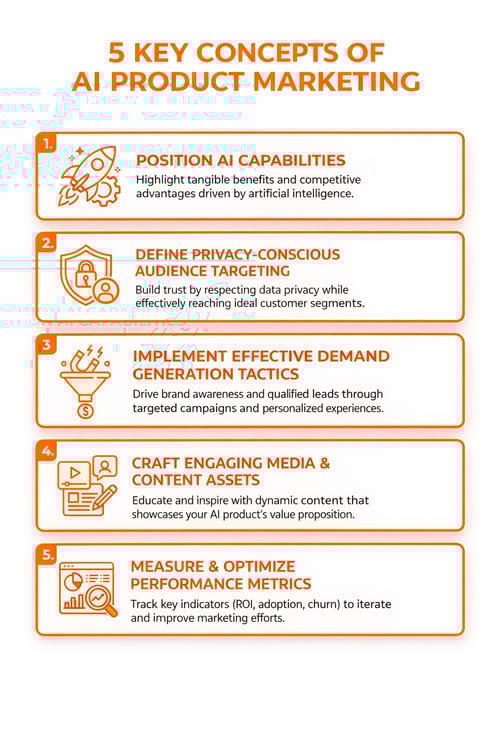
A concise visual guide to the five essential concepts in AI product marketing. Learn how these ideas drive product-led growth and smarter go-to-market strategies.
Did You Know?
Sales teams using AI-driven coaching and conversation intelligence saw 14% higher win rates.
Real‑Time AI Coaching for Sales Teams
AI is now capable of analyzing conversations while they happen.
During calls, systems can detect objections and recommend responses instantly.
This real-time coaching improves rep confidence and consistency.
It also allows new sales hires to perform at a higher level faster.
- Live objection detection
- Suggested messaging responses
- Deal risk alerts
- Conversation summaries
- Performance insights for managers
Aligning Marketing and Sales With Objection Data
Sales conversations reveal how buyers interpret messaging.
Marketing teams rarely hear these conversations directly.
AI closes this gap by extracting insights from thousands of interactions.
These insights improve positioning, messaging clarity, and campaign performance.
Buyer objections are often the clearest signal of messaging problems in a go‑to‑market strategy.
When teams analyze objections at scale, they discover gaps between product positioning and customer perception.
Executive Visibility: Revenue Intelligence From Sales Conversations
Executives need a clear picture of why deals stall or close.
AI-powered revenue intelligence dashboards provide that visibility.
Leaders can see objection frequency, competitive threats, and messaging performance.
This data helps guide pricing decisions, roadmap priorities, and positioning strategy.
|
Executive Metric |
Strategic Insight |
|---|---|
|
Objection frequency |
Reveals positioning weaknesses |
|
Deal blockers |
Identifies product gaps |
|
Win rate trends |
Evaluates messaging effectiveness |
|
Competitor mentions |
Signals emerging market threats |
Challenges of Implementing AI Sales Enablement
Despite strong results, many organizations struggle to deploy AI-driven enablement systems.
Data fragmentation across CRM, call platforms, and marketing tools often slows adoption.
Sales teams also require trust in the insights generated by AI.
Platforms that unify signals and workflows make adoption significantly easier.
- Fragmented data sources
- Privacy and compliance requirements
- Integration with CRM systems
- Training teams to trust AI insights
Did You Know?
AI-driven sales intelligence delivers 91% accuracy in deal outcome predictions, compared to only 67% for traditional methods.
Security, Privacy, and Enterprise Readiness for AI Sales Intelligence
Enterprise organizations require strict governance when deploying AI systems.
Customer data, conversation transcripts, and CRM signals must be protected.
Modern AI platforms embed encryption, identity controls, and compliance frameworks into their architecture.
These safeguards ensure that revenue intelligence systems remain trusted across teams.
- Encryption of conversation data
- Role-based access controls
- Secure data centers
- Compliance monitoring
The Future: Autonomous Revenue Intelligence Systems
AI-driven enablement continues to evolve rapidly in 2026.
Future systems will automatically update messaging, sales playbooks, and campaign strategies based on real-time conversation insights.
Predictive models will identify objections before they appear in deals.
This will give organizations a proactive advantage in competitive markets.
- Predictive objection detection
- Automated enablement updates
- AI-generated competitive playbooks
- Real-time go-to-market insights
Conclusion
Sales conversations contain the most accurate insights about buyer intent, objections, and product perception.
In 2026, AI product marketing platforms allow organizations to analyze these conversations at scale and convert them into strategic revenue intelligence.
When marketing, sales, and leadership operate from the same data-driven insights, enablement becomes far more than training.
It becomes a continuous intelligence system that improves messaging, reduces objections, and increases win rates across the entire revenue organization.