

B2B teams collect massive volumes of customer and market data, yet most of it never connects. In fact, B2B organizations using AI within their CRM are 83% more likely to exceed sales goals through predictive lead scoring and personalized interactions, proving that data only becomes valuable when it works together.
Key Takeaways
|
Question |
Answer |
|---|---|
|
How do you integrate CRM support and competitor data? |
Create a CRM data integration strategy that connects CRM systems, support platforms, and market monitoring tools through APIs and shared signal definitions. |
|
What is a unified customer data strategy? |
A framework where marketing, sales, and product teams share one view of customer behavior, pipeline signals, and market context. |
|
Why connect CRM support and market signals? |
Support conversations reveal product issues while CRM reveals deal context. Together they expose the real reasons buyers convert or churn. |
|
What powers modern B2B data orchestration? |
AI-driven intelligence layers such as the Marketing Context Engine unify CRM, support, and competitor signals. |
|
What tools enable unified marketing intelligence? |
Platforms like the AI Content Marketing Platform for B2B Teams combine customer signals, market intelligence, and content execution. |
|
Why is competitor intelligence integration important? |
It gives marketing and sales visibility into how competitors influence deals and messaging. |
Why is B2B Data Fragmented?
Most organizations run multiple systems that rarely communicate. Each platform collects insight but stores it in isolation.
CRM systems track pipeline activity, support platforms capture customer issues, and market monitoring tools track competitors. The result is fragmented intelligence.
This fragmentation blocks strategic insight. Teams see isolated events instead of connected patterns.
A modern unified marketing data platform solves this by turning scattered signals into structured intelligence.
What Happens when CRM, Support, and Competitor Signals Connect?
When these signals combine, raw data becomes strategic context. Teams stop guessing and start seeing patterns.
Sales teams understand which competitors appear in late-stage deals. Product teams detect feature gaps earlier.
Marketing gains real buyer language from support tickets and deal conversations. Messaging becomes grounded in reality.
This is the foundation of a modern unified customer data strategy.
- Identify competitor influence in deals
- Understand product frustrations earlier
- Connect marketing messaging to real buyer language
- Predict churn or expansion patterns
The Three Core Data Sources Every B2B Intelligence Engine Needs
True B2B intelligence emerges when three signal categories combine. Each source answers a different strategic question.
CRM Signals
CRM data captures account profiles, deal stages, buying committees, and engagement history.
This layer answers a single question. Who is buying and where they are in the journey.
Support Signals
Support tickets, chat conversations, and feature requests reveal product friction and unmet needs.
These signals often appear months before churn or competitor displacement.
Competitor Signals
Competitor pricing changes, launches, and analyst coverage show how the market shifts.
Without competitor intelligence integration, teams operate blind to external pressure.
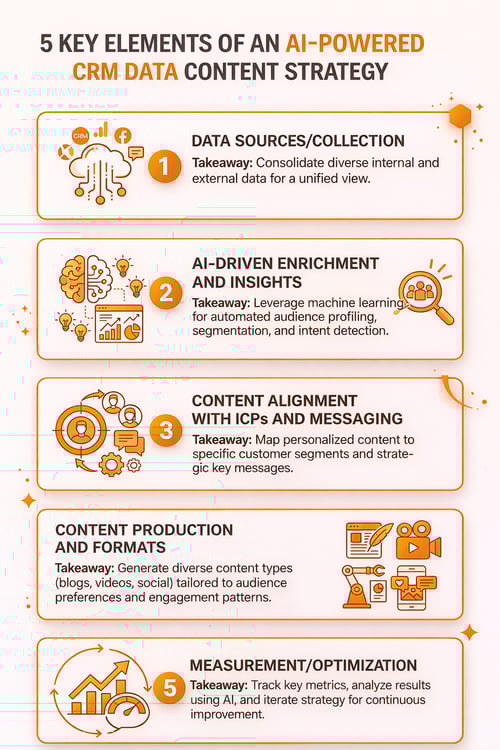
A concise visual breakdown of the five elements shaping an AI-powered CRM data content strategy.
Framework Step 1: Define the Signals That Actually Matter
Most organizations collect too much data and extract too little insight. The first step is identifying the signals that drive decisions.
These signals should map directly to pipeline outcomes and market movement.
- Deal velocity
- Competitor mentions in sales calls
- Product complaints from support
- Churn triggers
- Feature requests tied to lost deals
Once standardized, these signals become the building blocks of a real CRM data integration strategy.
Did You Know?
Poor data quality and fragmented silos cost B2B organizations an average of 12% of their total annual revenue.
Framework Step 2: Connect CRM, Support, and Intelligence Tools
After defining signals, systems must connect. APIs and event pipelines typically power this integration.
Most modern architectures connect these sources:
- CRM platforms
- Support tools like ticket systems
- Market intelligence and monitoring platforms
- Marketing automation systems
This integration layer enables marketing signal integration across the entire revenue engine.
Framework Step 3: Normalize and Structure the Data
Different systems use different naming conventions. Without normalization, analysis becomes inconsistent.
Normalization ensures signals align across systems.
|
Data Field |
Normalization Goal |
|---|---|
|
Company names |
Standard account identifier |
|
Industries |
Unified taxonomy |
|
Competitor mentions |
Consistent competitor tagging |
|
Product categories |
Shared classification model |
This step enables accurate B2B data orchestration across departments.
Framework Step 4: Build the Unified Signal Layer
The unified signal layer becomes the brain of your marketing intelligence system.
This environment combines structured signals from every source.
Organizations typically implement this layer using:
- Data warehouses
- Customer data platforms
- AI-driven intelligence engines
Platforms like Intelligent Research convert unified signals into continuously updated market insights.
How Integrated Signals Improve Marketing, Sales, and Product Strategy
Once signals connect, every team operates with the same intelligence.
Marketing understands which messaging wins against competitors.
Sales receives competitor insights during active deals.
Product teams identify recurring feature gaps directly from support data.
- Marketing identifies high-performing messaging
- Sales prepares for competitor objections
- Product teams detect emerging needs earlier
- Customer success predicts churn risk
Did You Know?
Sales reps with access to integrated competitor and market signals generate 19% to 30% higher annual revenue than those operating without proactive intelligence.
How AI Uses Unified CRM and Market Data
AI systems only perform well when they understand context.
Without integrated signals, AI models rely on incomplete information.
When CRM, support, and competitor signals connect, AI can:
- Detect emerging market trends
- Prioritize accounts
- Predict deal outcomes
- Generate buyer-relevant content
Modern platforms like AI solutions for content marketing convert these signals into content and campaign execution.
Building a Modern B2B Intelligence Layer in 2026
In 2026, the competitive edge is no longer data collection. It is signal orchestration.
Organizations that connect CRM, support, and competitor signals operate with a clear picture of the market.
This intelligence layer becomes the foundation for:
- Content strategy
- Demand generation
- Sales enablement
- Product roadmap decisions
Companies adopting a unified marketing data platform move faster because insight flows directly into execution.
Conclusion
Most companies think their challenge is collecting more data. The real challenge is connecting the data they already have.
When CRM, support systems, and competitor intelligence integrate into a unified signal layer, organizations gain real context. Marketing understands buyers, sales see competitive pressure, and product teams detect market shifts earlier.
This is the foundation of modern B2B intelligence. Companies that connect these signals in 2026 build faster strategies, stronger messaging, and more predictable pipeline. Data alone does not drive growth. Connected signals do.
FAQs
What integration platform connects AI-generated content with CRM systems?
Omnibound integrates directly with leading CRM platforms, allowing AI-generated content to reflect real customer and pipeline data.