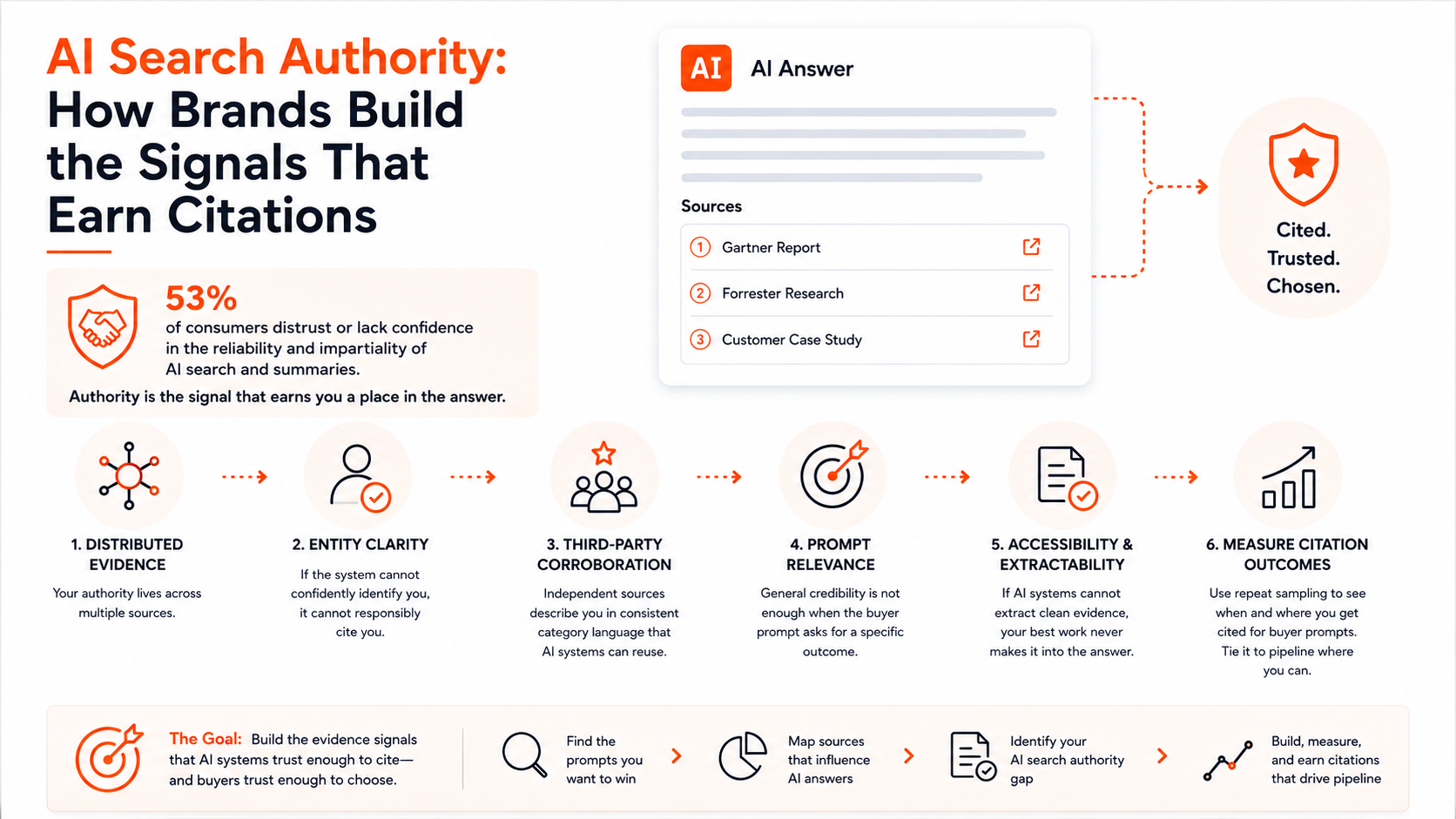


In 2026, 53% of consumers distrust or lack confidence in the reliability and impartiality of AI search and summaries. That single reality changes the authority question for B2B brands, because your buyers are not just looking for answers, they are looking for evidence they can trust when the AI answer is doing the shortlisting.
Key Takeaways
|
What to focus on |
Why it matters for AI search authority |
|---|---|
|
AI search authority is distributed evidence |
It lives across your site, partners, customers, reviews, comparisons, and analyst coverage. |
|
Entity clarity is the gate |
If the system cannot confidently identify you, it cannot responsibly cite you. |
|
Third-party corroboration beats “we say so” |
Independent sources describe you in consistent category language that AI systems can reuse. |
|
Prompt relevance decides which “authority” wins |
General credibility is not enough when the buyer prompt asks for a specific outcome. |
|
Accessibility and extractability control whether evidence can be reused |
If AI systems cannot extract clean evidence, your best work never makes it into the answer. |
|
Measure citation outcomes, not just “visibility” |
Use repeat sampling to see when and where you get cited for buyer prompts. Tie it to pipeline where you can. |
- Question: “What is AI search authority?”
Answer: The accumulated evidence that connects your brand to a topic across sources AI systems can retrieve, verify, and cite.
- Question: “How do I earn citations?”
Answer: Build entity clarity, topical evidence, independent corroboration, prompt-specific relevance, and technical accessibility. No single tactic replaces the full stack.
- Question: “Where do we start?”
Answer: Start with the prompts you want to win, then map which sources influence AI answers and identify your AI search authority gap using the free AI Search Visibility Checker.
Internal note: We do not treat authority as a checklist. We treat it as an operating framework for evidence, consistency, relevance, corroboration, and accessibility.
What Is AI Search Authority?
AI search authority is the strength and consistency of the evidence available across the web that connects a brand or entity with a specific category, expertise area, product, use case, or claim.
That definition matters because it prevents a common failure mode. A lot of teams ask: “How authoritative is our domain?”
The AI-search reality asks a different question: “Does this source provide credible, relevant evidence for this specific question?”
Authority in 2026 is also:
- Topic-specific. You can be credible in one slice of the market and irrelevant in another.
- Query-dependent. The prompt changes what evidence is relevant.
- Platform-dependent. Different AI answer systems retrieve, rerank, and cite differently.
- Distributed. Authority is not located only on your website.
- Dynamic. Evidence accumulates and citations shift as new sources appear.
It is not a single number. No major AI answer system publicly publishes a complete, verifiable ranking formula. So we use a practical operating framework derived from platform documentation, independent research, and observed citation patterns.
One more critical distinction:
AI search authority is not the same as AI search visibility, and it is not the same as AI citation.
You can be mentioned without being cited. You can be cited without being recommended. You can appear in one category prompt but vanish in another. The “authority” concept exists to explain that difference with clarity and business relevance.
AI Search Authority vs. AI Visibility vs. AI Citations vs. AI Recommendation
In 2026, many B2B teams collapse these terms into one metric. That creates blind spots, because each outcome depends on a different part of the evidence stack.
Here is the practical separation:
- AI Search Visibility: Are we appearing in AI answers?
- AI Citation: Is our content being used as a source?
- AI Search Authority: Does the ecosystem contain enough consistent, independent, relevant evidence for AI systems to recognize us as credible for a specific topic?
- AI Recommendation: Does the system recommend the brand, not just mention it?
It got cited. And then ignored.
That sentence is how authority becomes pipeline impact or stalls out. Citation-worthy content does not guarantee selection. But without AI search authority, you rarely get to the point where selection becomes possible.
AI search authority shows up as citations and prompt coverage, not as a one-time “score.”
The Five Signals That Build AI Search Authority
When teams get results in 2026, it is rarely because they found one lever. It is because they built the right combination of signals for a specific buyer prompt.
We use a five-signal framework for AI search authority. Think of it as the stack AI systems have to “survive” to turn evidence into citations.
Signal 1: Entity clarity
Can AI systems confidently identify who you are and what you do?
- Consistent brand name across platforms.
- Clear organization descriptions that match your actual category.
- Authoritative entity references in the ecosystem.
- Profiles and supporting pages that reduce ambiguity.
Important: entity schema alone does not create authority. But unclear identity creates friction. And friction prevents citations.
Signal 2: Topical evidence
Do you consistently demonstrate expertise in the topic behind the buyer prompt?
This is where your evidence needs to look like buyer work, not marketing claims. Deep topic coverage, original research, technical documentation, and concrete customer examples often do better than generic thought leadership.
If you want a starting point for building evidence-backed thought leadership, we recommend Content that reflects real customer reality (Marketing context engine).
Signal 3: Independent corroboration
“We are experts” is a claim.
Independent corroboration is the part that changes trust behavior. When independent publications, reviewers, customers, analysts, communities, and comparison sites describe you with consistent category language, AI systems can reuse that description as verifiable context.
Directional proof from vendor research is common here. For example, Omnibound cites a B2B SaaS study where 87.4% of ChatGPT citations pointed to third-party sources rather than the recommended vendor’s own site. We treat that as directional, not universal. The point still holds: third-party evidence is often part of the citation trail.
Signal 4: Relevance to the specific buyer question
This is the most missed layer.
A brand can have strong general authority and still fail to appear for a high-intent prompt because it lacks prompt-specific evidence.
Example:
- You may be credible in marketing automation.
- But if the prompt is “best enterprise marketing intelligence platform,” your authority needs category association, comparison presence, and buyer-validation evidence for that exact framing.
You need to map:
- Target prompt
- Claim the buyer needs to believe
- Evidence that supports the claim
- Source type most likely to be cited
- Citation opportunity where that evidence can be reused
We treat that mapping as the core workflow for AI search authority, because it converts “authority” into decisions and coverage.
Signal 5: Technical accessibility and extractability
If AI systems cannot retrieve and reuse your evidence, your authority does not survive the pipeline.
In practice, accessibility and extractability include:
- Crawlability and indexing
- Rendering and content readability
- Clear page structure and headings
- Evidence near claims (not buried)
- Concise, answer-shaped sections where appropriate
We also treat this as platform-specific, not a secret AI hack. Google guidance focuses on standard search eligibility. Microsoft guidance goes deeper into structural recommendations. The operational point is the same: if evidence cannot be extracted cleanly, it will not be cited reliably.
Did You Know?
80%+ of AI-answer queries end without a click
Source: Rankability
Owned Authority vs. Earned Authority
Owned content establishes what you claim.
Earned content establishes what the ecosystem believes about you.
That is why AI search authority feels different from traditional “post and pray” marketing. It requires both evidence declaration and corroboration.
|
Signal |
Owned |
Earned |
|---|---|---|
|
Product claims |
Your website and documentation |
Reviews, customer validation, analyst coverage |
|
Expertise |
Blog, technical guides, original research |
Publications, interviews, guest research |
|
Customer proof |
Case studies and implementation stories |
Independent reviews and third-party comparisons |
|
Category association |
Your descriptions and positioning pages |
Third-party descriptions in consistent language |
|
Comparison presence |
Your own comparisons (when appropriate) |
Independent “best for” lists and category evaluators |
We do not recommend abandoning owned content. We recommend treating it as a foundation, then earning the corroboration that makes citations durable.
Why Third-Party Sources Matter So Much
Third-party sources matter because AI answers often rely on external evidence while constructing responses.
When those sources provide:
- Independent descriptions
- Product comparisons
- Reviews and customer experiences
- Expert opinions
- Category context
AI systems have cleaner “supporting material” for claims. That is the mechanism behind why citations frequently point outward.
But not every third-party mention has equal value. The ecosystem has to be able to reuse it.
High-value third-party evidence usually has at least one of these properties:
- Specificity (it describes your actual use case, not just your brand)
- Consistency (other sources echo your category language)
- Comparability (it places you next to alternatives, not in a vacuum)
- Buyer relevance (it answers the exact question the prompt is asking)
This is also where your prompt mapping becomes essential. If a third-party source corroborates a claim that does not match the buyer prompt, it will not help much.
Not All Authority Signals Are Equal
If you treat the five signals as equally weighted, you will overinvest in the wrong places. Authority is conditional.
Here is a practical matrix for how these signals typically contribute to AI search authority outcomes. We do not claim universal weights, because each AI answer system is different.
|
Authority signal |
Potential role |
|---|---|
|
Independent editorial coverage |
Strong corroboration and category credibility |
|
Industry research |
Expertise and evidence density |
|
Review platforms |
Buyer validation and real-world performance context |
|
Comparison pages |
Commercial and category framing for the prompt |
|
Community discussions |
Real-world experience and implementation detail |
|
Expert interviews |
Human expertise and grounded explanation |
|
Podcasts and video transcripts |
Distributed expertise evidence across formats |
|
Directory listings |
Entity consistency and lookup support |
|
Backlinks |
Traditional context and relevance signals that can still matter |
Build Authority Around the Prompts You Want to Win
Start with prompts, not with production volume.
That is where most teams fail. They ask “What should we publish next?”
AI search authority asks “Which buyer prompts do we need to become authoritative for?”
Here is the workflow we use for prompt-specific authority building:
- Identify high-value buyer prompts
Category prompts, comparison prompts, “best” prompts, alternatives, pricing prompts, and problem-specific prompts. - Identify what AI currently cites
Track which sources show up and what claims they support. - Map the sources influencing those answers
Owned sites, review platforms, comparisons, editorial publications, community sources, and analyst coverage. - Identify competitor authority gaps
Where competitors appear across multiple corroborating sources and you do not. - Build the missing evidence
Create or secure owned evidence, then pursue third-party corroboration that matches the prompt framing. - Measure citation changes
Use repeat sampling because AI responses can vary by run and by phrasing.
This workflow is why we treat AI search authority as an evidence system, not a publishing plan.
The AI Search Authority Gap
Authority Gap = Trusted Sources Influencing AI Answers Where Your Brand Is Missing.
Example prompt:
“best AI search visibility platform for B2B SaaS”
In many real accounts, AI cites:
- Publication A
- Review platform B
- Comparison page C
- Community D
Competitor appears across A plus B plus C.
Your brand appears across none.
That is not a “content gap.” It is an AI search authority gap. It is the ecosystem refusing to treat you as a credible option for that prompt because corroboration is missing.
For teams that want to operationalize this quickly, you can start with AI Search Intelligence to track prompts, citations, and gaps across AI engines. The goal is the same, build authority where it will be cited, not where it will merely be noticed.
Did You Know?
AI Overviews now appear in 25.11% of Google searches, up from 13.14% in March 2025
Source: Omnibound
How to Measure AI Search Authority (Without Fake Scores)
Do not chase an “AI authority score.” It does not exist as a verified, public metric.
Authority has to be inferred from observable outcomes. You can measure outcomes like these in 2026:
- Citation share: How often your brand appears in relevant AI answers.
- Citation source diversity: How many independent source types contribute to visibility.
- Prompt coverage: Percentage of target prompts where your brand is represented.
- Third-party citation share: What portion of citations originate from external sources.
- Competitive citation gap: Prompts where competitors appear but you do not.
- Entity consistency: Whether sources describe your brand consistently.
- Citation persistence: Whether visibility survives repeated measurements over time.
Also, measure with repeat sampling. AI answers can shift based on run conditions and paraphrase choices. One check is not a measurement.
When you want to connect measurement to your pipeline, we outline that link in B2B AI Search Playbook.
What Does Not Build AI Search Authority
Authority is evidence. Evidence is not volume for volume’s sake.
In 2026, avoid these false shortcuts:
- Publishing hundreds of AI-generated articles without buyer-relevant evidence.
- Stuffing brand mentions into otherwise generic content.
- Creating fake reviews or manipulated testimonials (regulatory and reputational risk).
- Manipulating community discussions to manufacture consensus.
- Buying low-quality backlinks that do not create corroboration.
- Recycling generic thought leadership without original insights.
- Adding schema everywhere without improving the page’s actual extractable evidence.
- Repeatedly mentioning your brand name in contexts where you are not actually relevant to the prompt.
The goal is not artificial signals. The goal is credible, consistent evidence that survives retrieval, reranking, generation, and citation.
AI Search Authority vs. Traditional Authority
Traditional site authority still matters for fundamentals like content quality, technical accessibility, and link context. But AI search authority behaves differently.
|
Traditional authority (common framing) |
AI search authority framing |
|---|---|
|
Rankings |
Retrieval + citation plus selection in the answer |
|
Backlinks |
Distributed corroboration across sources |
|
Domain authority |
Topic and entity evidence |
|
Keyword relevance |
Prompt relevance to buyer intent |
We still care about the fundamentals. But we stop pretending that one site metric explains why an AI answer includes or excludes your brand.
How AI Search Authority Compounds
AI search authority compounds like a flywheel, because evidence begets citations, and citations beget more evidence.
That flywheel looks like this:
- Original insight
- Owned content
- Third-party references
- AI citations
- Buyer discovery
- Brand recognition
- More independent references
- Stronger authority
Again, this is a strategic model, not a guaranteed algorithmic loop. But it is an accurate description of how evidence ecosystems mature when teams build intentionally.
OMNIBOUND Differentiation: Finding Where Authority Is Missing
Traditional content workflows ask, “What should we publish next?”
AI search authority workflows ask, “What sources are influencing AI answers for the buyer prompts we care about, where are competitors present, and where are we absent?”
Content authority is what you publish.
AI search authority is what the entire information ecosystem says about you, when it can be retrieved, verified, and cited.
Omnibound is built around that operational gap. We help teams identify where external sources influence AI answers, find competitor presence across those source types, prioritize the evidence that matters for prompt relevance, and pursue the placements that change citation outcomes.
If your team is ready to connect customer intelligence to citation-worthy content, start with creating citation-worthy content and then map it to prompts through Intelligent Research.
Conclusion
AI search authority is not something a brand declares on its own website. It is the accumulated evidence that connects your brand to a topic across sources AI systems can retrieve, verify, and cite.
In 2026, the winning strategy is not “publish more and hope.” It is: identify the prompts, map the sources influencing AI answers, find the AI search authority gap, build the missing evidence, measure citation coverage, and repeat.
Frequently Asked Questions
What is AI search authority?
AI search authority is the accumulated evidence that connects a brand to a topic across sources AI systems can retrieve, verify, and cite. It is topic-specific, prompt-dependent, and distributed across owned and third-party sources.
How is AI search authority different from domain authority?
Domain authority is a property of a website. AI search authority is evidence and corroboration across the information ecosystem for a specific buyer prompt.
What signals help brands earn AI citations?
Entity clarity, topical evidence, independent corroboration, prompt-specific relevance, and technical accessibility are the core signals. Citations typically reflect the sources that best support the specific claim behind the prompt.
Do backlinks still matter for AI search authority?
Backlinks can contribute to traditional context and relevance, but AI citations often rely heavily on extractable, credible evidence from multiple source types. Backlinks are rarely sufficient alone for prompt-specific authority.
Why do AI search engines cite third-party websites?
Third-party sources often provide independent descriptions, comparisons, reviews, and category context that help the system justify claims. That corroboration reduces reliance on a single vendor’s statements.
How can a brand build AI search authority outside its own website?
Build corroboration through independent editorial coverage, review platforms, expert interviews, comparisons, community proof, and analyst or customer-facing mentions. Then align that earned evidence to the exact buyer prompt you want to win.
How do you measure AI search authority?
Measure observable outcomes like citation share, prompt coverage, third-party citation share, competitive citation gaps, entity consistency, and citation persistence. Use repeat sampling because AI answers can vary across runs.
How can I find the sources influencing AI citations for my brand?
Track which sources get cited for your target prompts and capture which claim each source supports. Then map competitor presence across those source types, so you can identify where your brand is missing corroboration.
Can a smaller brand build AI search authority?
Yes, a smaller brand can earn AI search authority when it has strong prompt-specific evidence and third-party corroboration in the exact categories buyers ask about. The strategy is focused coverage, not broad publishing.