




Table Of Contents
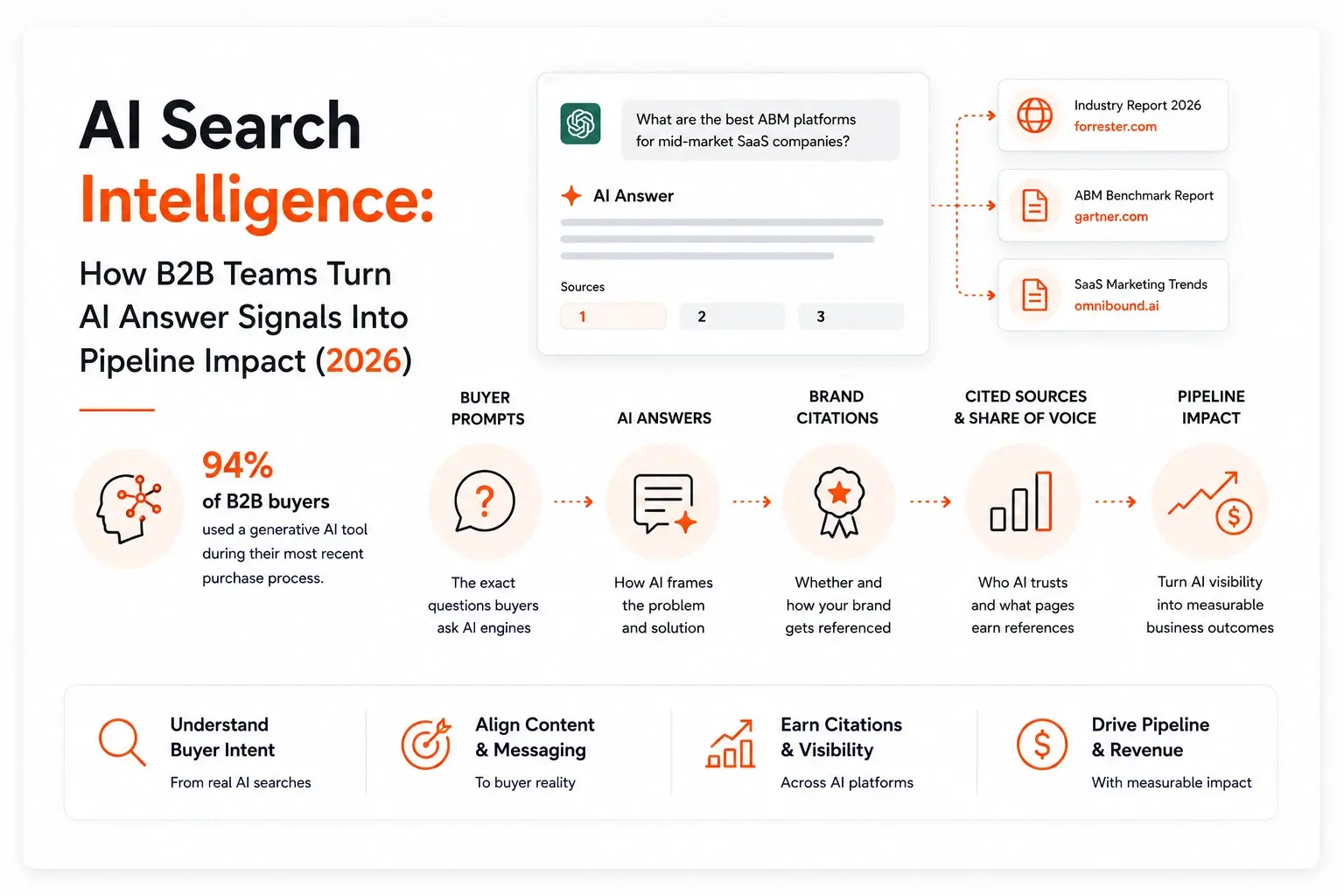
In 2026, buyers are no longer forming opinions from blue links. 94% of B2B buyers used a generative AI tool during their most recent purchase process, which means your marketing context now starts inside AI answers, not on your website.
Key Takeaways
|
AI Search Intelligence piece |
What it tells you |
What you do with it |
|---|---|---|
|
Buyer prompts |
Which exact questions buyers ask AI engines |
Build content around real prompt intent (not guessed keywords) |
|
Prompt intent |
Stage and job-to-be-done behind the question |
Map prompts to funnel stages and content formats |
|
AI-generated answers |
How AI frames the problem and solution |
Adjust messaging, positioning, and proof points to match buyer reality |
|
Brand mentions and citations |
Whether and how your brand gets referenced |
Improve citation-worthy content (see how to monitor brand citations across different AI search platforms) |
|
Cited sources, URLs, share of voice |
Who AI trusts and what pages earn references |
Compare against competitors and fix content gaps (see compare your AI search visibility against top industry competitors) |
|
Visibility and trends |
How stable your AI search presence is over time |
Run remeasurement, not one-time “optimization” |
- SEO is visibility. AI search intelligence is understanding why a brand is included or excluded from AI answers, then acting on it.
- Use prompts and AI citations to drive “content opportunities” that connect directly to pipeline outcomes.
- If your team is mapping buyer prompts to content only once, you will miss fast-changing citation dynamics.
- Start with buyer-focused prompt mapping, then connect AI visibility metrics to measurement and action (see AI search visibility metrics and how to map buyer prompts to existing blog content for AI search).
SEO-optimized questions we will answer:
- What is AI search intelligence? A system for collecting AI answer signals, diagnosing representation, and taking actions to improve citations and business outcomes.
- How is AI search intelligence different from SEO? SEO optimizes traditional discoverability, while AI search intelligence measures AI inclusion in prompts, answers, and citations.
- How do you measure AI search intelligence? Track prompts, intent, AI answers, brand mentions, citations, cited URLs, share of voice, and visibility trends across engines.
What Is AI Search Intelligence?
AI search intelligence is the practice of systematically collecting, analyzing, and acting on signals from AI-generated search and answer experiences. The goal is simple: understand how your brand, products, competitors, and content are represented to buyers, then make marketing decisions with evidence instead of prompt guesswork.
Also important: terminology is still evolving. Some vendors call this “AI search visibility,” others call it “answer engine optimization intelligence,” and some wrap it into “customer intelligence.” The core idea is consistent, but labels vary by provider and product.
That intelligence layer can include the signals marketers need to answer the real business question: “Will buyers hear us, and will it help?” It can include:
- Buyer prompts (the exact questions people type or ask)
- Prompt intent (the job-to-be-done, stage, and constraints inside the prompt)
- AI-generated answers (how the model explains the problem and recommends approaches)
- Brand mentions (whether your name appears in the answer)
- Citations (whether your brand is referenced as a source)
- Cited sources and URLs (which pages earned the reference)
- Competitor mentions (who shows up instead of you)
- Share of voice (how often you appear versus others)
- Visibility trends (whether inclusion is stable or volatile)
- Buyer personas (who asks and how their questions differ)
- Funnel stages (awareness, evaluation, implementation, recommendation)
- Content gaps (what buyers need that your assets do not yet cover)
- Competitive gaps (which proof points, entities, or comparisons competitors dominate)
- AI-driven traffic where measurable (signals from traffic attribution or downstream conversion reporting)
Why AI Search Intelligence Matters
AI search is now where buying decisions begin. B2B buyers can ask AI highly specific category, vendor, comparison, problem, implementation, and recommendation questions before they ever visit your company's website.
That changes the game. It got cited. And then ignored. Or it got cited and it triggered a vendor shortlist. The difference is visible if you measure the citations, not if you just count impressions.
For B2B teams, AI search intelligence matters because your audience asks in a form that looks like:
- “How should we structure an AI governance program for marketing teams?”
- “Which vendor is best for monitoring brand citations across AI assistants?”
- “How do we connect AI visibility to pipeline outcomes?”
- “What implementation steps come first for citation-worthy content?”
When you collect those prompts and analyze the answers, you stop guessing. You build a content foundation that matches how buyers actually talk. And you make AI Search Intelligence a revenue channel, not just a visibility metric.
Did You Know?
83% of AI Overview citations come from outside Google’s top 10 search results.
Source: SEO Sherpa
How AI Search Intelligence Works
We use a progression that mirrors how AI buyers experience the world. It keeps your team grounded in what actually happens from prompt to action.
- Buyer question → what the buyer wants answered
- Prompt → the actual text or prompt format used
- AI answer → the generated response and recommended approach
- Brand/competitor representation → mentions, comparisons, and suggested vendors
- Citations/sources → whether AI cites your assets, and which ones
- Measurement → visibility, share of voice, stability, and prompt intent coverage
- Gap identification → content gaps and competitive gaps by persona and stage
- Action → content, entity, and proof point updates mapped to the gaps
- Remeasurement → verify that citations move, not just that content was published
Think about it like this: the “intelligence” part is what tells you why representation changes. The “acting” part is what prevents your team from writing in a vacuum.
If you want an operational view of how we guide content from signals to citations, we build the work around AI Search Intelligence, and we connect it to citation-worthy content through our Create Citation-Worthy Content workflow.
What AI Search Intelligence Measures
You measure AI search intelligence the way you would measure revenue work. Not with a single metric, but with a chain of evidence.
Here are the core measurement outputs we recommend for B2B teams:
- Prompt coverage: which buyer prompts you can influence, by persona and stage
- Intent alignment: whether your assets match the intent inside the prompt
- Citation visibility: whether your brand gets cited and how often
- Cited URL quality: which pages earn citations, and whether they are the right pages
- Competitor representation: where competitors appear instead of you
- Source diversity: how many different sources AI uses to form the answer
- Visibility trends: whether your citations persist across time and engines
- Downstream impact: measurable traffic and pipeline movement when attribution is available
Also, you track variability. AI answers do not behave like stable lists. One month can be strong. The next month can be missing. That is why teams should remeasure as part of the workflow.
AI Search Intelligence Signals
Below is a practical signal map. It tells you what each signal means and how a marketing team should use it.
|
Signal category |
Signals included |
What it tells your marketing team |
Example action |
|---|---|---|---|
|
Prompt and intent |
Buyer prompts, intent, funnel stage, persona context |
What buyers actually ask, and why they ask it now |
Build a comparison guide for “implementation recommendations” for IT buyers |
|
Answer and framing |
AI-generated answers, problem framing, recommended approach |
How AI describes the solution space and where you fit |
Rewrite your key value claims to match AI’s language for the same intent |
|
Representation |
Brand mentions, competitor mentions, share of voice |
Whether you are considered, and who is winning mindshare |
Create missing entities and proof points that competitors already earn |
|
Citation proof |
Citations, cited sources, cited URLs, source attribution |
Which assets are citation-worthy, and which are invisible |
Update the specific cited URL or create a new page matching the same claim structure |
|
Stability and trends |
Visibility trends, month-over-month citation persistence |
Whether your inclusion is reliable or fragile |
Schedule monthly review prompts and remeasurement after content releases |
|
Business linkage |
Measurable AI-driven traffic, conversion signals, CRM outcomes |
Whether AI citations lead to pipeline movement |
Prioritize prompts that correlate with qualified inbound and meetings |
AI Search Intelligence vs SEO
Traditional SEO focuses on optimizing visibility in traditional discoverability channels. That work can still help, but it cannot explain AI citation outcomes by itself.
AI search intelligence is different in four ways:
- What you measure: citations, cited URLs, and brand representation inside AI answers.
- Where you intervene: the content claims, entities, and proof points that AI uses when it decides what to cite.
- How you validate: remeasurement of prompts and answers, not only content publishing.
- Why it matters: B2B buyers often decide vendors based on what AI includes before they ever visit your website.
If you want a direct comparison between these concepts and how to think about visibility in AI, read AI search visibility vs traditional SEO and What Is AI Search Visibility?
AI Search Intelligence vs AEO
AEO (Answer Engine Optimization) usually describes content and entity optimization so AI-generated answers use your material. In practice, AEO can be tactical, but it often stops at “optimize and hope.”
AI search intelligence completes the loop:
- You collect the buyer prompts that trigger answers.
- You analyze AI-generated answers and citations.
- You identify why your brand is or is not included.
- You take actions that map to the gaps.
- You remeasure to confirm that citations moved.
That is why we prefer to treat AI search intelligence as the operational system around optimization, not a one-time checklist.
AI Search Intelligence vs GEO
GEO (often discussed as “Generative Engine Optimization” in industry conversations) tends to focus on structuring content for how generative models interpret entities, context, and relationships.
AI search intelligence goes beyond structure. It answers questions like:
- Which prompts still produce citations for us, and which prompts stopped?
- Which competitor sources are being used instead?
- Are we winning at awareness, evaluation, and recommendation, or only at one stage?
- Do our cited URLs still match the claims AI is making in the answer?
In short: GEO can improve “eligibility.” AI search intelligence validates “inclusion” and drives the next action based on evidence.
Did You Know?
68% of queries that generated citations in one month did not generate them the next.
Source: Passionfruit Labs
AI Search Intelligence vs AI Search Visibility
AI search visibility typically measures whether you appear in AI answers, often using prompt-based visibility and brand mention frequency.
AI search intelligence is what happens after visibility measurement. It adds “why” and “what next.” It uses the visibility signals to diagnose representation:
- Why: which prompt intent you fail to cover, which proof points are missing, which competitor sources are stronger for that exact question.
- What next: what to write, which page to update, which claims to add, which entities to include, and how to align with funnel stages.
- Reconfirmation: whether citations and recommendations actually change after the work ships.
If you need a starting point on what “visibility” means, read What Is AI Search Visibility? or need to check your AI Search Visibility Metrics check the links.
Example: AI Search Intelligence for a B2B SaaS Company
Let’s make this concrete. Imagine a B2B SaaS company that sells an “AI-powered customer research and marketing context” platform to marketing and product teams.
Your marketing team runs AI Search Intelligence workflows for two personas that buy differently:
- Persona A: Marketing Operations Lead (cares about governance, repeatability, and reporting)
- Persona B: Demand Gen Manager (cares about pipeline speed, campaign execution, and performance)
They test prompt sets in 2026 across major AI assistants. The system records buyer prompts, intent, the AI answer, brand mentions, citations, and the cited URLs.
Results:
- For the same category topic, Persona A receives AI recommendations that heavily cite content about privacy, compliance, and enterprise readiness.
- For the same category topic, Persona B receives AI recommendations that cite content about inbound demand, pipeline impact, and content production workflow.
- Your brand is mentioned in both cases, but the cited pages are different. Persona A sees your governance messaging, while Persona B sees (and sometimes does not see) proof tied to revenue impact.
- Competitors appear in Persona B’s answers for implementation and “how to translate visibility into pipeline” questions, because their cited assets better match the Demand Gen Manager’s prompt intent.
Now the team acts. They do not just write “more content.” They create a citation-worthy page and supporting assets that match the exact prompt intent and stage language for Demand Gen Manager questions. They update the cited URLs for that intent and add the missing “from citations to pipeline” logic.
After shipping, they remeasure the same prompts. The intelligence layer confirms whether the brand becomes cited more often for Persona B’s specific recommendations. That is AI search intelligence in practice, one person, one workflow, full campaign.
Here’s a practical build order:
- Define your prompt universe: Start with buyer questions pulled from sales calls, support tickets, community forums, and CRM notes. Teams that pull questions directly from these sources have a structural advantage over teams guessing at buyer intent from a keyword tool.
- Normalize prompts by persona and funnel stage: For each persona, label whether the prompt is awareness, evaluation, implementation, or recommendation. This step prevents you from mixing “top of funnel” questions with “vendor shortlist” questions.
- Run prompt-to-answer capture: Collect the AI answer, brand mentions, citations, cited sources, and cited URLs for each prompt in 2026. Store the results so you can compare month-over-month.
- Measure representation and stability: Track share of voice, visibility trends, and whether your citations persist. If a prompt drops citations after content changes, you need to diagnose why.
- Identify content and competitive gaps: Use the cited URLs to determine what content structures and proof points AI prefers. Then map gaps to what your team can ship next.
- Act with citation-worthy content: Write or update assets based on real buyer language and the AI search signals that triggered the citations or the exclusions.
- Recheck the same prompts: Remeasure. If you do not measure again, you will never know whether your changes improved citations.
If you want a ready-made path for content teams, we build our approach through our AI solutions for content marketing and our how B2B AI search is rewriting content strategy.
And yes, this includes governance. We include enterprise security and privacy controls so teams can operationalize AI Search Intelligence without creating data risk (see security built into everything we do and privacy is a top priority).
What to Look for in an AI Search Intelligence Platform
Not every tool that measures “visibility” actually gives you intelligence. The platform should help you answer “what is happening, why it is happening, and what our team should do next.”
Look for these capabilities:
- Prompt tracking across AI assistants: it should record the prompts buyers actually ask and connect them to outcomes.
- Citation-level visibility: not just mentions, but cited sources and URLs.
- Competitor comparisons: where competitors appear instead, and which assets earn citations.
- Persona and funnel stage segmentation: so you can diagnose differences between buyer types.
- Trend history and remeasurement: because citations can be volatile across time.
- Action support: gap identification tied to content opportunities.
- Enterprise readiness: privacy, security, and compliance so the workflow works at scale (for example, SOC 2 Type II and enterprise readiness).
Omnibound’s AI Search Intelligence is built to track every prompt your buyers ask, identify where you appear (and where you are missing), and guide teams toward the next content and citation actions.
If your team wants the full operational package, start with the product page and then connect it to citation-worthy content creation through Create Citation-Worthy Content.
FAQs
What is AI search intelligence for B2B marketers in 2026?
AI search intelligence is the practice of collecting and analyzing signals from AI-generated answers, including buyer prompts, AI-generated responses, brand mentions, and citations with cited sources and URLs. In 2026, it is especially important for B2B because buyers ask detailed category, vendor, comparison, and implementation questions before visiting vendor websites.
How is AI search intelligence different from AI search visibility?
AI search visibility measures whether and how often your brand appears in AI answers, often using prompt-based inclusion metrics. AI search intelligence goes further by explaining why representation changes, identifying content gaps and competitive gaps, and driving action with remeasurement.
Do teams need to track cited URLs, or is brand mention enough?
Brand mentions help, but cited URLs are where the work becomes actionable. AI Search Intelligence should track citations and cited sources so your team knows exactly which pages AI trusts and which pages must be updated or replaced.
Why do AI citations disappear from month to month?
Citation behavior can be volatile because AI answers vary based on prompt context, model behavior, and available sources. That is why AI search intelligence includes visibility trends and remeasurement, not one-time optimization.
Can AI search intelligence help us understand competitor positioning?
Yes. AI search intelligence tracks competitor mentions, share of voice, and which competitor sources are cited for the same prompts and personas. That turns “we think they are winning” into evidence you can use to build citation-worthy content.
Is AI search intelligence only useful for marketing, or does sales benefit?
It is useful for both. Marketing uses AI search intelligence to build citation-worthy content that matches buyer intent, and sales benefits because the signals clarify which questions lead to recommendations and vendor shortlists.
Conclusion
AI search intelligence is how B2B teams make AI answer signals useful, not just observable. You collect buyer prompts, analyze prompt intent, inspect AI-generated answers and brand representation, verify citations with cited sources and URLs, measure visibility and trends, identify content gaps and competitive gaps, act, then remeasure. The shift is not about abandoning strategy. It is about grounding that strategy in evidence rather than assumption, so your team can make AI search a revenue channel, not just a visibility metric.
At scale, an AI Search Intelligence platform operationalizes this process by automating prompt capture, citation tracking, persona and funnel segmentation, competitor comparisons, gap identification, and ongoing remeasurement.
Turn Your Content Into AI-Search Winners
Get cited across ChatGPT, Claude & Perplexity — not just ranked on Google.
- Increase AI citations
- Improve answer visibility
- Track brand mentions in LLMs
.webp?height=245&name=10%20Ways%20AI%20Semantic%20Analysis%20Improves%20B2B%20Content%20Strategy%20in%20the%20AI%20Search%20Era%20(2).webp)