

The question of AI search visibility and link building impact is one of the most consequential questions B2B marketing teams face in 2026. AI search is deciding B2B pipeline. Most content was never built for AI visibility, and most link building strategies were built for a world that no longer exists.
Link Building Impact on AI Search Visibility Is Real, But Misunderstood
Most teams still ask the wrong question. They ask, "How many backlinks do we have?" The right question is, "Does AI trust our brand enough to include it in the answer?"
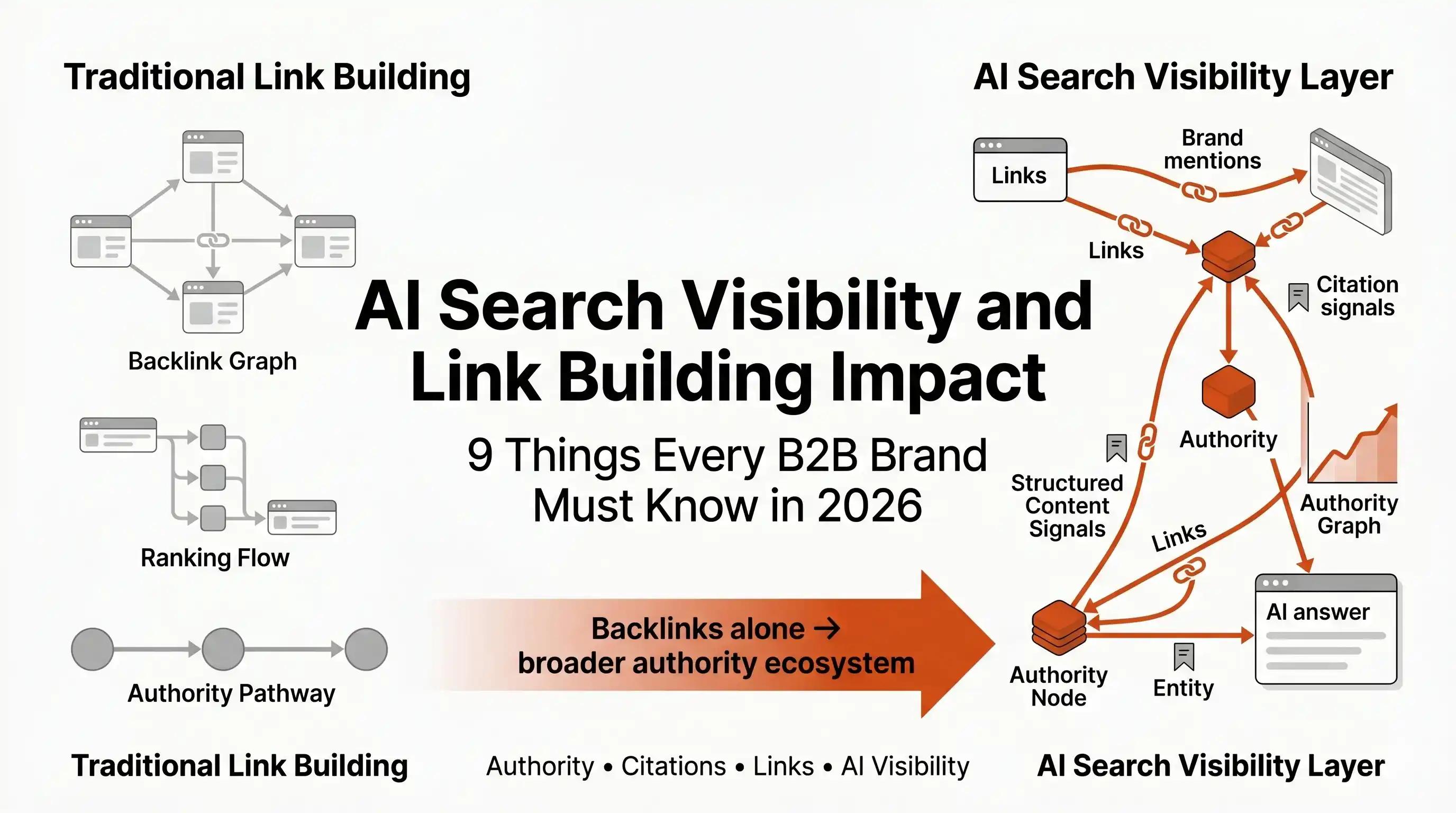
The link building impact on AI search visibility is not zero. But it is not the same lever it was for traditional page-authority models. AI systems like ChatGPT, Perplexity, Gemini, Claude, and Google AI Mode do not simply count links and rank accordingly.
They synthesize answers from indexed sources, corroborated information, structured content, and multi-layered authority signals. Backlinks are one input into that system, not the system itself.
How Traditional Link Building Shaped Authority (And Why That Model Is Incomplete Now)
Traditional authority models rewarded link volume. The logic was simple: more links from high-authority domains meant higher PageRank, which meant better placement in results.
Anchor text, domain authority, and link acquisition velocity were the primary signals marketers optimized for. That model worked inside a purely algorithmic, link-counting system.
AI retrieval is not that system. It does not see a backlink count. It sees whether your brand is consistently cited, clearly structured, and trusted across multiple independent sources.
AI Search Visibility Relies on a Multi-Layer Authority Model, Not Just Links
This is the section where most competitors stop short. They acknowledge that AI is "different" and move on. We are more precise than that.
AI search visibility and link building impact intersect across five distinct authority layers:
- Link authority still matters as a foundational trust signal.
- Entity recognition tells AI systems what your brand is, what category you own, and which topics you're authoritative on.
- Cross-source consistency means the same information about your brand appears accurately across multiple trusted environments.
- Citation behavior tracks which sources AI repeatedly references when answering specific buyer questions.
- Content extractability determines whether AI can quickly parse, understand, and confidently surface your content in an answer.
Backlinks are becoming one trust signal among many. Teams that optimize for link volume alone, without addressing the other four layers, will find themselves invisible in AI answers even with strong domain authority.
What the AI Search Visibility and Link Building Impact Comparison Actually Looks Like
We find it useful to put the contrast in direct terms. Here is how the old model compares to what AI retrieval actually rewards:
|
Old Link Building Model |
AI-Era Authority Model |
|
Mass backlink volume |
Trusted editorial mentions |
|
Generic domain authority chasing |
Topical authority and entity clarity |
|
Spammy outreach campaigns |
Citation-worthy content assets |
|
Anchor text manipulation |
Cross-source consistency |
|
Link quantity metrics |
Prompt-level citation tracking |
The Rise of Citations and Entity Authority as the New Link Building for AI Search
This is the section most competitor content underdevelops. Citations and mentions inside AI systems behave differently from backlinks inside crawl-based indexes.
AI visibility increasingly depends on brand mentions in the right contexts, expert citations in research and industry commentary, consistent entity representation across knowledge sources, trusted ecosystem presence in communities and publications, and cross-source validation where information about your brand is corroborated independently.
A brand can gain meaningful AI search visibility without a massive backlink profile if its authority signals are strong elsewhere. But strong editorial backlinks still reinforce trust. That is the nuanced reality most takes miss entirely.
Basic prompts produce slop content. Without a real buyer and market context, AI engines have no reason to cite you over a competitor. The citation gap is not a link problem. It is an authority and relevance problem.
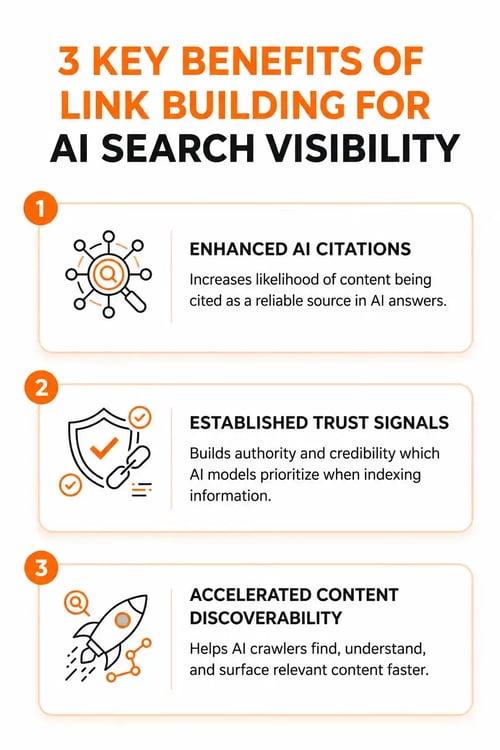
This infographic highlights three key benefits of link building for AI search visibility. Learn how authoritative backlinks can boost rankings and AI indexing performance.
7 Link Building and Authority Tactics That Actually Move AI Search Visibility in 2026
The tactics that strengthen AI search visibility and link building impact together are not the same tactics that filled quarterly backlink reports three years ago. Here is what the work actually looks like now:
- Earn authoritative citations through original research. Data studies, benchmark reports, and proprietary findings give AI systems a reason to cite you specifically, not just reference your category.
- Build entity recognition through consistent brand messaging. If AI systems cannot clearly identify who you are and what category you own, no volume of backlinks fixes that gap. Consistent voice, structured data, and knowledge graph clarity matter.
- Expand third-party validation through earned media. Reviews, community discussions, analyst mentions, and expert references create the cross-source consistency that AI retrieval rewards.
- Create citation-worthy content assets grounded in buyer language. Frameworks, comparisons, and benchmarks built on what buyers actually ask, not what keyword tools estimate, earn stronger citations. Prompts and content built on a one-time research snapshot stop earning citations. The research layer needs to be always-on.
- Strengthen content extractability through structured formatting. Clear answers, FAQ structures, and concise framing help AI systems parse and surface your content confidently inside generated answers.
- Track per-engine citation presence across AI systems. Where your brand appears in ChatGPT answers versus Perplexity versus Google AI Mode is not the same. AI Search Intelligence gives you the prompt-level visibility to know exactly where you stand and where competitors are being cited instead of you.
- Audit existing content against AI citation potential before publishing or refreshing. Not all content earns citations. Knowing whether a page will be cited before you invest in it changes how you prioritize and allocate resources. Our content audit and optimization workflow makes that assessment systematic.
Common Link Building Mistakes That Hurt AI Search Visibility and Link Building Impact
We see the same failure modes repeatedly. Each one weakens AI search visibility even when traditional authority metrics look healthy.
- Volume-only backlink strategies that chase quantity without relevance or editorial context.
- Irrelevant guest posting that builds links on sites with no topical relationship to your category.
- Authority without entity consistency where your brand messaging differs across sources, preventing AI from forming a clear identity picture.
- Link schemes that generate signals AI systems are increasingly trained to discount or penalize.
- Ignoring citations and mentions while only tracking traditional link metrics.
- Optimizing for traditional placement metrics without tracking whether AI systems are actually citing your content in buyer-relevant answers.
- Static content strategies that stop earning citations because they are not refreshed as buyer conversations and market context evolve.
How the Omnibound Approach Reframes AI Search Visibility and Link Building Impact
Traditional tools track link counts, domain authority movement, and keyword placement. That is describing what happened. Our view is that the question B2B teams need to answer right now is not "What is the metric?" but "What should marketing do about it right now?"
At Omnibound, we built an AI search intelligence layer that addresses the full authority stack, not just the link component of it. We analyze real buyer conversations and market signals to uncover what your buyers are asking AI engines, then create and optimize content that improves AI search visibility and gets your brand ranked, cited, and recommended across ChatGPT, Perplexity, Gemini, Claude, and Google AI Mode.
Customer and market signals are unified into a single context layer. AI groups patterns, removes noise, and surfaces insights, with human-in-the-loop verification to ensure accuracy and relevance. That context layer is what makes content citation-worthy, not a link count.
Most AI search visibility tools guess prompts from keywords and open-source data. We do not guess. We build from actual buyer conversations, CRM signals, support interactions, and competitive intelligence through our B2B Marketing Context Engine.
The Future of AI Search Visibility and Link Building Impact: Where This Is Heading
The shift is already underway. Winning brands in 2026 are not asking "How many backlinks did we gain this quarter?" They are asking whether AI systems trust them enough, understand them clearly enough, and find them consistent enough to include them in the answer.
That requires a different infrastructure. Feeding a few sales calls into an LLM does not tell the whole story. Building a living research engine that stays current as customer conversations and market behavior change is what creates durable AI search visibility.
The future belongs to brands that build authority ecosystems: trusted mentions, entity clarity, proprietary research, reputation signals, and content workflows designed specifically for how AI retrieval actually works. Our content workflow connects every asset you create so your content stays aligned, structured, and built to perform inside AI answers at scale.
You can start with our AI Search Visibility Diagnostic to get a clear picture of where your brand stands across AI systems today and exactly what to do about it.
Conclusion
The AI search visibility and link building impact story is not binary. Links did not die. They evolved into one component of a much larger trust and authority system that AI retrieval models reward in ways traditional link-counting never required.
The brands that understand this in 2026 are building authority ecosystems, not backlink portfolios. They are tracking prompt-level citations, not just domain metrics. They are creating content grounded in real buyer context, not keyword estimates. And they are measuring whether AI trusts them, not just whether a crawler found them.
The question is no longer "How many backlinks do you have?" It is increasingly: "Does AI trust your brand enough to include it in the answer?" That is the standard we build toward. That is the standard that drives pipeline.
FAQs
Does link building still matter for AI search visibility in 2026?
Yes, link building still matters for AI search visibility, but its role has shifted. Editorial backlinks from trusted sources reinforce authority signals that AI systems factor into trust modeling, but they are no longer the primary lever for citation frequency or answer inclusion.
Do backlinks help with visibility in ChatGPT, Perplexity, or Gemini?
Backlinks help indirectly by strengthening crawl authority and domain trust, which affects what content AI systems index and surface. However, the link building impact on AI search visibility is far weaker in isolation than cross-source consistency, content extractability, and entity recognition combined.
What is the difference between backlinks and citations in AI search?
Backlinks are hyperlinks from external domains that signal authority to crawl-based systems. Citations in AI search are references to your brand or content inside AI-generated answers, driven by trust, relevance, and cross-source corroboration, not link count alone.
How do AI search engines evaluate authority when forming answers?
AI search engines evaluate authority through multiple layers: link signals, entity recognition, content clarity, cross-source consistency, and citation behavior patterns across their training and retrieval data. No single layer dominates the way PageRank once did for traditional results.
What replaces traditional link building in an AI search visibility strategy?
Authority ecosystem building replaces volume-focused link acquisition. This means earning trusted mentions, creating citation-worthy content assets grounded in buyer context, building entity clarity, and expanding cross-source validation through earned media and expert commentary.
How can I find out where my brand is currently being cited in AI search?
Prompt-level citation tracking tools show where your brand appears (and where competitors appear instead) across AI engines like ChatGPT and Perplexity. Our AI Search Visibility Diagnostic gives you that clear picture along with specific recommended actions to close visibility gaps.
Is it possible to improve AI search visibility without a large backlink profile?
Yes. A brand with strong entity recognition, consistent buyer-grounded content, and a presence in trusted third-party environments can earn meaningful AI citation visibility without a massive backlink profile. Strong editorial links still help, but they are no longer the prerequisite they once appeared to be.