

B2B AI search has fundamentally changed how go-to-market teams understand their buyers, and the gap between those who use it and those who don't is widening fast. An astonishing 80% to 90% of all B2B enterprise data is unstructured, consisting of call transcripts, emails, and notes that traditional CRMs cannot natively analyze, which means the vast majority of your most valuable buying signals are currently invisible to your team.
Key Takeaways
|
Question |
Answer |
|---|---|
|
What is B2B AI search intent extraction? |
It is an AI-driven process that analyzes structured and unstructured data from CRM records, sales calls, and inbound leads to identify buyer readiness, priorities, and decision criteria in real time. |
|
Why do traditional CRMs fail at intent detection? |
CRMs store lagging indicators and static records. They capture what happened, not what a buyer intends to do next, leaving sales teams guessing. |
|
How does AI extract intent from sales calls? |
AI uses natural language processing (NLP) to analyze call transcripts for objections, competitor mentions, urgency signals, and feature requests that indicate buying stage and decision criteria. |
|
What is the biggest gap in B2B buyer intent data today? |
No single system currently unifies CRM data, sales call insights, and inbound lead signals into one intent intelligence layer. That is exactly the gap we solve at Omnibound's AI search platform. |
|
What teams benefit most from AI intent extraction? |
Sales, demand generation, product marketing, and brand marketing teams all gain significant advantages when they operate from unified intent intelligence rather than siloed channel data. |
|
Can AI intent data reduce the sales cycle? |
Yes. Intent-driven strategies reduce the average B2B sales cycle length by 30% to 40% by helping teams prioritize the right accounts at the right moment. |
What is Intent Extraction in B2B AI Search?
Intent extraction is the AI-driven process of analyzing both structured and unstructured data to identify where a buyer is in their purchase journey, what they care about most, and how ready they are to make a decision.
This is not lead scoring. It is not basic analytics. It is decision-level intelligence that tells your team exactly what action to take next, and why.
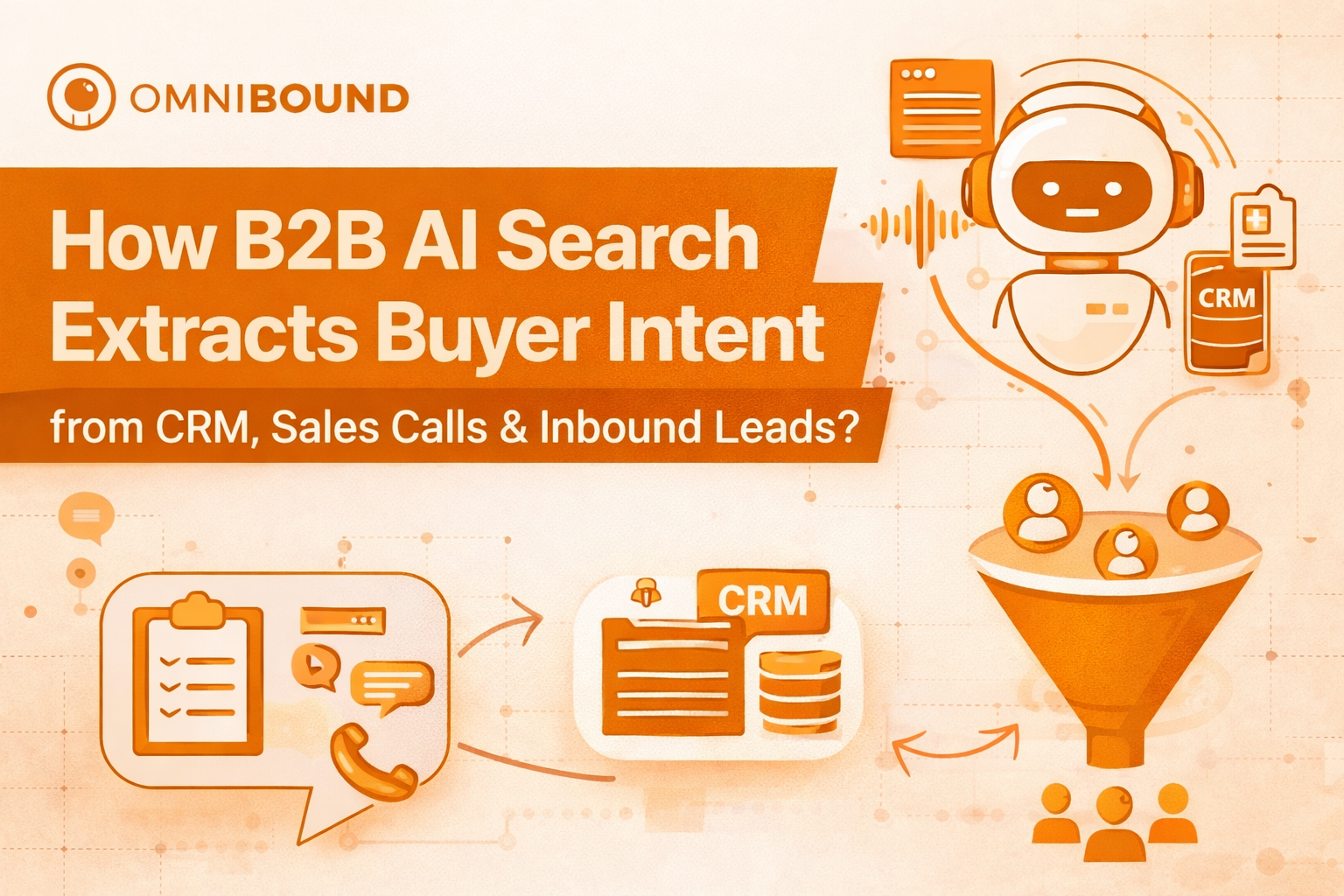
In the context of B2B AI search, intent extraction works across three distinct but interconnected data layers: your CRM, your sales conversations, and your inbound lead activity. When these three sources are unified under a single AI intelligence layer, the result is a real-time picture of buyer intent that no single channel can provide on its own.
We built our AI content marketing platform for B2B teams specifically around this unified approach, because fragmented signals produce fragmented strategies.
Why B2B AI Search Requires More Than Traditional Lead Scoring?
Most B2B teams don't lack data. They lack interpreted intent. The problem is that the systems they rely on were never designed to read between the lines.
Here is how traditional methods fail, point by point:
- CRM records are lagging indicators. They tell you what already happened, not what is about to happen.
- Rule-based lead scoring is static. It assigns points based on arbitrary thresholds, not actual behavioral signals or stated priorities.
- Sales notes are subjective. Two reps hearing the same call will log entirely different takeaways depending on their experience and bias.
- Marketing automation is event-triggered, not intent-driven. A download or a page visit tells you what someone did, not what they meant by it.
Intent is dynamic. The moment a buyer's priorities shift, your static system falls behind. B2B AI search solves this by continuously analyzing signals across all touchpoints and surfacing intent in real time.
|
Traditional Approach |
B2B AI Search Approach |
|---|---|
|
Rule-based scoring |
Signal-based intent scoring |
|
Static lead score |
Real-time intent score |
|
Channel-specific view |
Unified cross-channel view |
|
Reactive outreach |
Predictive action recommendations |
How B2B AI Search Extracts Intent from 3 Core Data Sources?
The real power of B2B AI search lies in its ability to synthesize three distinct types of data that have historically lived in separate systems. Here is how it works across each source.
Source 1: CRM Data
Your CRM holds a wealth of historical context, including pipeline stage movement, deal velocity, engagement history, and past interactions. AI processes this data to identify patterns that human analysts miss.
- Buying signals: Accounts that are accelerating through stages faster than average
- Drop-off risks: Deals that have gone quiet after a high-engagement period
- Upsell potential: Existing customers whose behavior mirrors pre-purchase patterns
Source 2: Sales Calls and Conversations
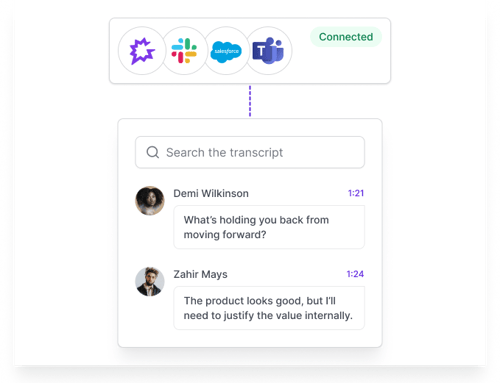
Call transcripts are the richest source of buyer intelligence available to any B2B team. The problem is that they are completely unstructured, which means they are nearly impossible to analyze at scale without AI.
Our AI processes call data to extract these critical signals:
- Pain points: The specific problems a buyer articulates, in their own words
- Urgency signals: Language patterns that indicate a compressed decision timeline
- Decision criteria: The factors a buyer explicitly says matter most
- Competitor mentions: Which alternatives are being evaluated and how they are framed
- Objections: The concerns that need to be addressed before a deal can move forward
Source 3: Inbound Leads
Inbound leads generate enormous signal volume, but most teams treat them as binary: either a lead converts or it doesn't. AI reads far more into each interaction.
- Awareness vs. decision stage: A first-time visitor downloading a thought leadership piece is different from someone comparing pricing pages
- Content intent: The sequence and type of content consumed reveals what problem a buyer is actively trying to solve
- Conversion likelihood: Behavioral pattern matching against historical conversion data to predict who will actually buy
7 High-Impact Use Cases of B2B AI Search for Intent Extraction
Understanding how AI extracts intent is valuable. Knowing exactly where to apply it in your go-to-market motion is where the real competitive advantage lives.
- Prioritizing high-intent accounts: AI ranks your pipeline by real-time intent score so your team focuses effort where it matters most, not just where it is most comfortable.
- Personalizing outreach at scale: When AI has extracted a specific pain point from a call or form fill, every subsequent touchpoint can be tailored to that exact concern.
- Aligning sales and marketing around shared intent data: Both teams operate from the same intelligence layer instead of arguing over lead quality.
- Improving content relevance for AI-cited answers: Intent data reveals what your buyers actually ask AI engines, so your content answers those exact questions. Our B2B content playbook from buyer conversations to AI search covers exactly this workflow.
- Reducing sales cycle length: Reps who walk into every call knowing the buyer's top priorities skip the discovery phase and move straight to value alignment.
- Improving product positioning: Aggregated intent signals across hundreds of calls reveal which messaging resonates and which falls flat, informing your next product narrative.
- Detecting churn risk early: Shifts in engagement patterns and sentiment from customer calls can flag at-risk accounts weeks before renewal conversations begin.
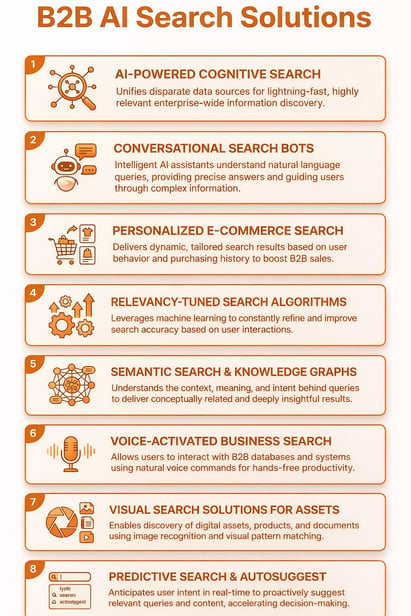
An infographic visualizing eight high-relevance B2B AI Search solutions and their impact on enterprise search. Helps readers compare approaches at a glance.
From Signals to Strategy: How GTM Teams Actually Use Intent Data
Collecting intent data is only half the equation. The competitive edge comes from operationalizing it across every function in your go-to-market team.
Here is how intent flows into strategy at each level:
- Intent drives messaging: When AI surfaces that 60% of your pipeline mentions "integration complexity" as a concern, your next campaign addresses it directly. No guessing, no averaging across segments.
- Intent drives campaign orchestration: Buyers in the decision stage get different content sequences than those in awareness. AI automates this segmentation in real time based on actual signals, not assumed personas.
- Intent creates product feedback loops: Feature requests and objections extracted from sales calls feed directly into your product roadmap, creating a closed loop between market intelligence and product development.
This is the Omnibound model: taking what buyers and markets actually say and turning it into content and strategy that wins in B2B AI search. Our platform for AI solutions for product marketing is built around exactly this signal-to-strategy pipeline.
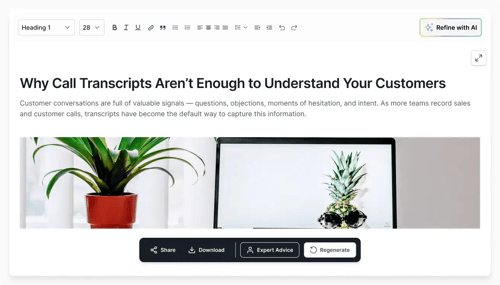
The Technologies Powering B2B AI Search Intent Extraction
You don't need to build this stack from scratch, but you do need to understand what's powering the most effective intent extraction systems in 2026.
The key technology categories to know:
- Conversation intelligence platforms: Tools that transcribe, tag, and analyze sales calls at scale using NLP models trained on B2B conversation patterns
- CRM AI layers: Native or bolt-on AI capabilities that surface patterns and predictions from your existing pipeline data without requiring data migration
- Behavioral analytics tools: Platforms that go beyond page views to map content consumption sequences and identify intent-stage transitions
- AI signal aggregation platforms: Systems that ingest signals from multiple sources and output a unified intent score, like the Omnibound platform itself
The critical distinction is that the most powerful systems don't just analyze one channel in isolation. They connect CRM history, call intelligence, and inbound behavior into a single intent view. Our AI solutions for brand marketing leverage all three layers to ensure brand content aligns with real buyer language and priorities.
Implementation Framework: 5 Steps to Activate Intent Intelligence
Most teams fail at intent extraction not because the technology is too complex, but because they skip the foundational steps. Here is the framework we recommend.
- Centralize your GTM data sources. Connect your CRM, call recording platform, marketing automation system, and website analytics into a single data environment. Siloed inputs produce siloed intelligence.
- Clean and structure your inputs. Raw CRM data is often inconsistent. Call transcripts need speaker labeling. Form fills need normalization. Before AI can find patterns, the data needs to be readable.
- Apply AI models appropriate to each data type. NLP models for call transcripts, predictive models for CRM pipeline movement, and behavioral models for inbound lead sequences. Each data type requires a different analytical approach.
- Define your intent scoring logic. What signals indicate high intent for your specific product and buyer profile? This is where your business context shapes the AI output. Generic models produce generic results.
- Activate insights across your GTM teams. Intent intelligence sitting in a dashboard nobody checks is worthless. Push scores and recommended actions directly into the tools your sales, marketing, and product teams already use every day.
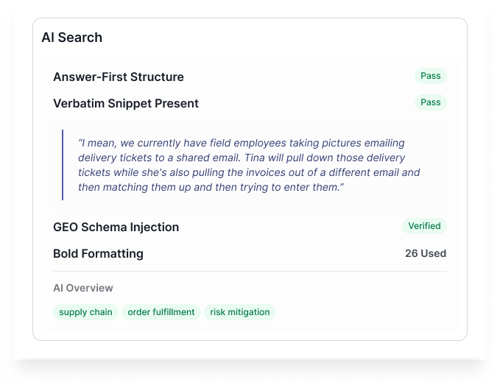
Did You Know?
Machine learning-based intent extraction delivers 75% higher conversion rates compared to traditional lead scoring methods, making it one of the highest-ROI investments in any B2B GTM stack.
The Metrics That Prove B2B AI Search Intent Extraction is Working
If you can't measure it, you can't improve it. These are the metrics that directly reflect the impact of AI-driven intent extraction on your GTM performance.
|
Metric |
What It Measures |
Benchmark Improvement |
|---|---|---|
|
Lead-to-opportunity rate |
Quality of intent signals used to qualify leads |
+30-45% |
|
Conversion rate uplift |
Effectiveness of intent-personalized outreach |
+75% (ML-based) |
|
Sales cycle length |
Speed of moving intent to close |
-30 to 40% |
|
Engagement depth |
Whether buyers consume intent-matched content |
Measured by session depth and return visits |
|
Revenue attribution |
Revenue tied to intent-driven campaigns and actions |
Varies by team; typically 2-3x clearer attribution |
Challenges to Watch Out for in AI Intent Extraction
We are direct with our customers: AI intent extraction is powerful, but it is not plug-and-play. There are real challenges that teams need to plan for.
- Data silos: If your CRM, call recordings, and marketing platform don't communicate, the unified intent layer simply cannot be built. Integration is a prerequisite, not an option.
- Poor data quality: AI finds patterns in data. If the underlying data is inconsistent, incomplete, or mislabeled, the patterns it finds will be wrong, sometimes dangerously so.
- Over-reliance on automation: Intent scores should inform human judgment, not replace it. Reps who follow AI recommendations without applying their own context will miss important nuance.
- Privacy and compliance: Particularly in regulated industries like healthcare and financial services, call recording, data storage, and analysis must comply with applicable privacy laws. Our AI solutions for healthcare and life sciences are specifically designed with compliance requirements built in.
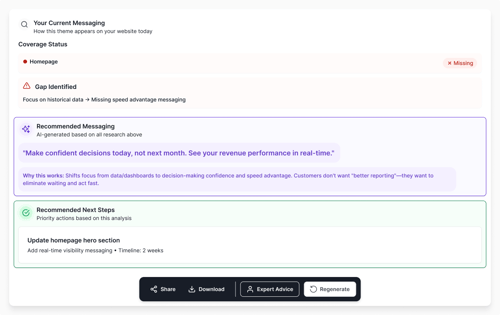
The Future of B2B AI Search and Intent-Driven GTM
In 2026, the leading edge of B2B AI search has moved beyond intent detection into intent activation. The next wave is fully autonomous GTM systems that don't just identify buyer intent, they act on it.
Here is where the trajectory is heading:
- Real-time orchestration: AI systems that update messaging, content, and outreach sequences automatically as buyer intent signals shift, without waiting for a human to pull a report.
- Autonomous GTM agents: AI agents that manage entire outbound sequences, content scheduling, and lead routing based on continuously updated intent scores, with humans focused on strategy and relationship management.
- Intent-to-citation loops: AI that uses extracted intent signals to generate content specifically designed to be cited by other AI systems when buyers ask questions. This is the intersection of conversation intelligence and B2B AI search visibility, and it is where we are most focused at Omnibound.
- Cross-account intelligence: Aggregating intent patterns across hundreds of accounts to identify macro buying trends before they appear in any single deal, giving your team a structural advantage over competitors who only analyze individual accounts.
The shift is from data collection to intent understanding to autonomous action. Teams that build this capability now will have compounding advantages over those who wait.
For teams in sectors with complex buyer journeys, we have built intent-aware solutions for telecommunications and IT services, technology and software, and professional services, each tailored to the specific buying patterns and data challenges of that industry.
Conclusion
B2B AI search is not a single tool or a one-time initiative. It is a fundamental shift in how go-to-market teams understand their buyers and act on that understanding.
The teams winning in 2026 are those that have moved beyond collecting data and started extracting meaning from it. They use AI to synthesize what buyers say on calls, what their CRM records quietly reveal, and what inbound lead behavior signals, into a unified, real-time intent intelligence layer that drives every GTM decision.
The gap between fragmented signals and actionable intent is exactly what Omnibound is built to close. From AI solutions for content marketing to full-stack B2B AI search visibility, we give your team the intelligence to create content that gets cited, messaging that resonates, and strategies that convert.
Start your free trial today and see how AI intent extraction turns your buyer conversations into your most powerful competitive advantage.
FAQs
What is buyer intent in B2B marketing?
Buyer intent in B2B marketing refers to the signals that indicate how likely an account or individual is to make a purchase decision, how soon, and based on what priorities. These signals come from behavioral data, conversation content, CRM activity, and content consumption patterns, and AI is the only scalable way to synthesize all of them simultaneously.
How does AI detect intent from sales calls?
AI uses natural language processing to transcribe and analyze call recordings, identifying specific phrases, emotional tone, objection patterns, competitor mentions, and urgency indicators. These signals are then scored and aggregated to produce a clear picture of where a buyer sits in their decision journey and what they need to move forward.
Can CRM data alone capture buyer intent?
No. CRM data captures lagging indicators of past activity, not forward-looking intent signals. It tells you what happened, not what a buyer is thinking right now. Combining CRM data with call intelligence and inbound lead signals through AI is what produces actionable buyer intent intelligence rather than just a historical record.
What tools help extract intent from inbound leads?
The most effective tools combine behavioral analytics, AI lead scoring, and content intelligence. Platforms like Omnibound go further by connecting inbound signals to CRM history and call data, so your team gets a complete intent picture rather than a channel-specific view of any single interaction.
How do you use intent data in a B2B content and AI search strategy?
Intent data tells you exactly what questions your buyers are asking and what concerns are blocking their decisions. You use that intelligence to create content that directly answers those questions, which is also exactly the type of content that B2B AI search engines cite when buyers query them. This is why intent extraction and B2B AI search visibility are two sides of the same strategy.