

Table Of Contents
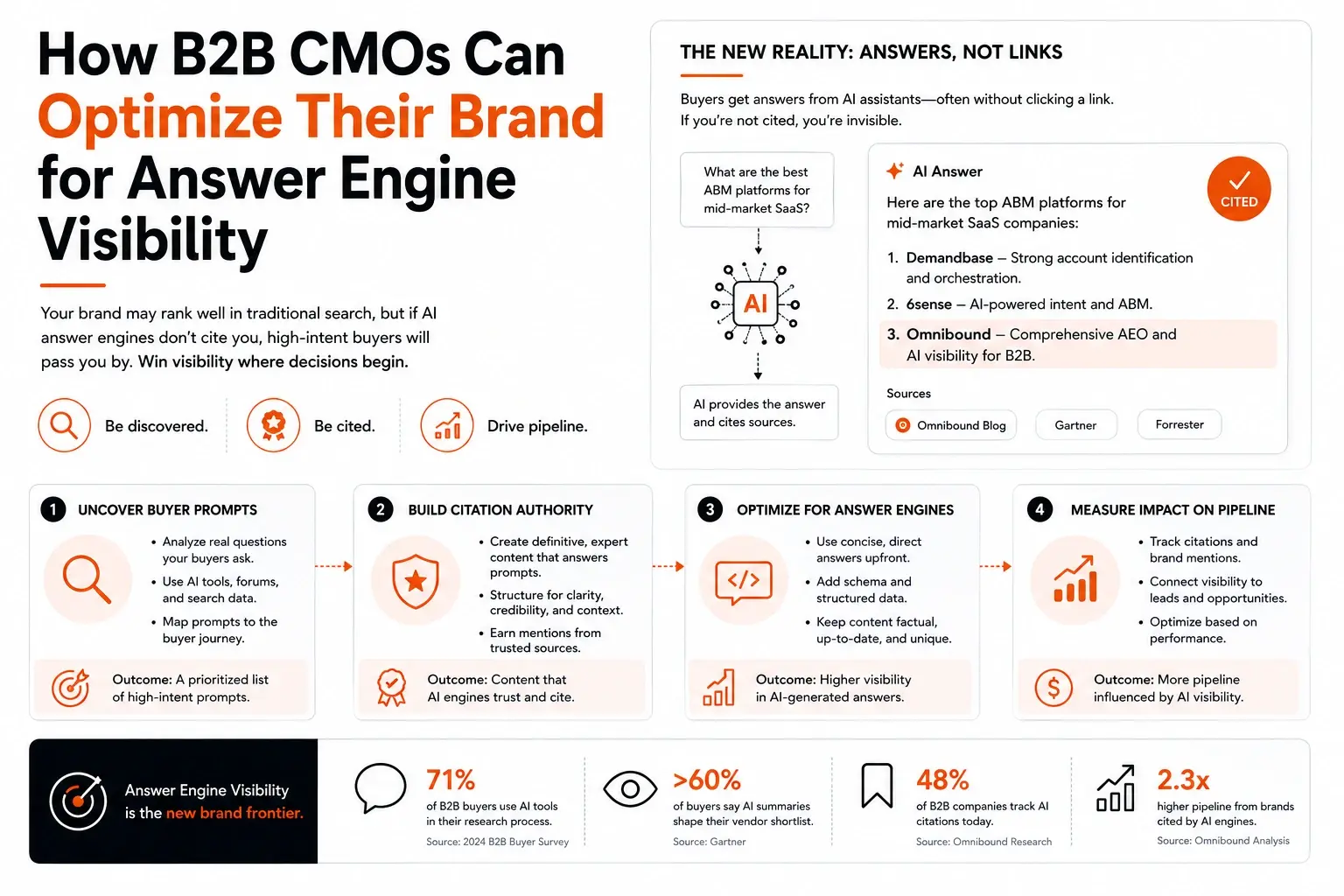
For a B2B chief marketing officer, the shift from traditional search to AI‑driven answer engines feels like a sudden change of terrain. Your brand may rank well in a keyword‑centric console, yet the AI assistant still does not cite you when a prospect asks a direct question. That gap means high‑intent buyers are passing you by without ever clicking a link. The solution is to treat the AI answer engine as a new brand frontier and align every piece of content with the exact prompts your buyers use. In this guide you will learn why answer engine optimization matters, how to uncover buyer prompts, how to build citation authority, and how to measure the impact on pipeline.
Why Answer Engines Are the New Brand Frontier
AI answer engines synthesize information from the web and return concise answers instead of a list of links. When your content is not engineered for that model, the engine defaults to other sources, leaving your brand invisible. This reality is amplified by the fact that many CMOs still rely on traditional SEO dashboards that show impressions but not whether the brand is being quoted. The result is a silent loss of high‑intent traffic that could have shortened the sales cycle. Forrester research highlights that AI‑first discovery is reshaping B2B buying, making answer engine visibility a critical competitive advantage. Answer engine optimization therefore becomes the first line of defense against being bypassed by AI assistants.
To protect your brand’s presence, you must first audit where you currently appear in AI answers. Look for patterns where competitors are cited and note the topics where you are absent. This audit reveals the ai search visibility gaps that are invisible in conventional analytics. Once identified, you can prioritize closing those gaps based on the buyer’s stage and the potential impact on revenue. The audit also feeds directly into a share of voice optimization plan that tracks how often your brand is the source of truth in AI‑generated answers.
Armed with this insight, you can begin to map the specific prompts that trigger AI citations and design content that directly answers them. This shift from keyword targeting to prompt alignment is the cornerstone of modern AEO strategy. Recommended Read: Best AI Demand Generation Tactics for Growth Teams in 2026 - Shows how AI‑driven demand tactics complement answer engine visibility efforts.
The conversational nature of AI assistants means that users often see a single sentence answer rather than a list of options. In that moment, the cited source becomes the de‑facto authority. Therefore, securing that citation is equivalent to winning a prime placement on a traditional SERP, but with the added benefit that the user may not need to click further to trust your brand.
Mapping the Prompts That Drive Buyer Conversations
The most common pain for CMOs is not knowing the exact language prospects use when they query an AI assistant. Generic keyword lists miss the nuance of real buyer intent, so the engine cannot match your content to the question. The remedy is a systematic prompt‑mining process that extracts the exact questions from sales calls, CRM notes, and support tickets. By ingesting this buyer‑generated language, you create a living inventory of prompts that can be mapped to content assets.
When you surface these prompts, you quickly see clusters of high‑value queries that are currently unanswered by your site. For example, a sales call may reveal a prospect asking, "How does X integrate with Y in a SaaS environment?" If no page directly answers that, the AI will cite a competitor that has published a guide. Capturing the prompt and creating a dedicated, citation‑ready page closes that gap. This approach also fuels the identifying visibility gaps in ai search results workflow, turning raw conversation data into a strategic content pipeline.
To operationalize prompt mapping, start with a simple three‑step loop: collect, cluster, and create. Collect raw buyer language from your existing tools, cluster similar prompts to prioritize effort, and create concise, answer‑focused pages that address each cluster. Recommended Read: AI Search Optimization Checklist: Win AI Citations and Drive B2B Pipeline - A step‑by‑step playbook for turning prompts into citation‑ready assets.
Clustering can be as simple as grouping prompts that share key terms, or you can use basic text‑similarity algorithms to surface hidden patterns. Involving product managers, sales engineers, and support leads in the review ensures that the resulting content reflects real‑world use cases and technical depth.
Building Citation Authority to Win AI Answers
Even when your content matches a buyer prompt, the AI engine decides which source to cite based on credibility signals. Citation worthiness is the metric that captures how often a piece of content is referenced across the web. Engines favor sources that are frequently cited, have strong backlink profiles, and demonstrate expertise through authorship and credentials. Building that authority requires a deliberate strategy that combines content quality, external references, and author reputation.
One effective tactic is to embed author bios with verifiable credentials on each answer‑focused page. This practice aligns with the best practices for optimizing authorship and credentials to improve ai visibility and citation worthiness. Additionally, securing off‑domain citations from reputable industry sites amplifies your citation worthiness. Each earned citation acts like a vote of confidence, nudging the AI toward your brand when the same prompt appears.
Finally, maintain a consistent publishing cadence that reinforces your expertise. Regularly update high‑performing pages to reflect the latest product capabilities and market trends, ensuring the AI sees your content as fresh and reliable. Recommended Read: Webinar | From AI Visibility to Pipeline: How Buyer‑Focused AI Search Optimization Translates into Revenue - Explores how citation authority translates directly into pipeline growth.
Supplementing your own pages with third‑party case studies, analyst reports, and customer testimonials adds layers of external validation. When reputable sources reference your solution, the AI engine treats those signals as strong endorsements, further boosting your citation worthiness.
Turning Buyer Signals into Optimized Content
Once you have a catalog of buyer prompts and a plan to boost citation authority, the next step is to create content that satisfies both the AI engine and the human reader. This content must be concise, structured for easy extraction, and optimized for the answer engine optimization aeo tool ecosystem. Use clear headings, bullet points, and schema markup to signal answerability to the model.
In practice, start each page with a direct answer to the prompt, followed by supporting details and a call‑to‑action that ties back to the buyer’s journey stage. Enrich the page with relevant data, case snippets, and links to deeper resources. The content pipeline automation tool with answer engine optimization tracking can streamline this workflow by automatically flagging new prompts, assigning content owners, and tracking citation outcomes.
By aligning the creation process with real buyer language, you ensure that every asset contributes to the broader AEO strategy. This alignment also feeds into the ai visibility metrics platform, which aggregates performance signals across prompts, citations, and pipeline impact.
Implementing structured data such as FAQPage or HowTo schema helps the AI engine quickly extract the answer block, while also improving the chance of appearing in rich results on traditional search pages.
Measuring Share of Voice and Pipeline Impact
Measurement is the bridge that turns visibility into revenue. Traditional SEO metrics like impressions and clicks no longer tell the full story. Instead, focus on share of voice optimization that quantifies the proportion of AI‑generated answers that cite your brand versus competitors. Pair this with a citation worthiness score to gauge the quality of those citations.
Below is a simple framework for tracking the core metrics that matter to a B2B CMO.
| Metric | Definition | Data Source | Target | Impact |
|---|---|---|---|---|
| AI Share of Voice | Percentage of AI answers that cite your brand | AI visibility metrics platform | ≥ 20% | Higher brand authority and lead flow |
| Citation Worthiness Score | Weighted score of external citations and author credibility | Backlink analysis tool | ≥ 75 | Improved AI ranking confidence |
| Prompt Coverage Rate | Proportion of identified buyer prompts with dedicated pages | Prompt mapping database | ≥ 80% | Reduces visibility gaps |
The table shows how each metric feeds into a unified dashboard that ties AI visibility directly to pipeline stages. Tracking these numbers over time reveals whether your AEO investments are moving the needle on revenue.
When you notice a dip in share of voice, drill down to the specific prompts that are underperforming and create or refresh content accordingly. This full‑loop measurement creates a feedback cycle that continuously improves both visibility and pipeline outcomes.
Regular monthly reviews of these metrics allow you to spot trends early, reallocate resources, and keep the content pipeline aligned with evolving buyer language.
Implementing a Full‑Loop AEO Strategy with Omnibound
Omnibound’s platform is built around the exact workflow described in the previous sections. It ingests real‑time buyer signals from CRM and support systems, surfaces the high‑impact prompts, and recommends content actions that boost citation authority. The platform also provides an ai search visibility tracking tool that monitors share of voice, citation worthiness, and prompt coverage in a single pane.
Using Omnibound, a CMO can set up automated alerts for any newly discovered ai search visibility gaps. The system then assigns the prompt to a content owner, tracks the creation of a citation‑ready page, and updates the ai visibility metrics platform once the page is live. This closed‑loop process reduces the time from insight to execution and ensures that every piece of content contributes to measurable pipeline impact.
By integrating the platform into your existing marketing stack, you create a single source of truth for AI search performance, turning brand invisibility into a predictable engine for revenue growth.
Aligning the AEO calendar with product launches, industry events, and quarterly business reviews helps ensure that new prompts are addressed when market interest peaks, maximizing the impact of each citation‑ready asset.
Common Pitfalls to Avoid When Launching an AEO Program
Even with a solid framework, teams can stumble on avoidable mistakes. First, over‑optimizing for AI at the expense of human readability can make content feel robotic and reduce engagement. Second, neglecting internal linking means that citation‑ready pages may not benefit from the authority of existing high‑traffic assets. Third, ignoring content freshness leads to the AI engine favoring more up‑to‑date competitors. By balancing AI‑focused structure with a genuine, audience‑first voice, you protect both search visibility and the reader experience.
FAQs
1. How does Omnibound differ from traditional SEO tools?
Traditional SEO tools focus on keyword rankings and click‑through rates, while Omnibound targets the AI answer engine layer. It extracts buyer‑generated prompts, optimizes content for answerability, and tracks citation metrics that directly influence AI‑driven visibility. This shift enables CMOs to capture high‑intent traffic that bypasses the classic SERP.
2. Can the platform integrate with our existing CRM and marketing automation?
Yes. Omnibound offers native connectors for major CRMs and marketing automation platforms. The integration pulls buyer conversation data in real time, feeding the prompt‑mining engine and ensuring that the content pipeline stays aligned with the latest buyer language.
3. What kind of reporting does Omnibound provide?
The platform delivers a dashboard that combines share of voice optimization, citation worthiness, and prompt coverage rate. Reports can be filtered by product line, buyer stage, or competitive set, giving you clear visibility into how AI search performance translates into pipeline milestones.
4. How quickly can we expect to see an impact on pipeline?
Results vary by market, but early adopters typically observe a measurable lift in qualified leads within 60‑90 days after publishing the first set of citation‑ready pages. The speed comes from the feedback loop that continuously surfaces new prompts and drives rapid content iteration.
5. Is there a risk of over‑optimizing for AI and losing human readability?
Omnibound’s guidelines balance answerability with human‑centric storytelling. Content is structured for AI extraction but remains engaging for readers, ensuring that both the engine and the audience find value.
6. How do we measure ROI from answer engine optimization?
By linking citation share and AI visibility metrics to CRM stages, you can attribute pipeline revenue to specific AEO initiatives. The platform’s attribution model quantifies the contribution of each citation‑ready asset to closed‑won opportunities.
Conclusion
Answer engine visibility is no longer optional for B2B CMOs it is a core component of modern brand strategy. By mapping buyer prompts, building citation authority, and measuring share of voice, you turn AI‑driven discovery into a reliable pipeline source. Omnibound provides the technology to automate this loop, giving you real‑time insight and actionable guidance. To see how Omnibound can make your brand the go‑to source in AI answers, explore the platform today.
Recommended Authority Resources
- Reference: In the Answer Economy, Don't Win the Click - G2 research showing the high percentage of B2B buyers starting research with AI chatbots.
- Reference: From Keywords To Context: Impact And Opportunity For AI … - Forrester analysis on how AI‑first search reshapes B2B marketing.
Turn Your Content Into AI-Search Winners
Get cited across ChatGPT, Claude & Perplexity — not just ranked on Google.
- Increase AI citations
- Improve answer visibility
- Track brand mentions in LLMs