

Table Of Contents
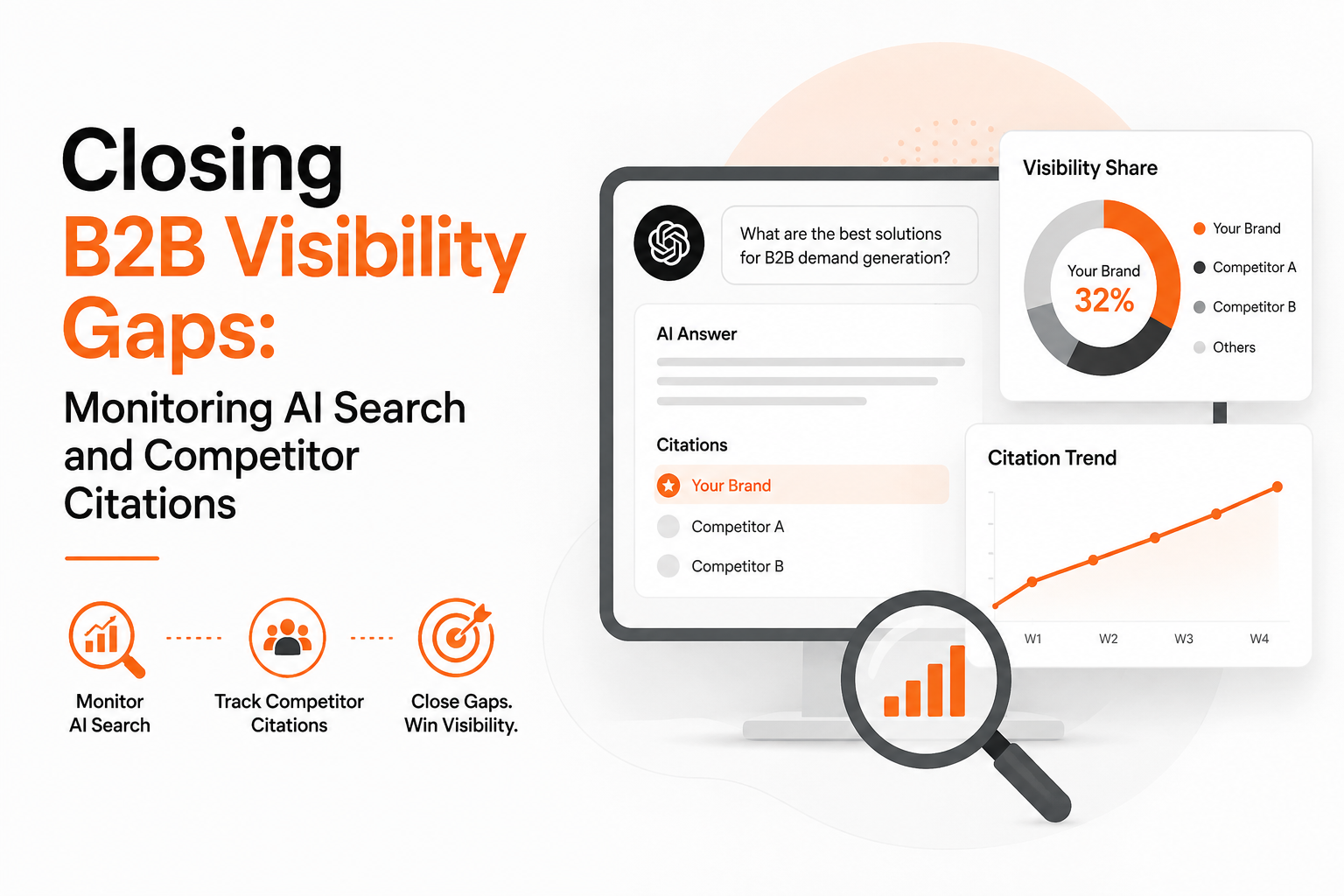
Demand‑generation leaders are waking up to a new reality: buyers are no longer scrolling through traditional search‑engine results pages. Instead, they ask conversational assistants like ChatGPT, Gemini, or Perplexity and receive concise, AI‑generated answers. When those answers quote external content, the brand behind the citation gains instant authority. Yet many B2B marketers still cannot see which of their assets are being quoted, nor when rivals surface in those AI answers. This lack of visibility creates blind spots that erode share of voice and ultimately weaken the pipeline. In this guide you will learn why AI‑driven answer engines matter, how to uncover hidden citation gaps, how to mine buyer prompts, and how to build a continuous competitor‑monitoring engine that turns insight into revenue.ai search visibility tool and ai search visibility monitoring are the foundations of a disciplined approach that keeps your content in front of the buyer at the exact moment of intent.
Why AI‑Driven Answer Engines Are Redefining B2B Visibility
Modern answer engines surface answers directly within the chat interface, bypassing the traditional list of organic links. For a VP of Marketing, this shift means the first brand a buyer sees may be the one cited in the AI response, not the one that ranks on a SERP. The consequence is a new metric: citation share, which reflects the proportion of AI‑generated answers that reference your content. According to a AI search adoption study, a growing share of B2B queries now end in a zero‑click answer, making citation worthiness a critical differentiator.ai answer engine visibility therefore directly impacts pipeline velocity.
Because AI models draw from a curated set of high‑quality sources, they favor assets that are well‑structured, fact‑dense, and frequently referenced. This creates a feedback loop: the more your content is cited, the more likely the engine will cite it again. The emerging discipline of ai search visibility and citation worthiness encourages marketers to think beyond keyword rankings and design assets that are citation‑ready. That means using clear headings, concise summaries, and data‑backed statements that AI can extract with confidence.
To get ahead, start treating every buyer prompt as a potential citation trigger. Map the natural‑language questions that surface in your CRM notes, sales calls, and support tickets, then align your content to answer those prompts verbatim. When you can reliably predict which prompts will generate AI answers, you can prioritize updates, create new assets, and close the visibility gap before competitors do.
Imagine a VP of Marketing reviewing a quarterly performance dashboard and seeing that a competitor’s whitepaper appears in 30 percent of AI‑generated answers for a core product category, while their own flagship guide is absent. That single insight can spark a focused content sprint that upgrades the guide’s structure, adds fresh data, and re‑optimizes schema markup – actions that directly increase the likelihood of being quoted in future AI responses.
Recommended Read: AI Search Optimization Checklist: Win AI Citations and Drive B2B Pipeline - A step‑by‑step playbook for building citation‑ready assets.
The Hidden Gap: Not Knowing Which Content AI Engines Cite
Many B2B teams operate in the dark, assuming that high organic rankings guarantee AI visibility. In reality, AI engines select sources based on relevance, authority, and freshness, which may differ from traditional SEO signals. Without a clear view of which pages are being quoted, you cannot prioritize updates or allocate resources effectively. This hidden gap often surfaces when marketers discover that a competitor’s whitepaper appears in AI answers while their own flagship guide does not.
As one marketing director put it, "We pulled live data on which Tellius pages Google's AI actually quotes and which questions it answers." That insight revealed a mismatch between the assets the team believed were influential and the ones the AI actually referenced. The quote underscores the need for real‑time citation tracking to surface the exact buyer prompts that drive traffic.
Implement a lightweight monitoring process: use API endpoints from major answer engines (where available) or leverage web‑scraping tools to capture the snippets that reference your domain. Log the URL, the quoted excerpt, and the associated buyer prompt. Over time, this data set becomes a living map of AI citation pathways, enabling you to prioritize high‑impact pages, refresh outdated content, and expand coverage on under‑served topics.
Freshness matters because AI models are regularly retrained with newer web data. A page that was authoritative six months ago may lose citation weight if it is not updated with the latest industry benchmarks or product releases. By incorporating a schedule that checks citation status alongside content freshness, you protect your assets from slipping out of AI consideration.
Recommended Read: How to Build AI Answer Citations That Drive B2B Pipeline - Practical guidance on turning citation data into content strategy.
Mining Buyer Prompts to Power Citation‑Ready Content
Buyer prompt mining is the practice of extracting the exact natural‑language questions that prospects use when interacting with AI assistants. These prompts differ from traditional keyword queries because they capture intent, context, and phrasing that AI models understand natively. For a demand‑generation leader, the ability to surface these prompts provides a direct line to the language that drives AI citations.
Start by aggregating conversational data from sales calls, webinar Q&A sessions, and support tickets. Use text‑analysis tools to identify recurring question patterns and cluster them by buying stage. The resulting list becomes a prioritized prompt inventory. Below is a simple framework that maps prompts to content actions:
| Prompt Cluster | Typical Buying Stage | Content Format | Action Needed | Potential AI Citation |
|---|---|---|---|---|
| "How does X improve ROI?" | Evaluation | Case Study | Add ROI metrics | High |
| "What are best practices for Y?" | Awareness | Guide | Include step‑by‑step checklist | Medium |
| "Can I integrate Z with my stack?" | Decision | Technical FAQ | Detail integration steps | High |
The table shows how each prompt cluster aligns with a buying stage, the optimal content format, and the specific action required to make the asset citation‑ready. By systematically addressing each cluster, you create a library of assets that directly answer AI‑driven buyer questions.
When you have the inventory, use AI‑assisted clustering to surface subtle variations of the same intent – for example, “What is the ROI of X?” versus “Will X boost my bottom line?” Consolidating these variations under a single content theme reduces duplication and concentrates citation power.
Once your prompt inventory is in place, embed the exact phrasing into your content titles, headings, and FAQs. AI models prioritize exact matches, so mirroring the buyer’s language increases the likelihood of being cited. Track the performance of each updated asset using ai search visibility tracking software to see how citation share evolves over time.
Recommended Read: Best 22 AEO Tools for Answer Engine Optimization in 2026 - An overview of platforms that support prompt mining and citation tracking.
Building a Continuous Competitor‑Monitoring Engine for AI Search
While tracking your own citations is essential, the competitive landscape in AI search moves at lightning speed. Rivals can publish a new blog post, and within hours the AI engine may begin quoting it, stealing share of voice. A disciplined monitoring engine delivers real‑time alerts when competitors appear in AI answers, allowing you to react before the gap widens.
One common request illustrates the need: "can you also help with how we can build the tool to get notifications when any competitor of ours gets mentioned on LinkedIn using apify or similar?" This request highlights two requirements – automated detection across platforms and immediate notification. Implement a workflow that (1) polls AI answer APIs or scrapes answer snippets, (2) cross‑references the source URLs against a list of competitor domains, and (3) triggers alerts via Slack, email, or a dashboard when a match is found.
Integrate the alert feed with your content planning calendar. When a competitor citation spikes, schedule a rapid response: create a counter‑content piece that addresses the same prompt but adds unique data or a stronger value proposition. Over time, this loop transforms competitor monitoring from a reactive chore into a proactive pipeline generator. Remember to measure the impact using share of voice optimization ai search metrics so you can quantify how each response shifts the citation balance in your favor.
Link the monitoring system to your CRM so that any lead generated from a newly cited asset is automatically tagged with the source prompt. This data enrichment enables you to calculate the exact contribution of AI citations to pipeline velocity, a figure that resonates strongly with finance and executive stakeholders.
Recommended Read: Best 22 AEO Tools for Answer Engine Optimization in 2026 - A curated list of tools that support competitor monitoring and share‑of‑voice analysis.
Practical Tips for Crafting Citation‑Ready Content
Creating assets that AI engines love does not require a complete overhaul of your content strategy. Start by auditing existing top‑performing pages for three key attributes: clear, declarative headings; concise, data‑rich paragraphs; and structured markup such as FAQ schema. Where headings can be phrased as direct answers to buyer prompts, AI models are more likely to surface the snippet.
Second, embed supporting evidence close to the claim. A statistic followed by a citation to a reputable source within the same paragraph signals authority to the AI model. This practice also improves human credibility and reduces the need for downstream fact‑checking.
Third, keep the language natural. Avoid keyword stuffing or overly technical jargon that diverges from how buyers actually speak. When you hear a prospect say “How do I cut churn by half?” mirror that phrasing in a sub‑heading and provide a step‑by‑step answer.
Finally, maintain a regular cadence of refreshes. Even a well‑structured page can lose citation relevance if the underlying data becomes stale. A quarterly review that updates numbers, adds new case studies, and checks for emerging buyer prompts keeps the asset fresh in the eyes of AI retraining cycles.
Measuring the Impact of AI Citation Visibility
Quantifying the business value of AI citation work is essential for securing ongoing investment. Begin with a baseline citation share metric – the proportion of AI‑generated answers that reference your domain versus competitors. Track this metric month over month to identify upward or downward trends.
Next, map each citation to a downstream lead or opportunity. By tagging inbound leads with the originating AI prompt, you can calculate conversion rates specific to citation‑driven traffic. Compare these rates against traditional organic traffic to highlight efficiency gains.
Third, assess the influence on deal velocity. Opportunities that originated from citation‑rich assets often progress faster because the buyer has already received a concise, authoritative answer. Measuring average sales cycle length for citation‑originated deals provides a concrete ROI figure.
Combine these quantitative signals with qualitative feedback from sales reps who notice higher engagement when prospects reference AI answers. This blended approach creates a compelling narrative that AI citation visibility directly fuels pipeline growth.
FAQs
1. How can I start tracking AI citations without a dedicated platform?
Begin with a manual audit of high‑value pages. Use site‑specific searches (e.g., "site:yourdomain.com" combined with known AI answer snippets) to locate existing citations. Then set up simple alerts via Google Alerts or RSS feeds for competitor domains. Over time, transition to a purpose‑built ai search visibility platform that automates data collection and provides dashboards for share‑of‑voice analysis.
2. What is the difference between AI search visibility and traditional SEO?
Traditional SEO focuses on ranking in a list of links, whereas AI search visibility measures whether your content is quoted in a conversational answer. The former relies on backlinks and keyword optimization; the latter depends on factual density, schema markup, and alignment with natural‑language prompts. Both are important, but AI citation metrics directly influence zero‑click traffic and early‑stage buyer perception.
3. How often should I refresh content to maintain citation relevance?
AI models favor fresh, authoritative sources. Establish a quarterly review cycle where you revisit top‑performing citation assets, update statistics, and incorporate new buyer prompts. If you notice a decline in citation share for a specific asset, prioritize an immediate refresh to restore relevance.
4. Which metrics should I track to prove the ROI of AI visibility work?
Key metrics include citation share (percentage of AI answers that reference your content), prompt coverage (number of buyer prompts addressed), and pipeline impact (conversion rate of leads originating from AI‑cited assets). Pair these with traditional lead‑generation KPIs to build a comprehensive ROI narrative for stakeholders.
Conclusion
AI‑driven answer engines are now the front door to B2B information. By systematically uncovering which of your assets are being quoted, mining the exact buyer prompts that trigger those citations, and building a real‑time competitor‑monitoring engine, you can close visibility gaps that otherwise erode share of voice. Apply the frameworks in this guide, track ai search visibility and share of voice optimization metrics, and turn every AI citation into a pipeline opportunity. When you make AI citation visibility a core part of your demand‑generation strategy, you ensure that your brand is the one buyers hear first – and ultimately, the one they choose.
Recommended Authority Resources
- Reference: New front door to the internet: Winning in the age of AI search - McKinsey - Provides industry‑level data on AI answer engine adoption, supporting the importance of AI citation visibility.
- Reference: AI Search Visibility Services Market Size, Share & 2031 Growth Trends ... - Mordor Intelligence - Offers market‑size figures and growth forecasts that underline the expanding opportunity for AI search visibility monitoring.
Turn Your Content Into AI-Search Winners
Get cited across ChatGPT, Claude & Perplexity — not just ranked on Google.
- Increase AI citations
- Improve answer visibility
- Track brand mentions in LLMs