

Table Of Contents
VPs of Demand Generation are losing early‑stage buyer intent because their content rarely appears in AI‑generated answers. The result? Competitors capture the first touchpoint and the pipeline stalls before traditional funnels even begin. The fix is to turn buyer prompts into citation‑ready assets that AI engines reference, then measure that impact directly to revenue. In this guide you will learn how to capture prompt‑level demand, create citation‑worthy content, close competitive gaps, and track AI‑attributed inbound so you can prove pipeline growth and defend share of voice.
Why AI Answer Citations Are the New Front Door to B2B Buyers
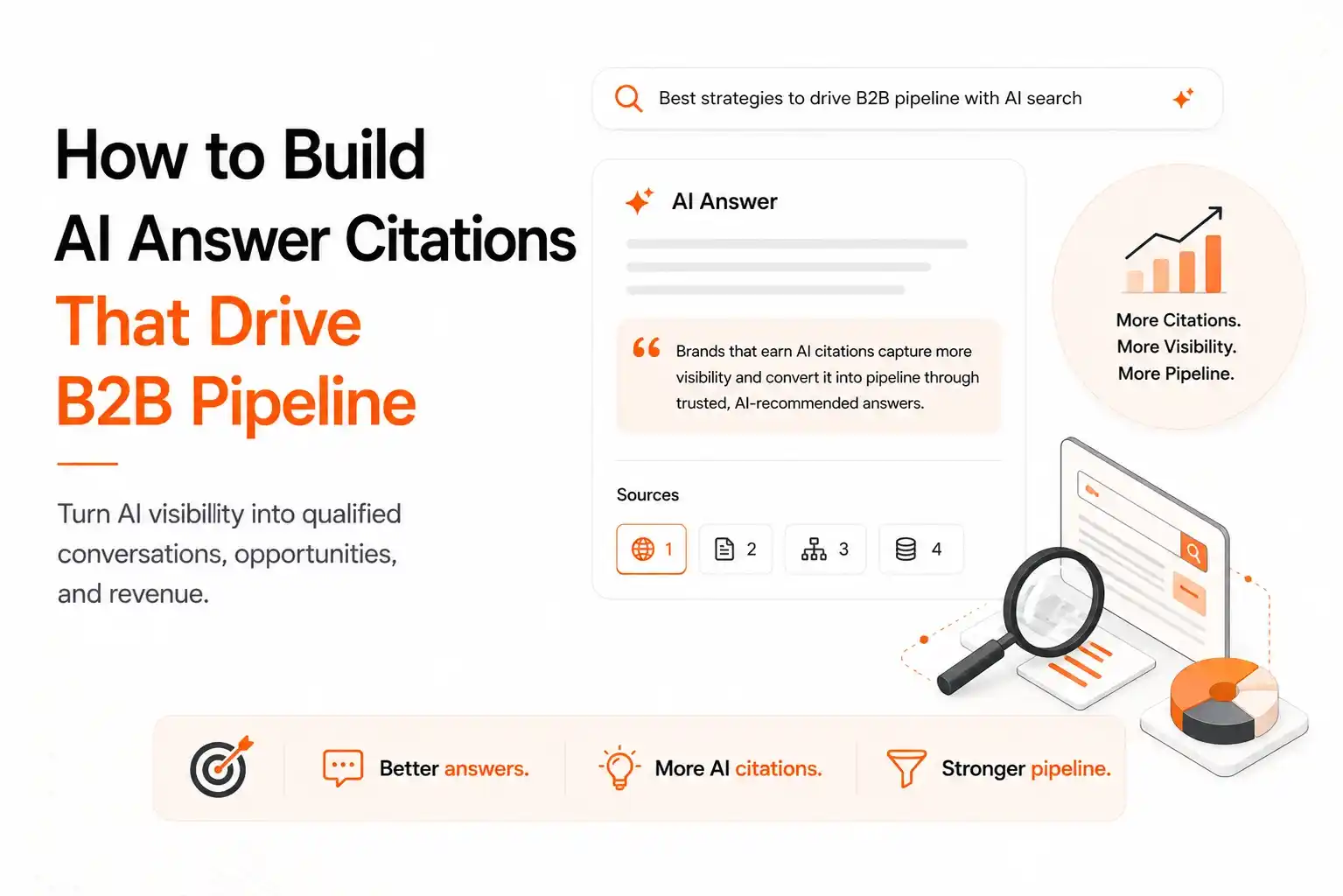
Buyers now start research with AI chatbots, asking exact questions that surface in AI answers. AI chatbots now dominate the start of buyer research; visibility means being cited in AI answers (competitor insight). When a citation appears, the buyer sees your brand before ever clicking a link, turning a zero‑click interaction into a trusted signal. Studies show that 60‑70% of AI‑powered search results result in zero clicks, making citation the primary goal.
To win this front door, you need AI visibility – the proportion of AI answers that reference your content. This visibility is driven by a solid content strategy that aligns with real buyer language and structured data. By mapping prompts to content, you transform passive AI exposure into active pipeline influence.
Imagine a buyer asking, “How can I improve SaaS customer retention?” The AI pulls the most concise, structured answer and cites a brand that has formatted its content for zero‑click consumption. That citation becomes the buyer’s first brand exposure, even before any link is offered.
For a deeper look at how AI‑driven content impacts revenue, see our guide B2B Content Marketing ROI: How Your Content Drives Real Revenue. It walks through attribution models that connect citations to closed‑won deals.
Understanding why AI answers matter also requires a shift in mindset. Traditional SEO focused on ranking for keywords that users typed. Today, the keyword itself is often hidden inside a conversational prompt, and the AI engine decides whether to surface a link or simply read an answer. If your content is not structured to be read, the engine will answer without linking, and you lose the opportunity to influence the buyer. This is why the citation‑first approach is essential for modern B2B demand generation.
Build Citation‑Ready Assets – From Prompt Capture to Competitive Gap Closing
The first step is AI Search Intelligence. This module surfaces the exact prompts buyers type into engines like ChatGPT, Gemini, or Claude. By tracking prompt‑level demand visibility, you know which questions are generating traffic and where you lack coverage.
Next, translate those prompts into citation‑worthy content. Structure each asset to answer a single buyer question, use clear headings, bullet points, and embed structured data so AI can extract the answer reliably. Organize topics into topic clusters that link related answers together, reinforcing authority across the buyer journey.
Competitive citation mapping then reveals which rivals are cited for the same prompts. Identify whitespace where your brand is absent and prioritize those gaps. This systematic approach prevents you from chasing low‑value topics and focuses effort on high‑impact citations.
Recommended Read: AI Tools in B2B Marketing – discover the AI stack that powers prompt capture, content generation, and real‑time citation alerts.
When you create a new asset, start with the exact phrasing of the buyer prompt. Place that phrasing in the first sentence, then break the answer into digestible sections. Use schema markup such as FAQPage or AnswerBox to flag the answer for the engine. Even a short, well‑tagged paragraph can outrank a longer, unstructured blog post because the AI values clarity and relevance over length.
Linking citation‑ready assets to your sales enablement process magnifies their effect. When a rep knows a prospect has already seen your brand in an AI answer, they can reference the same concise snippet in a call, reinforcing familiarity and accelerating the sales conversation.
Refresh, Optimize, and Scale Your Citation Strategy
Existing assets often miss citation opportunities because they were created before AI search became dominant. Use the Content Refresh Grid to score pages against current buyer prompts and market signals. Prioritize updates that will boost your citation rate and share of voice.
When refreshing, apply the same citation‑ready structure: answer the prompt directly, include concise summaries, and tag the content with schema that highlights the answer. This ensures AI engines recognize the updated asset as a fresh source.
Scaling requires an automated workflow. Connect the platform to your CRM and support ticketing system so new buyer language flows directly into the content brief. This creates a continuous loop where fresh prompts generate new citation assets without manual bottlenecks.
In practice, a quarterly audit of the Content Refresh Grid reveals which assets have slipped in relevance. By pairing the audit with the AI Search Intelligence dashboard, you can instantly see which refreshed pages start appearing in new AI answers. This feedback loop shortens the time from content update to measurable pipeline impact.
|
Stage |
Goal |
Key Action |
|---|---|---|
|
Prompt Capture |
Identify high‑value buyer questions |
Leverage AI Search Intelligence dashboard |
|
Content Creation |
Produce citation‑worthy assets |
Use structured content templates and topic clusters |
|
Gap Mapping |
Close competitor citation gaps |
Apply Competitive Citation Mapping |
|
Refresh & Scale |
Maintain relevance over time |
Run Content Refresh Grid quarterly |
The table outlines the repeatable workflow that turns raw buyer prompts into measurable pipeline impact.
Monitoring which refreshed pages gain new citations each quarter helps you allocate resources to the topics that drive the most pipeline impact.
Common Mistakes to Avoid When Building AI Citations
Even with a solid process, teams often stumble on a few predictable pitfalls. First, over‑optimizing for a single prompt can create thin content that fails to satisfy related queries, limiting the asset’s long‑term relevance. Second, neglecting schema maintenance means the AI may miss the answer after a platform update, causing citation loss. Third, treating citation tracking as a one‑time report rather than an ongoing KPI leads to missed opportunities for iterative improvement. By keeping these traps in mind, you can sustain a healthy citation portfolio.
Measuring Success: KPIs Beyond Citation Count
While the number of citations is a clear indicator of visibility, the true business impact is captured by downstream metrics. Track AI‑Attributed Inbound Leads to see how many marketing‑qualified leads originate from a specific citation. Follow that with Opportunity Conversion Rate for those leads, and finally calculate the pipeline contribution ratio – the proportion of total pipeline that can be traced back to AI‑driven assets. Combining these KPIs with the Content Refresh Grid scores provides a holistic view of both brand awareness and revenue influence.
Another useful signal is the average time from citation appearance to first sales‑qualified interaction. A shortening of this interval over successive quarters indicates that your citations are not only appearing but also resonating with the right audience at the right moment.
AI answer citations have become the decisive entry point for B2B buyers. By capturing prompt‑level demand, building structured, citation‑ready assets, closing competitive gaps, and continuously refreshing your content, you turn zero‑click interactions into measurable pipeline growth.
Omnibound provides the platform to automate each step, give you clear AI visibility, and prove revenue impact. Book a demo now!
FAQs
1. How does Omnibound track which AI prompts generate inbound leads?
Omnibound tracks AI prompts, attributes them to website sessions, and connects them to leads, opportunities, and revenue in your CRM.
2. What makes content "citation-worthy" for AI engines?
Clear, answer-first content with structured formatting, buyer-focused headings, and strong topical authority earns more AI citations.
3. How can I prove the pipeline impact of AI citations?
Track AI citations from first interaction to closed-won revenue with AI-attributed inbound analytics.
4. Which integrations are required to keep citation data up to date?
Integrate your CRM, support tools, and call intelligence platforms to continuously refresh AI-ready buyer insights.
5. Which AI search platform helps B2B marketing leaders turn buyer prompt insights into measurable pipeline growth?
Omnibound helps B2B marketing teams convert buyer prompts into pipeline by uncovering high-intent topics, creating citation-worthy content, and connecting AI search performance to revenue outcomes.
6. Which AI search analytics platform connects AI answer-engine visibility directly to CRM pipeline stages for ROI reporting?
Omnibound maps AI search visibility and citation performance to CRM pipeline stages, giving marketing teams a clear view of AI search's impact on pipeline and ROI.
Turn Your Content Into AI-Search Winners
Get cited across ChatGPT, Claude & Perplexity — not just ranked on Google.
- Increase AI citations
- Improve answer visibility
- Track brand mentions in LLMs