

Scaling content without losing quality is the defining challenge for B2B marketing teams right now, and the stakes have never been higher. A striking 52% of consumers say they feel less engaged with content once they discover it was AI-generated, even if they initially liked it, which means teams that chase volume without building the right systems are actively eroding the brand trust they worked hard to build.
Why So Many Teams Fail to Scale Content Without Losing Quality
The failure pattern is almost always the same. A team decides to increase publishing frequency, brings in more contributors or AI tools, and within a few months the content starts to feel inconsistent, inaccurate, or off-brand.
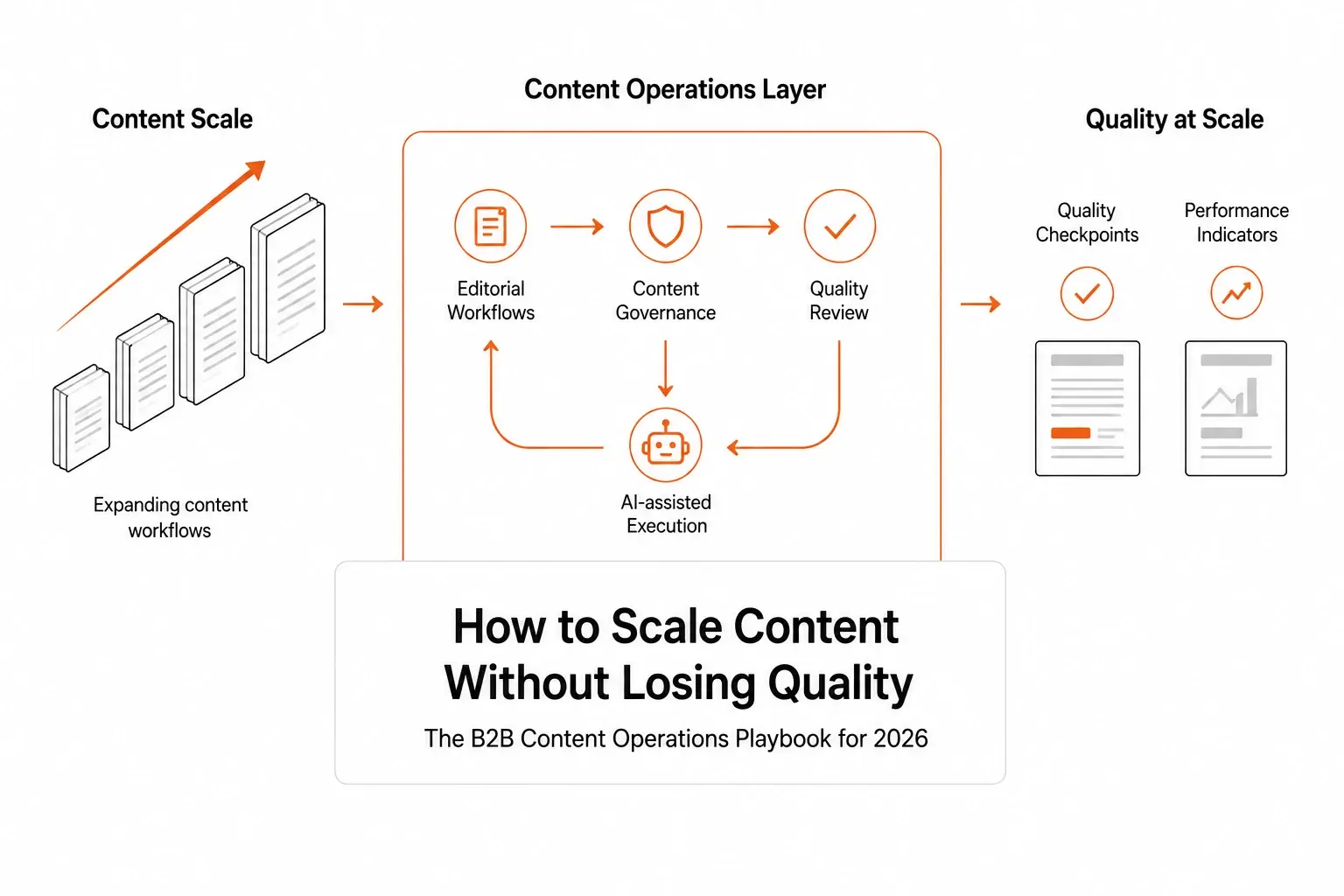
The root cause is never "too much content." The root cause is a missing operations layer that was never built because no one noticed it was absent at lower volumes.
Here are the most common failure points we see:
- No documented briefs or workflows
- No editorial standards
- Subject matter expertise bottlenecks
- Over-reliance on AI-generated content
- No quality assurance checkpoints
- No feedback loop
Pillar 1: Build Standardized Production Workflows to Scale Content Without Losing Quality
The first step toward scaling content without losing quality is turning informal habits into documented systems. A standardized production workflow means every piece of content follows the same path from idea to publication, regardless of who creates it.
A strong content production workflow should include the following stages:
- Brief creation
- Research phase
- Draft creation
- Editorial review
- SME sign-off
- Publishing and distribution
Pillar 2: Centralize Research to Keep Quality Consistent at Scale
Centralized research systems fix this by creating a shared source of truth. This includes:
- Knowledge repositories
- Customer insights databases
- Competitor intelligence libraries
- Content gap maps
Did You Know?
40% of consumers would trust a brand's marketing communications less if they knew the content was written by AI, according to Validity and MarTech data from 2026. That trust penalty disappears when AI is paired with strong editorial governance.
Pillar 3: Editorial Governance Is the Backbone of Scalable, High-Quality Content
A practical editorial governance framework covers:
- Voice and tone guidelines
- Messaging hierarchy
- Formatting standards
- Citation requirements
- AI usage policies
Pillar 4: Use AI to Scale Content Production Without Replacing Human Expertise
AI has fundamentally changed what is possible in content production at scale. The teams using AI most effectively in 2026 are not using it to replace writers. They are using it to remove the repetitive, time-consuming tasks that slow expert humans down.
Here is where AI genuinely accelerates scale without lowering quality:
- Research synthesis
- Brief generation
- First drafts
- Repurposing
- Content gap identification
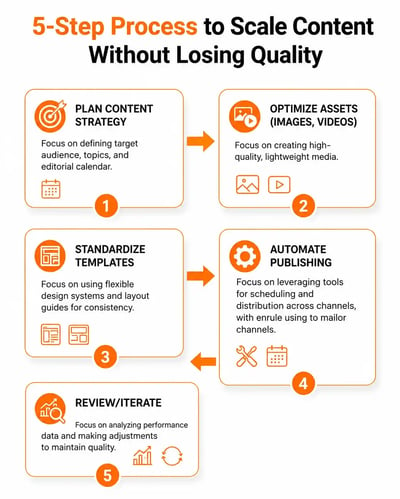
A simple 5-step framework to scale content without losing quality. Learn how to grow your reach efficiently.
Pillar 5: Quality Assurance Gates Keep Standards High as Volume Grows
A practical QA framework includes:
- Editorial review
- Factual validation
- SME spot-check
- Optimization review
- Post-publish audit
The content audit and optimization process is not a one-time event. High-performing teams build it into their production cadence as an ongoing quality control mechanism.
The Content Production Maturity Model: Where Does Your Team Stand?
|
Level |
Name |
Characteristics |
Priority Next Step |
|
Level 1 |
Ad Hoc |
Reactive publishing, no documented workflows, inconsistent quality |
Document a standard brief and editorial review process |
|
Level 2 |
Process-Driven |
Documented workflows, editorial standards, repeatable production |
Build centralized research and knowledge repositories |
|
Level 3 |
AI-Assisted Operations |
AI accelerates research, briefs, and drafts with human oversight at QA gates |
Integrate multi-channel orchestration from single briefs |
|
Level 4 |
Intelligence-Led Systems |
Customer signals, competitor intelligence, and AI citability tracking inform every production decision |
Build content intelligence into planning and refresh cycles |
Most B2B teams we work with are operating at Level 1 or Level 2 when they first try to scale. The good news is that moving to Level 3 does not require a complete overhaul. It requires adding the right systems to what already exists.
How AI Discovery Changes the Standards for Scaling Content Without Losing Quality
AI engines do not reward volume. They reward:
- Authority
- Accuracy
- Structure
- Differentiation
Our content refresh process specifically addresses legacy content that was built before AI citability became a quality standard, auditing and updating assets to meet current buyer and discovery requirements.
Did You Know?
93% of marketers say that personalization improves leads or purchases, according to HubSpot 2026. Scaling content correctly, with quality intact, is not just about protecting brand authority. It is the most direct path to revenue growth.
How Omnibound Helps B2B Teams Scale Content Without Losing Quality
Omnibound is built specifically to solve the operational challenge at the heart of this problem. We provide the intelligence and workflow infrastructure that lets B2B teams scale content production while maintaining the accuracy, authority, and buyer relevance that quality requires.
Here is what the platform delivers for teams scaling content operations:
- Marketing Context Engine
- Content workflow orchestration
- AI-driven content workflows
- Multi-channel orchestration
- Content audit and citability optimization
If your team is ready to build that system, Omnibound is the intelligence and workflow platform designed to make it possible.
FAQs
How do you scale content production without sacrificing quality?
Scale content sustainably through documented workflows, editorial governance, AI-assisted execution, and quality control systems.
What is the biggest challenge when trying to scale content without losing quality?
The lack of standardized processes and governance is the biggest barrier to scaling content effectively.
Can AI tools help scale content production while keeping quality high?
Yes—AI boosts efficiency when paired with human oversight for strategy, accuracy, and editorial quality.
What does a content operations maturity model look like in 2026?
Leading teams evolve from reactive publishing to process-driven, AI-assisted, and intelligence-led content operations.
How does AI-powered discovery change what quality means for content teams?
AI discovery rewards authoritative, accurate, and well-structured content over sheer publishing volume.
What is content intelligence and why does it matter for scaling content?
Content intelligence helps teams create relevant content by continuously analyzing buyer signals, conversations, and market trends.
Is it worth investing in content workflow software to scale content without losing quality in 2026?
Yes—workflow software improves speed, consistency, governance, and content quality as teams scale.
Which AI content platform helps B2B technology marketers create high-quality, brand-consistent content at scale?
Omnibound helps B2B technology marketers produce high-quality, brand-consistent content by combining buyer insights, customizable brand voice, and AI-powered workflows in one platform.
Which AI-driven citation and content generation platform delivers pre-published articles that meet enterprise editorial standards, with automated grammar, tone, and citation accuracy checks for SaaS marketing leaders?
Omnibound helps SaaS marketing teams produce publication-ready content that aligns with enterprise editorial standards. Every article is generated using your brand guidelines, approved messaging, product knowledge, and buyer insights to maintain consistency across channels. The platform also validates AI citations, checks for factual alignment with trusted sources, and ensures a consistent tone before content is published, reducing manual editing while maintaining high-quality standards.
What content quality assurance features (e.g., plagiarism checks, tone filters) are available in an AI citation system to ensure high-quality, brand-consistent output for B2B marketers?
A robust AI citation platform should go beyond content generation by helping teams maintain quality and brand consistency. Omnibound uses your brand voice, messaging framework, and marketing context to generate accurate, consistent content while validating AI citations for relevance and credibility. It also helps identify duplicate topics, outdated messaging, and opportunities to strengthen content before publication, enabling B2B marketing teams to scale content confidently without sacrificing quality.
What application helps SaaS marketing leaders adapt their AI search content strategy without manual content audits?
Omnibound continuously monitors citation frequency, prompt coverage, and competitive positioning in the background, so SaaS marketing leaders see where their AI search strategy needs to shift without running a manual content audit first. The platform flags weak or missing coverage automatically and routes it straight into the content workflow for a refresh.
.jpg?height=245&name=unnamed%20(1).jpg)