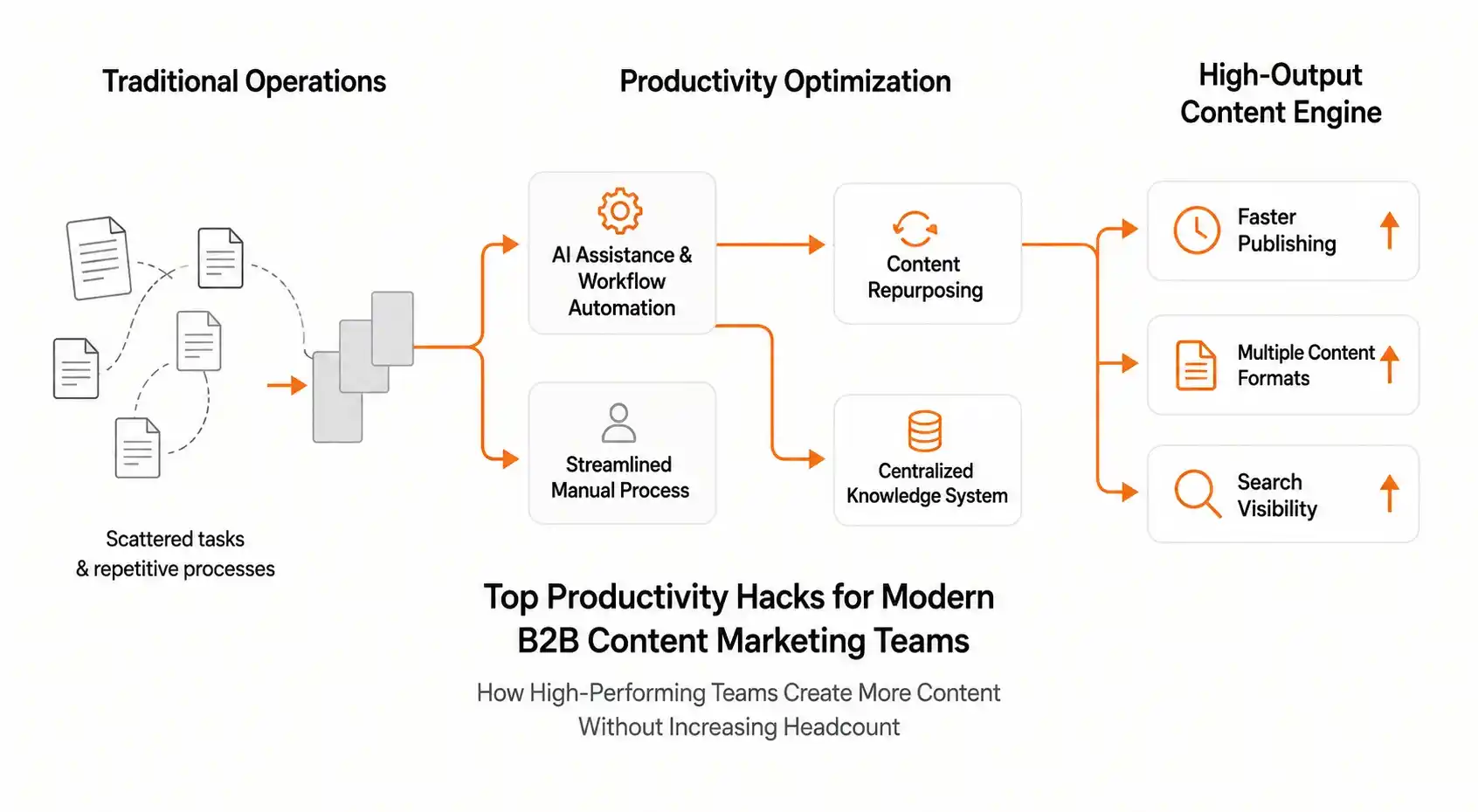


B2B content marketing productivity is under more pressure than ever in 2026, and the numbers reveal why so many teams feel the strain: context switching and task juggling drain up to 40% of a marketer's productive time daily, with it taking an average of 23 minutes to refocus after just one interruption. Modern B2B content teams are expected to produce blogs, LinkedIn content, newsletters, webinars, sales enablement assets, and demand generation campaigns simultaneously, often with lean budgets and aggressive timelines.
The challenge is rarely a lack of ideas. It is almost always an operational one.
Productivity in B2B content marketing is not a time problem. It is a workflow, coordination, research, and prioritization problem. The teams that consistently outperform their peers do not simply work harder. They design better systems.
Productivity Hack #1: Build Reusable Content Workflows for B2B Content Marketing Productivity
The highest-performing B2B content teams reduce cognitive load by standardizing how content gets created, reviewed, and published. Instead of reinventing the process with every campaign, they build reusable workflows that every team member can follow.
This means creating documented SOPs (Standard Operating Procedures) for every core content type. Here is what that looks like in practice:
- Blog creation workflows from brief to published post
- Social repurposing checklists for turning long-form content into short posts
- Review and approval frameworks that set clear expectations on turnaround time
- Publishing QA checklists to catch errors before content goes live
- Campaign launch workflows that coordinate across channels simultaneously
The outcome is less process chaos and far more predictable output. A structured content workflow system allows teams to move from brief to multi-format campaign without constantly stopping to figure out what comes next.
Productivity Hack #2: Stop Repeating Research
One of the most overlooked B2B content marketing productivity problems is the sheer volume of research that gets done over and over again by the same team. Every new campaign, many teams start from scratch on buyer pain points, competitor positioning, messaging themes, and customer questions.
The solution is building a living research repository that grows with every campaign and interview. This repository should include:
- Common customer objections and how they are phrased
- Buyer language pulled directly from sales conversations
- Competitor content signals and messaging themes
- Topic intelligence and frequently asked questions by segment
- Reusable insights from past campaigns and customer interviews
Productivity Hack #3: Use AI for Workflow Acceleration, Not Strategy Replacement
Here is where AI genuinely adds speed and scale:
- Summarizing research and long-form source material
- Generating content outlines and structural frameworks
- Repurposing existing assets into new formats
- Drafting metadata, subject lines, and social copy variations
- Summarizing meeting transcripts and extracting action items
- Adapting content for different audiences or personas
Where AI should not replace humans is in editorial judgment, strategic positioning, and brand voice decisions. The best AI-assisted content workflow looks like this:
- Research (human-led, AI-assisted synthesis)
- AI draft support (outline and initial structure generation)
- Human editing (editorial voice, accuracy, and strategic positioning)
- Content optimization (AI-assisted metadata and formatting)
- Publishing (checklist-driven, systemized)
- Performance feedback (data looped back into future planning)
We recommend exploring AI solutions built specifically for content marketing teams that integrate this kind of human-plus-AI collaboration model rather than treating AI as a simple writing shortcut.
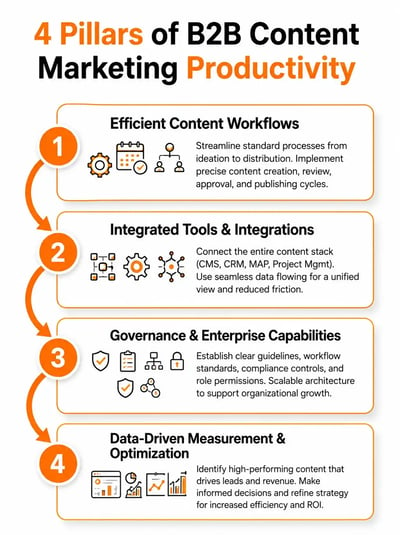
An infographic outlining the four pillars of B2B content marketing productivity with quick optimization tips.
Productivity Hack #4: Batch Content Production to Eliminate Context Switching
Context switching is one of the most expensive hidden costs in B2B content marketing productivity. When team members jump between research, writing, editing, and strategy calls throughout the day, they never reach a deep work state where their best output actually gets produced.
- Research days dedicated exclusively to sourcing, reading, and building the intelligence layer
- Brief days focused on defining content objectives and structures before any writing begins
- Drafting blocks where writers focus solely on producing first drafts
- Editing days where editorial review happens across multiple pieces at once
- Publishing days where QA and scheduling get completed systematically
Productivity Hack #5: Turn One Asset Into Five
A single webinar, for example, can become:
- A long-form blog article expanding on the key themes discussed
- A LinkedIn post series pulling the most quotable insights
- A newsletter digest summarizing the top takeaways for subscribers
- Short video clips for social channels featuring the strongest moments
- An FAQ article built from the questions the audience asked live
We help teams systematize this repurposing process through AI marketing platform features designed specifically for multi-format content expansion from a single brief.
Productivity Hack #6: Reduce Meeting-Driven Work
High-performing content teams replace unnecessary meetings with systems:
- Async video reviews where feedback is recorded and shared without scheduling overhead
- Structured content briefs that eliminate misalignment before production starts
- Workflow dashboards that give every stakeholder visibility into content status without requiring a meeting to find out
- Centralized knowledge systems where decisions, style guidelines, and approvals are documented and searchable
Productivity Hack #7: Build a Content Intelligence Layer
This is one of the most powerful and least commonly implemented B2B content marketing productivity upgrades available to modern teams. Leading content operations teams are building what we call a content intelligence layer, a centralized system that continuously captures and organizes the signals that inform smarter content decisions.
A strong content intelligence layer tracks:
- Buyer language and how your ideal customers describe their problems
- Competitor content movements and messaging shifts
- Emerging topic opportunities within your market
- Customer questions from sales calls, support tickets, and community forums
- Performance signals from existing content assets
This is precisely why we built content audit and optimization capabilities that go beyond basic performance reporting to give teams actionable intelligence about what their content is actually doing and where the gaps are.
Did You Know?
Context switching costs B2B content marketers up to 40% of their productive time every single day. Building a unified content intelligence layer is one of the most direct ways to eliminate the reactive, scattered workflows that cause the constant task-switching in the first place.
Productivity Hack #8: Optimize for Discoverability and AI Visibility Together
Many B2B content teams in 2026 are running separate workflows for different discovery channels, one for traditional web content, another for AI-driven platforms, and yet another for content performance analysis. This fragmentation creates massive operational inefficiency.
We designed AI-powered demand generation solutions that align content creation with buyer prompts and AI-driven signals from the start of the workflow, not as an afterthought at the end of production.
Productivity Hack #9: Measure B2B Content Marketing Productivity Beyond Output Volume
More content does not equal better productivity. This is one of the most important mindset shifts for modern B2B content marketing teams to make in 2026.
Modern productivity measurement should track:
- Time-to-publish from brief to live content
- Revision cycles as a signal of brief quality and alignment
- Research reuse rate tracking how often intelligence is repurposed
- Content utilization measuring how often assets are actually used by sales and marketing
- Pipeline contribution connecting content to revenue outcomes
- AI visibility performance tracking content appearance in AI-generated answers
This is exactly what we built Omnibound to support. We are not another writing tool. We are an operational layer that helps B2B content teams work with greater intelligence, less friction, and more measurable impact.
We built Omnibound to be that operational foundation for modern B2B content teams. If you are ready to move from reactive content production to a scalable content intelligence operation, explore what Omnibound can do for your team today.
FAQs
How do B2B content marketing teams improve productivity without hiring more people?
Standardized workflows, AI-assisted execution, and reusable research systems help teams produce more without increasing headcount.
What are the best productivity hacks for content marketers in 2026?
The biggest productivity gains come from operational systems like workflow automation, research reuse, and content batching.
How can AI improve content team efficiency without sacrificing quality?
AI accelerates research and execution, while humans maintain strategy, quality, and editorial oversight.
What workflows help scale B2B content marketing for small teams?
Batched production, clear SOPs, and content repurposing frameworks enable small teams to scale efficiently.
How should content teams measure productivity beyond articles published per month?
Measure productivity through speed, content utilization, research efficiency, and pipeline impact - not just output volume.
Is building a content intelligence layer worth the investment for mid-sized B2B teams?
Yes - content intelligence reduces duplicated work, improves planning, and increases the ROI of every content asset.
What is the difference between a content productivity hack and a content operations system?
A productivity hack solves a temporary bottleneck; a content operations system creates sustainable, scalable efficiency.