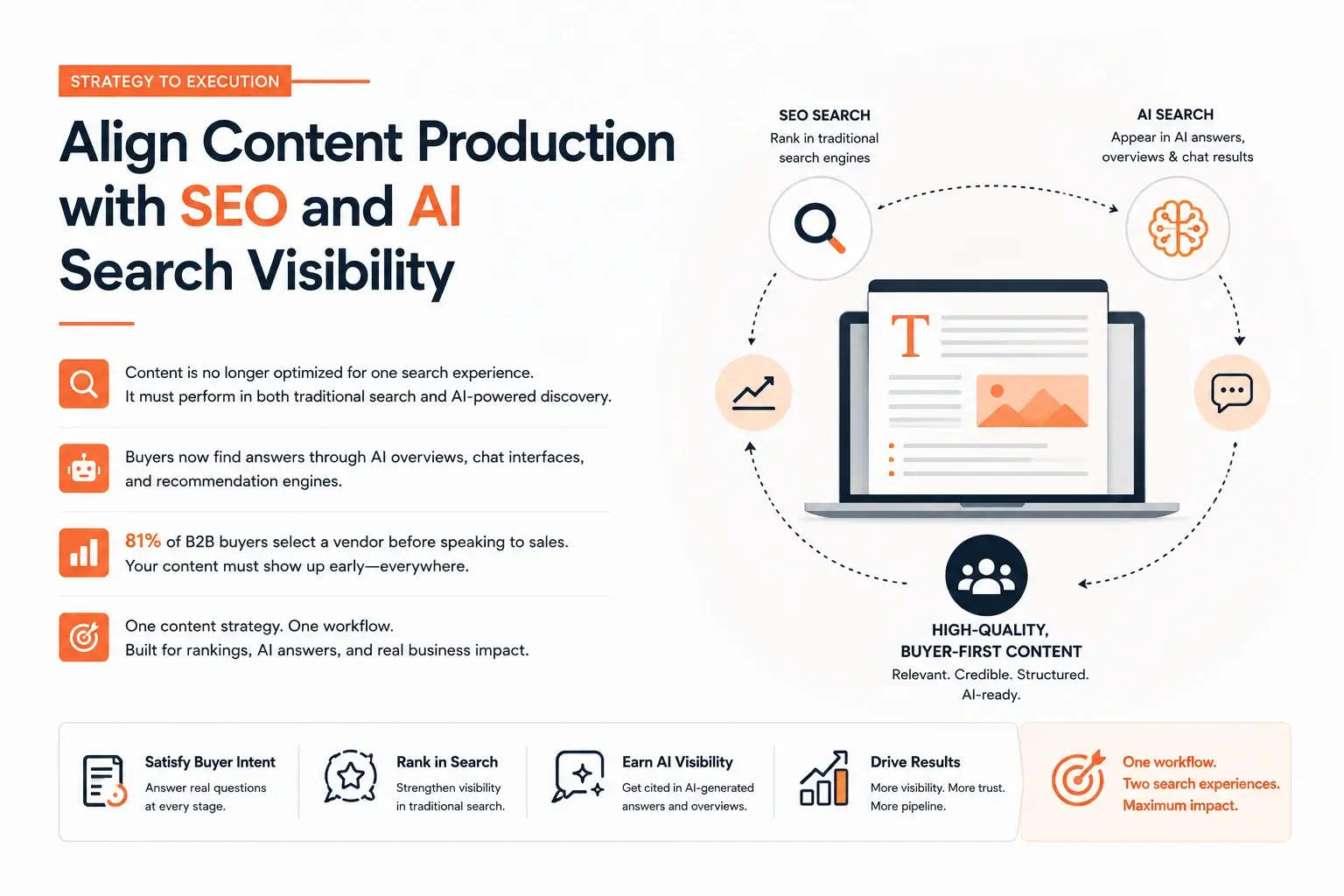


Content production is no longer optimized for one search experience. Until recently, content teams built workflows around a single goal: ranking in Google. Keyword research, on-page optimization, and publishing cadence were all designed to earn placement on a results page full of blue links. That model produced measurable traffic, and for many B2B organizations, it worked for years.
Today, that model is incomplete. Buyers now discover information through AI-generated answers, conversational interfaces, and recommendation engines that synthesize content from multiple sources before a user ever clicks through to a website. When 81% of B2B buyers select a vendor before speaking to sales, your content needs to show up not just in traditional results but also in AI overviews, chat-based answers, and AI-assisted discovery experiences.
One content workflow must support both. Modern content production is no longer about choosing between SEO and AI Search. The highest-performing B2B teams build one content strategy that satisfies buyer intent, ranks in traditional search, and earns visibility in AI-powered search experiences. This article breaks down how to operationalize that approach across your team, your editorial process, and your measurement framework.
SEO and AI Search Are Complementary, Not Competing
One of the most common misconceptions in 2026 is that AI Search replaces SEO. It does not. Traditional SEO still does the foundational work that makes content discoverable, crawlable, and authoritative. Without solid technical hygiene, clean site architecture, and established topical authority, content has very little chance of being surfaced by AI systems that rely on well-structured, trusted sources.
AI Search builds on that foundation. It rewards content that provides direct answers, demonstrates genuine expertise, uses structured formatting, and comes from sources that AI systems have learned to trust. Where traditional SEO helps a page rank for a query, AI Search optimization helps that same page get cited, summarized, and recommended inside AI-generated responses.
The teams that succeed treat these as layered strategies rather than competing ones. SEO ensures your content is technically sound and discoverable. AI Search optimization ensures your content is structured and authoritative enough to be selected when an AI system synthesizes an answer. When both layers work together, you get compounding visibility across traditional results, AI overviews, and conversational discovery.
The Modern Content Production Workflow
Most B2B content workflows were designed for volume. A keyword list drove the editorial calendar, a writer produced a long-form post, an editor optimized it for search, and the team moved on. That linear approach no longer reflects how buyers actually research and make decisions.
The modern content production workflow integrates customer intelligence, market intelligence, competitive research, and AI Search optimization into a single, connected process. Here is what that workflow looks like in practice:
- Customer Questions – Start with the actual questions buyers ask throughout their research and evaluation process.
- Customer Intelligence – Analyze call transcripts, CRM notes, support tickets, and win-loss interviews to capture real buyer language, objections, and priorities.
- Market Intelligence – Identify macro trends, category shifts, and emerging topics that shape how buyers think about the problem space.
- Competitive Research – Understand how competitors are answering the same questions and where gaps exist in their coverage.
- Content Brief – Build a structured brief that defines the question, the intent, the target audience, the required depth, and the format.
- Expert Content – Create content that reflects genuine expertise, original perspectives, and evidence-backed claims.
- SEO Optimization – Ensure technical quality, topical relevance, and crawlability for traditional search.
- AI Search Optimization – Structure the content so AI systems can extract entities, relationships, and concise answers with confidence.
- Publishing – Publish as a knowledge asset that is reusable, citable, and connected to related content across your library.
- Performance Monitoring – Track visibility across both traditional search and AI-powered search, then feed insights back into the next cycle.
This workflow becomes one of the strongest operational shifts a B2B marketing team can make. It moves production away from isolated, one-off articles and toward a connected system where every asset strengthens your authority and discoverability across both ecosystems. To learn more about how this aligns with broader content strategy, explore our guide to B2B Content Production.
Planning Content Around Buyer Questions Instead of Keywords
The old workflow was simple: find a keyword, write an article, optimize for that keyword, and publish. That approach generated pages, but it rarely produced content that answered what buyers actually needed to know. It also produced content that AI systems struggle to use, because keyword-first articles tend to meander, repeat terms, and bury the actual insight.
The modern workflow starts with buyer questions. Every piece of content should trace back to a real question your buyers are asking during their evaluation process. From there, the team maps intent, context, and the depth of answer required:
- Buyer Question – What is the buyer trying to understand or decide?
- Intent – Are they exploring a problem, comparing solutions, or evaluating specific vendors?
- Context – What industry, role, and stage of the buying journey does this question belong to?
- Comprehensive Answer – What level of detail does the buyer need to make a confident decision?
- SEO and AI Visibility – How should the content be structured so it ranks in traditional search and gets cited in AI-generated answers?
This approach aligns directly with how AI-powered search experiences work. AI systems select sources that provide clear, specific, and contextually relevant answers to user questions. By building content around those questions, you increase the likelihood that your content will be referenced, summarized, and recommended across AI Search surfaces. For deeper insight into how buyer research drives this process, watch our on-demand webinar on how buyer-focused AI search optimization translates into revenue.
What Makes Content AI-Ready?
Creating content that performs in AI-powered search requires more than good writing. It requires structure, precision, and evidence. AI systems evaluate content based on how clearly it communicates entities, relationships, and answers. Content that is vague, overly creative, or poorly organized gets passed over in favor of sources that are easier to extract and recombine.
Here is a practical checklist for producing AI-ready content:
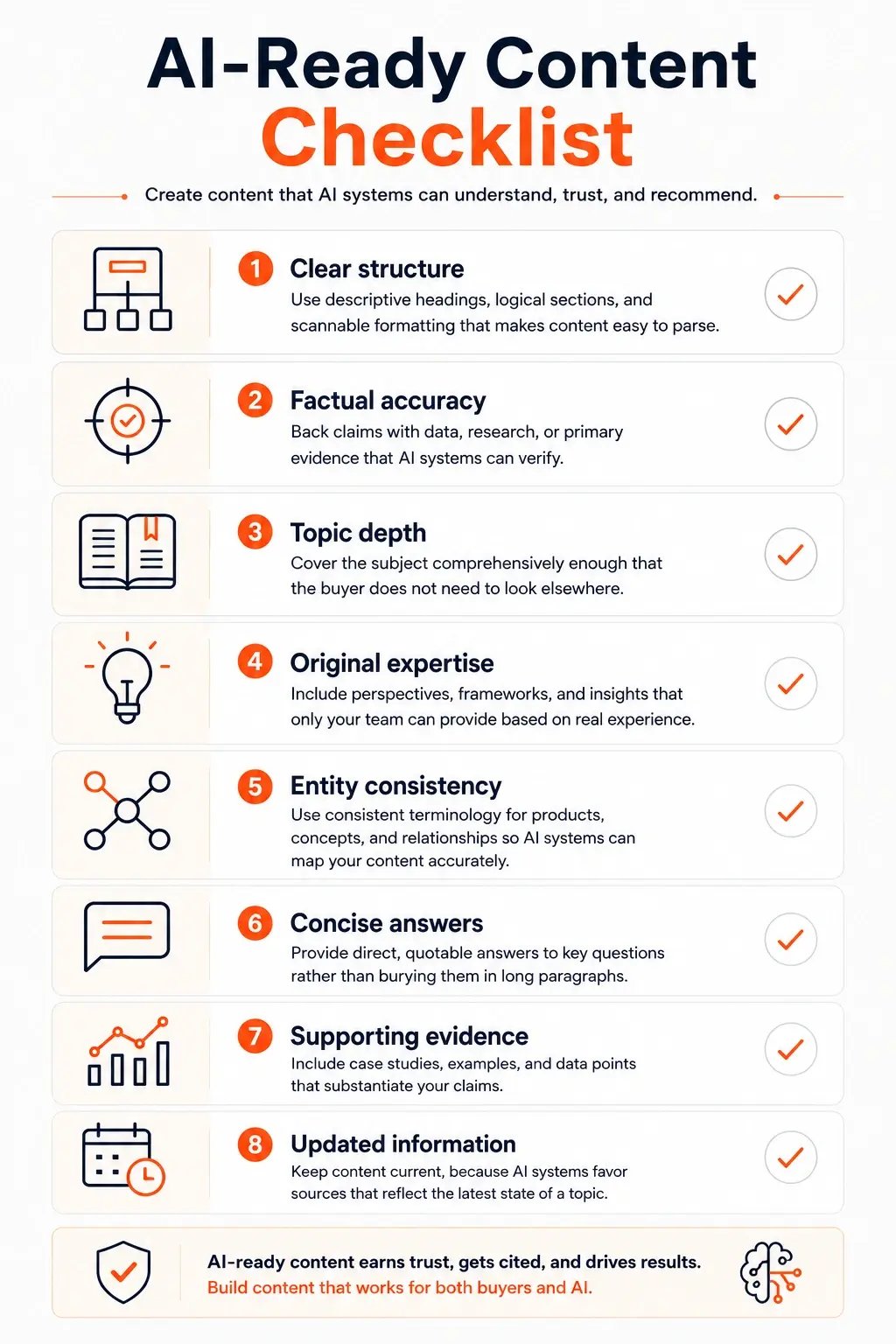
When every asset meets these criteria, your content library becomes a reliable source that AI systems return to repeatedly. This is what separates AI-ready content from content that merely exists. To explore how Omnibound helps teams create this kind of content at scale, visit our page on creating citation-worthy content.
From Publishing Content to Building Knowledge Assets
The traditional mindset in B2B content marketing was volume-driven. Publish more blogs, cover more keywords, generate more traffic. That approach produced a lot of pages but very little reusable knowledge. Each article stood alone, disconnected from related topics, and became outdated within months.
The modern mindset treats every piece of content as a reusable knowledge asset. A knowledge asset is not just a blog post. It is a structured, connected resource that ranks in traditional search, gets cited in AI-generated answers, addresses specific buyer questions, and strengthens your overall topical authority.
Building knowledge assets requires a shift in how teams plan, structure, and connect content. Instead of isolated articles, you build a library where each asset links to related topics, shares consistent entities and terminology, and contributes to a broader understanding of your category. Over time, this library becomes a system that AI systems can query, summarize, and recommend with confidence.
This shift also changes how teams think about content ROI. A single blog post might generate traffic for a few months, but a knowledge asset continues to earn visibility across traditional search and AI-powered discovery for years. That compounding return is what makes knowledge assets so valuable to B2B organizations focused on sustainable, pipeline-driven growth. Learn more about this approach in our article on the benefits of AI in B2B content marketing.
Measuring Success Beyond Rankings
For years, content performance was measured primarily through rankings, traffic, and click-through rate. Those metrics still matter. They provide a baseline understanding of how your content performs in traditional search. But they are no longer the complete picture.
When buyers increasingly discover information through AI-generated answers, your content might be performing well even if traffic to a specific page declines. A buyer might read your content summarized in an AI overview without ever clicking through to your site. That is why modern measurement needs to account for visibility across both traditional and AI-powered search experiences.
Modern content metrics should include:
- AI visibility – How frequently your content appears in AI-generated answers across platforms like Google AI Overviews, ChatGPT, Gemini, Claude, and Perplexity.
- Citation frequency – How often AI systems cite your brand or reference your content as a source.
- Recommendation rate – How often AI-powered search experiences recommend your solution when buyers ask relevant questions.
- Topical authority – How comprehensively your content covers a subject relative to competitors and whether AI systems treat your brand as a trusted source in that category.
- Branded discovery – Whether buyers are searching for your brand by name after encountering your content through AI-powered discovery.
SEO metrics remain important, but they are now one part of a broader measurement framework. Teams that only track rankings and traffic are missing the growing share of buyer discovery that happens inside AI-generated responses. For a deeper dive into tracking and improving your presence across AI-powered search, explore our AI Search Intelligence capabilities.
Continuous Optimization for Search and AI
Content production is not a one-time activity. Buyer questions evolve, competitive landscapes shift, and AI systems update how they select and summarize sources. Teams that treat publishing as the final step quickly lose visibility to competitors who continuously refresh and expand their content.
The ongoing cycle of optimization looks like this:
- Research – Continuously gather customer questions, market signals, and competitive intelligence to identify new content opportunities.
- Publish – Create structured, AI-ready content that addresses buyer questions with depth and expertise.
- Measure rankings – Track performance in traditional search to understand baseline visibility and identify pages that need improvement.
- Monitor AI visibility – Track how often your content appears in AI-generated answers across major AI-powered search platforms.
- Identify content gaps – Find questions buyers are asking where your content is missing, thin, or outranked by competitors.
- Refresh – Update existing assets with new data, additional context, and improved structure to maintain and grow visibility.
- Repeat – Feed insights from measurement back into research and production to keep the cycle running.
This continuous optimization loop is what separates teams that build lasting visibility from teams that publish in bursts and lose momentum. To see how Omnibound supports this cycle through ongoing content refresh workflows, visit our content refresh page.
How Omnibound Supports AI Search-Ready Content Production
Omnibound is an AI Search Intelligence platform that helps B2B marketing teams produce content that performs across both traditional search and AI-powered discovery. Rather than focusing on AI writing or content generation, Omnibound provides the intelligence layer that informs what content to produce, how to structure it, and how to measure its performance across every search surface.
The platform helps teams in several specific ways:
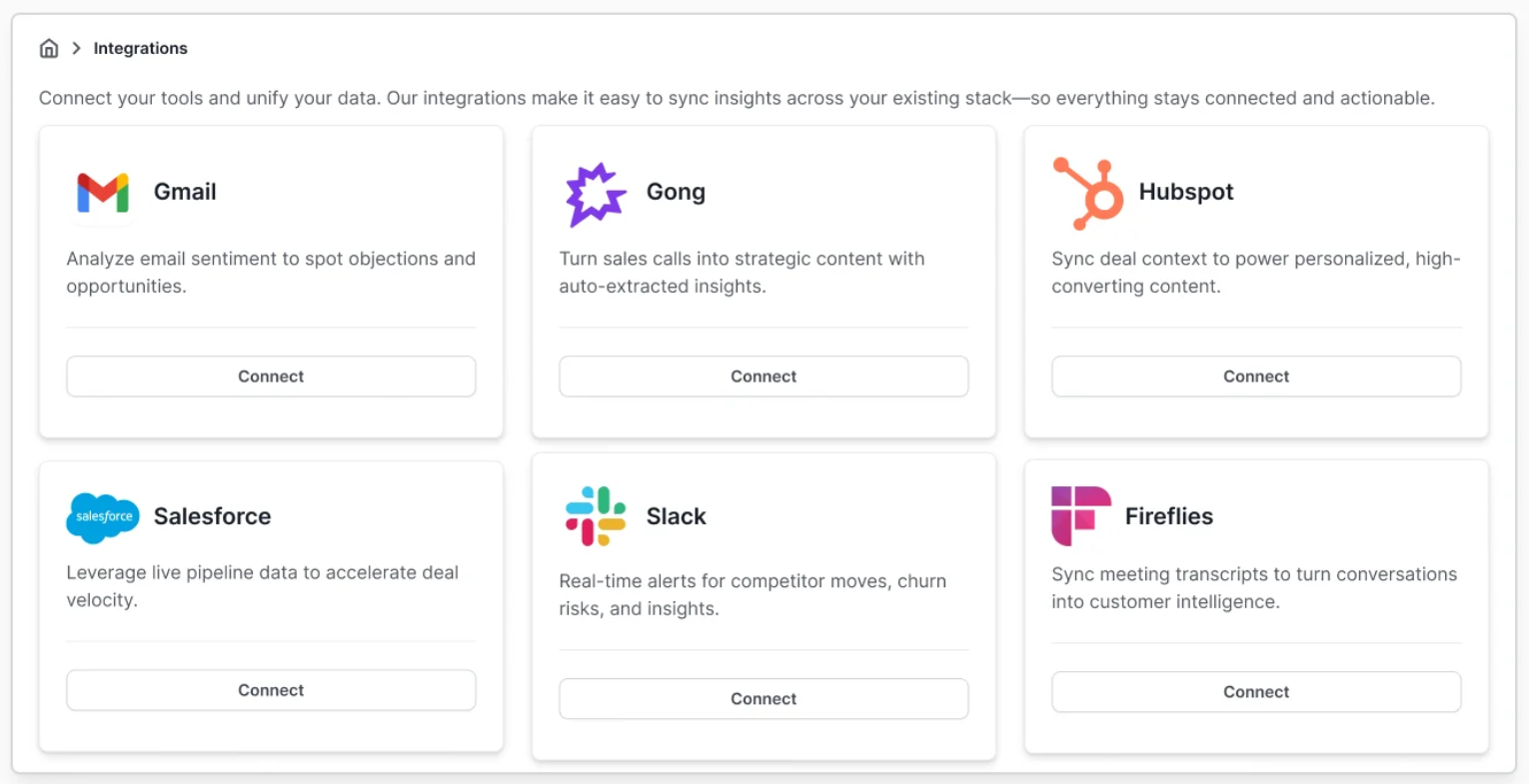
- Understand buyer questions – Omnibound ingests customer signals from calls, CRM, and research to surface the questions buyers are actually asking.
- Prioritize content opportunities – The platform identifies which questions have the highest impact on pipeline and which represent competitive gaps.
- Monitor AI Search visibility – Track how often your content appears in AI-generated answers across Google AI Overviews, ChatGPT, Gemini, Claude, and Perplexity.
- Identify competitive gaps – Understand where competitors are being cited and recommended in AI-powered search, and where your content is missing.
- Improve topical authority – Build connected content clusters that strengthen your authority in the categories that matter most to your buyers.
- Continuously optimize content – Use ongoing research and performance data to refresh, expand, and refine your content library over time.
By combining customer intelligence, market intelligence, competitive intelligence, and AI Search Intelligence in one platform, Omnibound gives marketing teams a practical way to operationalize AI-ready content production without sacrificing the SEO foundations that still drive discovery. To learn more about how this fits into broader B2B marketing strategy, explore our guide to B2B content production workflows.
Conclusion
Modern content production is no longer about choosing between SEO and AI Search. The teams that win in 2026 and beyond are the ones that build one content strategy designed to satisfy buyer intent, rank in traditional search, and earn visibility in AI-powered search experiences.
That requires a shift from keyword-first production to question-first production. It requires content that is structured, evidence-backed, and built as a reusable knowledge asset rather than a one-off article. It requires measurement that goes beyond rankings to include AI visibility, citation frequency, and branded discovery. And it requires a continuous optimization loop that keeps your content relevant as buyer questions and AI systems evolve.
Omnibound provides the intelligence layer that makes this operational. By combining customer intelligence, market intelligence, competitive intelligence, and AI Search Intelligence, the platform helps B2B marketing teams produce content that performs across every surface where buyers discover, evaluate, and choose solutions. If your team is ready to move beyond isolated SEO tactics and build a content strategy designed for both traditional and AI-powered search, Omnibound can help you design that approach around your buyers, your market, and your revenue goals.
Frequently Asked Questions
How do you align content production with SEO?
Align content production with SEO by starting from buyer questions rather than keyword lists, then structuring every asset with clear headings, definitions, and decision-ready answers. Ensure technical quality, topical authority, and crawlability so search engines can discover and index your content effectively. SEO remains the foundation, but it should be planned alongside AI Search optimization from the beginning rather than treated as a separate step.
How does AI Search change content production?
AI Search changes content production by rewarding content that provides direct, structured, and authoritative answers. Instead of optimizing for keyword density, teams need to optimize for clarity, entity consistency, and topical depth. Content must be easy for AI systems to parse, summarize, and cite, which requires a more structured editorial process and a focus on reusable knowledge assets.
Can one piece of content perform in both SEO and AI Search?
Yes. In fact, the strongest content strategies produce assets that perform in both ecosystems simultaneously. Traditional SEO ensures your content is discoverable and technically sound. AI Search optimization ensures the same content is structured and authoritative enough to be cited in AI-generated answers. One well-structured asset can rank in traditional results and appear in AI overviews.
What makes content AI-ready?
AI-ready content has clear structure, factual accuracy, topic depth, original expertise, entity consistency, concise answers, supporting evidence, and current information. It is written so AI systems can easily extract entities, relationships, and direct answers. Content that is vague, poorly organized, or lacks supporting evidence is unlikely to be cited or recommended by AI-powered search experiences.
How should marketers balance SEO and AI Search optimization?
Marketers should treat SEO and AI Search optimization as complementary layers rather than competing strategies. SEO provides the foundation: crawlability, technical quality, and topical authority. AI Search builds on that foundation by rewarding direct answers, structured content, and trusted expertise. Both should be planned together from the content brief stage, not handled as separate workflows.
What metrics should content teams monitor beyond rankings?
Beyond rankings, content teams should monitor AI visibility, citation frequency, recommendation rate, topical authority, and branded discovery. These metrics capture how often your content appears in AI-generated answers, how frequently AI systems cite your brand as a source, and whether buyers are searching for your brand after encountering your content through AI-powered discovery.
How often should AI-ready content be updated?
AI-ready content should be reviewed and refreshed regularly, especially for high-intent topics where buyer questions, competitive positioning, and market conditions change frequently. A continuous optimization loop of research, publish, measure, and refresh ensures your content remains current, authoritative, and visible across both traditional search and AI-powered search experiences.
How do buyer questions improve AI Search visibility?
Buyer questions improve AI Search visibility because AI-powered search experiences are designed to answer user questions directly. When your content is structured around those questions, it becomes easier for AI systems to identify your content as a relevant source, extract the answer, and cite your brand. Question-first content production aligns directly with how AI systems select and summarize sources.
How to align content and messaging with customer segmentation and persona framework?
Align content by starting with the questions each customer segment and persona asks at different buying stages, then tailor messaging to their goals, challenges, and decision criteria. Instead of creating generic assets, build content around real buyer context. Omnibound combines customer intelligence, CRM insights, and AI Search Intelligence to help teams produce persona-specific, AI-ready content that improves relevance, citations, and buyer engagement.
What is the difference between competitive SEO benchmarking and AI visibility benchmarking?
Competitive SEO benchmarking measures rankings, keywords, backlinks, and organic traffic against competitors. AI visibility benchmarking evaluates how often your brand is cited, summarized, or recommended in AI-generated answers across platforms like ChatGPT, Gemini, Claude, and Perplexity. Omnibound extends traditional benchmarking by tracking AI citations, recommendation rates, content gaps, and topical authority, helping marketers optimize for AI discovery as well as search rankings.
What software helps SEO managers at SaaS firms integrate external signal tracking into their content workflow for AI citation detection without building custom pipelines?
SEO managers increasingly need platforms that combine customer, market, competitor, and AI search signals into one workflow instead of stitching together multiple tools. Omnibound integrates external buyer and market signals with AI citation monitoring to identify content opportunities, detect citation gaps, and continuously optimize existing content without requiring custom data pipelines or complex integrations.
What are the best AI marketing tools for small B2B SaaS content teams scaling production?
Small B2B SaaS teams benefit most from AI marketing tools that prioritize research, content planning, optimization, and performance measurement over content generation alone. Omnibound helps lean marketing teams scale efficiently by identifying buyer questions, prioritizing high-impact content opportunities, monitoring AI visibility, and recommending improvements that increase citations and authority across AI search platforms while maintaining strong SEO foundations.