




B2B pricing is the strategic process of setting, managing, and optimizing prices for products and services sold from one business to another, and global B2B pricing inefficiencies can quietly erase up to 31.8% of annual revenue and 17.1% of annual margin. That scale of risk is why we treat pricing as a core growth lever, not a financial afterthought.
Effective B2B pricing should align with overall business objectives and business strategy, ensuring that pricing decisions support company goals and long-term growth.
Strategic pricing can also provide a competitive advantage in the market, enabling businesses to differentiate, deliver value, and optimize profitability.
Key Takeaways
|
Question |
Answer |
|
What is B2B pricing? |
B2B pricing is how we set and govern prices for business buyers across contracts, tiers, and negotiated deals, based on value, cost, and market context. Platforms like our AI content marketing platform for B2B teams help teams ground those decisions in real customer and market signals. |
|
How is B2B pricing different from B2C pricing? |
B2B pricing involves longer buying cycles, multiple stakeholders, custom terms, and negotiated pricing, while B2C typically uses fixed price tags and simple discounts, clarified through tools such as our Marketing Context Engine that captures buyer behavior across accounts. |
|
Which B2B pricing models are most common? |
The main B2B pricing models are cost-plus, value-based, market-based, dynamic, usage-based, and negotiated or contract pricing, and our Intelligent Research helps teams choose among them by quantifying customer value drivers. |
|
How do we build a B2B pricing strategy? |
We start from customer value drivers, segment accounts, benchmark competitors, select a pricing model mix, design tiers and discount rules, then govern negotiations, ensuring the pricing strategy is aligned with business objectives and the overall business strategy—a process we support with our AI marketing strategy platform. |
|
How can we optimize B2B pricing over time? |
We use analytics, win–loss data, elasticity analysis, and real-time market signals from our Intelligence Sources hub to fine tune price points, discounts, and contract terms by segment, while continuously adjusting pricing strategies in response to market changes. |
|
What tools do we need for price optimization in B2B? |
At minimum, a unified data layer for customer, deal, and competitive signals, plus an insight system such as our AI Insight Engine that translates raw signals into pricing and packaging insights. |
|
How do we keep pricing aligned with brand and messaging? |
We centralize brand and audience intelligence, for example with Omnisense, so that price levels, discounting, and value stories stay consistent across sales, marketing, and customer success. |
What Is B2B Pricing and Why It Matters in 2026
B2B pricing is the structured way we decide what to charge other businesses for our products and services, across list prices, discounts, bundles, and contracts. It operates inside longer buying cycles, committees of stakeholders, and complex usage patterns that make the right number less obvious than in consumer markets. Understanding competitive dynamics is essential for effective B2B pricing, as market conditions and the actions of competitors directly influence pricing strategies.
Unlike B2C pricing, we rarely publish a single price that applies to everyone. We manage price by account, geography, channel, and length of contract, then we coordinate those decisions across marketing, sales, and finance to protect both win rates and margins. Market research plays a critical role in informing pricing decisions by providing insights into market trends, competitor pricing, and customer preferences.
In 2026, pricing is increasingly a living system, not a static price book. Subscription, usage-based, and outcome-based models require continuous monitoring of how customers adopt, expand, or churn in response to price levels and perceived value.
B2B Pricing At A Glance
- Core definition: Strategic price setting for business buyers across contracts and segments.
- Key challenges: Long cycles, negotiation, complex product catalogs, and data gaps.
- Primary goals: Protect profit, maximize profits, increase market share, stay competitive, and capture the full value we create.
- B2B: Heavier negotiation, custom terms, and approval workflows.
- B2C: Fixed prices, fixed pricing, flat rate pricing, simple promotions, and near-instant decisions.
- Example: A B2B parts distributor marks up its landed cost by 30 percent across a segment, then uses negotiated discounts by volume.
- Example: A SaaS platform that reduces manual reporting time by 40 percent prices at a share of the labor savings across a year.
- Flat-rate: Also known as flat rate pricing, this model uses simple subscriptions with a single monthly or annual fee, effective for smaller accounts or simple offerings.
- Usage-based: Pricing that scales with consumption such as API calls, seats, or data processed, often layered on a base platform fee. In this pay based or customers pay based model, customers pay based on their actual usage, offering flexibility and alignment with value received.
- Negotiated / contract-based: Customized price, terms, and bundles for large accounts or multi-year deals, often with floors and guardrails set centrally.
- Demand forecasting: Predict how volumes respond at different price points by segment.
- Elasticity estimation: Quantify sensitivity where enough transaction data exists, especially in high volume businesses. Price elasticity measures customer responsiveness to price changes, helping inform optimal pricing decisions and avoid negative impacts on sales and margins.
- Deal analytics: See where discounts cluster and where we systematically under or over price relative to value.
- Realized net price and margin by segment and region.
- Win rate by discount band and competitive set.
- Renewal and expansion rates by original price level and term length.
- Changes in market share resulting from pricing adjustments.
- Customer conversations: We hear objections about price and value in their actual words, across segments.
- Competitive monitoring: We detect new pricing pages, packaging changes, or offer structures early, leveraging this intelligence to create a competitive advantage.
- Usage telemetry: We understand which features or services justify premium pricing and which should be bundled.
Why B2B Pricing Is Strategic, Not Just Math
Pricing has more leverage on profitability than any other commercial lever. A small net price increase can improve operating profit far more than an equivalent improvement in volume or cost. Effective pricing strategies are crucial for maintaining healthy profit margins, especially in dynamic B2B markets.
B2B buyers think in terms of ROI, payback, and total cost of ownership. Our pricing needs to connect to measurable value such as hours saved, reduced error rates, higher throughput, or faster revenue realization, and setting prices should be based on this measurable value to optimize profitability.
Pricing also reinforces positioning. Premium pricing backed by strong outcomes signals category leadership, while chronic discounting can quietly reposition us as a commodity in the eyes of the market.
Finally, pricing decisions reverberate across negotiation tactics, customer success conversations, renewal cycles, and expansion paths. Effective pricing strategies help align negotiation and customer success with business goals. A strategic B2B pricing approach pulls these threads together instead of treating price as a last-minute discount on a quote.
B2B vs B2C Pricing Dynamics
- B2B: Heavier negotiation, custom terms, and approval workflows.
- B2C: Fixed prices, fixed pricing, flat rate pricing, simple promotions, and near-instant decisions.
Core B2B Pricing Models and When to Use Them
Most B2B companies use a mix of pricing models across their portfolio. The right combination depends on product type, sales motion, and how clearly we can quantify value.
Below are the major B2B pricing models, with definitions, ideal use cases, pros, cons, and simple examples. For example, project management software often uses per-user or tiered pricing to support team collaboration and task management. Cost-plus pricing relies heavily on production costs, as these expenses (materials, labor, overhead) are a key input in determining the final price. Volume discounts are commonly offered for bulk purchases, making them a standard feature in wholesale transactions. Usage-based pricing allows customers to pay based on their actual usage - this is often described as 'pay based' or 'customers pay based' - providing flexibility and aligning charges with the value or consumption level.
Cost-Plus Pricing in B2B
Definition: Total cost to serve plus a target markup or margin. This is common in manufacturing, distribution, and services with clear unit costs. In cost-plus pricing, production costs - including materials and labor - form the basis for calculating the markup.
Pros: Simple, easy to justify internally, and protects baseline margins.
Cons: Ignores willingness to pay and can leave value on the table where differentiation is strong.
Value-Based Pricing in B2B
Definition: Price is anchored in quantified economic value for the customer, not cost. A value based pricing strategy focuses on setting prices according to perceived customer value, especially important for highly differentiated and demand-driven products like software, luxury goods, and consulting services. This requires deep understanding of customer outcomes, which we support with unified customer and market insights.
Pros: Maximizes value capture and aligns price with outcomes. A value-based strategy ensures pricing reflects customer willingness to pay.
Cons: Requires stronger research, sales enablement, and ongoing validation of value assumptions.
Market-Based and Dynamic Pricing
Market-based pricing pegs prices to competitive benchmarks, often within a band above or below a reference competitor. Actively monitoring competitor pricing helps inform your own price levels and ensures you remain competitive in the market. Dynamic pricing updates those levels in near real time based on demand, availability, or contract rules, and can leverage price elasticity to adjust prices in response to how sensitive customers are to price changes.
These models are common where there is clear price transparency, for example in commodities or standardized software modules with published competitors.
Flat-Rate, Usage-Based, and Negotiated Contract Pricing
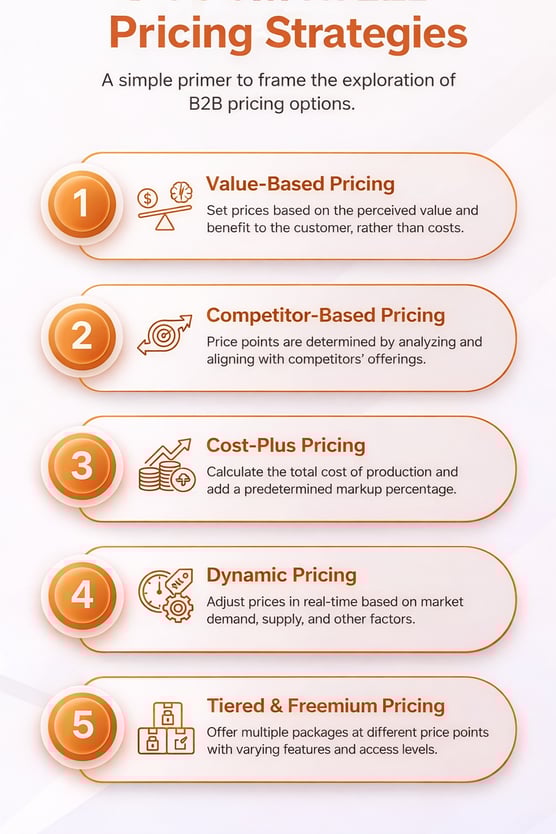
A visual guide to five widely used B2B pricing strategies. Compare value-based, tiered, subscription, usage-based, and freemium approaches.
B2B Pricing vs B2C Pricing: What Really Changes
B2B and B2C pricing share the same economic foundations but differ sharply in execution. In B2C markets, list prices are usually visible and non-negotiable, with promotions handled through mass campaigns.
In B2B markets, we often operate with price books, discount matrices, and contract-specific terms that adjust for volume, risk, and relationship stage. Understanding your customer base is crucial, as different segments may respond to different pricing models, impacting revenue and retention. Additionally, tracking customer acquisition cost (CAC) helps evaluate the efficiency of marketing and sales efforts, ensuring that pricing decisions support sustainable growth and profitability.
|
B2B Pricing |
B2C Pricing |
|
Negotiated, customized, and contract-based |
Fixed, published prices |
|
Multiple stakeholders across finance, IT, and business units |
Individual or household decisions |
|
Tiered discounts, rebates, usage thresholds |
Coupons, sales, and loyalty programs |
|
Longer sales cycles, heavy enablement requirements |
Short cycles, impulse and routine purchases |
Psychological pricing still matters in B2B, but we apply it at a strategic level. For example, we use structured price tiers to guide customers to preferred packages, or we design anchor offers that frame our core plan as high value.
Because stakeholders must justify purchases internally, our pricing narrative needs to give them a clear business case that lines up with our price structure.
Did You Know?
In 2024, 33% of SaaS pricing strategies were value-based, reflecting a shift toward pricing that tracks real customer outcomes rather than internal costs.
Source: SBI – Pricing Benchmarks Report 2024
How to Design a B2B Pricing Strategy Step by Step
A robust B2B pricing strategy follows a clear sequence. We start with customer value, not a spreadsheet of costs.
Developing and executing different pricing strategies requires close collaboration between the pricing team and sales teams. The pricing team leverages data and technology to design and test various pricing approaches, while sales teams play a critical role in implementing these strategies, ensuring market alignment and consistency across channels.
Here is a practical framework we use with our own customers and in our own pricing decisions.
Step 1: Understand Customer Value Drivers
We map the outcomes our solution delivers such as reduced cycle time, higher throughput, better lead quality, or lower risk. Then we translate those into economic impact by segment.
Understanding value perceptions among different customer segments helps tailor pricing strategies to align with what customers are willing to pay, optimizing both pricing and sales outcomes.
Unified customer intelligence, including call transcripts and CRM data, reveals the language customers use to justify ROI, which becomes the foundation of value-based pricing in B2B.
Step 2: Segment Customers and Buying Contexts
We rarely apply one price structure across every account. We analyze our customer base to inform segmentation, considering firmographic factors, use case, regulatory context, and willingness to pay.
For each segment, we define target price bands, discount thresholds, and the preferred pricing model such as subscription for mid market and bespoke contracts for enterprise.
Step 3: Assess Competitive and Market Context
We benchmark our prices and packaging against direct and adjacent competitors. This does not mean copying them, but knowing where we are premium, parity, or value priced. Conducting thorough market research and understanding competitive dynamics are essential to ensure our pricing strategies are aligned with current market conditions and customer expectations.
Real-time market intelligence helps us see competitor price moves and messaging shifts faster, so we can respond before those moves show up in lost deals.
Step 4: Select Pricing Models and Build Price Architecture
We often combine models: for example, a base platform subscription plus usage-based add ons and negotiated enterprise tiers. When selecting pricing models, we ensure they align with our business objectives to support scalability and overall company goals. Our price architecture defines list prices, fences between tiers, add-on logic, and discount rules.
We document guardrails, such as maximum discretionary discount by role and the ROI story that supports each tier.
Step 5: Govern Negotiation and Iterate
Without governance, even the best pricing strategy erodes under discount pressure. We install approval workflows, guidelines, and simple tools that show sellers target ranges by deal type.
We then monitor close rates, margin, and churn by segment, and we refine pricing twice a year or when meaningful shifts in customer behavior or input costs appear. Monitoring customer churn is especially critical, as it helps identify if pricing changes are causing dissatisfaction or loss of clients, enabling timely adjustments to minimize risk.
Pricing Structures in B2B: Bundling, Unbundling, and Add-Ons
The way you structure your B2B pricing can be just as important as the price itself. Bundling, unbundling, and add-ons are powerful pricing structures that help businesses serve diverse customer segments and maximize both revenue and customer satisfaction.
Bundling combines multiple products or services into a single package, often at a discounted rate compared to purchasing each item separately. This approach encourages customers to buy more, increases average deal size, and can help introduce new offerings by pairing them with established solutions. For example, a MarTech platform might bundle its core analytics suite with advanced reporting and onboarding services, creating a compelling value proposition for growing teams.
Unbundling takes the opposite approach, breaking down a comprehensive solution into individual components. This allows customers to select and pay for only the features or services they truly need, which is especially attractive for budget-conscious or highly specialized accounts. Unbundling can also reveal which features are most valued by different customer segments, informing future product development and pricing tiers.
Add-ons offer additional flexibility by letting customers customize their package with extra features, integrations, or support levels. This modular approach supports a tiered pricing system, where core functionality is available at a base price and customers can enhance their experience as their needs evolve.
By thoughtfully combining bundling, unbundling, and add-ons, B2B companies can create pricing structures that encourage customers to upgrade, expand usage, and remain satisfied over time. These strategies also make it easier to address the unique requirements of different customer segments, driving both revenue growth and long-term loyalty.
The Role of Customer Feedback in B2B Pricing Decisions
Customer feedback is a critical input for any effective B2B pricing strategy. It provides direct insight into how your customers perceive value, what price points resonate, and where opportunities exist to refine your pricing approach.
By systematically collecting and analyzing customer feedback—through surveys, interviews, win/loss analysis, and support interactions—businesses can uncover what features or services customers value most and how much they’re willing to pay. This information helps set optimal price points, identify where volume discounts or incentives might tip the scales, and ensure that your pricing aligns with real-world customer needs.
Customer feedback also highlights gaps in your current offerings or pricing structures, revealing opportunities to introduce new add-ons, adjust existing packages, or create more flexible pricing tiers. When customers feel heard and see their input reflected in your pricing decisions, it drives higher customer satisfaction and loyalty.
Incorporating customer feedback into your pricing process transforms it from a top-down exercise into a customer-centric pricing approach. This not only improves your ability to meet customer expectations but also strengthens your competitive position in the market.
Price Optimization & Analytics in B2B
Price optimization in B2B means using data and models to find the best price for each segment and deal type, not a single number for the entire catalog. We analyze historical sales, win–loss outcomes, discounts, and contract terms to understand price sensitivity. Effective price optimization helps maximize profits and maintain healthy profit margins by ensuring prices reflect market demand and competitive factors.
Instead of only cost-plus or blanket increases, we vary price changes by customer willingness to pay and competitive intensity, adjusting pricing strategies based on analytics.
Core Elements of B2B Price Optimization
- Demand forecasting: Predict how volumes respond at different price points by segment.
- Elasticity estimation: Quantify sensitivity where enough transaction data exists, especially in high volume businesses. Price elasticity measures customer responsiveness to price changes, helping inform optimal pricing decisions and avoid negative impacts on sales and margins.
- Deal analytics: See where discounts cluster and where we systematically under or over price relative to value.
Why Subscription and Usage Data Matter
For subscription and usage-based businesses, pricing optimization depends on cohort level metrics. We track expansion rates, downgrade patterns, seat utilization, and per feature adoption against price level and plan structure.
We also monitor customer churn to assess how pricing changes impact client retention and satisfaction.
This lets us distinguish between price that is truly too high and packaging that misaligns value with what customers actually use.
Example Pricing Analytics Dashboard
- Realized net price and margin by segment and region.
- Win rate by discount band and competitive set.
- Renewal and expansion rates by original price level and term length.
- Changes in market share resulting from pricing adjustments.
Using Real-Time Customer & Market Intelligence in B2B Pricing
Modern B2B pricing strategies rely on continuous intelligence. Static annual market studies are not enough when competitors adjust prices mid quarter or buyers rapidly change their evaluation criteria.
We unify signals from CRM, call recordings, product usage, reviews, and competitor moves into a single context layer that pricing and commercial teams can act on. Monitoring future trends in pricing and technology, such as advancements in AI and data-driven decision-making, is essential to stay ahead in the evolving B2B pricing landscape.
How Intelligence Improves B2B Pricing
AI-powered insight engines help summarize thousands of signals into clear pricing opportunities such as which segment can bear a targeted price increase or which feature is under monetized.
We then operationalize those insights using context aware AI agents that generate proposals and enablement content that reflect the new strategy.
Did You Know?
In Q1 2024, 24.7% of B2B SaaS companies were already charging specifically for AI features, often with dedicated AI pricing models like tiered or usage-based plans.
Source: PricingSaaS – 2024 Q1 B2B SaaS Pricing Benchmarks
Best Practices in B2B Pricing Strategy
There is no single right price, but there are clear practices that consistently separate high performing B2B pricing teams from the rest. We see these patterns across industries and company sizes.
A successful B2B pricing approach often involves the pricing team and sales teams working together to implement and experiment with different pricing strategies, such as A/B testing, to determine the most effective approach for their market.
These best practices help structure decisions and reduce internal conflict around pricing changes.
Align Price With Value, Not Just Cost
We quantify value by segment and build our pricing logic around measurable outcomes, using a value based strategy to align pricing with the perceived value to customers. Cost data sets floors, value data sets ceilings, and competitive context helps us choose our position in that band.
We also ensure our messaging and enablement content tells the same value story that our pricing model assumes.
Use Segmentation and Tiering Thoughtfully
Segmentation is one of the most powerful B2B pricing strategies. To design effective segmentation and tiering, it is essential to understand your customer base - identifying their needs, value perceptions, and willingness to pay. We use tiers and fences that reflect meaningful differences in value and ability to pay, rather than arbitrary feature gates.
Psychological pricing in B2B often shows up in how we name and frame tiers such as “Growth” or “Enterprise” instead of in minor .99 price endings.
Govern Pricing Changes and Communicate Clearly
We manage pricing changes with clear internal governance and external communication plans. That includes timelines, customer impact analysis, talking points, and objection handling guides.
We test assumptions with a subset of customers before a full rollout, then iterate based on adoption and feedback, adjusting pricing strategies as needed to ensure alignment with customer needs and market conditions.
Retaining Customers Through Smart B2B Pricing
Customer retention is the foundation of sustainable growth in B2B markets, and a smart pricing strategy is one of the most effective tools for keeping your best customers engaged. By leveraging dynamic pricing, businesses can quickly respond to shifts in market demand and competitive pressures, ensuring that their offerings remain attractive and relevant.
Competitive pricing helps you win and retain customers by demonstrating value relative to alternatives, while tiered pricing structures provide flexibility for customers to scale up or down as their needs change. This adaptability is especially important for retaining high-value customers, who may require custom solutions or incentives to stay loyal.
Customer segmentation enables you to identify and prioritize your most valuable accounts, tailoring pricing decisions and incentives to encourage long-term relationships. By using analytics and a well-designed pricing strategy, you can proactively address churn risks, reward loyalty, and ensure that your pricing remains aligned with customer expectations.
Ultimately, retaining customers through smart B2B pricing is about more than just offering the lowest price—it’s about delivering value, flexibility, and a pricing experience that evolves with your customers’ needs.
Common B2B Pricing Mistakes to Avoid
Most pricing problems in B2B arise from process gaps, not clever competitors. Failing to monitor key metrics like customer acquisition cost and customer churn when making pricing decisions can lead to inefficient spending and increased client loss. Avoiding a few common traps can protect both revenue and relationships.
Below are pitfalls we see frequently, along with ways to counter them.
Overreliance on Cost-Plus Pricing
Cost-plus pricing, which is based on production costs, feels safe but often ignores customer value and market dynamics. Companies that stick to it exclusively tend to leave value uncaptured in differentiated segments.
We address this by introducing at least partial value-based pricing where we can quantify outcomes convincingly.
Static Pricing in Dynamic Markets
Holding prices flat for years while costs, competition, and customer expectations change is risky. It compresses margins and sends the signal that we are not confident in our value. Adjusting pricing strategies is essential to avoid the pitfalls of static pricing and to respond effectively to dynamic market conditions.
We instead adopt a cadence of structured reviews, usually annual for list prices and more frequent for discount policies and packaging.
Inconsistent Governance and Shadow Pricing
Without clear rules, individual reps can create their own discount norms that undercut strategy. Over time, this leads to wide net price dispersion for the same value delivered, especially when sales teams lack guidance to maintain pricing consistency across channels.
We counter this with simple, enforceable approvals, visibility into deal pricing, and training that frames discounting as a strategic tool instead of a default lever.
Practical B2B Pricing Strategy Examples
Turning theory into practice is where many teams struggle. Practical B2B pricing strategies can help maximize profits and protect profit margins, especially when dealing with bulk purchases that often require volume discounts and careful margin management. Here are simplified examples of B2B pricing strategies that combine models, governance, and analytics.
These examples show how value-based, usage-based, and negotiated pricing can coexist in one commercial system.
Example 1: Tiered Value-Based SaaS Pricing
A B2B SaaS platform serving mid-market and enterprise customers offers three main tiers: Growth, Scale, and Enterprise. Growth and Scale use value-informed seat bundles with clear usage limits, while Enterprise is negotiated based on volume and security requirements. Project management software often uses similar tiered pricing models, with per-user or tiered pricing structures designed to support team collaboration and task management functionalities.
The team reviews plan mix and expansion every quarter, then adjusts thresholds and list prices annually guided by customer value research.
Example 2: Hybrid Cost-Plus and Market-Based Manufacturing Pricing
A manufacturer uses cost-plus as a baseline to set floors, factoring in production costs such as materials, labor, and overhead, then layers market-based differentials by region and competitor set. For strategic accounts and bulk purchases, it offers multi-year contracts with volume rebates and fixed price escalators, reflecting the impact of large order quantities on B2B pricing.
In high volatility markets, the company uses dynamic surcharges pegged to input indexes, communicated clearly at the contracting stage.
Example 3: Negotiated B2B Services Pricing With Outcome Components
A consulting and implementation firm prices base services via rate cards but negotiates outcome-based bonuses when clients meet agreed KPIs within a timeframe. This blends predictable baseline revenue with upside linked to client success.
Internally, the firm uses real-time feedback and project retrospectives to adjust which services warrant premium rates and where packages should be simplified. Additionally, the firm closely monitors customer acquisition cost and customer churn to evaluate the effectiveness of its pricing model, ensuring that pricing strategies remain cost-effective and help retain clients.
The Future of B2B Pricing: Trends to Watch for 2026 and Beyond
As we look ahead to 2026 and beyond, B2B pricing is set to become even more dynamic, data-driven, and customer-focused. The adoption of advanced pricing software and automated pricing tools is accelerating, enabling businesses to analyze vast amounts of data and make real-time pricing decisions that reflect current market conditions and customer behavior.
Value based pricing will continue to gain traction, as companies seek to differentiate themselves by aligning prices with the unique value they deliver to each customer segment. At the same time, competitor based pricing will remain essential, with businesses closely monitoring market shifts and adjusting their prices to maintain a competitive edge.
Artificial intelligence and machine learning are poised to revolutionize pricing decisions, allowing for more precise segmentation, personalized offers, and predictive adjustments based on evolving customer preferences and market trends. Automated pricing systems will help businesses respond instantly to changes in demand, cost structure, or competitor moves, ensuring that pricing remains both competitive and profitable.
Finally, customer satisfaction and experience will become central to pricing strategy, as businesses recognize that long-term growth depends on building trust and delivering consistent value. By embracing these trends and investing in the right pricing tools, B2B companies can position themselves for sustained success in an increasingly complex and competitive landscape.
B2B Pricing FAQs
Leaders and pricing teams tend to ask the same core questions as they revisit B2B pricing models and strategies. Addressing these directly helps create alignment across the commercial organization.
Use these answers as a starting point for internal discussion and documentation.
What factors influence B2B pricing decisions?
B2B pricing decisions are influenced by a range of factors, including cost structure, customer value perception, competitor pricing, and market demand. Additionally, maintaining healthy profit margins, capturing or increasing market share, and achieving a sustainable competitive advantage are key considerations. Effective pricing strategies should balance these elements to ensure business growth and resilience in dynamic markets.
What factors influence B2B pricing decisions?
Key factors include customer value and outcomes, competitive price levels, cost to serve, deal risk, and strategic positioning. Conducting thorough market research is essential to gather data on market trends, competitor pricing, and customer preferences, ensuring pricing strategies are well-informed. Additionally, understanding competitive dynamics - how market conditions and the competitive landscape influence pricing decisions - helps businesses adapt their pricing to changing external factors. Internal capabilities such as pricing analytics and governance also shape what is practical.
Which B2B pricing model should we choose first?
Start with the model that best reflects how buyers perceive value and aligns with your business objectives. For many SaaS and services firms, that means tiered and value-based pricing with usage components for heavier customers.
How often should we change B2B prices?
Most teams review pricing at least annually and adjust more often in inflationary or fast changing markets. Adjusting pricing strategies in response to market changes - such as shifts in supply and demand, competitive actions, or broader economic trends - is essential for maintaining competitiveness and profitability. Plan structures and terms can change on a similar cadence, but targeted changes for specific segments can happen sooner if analytics support them.
How can pricing optimization improve profitability?
By identifying pockets of underpricing, runaway discounting, or misaligned packages, we can raise realized prices where value supports it while reducing churn risk. Pricing optimization enables B2B companies to maximize profits by setting the right prices based on market demand and competitive factors. Even modest improvements in average net price yield outsized effects on profit.
Conclusion
B2B pricing in 2026 is a strategic system that integrates value understanding, model selection, analytics, and governance. It touches everything from positioning and messaging to negotiation and renewal.
When we treat pricing as a continuous, insight driven process rather than a one-time decision, we capture more of the value we create, support healthier customer relationships, and protect margin in competitive markets. By staying ahead of future trends and leveraging strategic B2B pricing, businesses can build a sustainable competitive advantage in an evolving marketplace.
.jpg?height=245&name=unnamed%20(6).jpg)