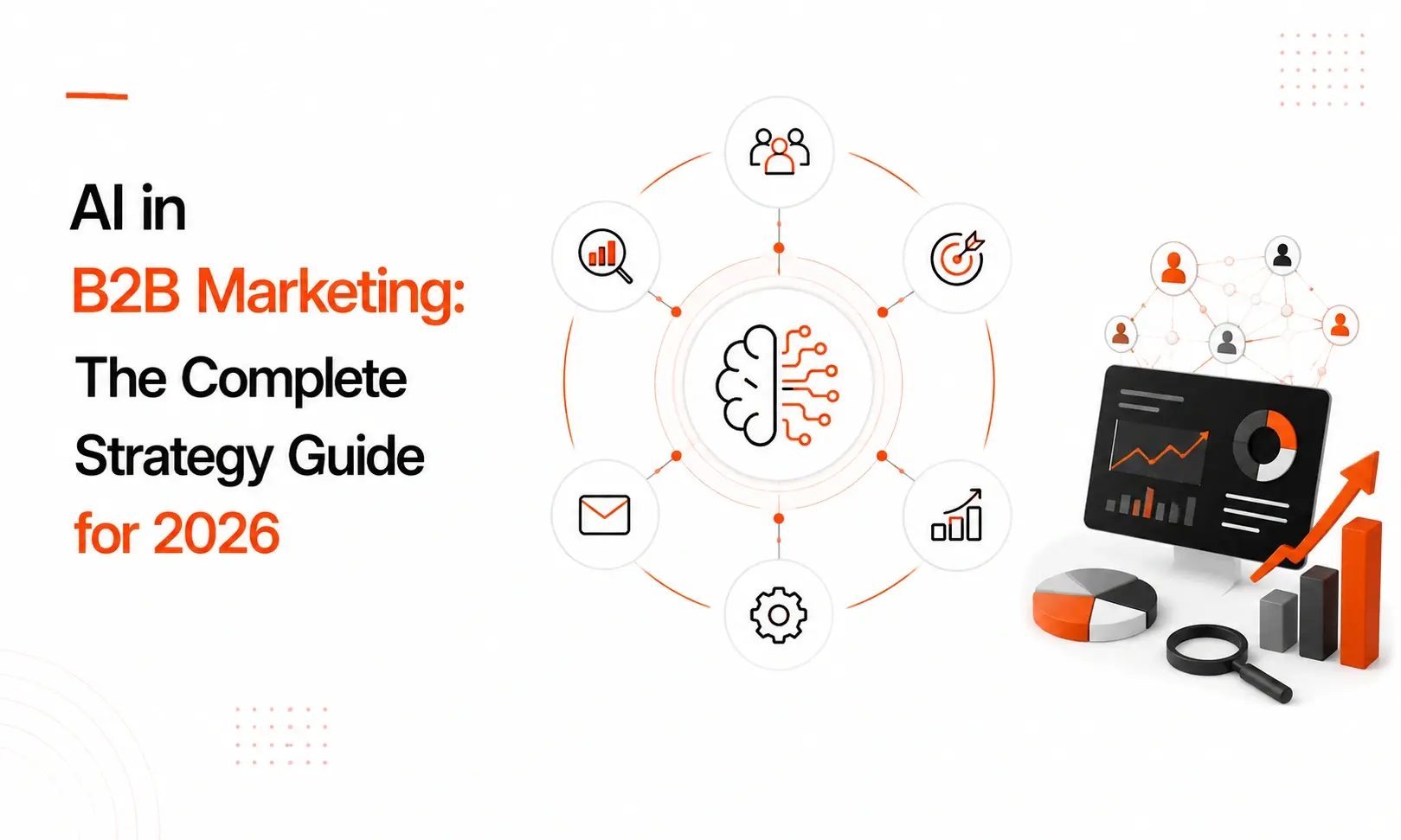


Most B2B marketing teams have already adopted AI in some form. Content drafts, campaign summaries, lead scoring, chat responses, these are table stakes now, not competitive advantages. The organizations pulling ahead in 2026 are not the ones using AI the most, but the ones using it to understand buyers better, sharpen positioning, and earn visibility inside AI-powered buying journeys.
This guide reframes AI in B2B marketing around that shift. Instead of walking through tools and productivity hacks, it explains how AI supports customer research, positioning, content strategy, demand generation, and the emerging discipline of AI Search visibility, the practices that actually move pipeline and revenue in a market where buyers increasingly start their research inside AI-powered answers rather than a search results page.
Key Takeaways
- AI adoption is now standard across B2B marketing; the differentiator is how AI is applied to customer understanding, positioning, and buyer discovery.
- Customer Intelligence, built from CRM data, sales conversations, support tickets, reviews, and buyer questions, is the foundation that makes AI-powered research useful.
- Buyers are starting their evaluation process inside AI Search experiences before they ever visit a vendor's website.
- Content strategy now depends on expertise and AI-citable authority, not publishing volume.
- Positioning is a continuous process informed by ongoing Market Intelligence and Competitive Intelligence, not a static document.
- Success metrics are shifting from traffic and content volume toward pipeline contribution, AI Search visibility, and buyer question coverage.
AI Is Changing How B2B Buyers Discover Vendors
For the better part of two decades, the B2B buyer journey followed a predictable path. A prospect ran a search, landed on a vendor's website, compared a few options, and eventually booked a demo. Marketing teams built entire strategies around that sequence, optimizing pages, forms, and nurture flows to guide someone from search to sales conversation.

That path is no longer the default. Buyers now frequently begin their research inside AI Search experiences, asking direct questions about problems, categories, and vendors before they ever type a company name into a browser. By the time they reach a website, many have already formed an opinion about which vendors belong on the shortlist and which ones don't.
The Modern Buyer Journey Looks Different
Instead of moving in a straight line from search to website to demo, buyers now move through a longer, less visible research phase. They ask an AI Search tool to explain a category, compare approaches, or recommend vendors for a specific use case. The answers they receive are shaped by whichever companies have published clear, well-structured, and trustworthy content on the topic.
This means the earliest and most influential stage of B2B buying decisions may happen before a prospect ever identifies themselves to a vendor. If your content isn't part of the material an AI Search tool references, you may be excluded from consideration before your sales team knows the opportunity exists.
What This Means for Marketing Teams
Marketing leaders now need to think about two audiences for every piece of content: the human reader and the AI Search systems that summarize, compare, and recommend based on published material. Content that is vague, overly promotional, or thin on substance rarely gets referenced, no matter how well it reads to a person.
Educational content, comparison pages, and documentation that directly answer real buyer questions perform better in this environment because they give AI Search systems something concrete to cite. Our guide on how AI is changing B2B marketing explores this shift in more depth, including how discovery, evaluation, and vendor selection are being reshaped at every stage.
Practically, this requires marketing teams to map the buyer questions being asked at each phase of the journey, then build content that answers them clearly and specifically. Generic blog posts written for volume rarely earn a place in an AI-generated answer. Detailed, well-sourced explanations usually do.
Customer Intelligence Is the Foundation of AI in B2B Marketing
AI-powered research is only as good as the customer understanding behind it. A tool can draft a hundred variations of a message, but if none of them reflect how real buyers describe their problems, none of them will land. This is why Customer Intelligence, not the AI-powered research itself, is the actual foundation of effective B2B marketing.
Where Customer Intelligence Comes From
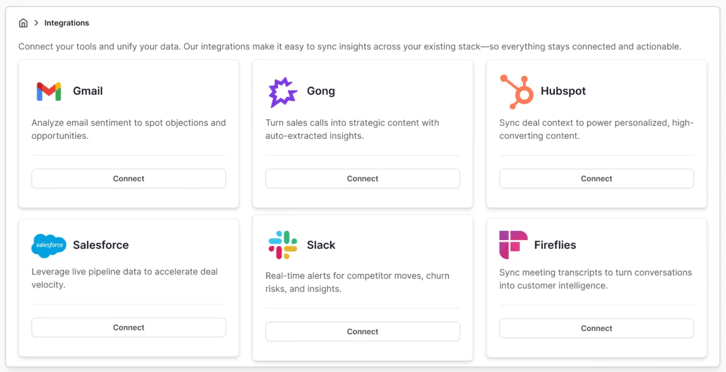
Strong Customer Intelligence pulls from many sources at once: CRM records, sales call transcripts, support tickets, review site feedback, survey responses, and the direct questions buyers ask during the evaluation process. Each source captures a different angle on how customers think, what they struggle with, and which language they actually use.
The pattern that matters here is straightforward:
Customer Signals flow into Customer Intelligence, which shapes Marketing Strategy, which informs Content, which ultimately drives Pipeline. Skip any step in that chain and the output weakens. Marketing strategy built on assumptions instead of signals tends to produce content that sounds plausible but doesn't resonate.
Why Prompts Alone Fall Short
A common mistake is treating AI-powered tools as a replacement for customer research rather than an accelerator of it. Asking a model to write positioning copy without feeding it real buyer language, objections, and use cases produces generic output that could describe almost any vendor in the category.
The stronger approach connects AI-assisted research directly to structured customer data. Our work on customer insights and voice of the customer practices covers how to build that connection so AI-powered output reflects what customers actually say, not a generic approximation of it. Teams that invest here see a meaningful difference in how well their messaging performs, because it's grounded in real conversations rather than guesswork.
AI Is Changing Content Strategy
Content teams spent the last two years focused on production speed. Draft more, publish more, test more variations. That approach made sense when content volume was still scarce relative to demand. It makes far less sense now that most competitors can produce content just as quickly.
From Volume to Expertise
What differentiates content today is depth, specificity, and demonstrated expertise, the qualities that make a piece worth citing rather than skimming. Buyer questions, comparison pages, documentation, and thought leadership pieces that reflect firsthand knowledge of a category consistently outperform generic explainer content, both with human readers and with AI Search systems looking for authoritative sources.
Effective content strategy now starts by identifying the actual questions buyers ask during their research, not by guessing at keyword topics. A content plan built around real buyer questions naturally produces material that AI Search tools can reference confidently, because it directly answers what someone is trying to learn.
Building AI-Ready Content
AI-ready content is structured clearly, backed by evidence, and specific enough that a system can extract a confident answer from it. Vague claims and marketing language tend to get filtered out of AI-generated summaries, while concrete facts, data points, and direct explanations tend to survive.
A practical exercise here is running an AI content gap analysis to identify which buyer questions your existing library fails to answer clearly. Closing those gaps with well-researched, AI-citable content is a higher-leverage investment than publishing more generic posts.
AI Is Reshaping Product Marketing and Positioning
Positioning used to be a project: a workshop, a messaging document, a launch, then silence until the next major update. That cadence doesn't hold up in a market where competitors update their messaging constantly and buyer language shifts as fast as the product category itself.
Positioning as a Continuous Process
AI-assisted research makes it realistic to treat positioning as an ongoing practice rather than a one-time document. Product marketing teams can continuously monitor competitor messaging, track how customers describe value in their own words, and update proof points as new case studies and results become available.
This shift touches several parts of the positioning discipline at once:
- Differentiation gets sharper when it's grounded in current Competitive Intelligence rather than a snapshot from a year ago.
- Messaging improves when it incorporates the actual phrases customers use in sales calls and reviews.
- Value propositions stay credible when proof points are refreshed as new outcomes and customer stories come in.
Why This Matters More in an AI Search Era
Positioning doesn't just shape how your sales team talks about the product. It shapes how AI Search systems summarize your category and describe your differentiation to a buyer who has never spoken to your team. Clear, consistent, well-substantiated positioning gives those systems something specific to reference, rather than a vague, interchangeable description that could apply to any vendor.
AI Search Is Becoming a Core B2B Marketing Channel
Marketing teams have spent years optimizing for traditional search: keywords, backlinks, and website structure feeding a predictable funnel into the site. That work still matters, but it's no longer the full picture. AI Search has emerged as a parallel, increasingly influential channel that operates on different rules.
How AI Search Optimization Differs
Traditional optimization runs through a fairly linear path: search engine, then website. Modern optimization runs through a longer chain: search engine, AI Search, educational content, authority, and only then buyer discovery. Each link in that chain requires something specific.
Structured expertise matters more than keyword density. AI Search systems are drawing from content that demonstrates clear knowledge of a subject, not content that repeats a phrase enough times to rank. Trusted sources matter more than raw traffic volume, since these systems tend to favor material that reads as credible and well-supported over content optimized purely for clicks.
Understanding AI Search Visibility
AI Search visibility describes how often and how favorably a brand appears in AI-generated answers, comparisons, and recommendations. It's a different measurement than traditional visibility metrics, and it requires different inputs: clear buyer question coverage, citation-worthy content, and consistent, accurate information across the sources these systems draw from.
Our guide on AI Search visibility walks through what this actually looks like in practice and how marketing teams can start tracking it alongside traditional metrics. The goal isn't to abandon existing optimization work, but to add a new layer focused on earning citations and appearing accurately in AI-generated answers.
Practical Starting Points
Teams getting started with AI Search typically begin by cataloging the questions buyers ask most often during evaluation, then auditing existing content against those questions to find gaps. From there, the priority is publishing clear, well-sourced answers rather than promotional pages, since promotional language tends to get filtered out of AI-generated summaries in favor of substantive explanation.
This work sits alongside, not instead of, traditional optimization. Both channels reward clear, well-organized, authoritative content, but AI Search adds citation potential and buyer question coverage as new success factors worth tracking deliberately.
AI Improves Marketing Decisions, Not Just Marketing Tasks
Early AI adoption in marketing focused almost entirely on task automation: drafting emails faster, summarizing calls, generating social captions. Useful, but limited. The more significant shift happening now is AI supporting actual decisions, not just executing tasks faster.
From Task Automation to Decision Support
Where early AI use cases stopped at automating repetitive work, current practice extends further: AI-powered research surfaces patterns across customer data, decision support translates those patterns into recommendations, strategy incorporates those recommendations into planning, and execution carries the plan forward. Task automation still happens at the execution stage, but it's no longer the main value driver.
Consider campaign planning. Instead of asking an AI tool to draft ad copy in isolation, marketing teams can pull in performance data, customer language, and competitive movement to inform which campaigns are worth running in the first place. The task-level output, the actual copy, becomes a downstream step rather than the starting point.
Strategic Recommendations, Not Just Faster Output
This is where the value of AI-powered research becomes clearest to marketing leadership. Strategic recommendations grounded in real customer and market signals help teams prioritize which positioning angle to test, which content gaps matter most, and which campaigns are likely to resonate, before a single asset gets produced. That's a meaningfully different contribution than shaving time off a content calendar.
AI Across the Entire Marketing Lifecycle
Rather than treating AI as a bolt-on for one function, the most effective B2B teams apply it consistently across the full marketing lifecycle: customer research, positioning, content strategy, demand generation, sales enablement, customer marketing, expansion, and advocacy.
Where AI Adds Value at Each Stage
In customer research, AI-assisted analysis helps surface patterns across calls, tickets, and reviews that would take a human team weeks to identify manually. In positioning, it supports continuous monitoring of competitive messaging and customer language. In content strategy, it helps prioritize which buyer questions deserve coverage first.
Demand generation benefits from AI-powered research that identifies which campaigns and messages are resonating with specific segments in near real time. Sales enablement gains from having customer language and objection patterns organized and accessible, rather than scattered across individual reps' notes. Customer marketing and expansion efforts benefit from Lifecycle Marketing approaches informed by usage patterns and support signals, helping teams identify expansion opportunities and advocacy candidates earlier.
Advocacy, often the most under-resourced stage, gains the most from AI-assisted organization: pulling together customer quotes, results, and stories that are already scattered across CRM notes, support tickets, and review sites, then making them usable for case studies and testimonials.
Revenue Marketing as the Connective Thread
What ties these stages together is a Revenue Marketing mindset: every activity, from customer research through advocacy, gets evaluated against its contribution to pipeline and revenue, not against isolated functional metrics. AI's role across the lifecycle is to make that connective thread visible and actionable, rather than leaving each function to operate on its own data and assumptions.
Trust Is Becoming the New Competitive Advantage
As AI-generated answers become a more common entry point for B2B research, trust takes on new weight. A buyer reading an AI-generated summary can't always tell where the information originated, which means the underlying sources need to be credible enough that the summary itself holds up under scrutiny.
What Builds Trust in an AI-Mediated Market
Expertise, documented and demonstrated rather than claimed, remains the strongest trust signal available. Case studies with specific, verifiable outcomes carry more weight than generic testimonials. Transparent messaging that acknowledges tradeoffs and limitations tends to read as more credible than messaging that oversells.
Educational resources that genuinely help a buyer understand a category, independent of whether they choose your product, build the kind of authority that AI Search systems and human buyers both respond to. This is consistent with broader industry commentary suggesting that as AI adoption matures, governance and data quality become the real differentiators, not the presence of AI itself.
Trust as an Input to Discovery
Trust isn't just a brand attribute anymore, it's functionally an input into whether a vendor gets surfaced in AI-driven buyer discovery at all. Content and messaging that reads as credible, specific, and well-substantiated is more likely to be referenced, cited, and recommended than content that reads as generic or promotional.
Practical AI Workflows Across B2B Marketing
Moving from concept to practice, here's how AI-powered research shows up in day-to-day marketing operations across common workflows.
Customer Research and Buyer Understanding
Rather than manually reviewing hundreds of sales call recordings, teams use AI-assisted analysis to surface recurring objections, questions, and language patterns across calls, tickets, and reviews. This turns scattered qualitative data into a usable, searchable body of Customer Intelligence.
Campaign Planning and Prioritization
Instead of planning campaigns based on internal opinion about what should resonate, teams use Market Intelligence and Customer Intelligence together to prioritize which messages, offers, and channels are most likely to perform with specific segments.
Content Prioritization and Messaging Refinement
AI-assisted research helps identify which buyer questions have the highest search and discussion volume but the weakest existing content coverage, directing content investment toward the gaps most likely to influence buyer decisions.
Competitive Monitoring
Ongoing Competitive Intelligence tracking replaces the periodic competitive audit, giving product marketing teams a current view of how competitors are positioning themselves at any given moment, rather than a snapshot from months earlier.
Lifecycle Marketing and AI Search Optimization
Customer success signals, like usage patterns and support ticket themes, feed into Lifecycle Marketing programs that identify expansion and advocacy opportunities. In parallel, content teams monitor AI Search visibility to understand which buyer questions their brand is and isn't being cited for, adjusting content priorities accordingly.
Common Mistakes to Avoid
Several patterns show up repeatedly among teams that adopt AI without seeing meaningful business results.
- Producing AI-generated content without underlying customer research. Output that sounds polished but doesn't reflect real buyer language rarely performs well with either human readers or AI Search systems.
- Automating a weak process instead of fixing it first. Speeding up a flawed workflow just produces flawed output faster.
- Treating positioning as a static document. Messaging that isn't updated against current Competitive Intelligence quickly becomes outdated and generic.
- Leaving customer data disconnected across systems. CRM records, support tickets, and reviews stored in silos prevent any single team from seeing the full picture.
- Relying only on prompts instead of structured Customer Intelligence. Prompts without real data behind them produce plausible-sounding but generic results.
- Ignoring AI Search entirely. Teams focused solely on traditional optimization miss an increasingly influential stage of the buyer journey.
- Measuring productivity instead of business outcomes. Content volume and time saved are easy to track but don't reflect whether marketing is actually influencing pipeline.
Measuring Success in AI-Powered B2B Marketing
Traditional marketing metrics, like traffic, content volume, and email open rates, still have a place, but they no longer tell the full story of whether AI-powered marketing is working.
Metrics That Matter Now
- Pipeline contribution: how much AI-informed content and campaigns directly influence opportunities and revenue.
- AI Search visibility: how often and how accurately a brand appears in AI-generated answers and comparisons.
- Customer understanding depth: whether Customer Intelligence is current, comprehensive, and actually being used across teams.
- Messaging consistency: whether positioning holds up across sales, content, and product materials.
- Buyer question coverage: how many real buyer questions are answered clearly and completely across the content library.
- Revenue influence: the ultimate test of whether AI-powered marketing efforts are connected to actual business outcomes, not just activity.
Shifting reporting toward these metrics forces a more honest conversation about whether AI adoption is producing results or just producing more output.
An AI-Powered B2B Marketing Framework
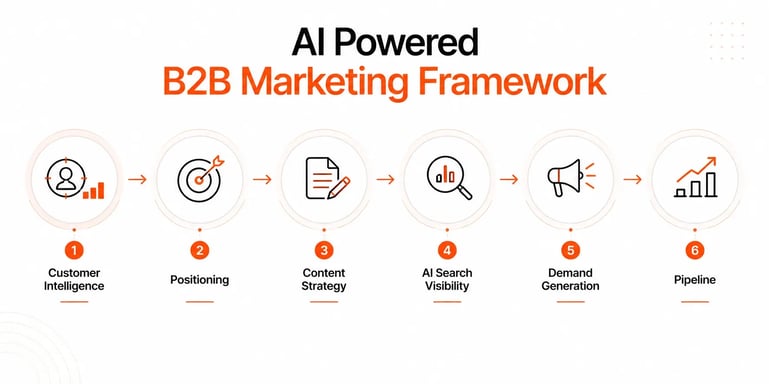
The framework running through this guide follows a consistent sequence: Customer Intelligence informs Positioning, Positioning shapes Content Strategy, Content Strategy builds AI Search visibility, AI Search visibility drives Demand Generation, and Demand Generation produces Pipeline. Each stage depends on the one before it, which is why skipping straight to content production or campaign execution without the underlying intelligence tends to underperform.
Compared against the traditional buyer journey, search, website, sales, the modern path adds several steps in between: AI Search, educational content, and a shortlist stage that often happens before a prospect ever fills out a form. Marketing strategies built only for the traditional path miss the stages where buyer opinions are actually forming.
Across the lifecycle, the pattern repeats: customer research feeds strategy, strategy feeds execution, execution feeds measurement, and measurement feeds continuous improvement back into research. Continuous research, not a one-time project, is what keeps this cycle functioning.
How Omnibound Supports AI-Powered B2B Marketing
Omnibound is built as an AI Search Marketing platform, not a generic content generator or automation tool. Its focus is helping B2B teams understand the questions buyers are actually asking, unify Customer Intelligence from CRM, calls, support tickets, and reviews, and turn that intelligence into stronger positioning and AI-ready content.
In practice, that means helping marketing teams identify content gaps against real buyer questions, monitor AI Search visibility against competitors, and keep positioning grounded in current Market Intelligence rather than a messaging document from last year. Teams working through B2B marketing automation and B2B SaaS marketing programs can use this same intelligence layer to keep campaigns aligned with what customers are actually saying, not just what internal teams assume they want to hear.
Deeper research capabilities, covered in our overview of intelligent research for B2B marketing teams, connect scattered customer signals into a single, continuously updated source that content, positioning, and demand generation teams can all draw from.
Conclusion
AI is no longer a standalone marketing capability, it has become part of how customer research, positioning, content strategy, and demand generation actually operate. The organizations getting real value from AI aren't necessarily producing the most content or automating the most workflows. They're using AI to understand customers more precisely, keep positioning current, and build content that earns trust with both human readers and AI Search systems.
As more of the buyer journey moves into AI-mediated research, marketing teams that combine strong Customer Intelligence, current Market Intelligence, and authoritative, AI-ready content will have more influence over vendor selection long before a sales conversation starts. That's the practical shift behind this guide: from AI as a productivity tool to AI as part of how marketing strategy itself gets built.
Frequently Asked Questions
What is AI in B2B marketing?
AI in B2B marketing refers to using AI-powered research and recommendation tools to support customer understanding, positioning, content strategy, and demand generation, rather than simply automating individual tasks like drafting copy or scheduling emails.
How are B2B companies using AI today?
Most B2B companies now use AI across content drafting, campaign analysis, and lead scoring. The more advanced use cases involve connecting AI-powered research to structured Customer Intelligence to inform positioning and strategy decisions, not just execution.
How is AI changing buyer behavior?
Buyers increasingly begin their research inside AI Search experiences, asking direct questions and reviewing AI-generated comparisons before visiting a vendor's website. This moves a meaningful part of the evaluation process earlier and outside of a vendor's direct visibility.
How does AI improve customer intelligence?
AI-assisted analysis helps unify signals from CRM records, sales calls, support tickets, and reviews into a single view of how customers describe their problems and evaluate solutions, which is far more useful than analyzing any one source in isolation.
How is AI Search changing B2B marketing?
AI Search adds an earlier stage to the buyer journey where vendors are discovered, compared, and shortlisted through AI-generated answers rather than a traditional search results page. This makes AI Search visibility a meaningful factor in whether a vendor even reaches the consideration stage.
Which marketing activities benefit most from AI?
Customer research, positioning, and content prioritization tend to see the strongest gains, since AI-powered research helps surface patterns and gaps that would take much longer to identify manually. Demand generation and lifecycle marketing also benefit when they're informed by that same intelligence.
How should marketing leaders prepare for AI-driven buyer journeys?
Start by mapping the actual questions buyers ask during evaluation, then audit existing content and messaging against those questions. Building Customer Intelligence and AI Search visibility into ongoing marketing operations, rather than treating them as one-off projects, is the more durable approach.
How does Omnibound help improve AI Search visibility?
Omnibound unifies Customer Intelligence, Market Intelligence, and Competitive Intelligence to help teams identify buyer question gaps, monitor how they appear in AI-generated answers relative to competitors, and produce AI-ready, citable content grounded in real customer and market signals.