




In 2026, 89% of businesses say they are competing primarily on customer experience, yet most still manage their lifecycle with disconnected tools and guesswork instead of a unified customer lifecycle strategy platform.
Key Takeaways
|
Question |
Short Answer |
|---|---|
|
What is the core value of a customer lifecycle strategy platform in 2026? |
It connects real customer and market signals across every stage into one context, so strategy and execution are driven by truth, not assumptions, as we do with our Marketing Context Engine. |
|
How does a lifecycle platform improve ICP and segment decisions? |
By unifying CRM, conversations, support, and market intel into intelligent research that updates ICPs and segments continuously instead of yearly. |
|
How can teams go from lifecycle strategy to execution fast? |
Use context-aware AI agents, like our Omnibound AI Agents, to turn lifecycle insights into ready-to-ship campaigns and content. |
|
Where does lifecycle content production fit? |
Lifecycle content is generated directly from your unified context and strategy using our AI Content Production suite so every touch matches stage, need, and persona. |
|
How do you keep lifecycle strategy aligned with real-world signals? |
By connecting continuous intelligence sources like calls, tickets, and market feeds into one living customer view. |
|
Can a lifecycle platform guide full-funnel marketing strategy? |
Yes, our Marketing Strategy Engine converts lifecycle data into messaging, nurture, and campaign blueprints that drive pipeline and retention. |
|
Where do teams start if they want a lifecycle strategy platform? |
Most teams start with our AI content marketing platform, then expand into research, context, and agents as lifecycle maturity grows. |
Why you Need a Customer Lifecycle Strategy Platform in 2026
Most teams run acquisition, nurture, onboarding, and expansion in separate tools, which creates gaps, duplicated work, and inconsistent experiences. A dedicated customer lifecycle strategy platform solves this by treating awareness, evaluation, purchase, adoption, and advocacy as one connected system that is powered by shared data and shared context.
Instead of relying on static playbooks, a lifecycle platform lets you adjust messaging, offers, and channels based on live customer signals, so every stage supports pipeline, retention, and expansion together.
Lifecycle is Now a Revenue System, not a Campaign Calendar
In 2026, 80% of customers say their experience with your company matters as much as your product, which means lifecycle strategy is now a core revenue system, not a “nice-to-have” nurture sequence. A lifecycle platform gives marketing, sales, and success one shared plan for how each stage contributes to pipeline, renewal, and expansion.
Instead of optimizing single emails or ads, you optimize the journey as a whole, which is where the biggest revenue gains sit.
Platform vs Point Solutions for Lifecycle
Point tools solve individual problems like email sends or in-app prompts, but they rarely share a full picture of the customer. A customer lifecycle strategy platform sits above these tools and feeds them a consistent strategy, audience, and message for every stage.
This lets you orchestrate lifecycle experiences across channels and devices without rebuilding logic in every single system.
Core Capabilities of a Modern Customer Lifecycle Strategy Platform
A strong lifecycle platform covers four pillars: intelligence, strategy, content, and activation, all grounded in real customer and market data. We designed Omnibound around these pillars so every output is tethered to truth instead of guesswork.
When you evaluate platforms in 2026, focus less on individual features and more on how well they keep these four pillars in sync across the customer lifecycle.
Unified Context Layer Across the Lifecycle
Your lifecycle strategy is only as good as the context behind it. Our B2B Marketing Context Engine unifies signals from CRM, calls, tickets, product usage, and external market feeds into one “source of truth” that informs every lifecycle stage.
This context layer is what allows your ICPs, personas, and lifecycle plays to evolve as your market and buyers change across 2026.
End-to-End Intelligence, Strategy, and Content
A lifecycle platform should help you go from insight to live asset without manual handoffs. With our Intelligent Research, Marketing Strategy Engine, and Content Production, you cover the full chain from signal to strategy to ready-to-use lifecycle content.
This shortens the time between discovering a new customer pattern and acting on it with stage-specific messaging and campaigns.
Mapping the Five Stages of a Customer Lifecycle Strategy Platform
Every customer lifecycle strategy platform should operationalize five key stages: awareness, consideration, purchase, adoption, and advocacy. The value is not in naming these stages, it is in how you feed them with real signals and connect actions from one stage to the next.
We build our lifecycle models around these five stages so that strategy, content, and activation are always tuned to where the account or user actually sits today.
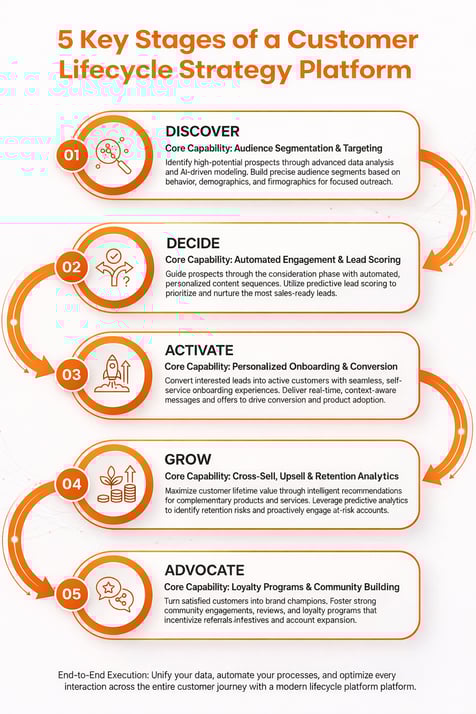
A concise visual map of the five stages in a customer lifecycle strategy platform, from awareness to advocacy. This infographic highlights how each stage connects to the next.
Lifecycle Stage Examples in Practice
In awareness, your platform might surface common pains from competitor calls and support tickets, then feed that into top-of-funnel messaging. In adoption, it might detect stalled onboarding patterns and trigger targeted walkthrough content for that segment.
By linking evidence and action at each stage, you reduce friction and increase the odds that prospects move all the way to advocacy.
Stage-Specific KPIs Inside the Platform
A lifecycle platform should track the metrics that matter at each stage, not just vanity engagement. We configure KPIs like time-to-first-value, product activation rate, expansion pipeline, and referral volume alongside acquisition metrics.
That way your lifecycle strategy optimizes for long-term revenue and satisfaction, not just top-of-funnel leads.
Turning Customer and Market Signals into Lifecycle Strategy
The biggest gap we see in 2026 is not data availability; it is the inability to turn raw signals into clear lifecycle decisions. A customer lifecycle strategy platform must ingest signals from customer conversations, tickets, usage, and the market, then turn them into actionable insights for each lifecycle stage.
Our Intelligence Sources and Intelligent Research are built exactly for this conversion step.
Data Types That Feed Lifecycle Strategy
- Customer signals: calls, chats, emails, tickets, NPS, product usage.
- Market and competitor signals: pricing changes, messaging shifts, feature launches.
- Engagement signals: email and in-app behavior, content consumption, responses.
Our platform brings these into one view, so you see not just what customers do, but why they do it at each stage.
From Signal to Lifecycle Play
Once signals are unified, the platform should recommend lifecycle plays like “adjust onboarding emails for this segment” or “create a competitive objection asset for late-stage deals.” We use AI to read these signals, but always tie every recommendation back to specific evidence.
This keeps your lifecycle strategy grounded and defensible when you present it to revenue leadership.
Did You Know?
85% of lifecycle marketers increased their AI usage in 2026, with 45% calling the increase “huge”, which is why a lifecycle strategy platform must have AI at the core, not as an add-on.
Designing Lifecycle Messaging and Positioning That Actually Converts
Customer lifecycle strategy fails when messaging sounds the same across every stage. Your platform should give you a clear, evidence-backed narrative that shifts from problem education to proof, value, and expansion as buyers move through the journey.
Our Marketing Strategy capabilities turn context into positioning and messaging frameworks tied directly to lifecycle stages.
Lifecycle Positioning Framework
We connect positioning pillars to buyer pains and expectations, then map those to lifecycle stages. For example, early-stage messaging may focus on risk reduction, while post-sale messaging emphasizes expansion use cases and value realization.
This way, every touch across the lifecycle builds on the last instead of repeating top-of-funnel claims.
Consistent Voice, Stage-Specific Narrative
A customer lifecycle strategy platform should ensure that even though your message shifts by stage, your voice stays consistent. Our narrative context keeps brand voice, key phrases, and proof points aligned across channels and teams.
Marketing, sales, and success all speak the same language to the customer, which builds trust and shortens decision cycles.
Building Lifecycle Content that Matches Every Stage
Once you have lifecycle strategy, you need content that is actually built from that strategy, not from generic prompts. That is where our Content Production capabilities come in as a core part of the customer lifecycle strategy platform.
We generate multi-format assets that are grounded in your ICPs, personas, and real customer language, then mapped to each lifecycle stage.
Lifecycle Content Types
- Awareness: educational articles, guides, and comparison content.
- Consideration: case studies, deep dives, ROI breakdowns.
- Purchase: battlecards, objection handlers, proof assets.
- Adoption: onboarding flows, how-to content, in-app tips.
- Advocacy: referral prompts, customer stories, co-marketing.
Our platform lets you specify lifecycle stage and audience, then generates the formats you need from the same verified context.
Lifecycle Content Repurposing
Instead of creating net-new content for every stage, you can repurpose a single asset across the lifecycle. For example, a research report can spin into top-of-funnel posts, mid-funnel webinars, and post-sale customer training content.
We make this easy by treating source content as structured knowledge that our AI can reshape for each lifecycle touchpoint.
Orchestrating Lifecycle Journeys with Context-Aware AI Agents
In 2026, by the end of the year, 40% of enterprise apps are expected to include AI agents, and lifecycle strategy is one of the most powerful use cases. Our context-aware AI Agents are built specifically to execute on lifecycle strategy using the shared context layer.
They read your lifecycle models, ICPs, and signals, then generate and activate the right content and workflows across channels.
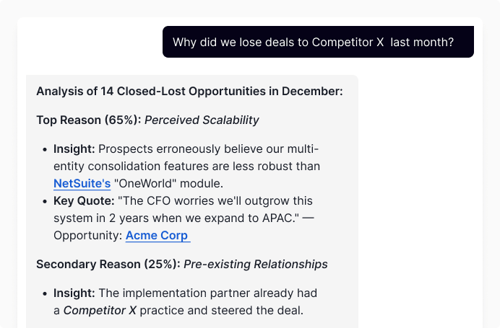
How Lifecycle AI Agents Work
Each agent operates with three contexts: audience, narrative, and work or activation. Audience context covers ICPs and personas, narrative context covers your messaging and positioning, and activation context covers channels and workflows.
When a lifecycle trigger fires, such as a new user stalling in onboarding, the agent uses all three contexts to generate the right response.
Lifecycle Triggers and Activation Moments
Our AI agents can be triggered from lifecycle insights like stage changes, engagement shifts, or risk signals. They can then draft nurture sequences, update messaging blocks, or propose new lifecycle plays for your team to approve.
This moves your customer lifecycle strategy platform from static planning to dynamic, always-on orchestration.
Did You Know?
431% ROI with payback in under six months has been reported when teams use unified data and journey optimization platforms, showing the upside of investing in a real lifecycle strategy platform.
Bringing AI Content Marketing and Lifecycle Strategy Together
Your customer lifecycle strategy platform should not live in a different universe from your content marketing. Our AI Content Marketing Platform for B2B Teams is built on the same context and lifecycle logic so every blog, guide, and email supports a defined stage and motion.
This lets your team create pipeline-driven content that ties directly back to lifecycle KPIs instead of disconnected vanity content.
Pipeline-Driven Lifecycle Content
We focus content planning on the lifecycle gaps that actually hold back revenue, such as stalled evaluations or low product adoption in specific segments. The platform surfaces those gaps and suggests content types and angles that can move those metrics.
Your editorial calendar becomes a lifecycle revenue roadmap, not a random list of ideas.
Shared Context Between Content and Lifecycle Journeys
Because content planning and lifecycle strategy run on the same context layer, we avoid the classic disconnect where demand gen and lifecycle teams tell different stories. Every piece of content is tagged by lifecycle stage, persona, and narrative pillar.
This makes it easier to measure performance by stage and continuously improve your lifecycle strategy platform with real results.
Measuring the Impact of Your Customer Lifecycle Strategy Platform
A lifecycle platform must prove it is driving revenue, not just adding another layer of complexity. In 2026, the strongest teams instrument their lifecycle strategy with end-to-end KPIs that cover acquisition, retention, and expansion together.
We design our reporting around the questions revenue leaders actually ask, like “Which lifecycle stage is slowing growth?” and “Which motions produce the most efficient pipeline?”
Key Lifecycle KPIs to Track
- Stage-to-stage conversion rates across the lifecycle.
- Time in stage and overall lifecycle velocity.
- Onboarding completion and time-to-first-value.
- Net revenue retention and expansion pipeline.
- Churn drivers by segment and lifecycle stage.
We tie these metrics back to specific lifecycle plays and content, so you know what is working and what needs to change.
Closing the Loop for Continuous Improvement
A customer lifecycle strategy platform should not be a one-time setup. It should adjust its recommendations as performance data comes in, highlighting which lifecycle strategies to double down on and which to replace.
We build feedback loops into every layer of the platform, so your lifecycle strategy gets sharper every quarter.
Aligning Marketing, Sales, and Success Around the Lifecycle
Even the best platform fails if teams are not aligned on how to use it. That is why we design our lifecycle strategy platform to be a shared workspace for marketing, sales, and customer success, with one common view of accounts, segments, and stages.
This alignment is critical in 2026 as budgets tighten and teams are expected to show clear impact from every lifecycle motion.
Shared Lifecycle Views and Playbooks
We give go-to-market teams one shared lifecycle map that shows where each account and user sits, what has happened so far, and which playbook is in motion. This reduces internal friction and prevents conflicting outreach.
Everyone sees the same customer story, which improves both experience and internal coordination.
Governance and Collaboration Inside the Platform
Our lifecycle platform supports role-based access, approvals, and collaboration on lifecycle plays and content. Marketing can propose new nurture flows, sales can flag objections, and success can highlight churn risks, all in one place.
This keeps lifecycle strategy living and cross functional, instead of locked in a slide deck.
Getting Started with a Customer Lifecycle Strategy Platform in 2026
If your lifecycle today lives in scattered tools and static documents, moving to a platform approach may feel like a big leap. We recommend starting where the revenue impact is highest, then expanding stage by stage.
Most of our customers begin with unifying context and research, then add strategy, content, and agents as they see results.
Practical First Steps
- Audit current lifecycle stages, tools, and gaps.
- Connect your key intelligence sources like CRM, calls, and tickets.
- Define the first lifecycle problem to solve, such as onboarding drop-off.
- Stand up stage-specific messaging and content for that area.
- Add AI agents and automation once the strategy is validated.
We support teams through this rollout, so you see early wins while building a long-term lifecycle foundation.
Why 2026 Is the Right Time to Invest
Customer lifecycle platforms, customer success platforms, and real-time journey tools are growing fast, with market size expected to continue rising through and beyond 2026. As more teams invest, the gap widens between companies with connected lifecycle systems and those still relying on disconnected campaigns.
Starting now means you can build a lifecycle strategy platform that fits your business, instead of reacting later on someone else’s terms.
Conclusion
A customer lifecycle strategy platform is no longer optional in 2026 if you want to compete on customer experience and revenue efficiency. By unifying intelligence, strategy, content, and activation across every stage, you turn the lifecycle into a measurable, repeatable growth system.
We built Omnibound to do exactly that for B2B teams, so if you are ready to move from fragmented tools to a unified lifecycle strategy platform, we would be glad to show you how it looks in your world.
.jpg?height=245&name=unnamed%20(7).jpg)