

Most B2B deals fall apart at the decision stage, not because buyers lack information but because content fails to deliver relevance, confidence, and timing. Decision-stage content that cannot answer the buyer's next question, in the format they now expect, quietly stalls deals instead of closing them.
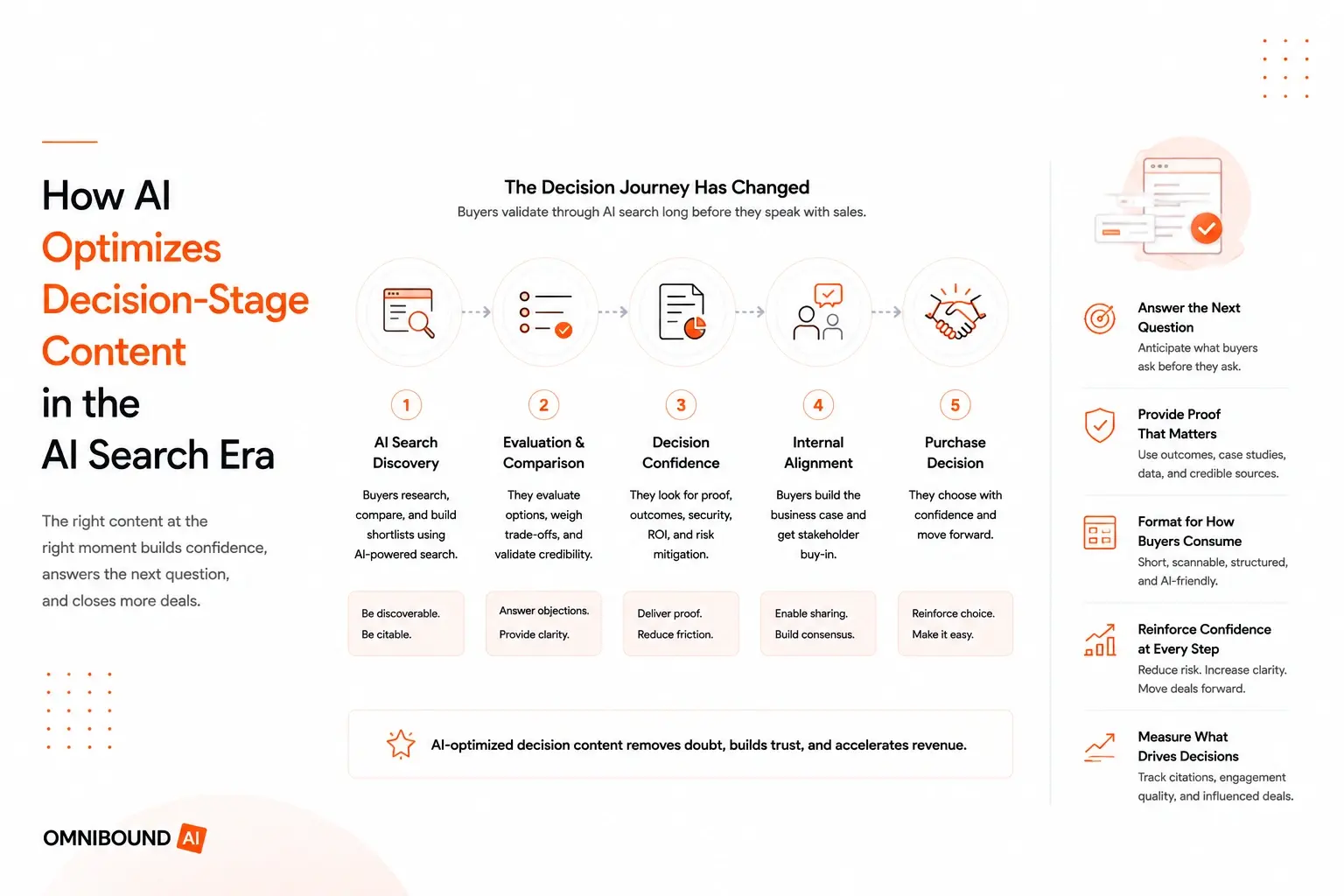
Today's buyers often validate vendors through AI-powered search before ever speaking with sales. By the time they reach a pricing page or a comparison guide, much of the evaluation has already happened somewhere else. Decision-stage content must therefore reinforce confidence, answer the questions buyers still have, and provide evidence that supports the purchasing decision they are already leaning toward.
How Does AI Enhance B2B Communication and Customer Engagement?
AI enhances B2B communication by turning scattered buyer signals, sales conversations, and market activity into a clear picture of what accounts actually need to hear next. Instead of guessing at messaging, marketing and sales teams can see the specific objections, comparison questions, and proof points that repeatedly influence decisions.
This matters most at the decision stage, where generic messaging costs deals. When teams understand the real language buyers use to describe their evaluation criteria, they can write comparison pages, proof content, and objection-handling material that actually matches how purchasing committees think.
Omnibound supports this by continuously analyzing customer conversations, support interactions, and market activity to surface the themes and questions that shape late-stage decisions. Rather than automating outreach, the platform helps teams understand what buyers are asking so content can answer those questions directly, in the places buyers are already looking, including AI-powered search.
Key Takeaways
- Decision-stage content optimization now starts before a buyer reaches your website, inside AI-powered search results.
- The goal has shifted from personalizing assets to reducing buying risk and earning buyer confidence.
- Comparison content, customer proof, and transparent limitations matter more than promotional copy.
- Customer intelligence, drawn from real sales conversations, sharpens comparison and proof content.
- Success should be measured by AI Search visibility, buyer question coverage, and sales cycle speed, not just conversion rate.
AI Search Has Changed the Decision Stage

For years, B2B marketing has treated the buying journey as a straight line: awareness, then consideration, then decision. Each stage had its own content, and teams built assets assuming buyers would move through them in order, mostly on a company's own website and email nurture.
That assumption no longer holds. Buyers now ask AI-powered search tools direct questions like "what's the difference between X and Y" or "is this solution right for a mid-market team," and receive answers that blend education, comparison, and validation in a single response. The traditional funnel has been replaced by something closer to this path: a buyer question, followed by AI Search, followed by vendor comparison, followed by a search for evidence, followed by a visit to a company's website, followed by a purchase decision.
Decision-stage content, in other words, now begins before a website visit ever happens. If a comparison question gets answered poorly, or not at all, inside AI Search, a vendor can be filtered out of consideration before a buyer ever opens a pricing page. This is a structural shift, not a minor tactical adjustment.
Recent discussion inside the AI Search community has pointed to a related pattern: AI systems increasingly compress what used to be multiple separate buying stages into one conversational answer. A single AI Search response might explain what a category of software does, compare three vendors, and cite a customer outcome, all in the same reply. That means a single piece of content is now expected to carry the weight of education, comparison, and proof at once.
This changes what "decision-stage content" needs to accomplish. It is no longer enough to write a comparison page that looks good on a company's own site. That page also needs to hold up as a standalone, trustworthy answer when it is referenced, summarized, or cited by an AI system responding to a buyer's question. Vague claims, unsupported superlatives, and thin comparisons do not translate well into that context. Specific numbers, named use cases, and balanced explanations do.
Marketing teams that still plan content around a rigid awareness-to-decision funnel are optimizing for a journey buyers no longer follow strictly. A buyer might land directly on a comparison page from an AI Search result having never seen a top-of-funnel blog post, arriving with decision-stage questions already in mind. Content built only for people who already know the category, and who arrived through a predictable nurture sequence, misses a growing share of real buyer behavior.
The practical implication is straightforward. Decision-stage content should be written to work in two places at once: as a page a buyer reads on a company's website, and as source material an AI system might pull from to answer a comparison or validation question. That means clear structure, direct answers to specific questions, and enough evidence that a summary of the page still sounds credible when a buyer never actually clicks through. Teams that treat this as a research problem, tracking the AI Search visibility of their comparison and proof content, are better positioned to show up at the exact moment a buyer is validating a shortlist.
Decision-Stage Content Should Reduce Buying Risk
Buyers at the decision stage are not looking for more education about the category. They already understand the problem and have a shortlist. What they need is confidence that choosing a specific vendor will not backfire on them internally.
That confidence comes from evidence, not enthusiasm. Buyers want proof, clear implementation expectations, a real understanding of return on investment, security and compliance clarity, honest comparisons, and validation from customers who look like them. Every one of those elements exists to answer one underlying question: what happens if this choice turns out to be wrong?
Framing decision-stage content around risk reduction changes what gets prioritized. A case study that only celebrates a win is less useful than one that also explains what the implementation actually required. A comparison page that only flatters one vendor is less trustworthy, and less useful to an AI system summarizing it, than one that fairly represents tradeoffs.
Buyer confidence is built cumulatively, across every touchpoint a buyer encounters, including ones a marketing team does not control directly, such as a summary generated by an AI Search tool. Content that consistently reduces uncertainty earns trust in all of those places, not just on a company's own domain.
Buyer Questions Drive Decision-Stage Content
Decision-stage content should be built around the specific questions a buying committee is actually asking, not around a generic template of "case study, comparison, pricing page." The questions tend to repeat across deals and across the AI Search queries buyers use during evaluation.
Strong decision-stage content directly answers questions like: why should a buyer choose this solution over the alternatives, how is it actually different, who is it built for, who is it not a good fit for, what results have similar buyers achieved, and what evidence backs up those claims.
These are also, increasingly, the exact phrasing buyers use inside AI-powered search. A prospect typing "is [category] right for a 200-person company" or "what's the real difference between these two vendors" is asking the same questions a sales rep would field in a late-stage call. Content that answers them clearly, with specifics rather than generalities, tends to get referenced by AI Search and trusted by human readers for the same reason.
Teams that treat customer persona research as an ongoing input, rather than a one-time exercise, are better equipped to keep this question set current as buying committees and their priorities shift.
AI Search Rewards Complete Decision Content
Content built purely to persuade tends to underperform in AI-powered search. Systems that summarize and compare vendors are looking for content that answers a full set of buyer questions, not content that only makes a single sales pitch.
Decision-stage pages that hold up well tend to include honest comparisons against alternatives, frequently asked questions written in buyer language, implementation guidance that sets realistic expectations, customer proof with specific outcomes, return-on-investment examples with real numbers, and balanced explanations of where a solution fits and where it does not.
This is a different standard than most promotional comparison pages meet today. A page that lists only advantages, avoids specifics, or dodges the question of fit is easy for a buyer, or an AI system, to discount. AI Search tends to reference content that answers the next question a buyer is likely to ask, not just the first one they typed.
Teams looking to close gaps between what buyers are asking and what current content actually answers can use a structured content analysis to identify where comparison and proof content is thin, outdated, or missing entirely.
Customer Intelligence Improves Decision Content
The best source of decision-stage content is not a competitor's website or a generic industry report. It is the actual conversations happening between a sales team and real buyers, right now.
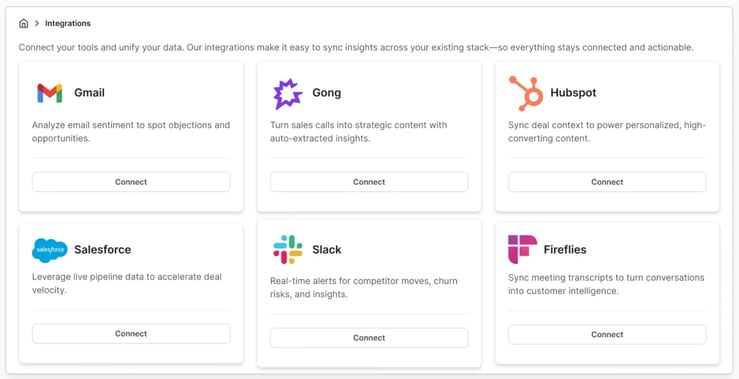
Sales calls, support tickets, and win-loss conversations reveal the specific objections buyers raise, the criteria a buying committee actually weighs, the concerns that come up in internal approval meetings, and the exact language buyers use to describe their problem and their options.
That intelligence, applied consistently, sharpens the assets that matter most at the decision stage. Pricing pages can address the exact budget objections buyers raise instead of generic ones. Comparison pages can address the specific criteria a committee is using. Return-on-investment pages can use the language finance stakeholders actually respond to. Implementation guides can set expectations that match what real customers experienced. Customer stories can highlight the outcomes that matter most to a specific buyer segment, rather than the outcome that sounds best in a press release.
Omnibound analyzes these customer conversations continuously, turning recurring objections, decision criteria, and buyer language into concrete direction for comparison pages, proof content, and positioning, rather than leaving that intelligence buried in call recordings nobody revisits.
Building AI Search-Ready Decision Content
Strong decision-stage content shares a common set of qualities, regardless of industry or product category. It includes transparent comparisons that name specific alternatives and fairly describe tradeoffs. It uses measurable outcomes instead of vague claims, citing real numbers wherever possible.
It sets realistic implementation expectations rather than implying adoption is instant. It includes customer validation with enough detail that the outcome feels credible, not generic. Where relevant, it acknowledges product limitations or poor-fit scenarios, because a page that is honest about who a solution is not for tends to be trusted more, not less.
Finally, it gives the buyer a clear next step that matches how far along they are, whether that is a deeper technical resource, a conversation with sales, or a way to validate a specific claim themselves. None of this requires reworking how content gets written from scratch. It requires reprioritizing what gets included, and writing every claim as if it might be read as a standalone answer rather than as one page in a longer nurture sequence.
What Tools Do Marketers Use to Improve Content Engagement?
Marketing teams typically rely on a mix of analytics platforms, content management systems, and increasingly, customer intelligence tools to understand what content actually holds a buyer's attention and moves a decision forward. Analytics tell teams what got clicked. Customer intelligence tells them why.
The gap in most stacks is connecting engagement data back to the actual language and objections buyers raise in sales conversations. Without that connection, teams end up optimizing headlines and layouts while missing the deeper reason a comparison page or case study fails to land.
Omnibound closes that gap by combining customer intelligence, market intelligence, and AI Search intelligence in one place, so teams can see not just which decision-stage pages get engagement, but which buyer questions and objections that engagement is actually responding to.
What Are the Best Tools for Building Content Pipelines That Support Multiple Versions Across Platforms?
Decision-stage content rarely lives in one format. The same comparison argument might need to exist as a webpage, a sales one-pager, a slide in a proposal deck, and an answer that holds up when summarized inside AI Search. Building that consistently, without duplicating research effort every time, requires a shared source of buyer intelligence that every version can draw from.
The strongest content pipelines start from one core research base, buyer questions, objections, proof points, and comparison criteria, and then adapt that same substance into whatever format a specific team or channel needs, rather than starting each version from a blank page.
Omnibound supports this by keeping buyer research, comparison insights, and proof points in one continuously updated place, so marketing, sales enablement, and content teams can each build their own version of a decision-stage asset from the same accurate foundation, using the Marketing Living Research Engine as the shared starting point.
How Do Top Marketers Structure Content Campaigns for Higher B2B Engagement?
Marketers who consistently get strong engagement at the decision stage structure campaigns around a specific buyer question or objection, rather than around a content format. Instead of planning "one case study, one comparison page, one pricing page," they map the actual questions a buying committee raises and make sure every format available, page, deck, video, FAQ, answers that same question consistently.
This question-first structure also happens to match how AI Search surfaces content. A campaign built around answering "how does this solution handle security requirements for regulated industries" performs better across both channels than one built around a generic theme like "trust and security."
Omnibound helps teams structure campaigns this way by identifying which buyer questions recur most often across sales conversations and AI Search activity, so content plans reflect real demand instead of assumptions about what buyers care about.
How Can I Improve Buyer Engagement With Better Marketing Content Management?
Improving buyer engagement at the decision stage usually has less to do with adding more content and more to do with managing what already exists more carefully. Outdated case studies, comparison pages that no longer reflect current competitors, and pricing pages that ignore common objections quietly erode trust even when traffic looks healthy.
Better content management means auditing decision-stage assets on a regular schedule, checking whether they still reflect current customer proof, current competitive positioning, and current buyer objections, and retiring or rewriting anything that no longer holds up.
Omnibound supports this by continuously surfacing when buyer language, objections, or competitive positioning shifts, giving teams a clear signal for when a comparison page, pricing page, or case study needs a refresh rather than waiting for a quarterly content audit to catch it.
Measuring Decision-Stage Success
Traditional decision-stage metrics, conversion rate, demo requests, and opportunity creation, still matter, but they only tell part of the story now that so much evaluation happens before a website visit.
A fuller picture also tracks AI Search visibility for comparison and proof content, how well decision-stage pages cover the actual questions buyers are asking, how much engagement comparison pages and customer proof receive relative to other assets, how much pipeline can be traced back to specific decision-stage content, and whether sales cycles are accelerating or stalling at the point buyers reach that content.
Teams that only measure clicks and form fills risk missing the moments where a buyer was actually swayed, often before they ever filled out a form. Pairing traditional pipeline metrics with AI Search visibility tracking gives a more complete view of what is actually influencing decisions.
Common Mistakes in Decision-Stage Content
A handful of mistakes show up repeatedly in decision-stage content, and they tend to cost deals quietly rather than obviously. Generic case studies that could apply to any company in any industry fail to reduce risk for a specific buyer. Promotional comparison pages that only flatter one vendor are easy to discount and often filtered out of AI Search summaries entirely.
Hiding pricing context, forcing buyers to request a call just to understand a starting range, adds friction at exactly the point buyers want clarity. Ignoring known objections instead of addressing them directly leaves buyers to resolve doubts elsewhere, often with a competitor's content. Optimizing only for clicks, rather than for whether a page actually answers a buyer's question, produces content that looks successful in analytics while doing little to move a decision. And writing for a rigid funnel stage instead of for the actual decision a buyer is trying to make produces content that feels disconnected from what the buyer needs in the moment.
Omnibound: A Marketing Intelligence Platform for Decision-Stage Content
Omnibound is a marketing intelligence platform built to help B2B teams understand what buyers are actually asking and how well current content answers those questions, both on a company's own website and inside AI Search.
Rather than functioning as a personalization tool, Omnibound combines customer intelligence, market intelligence, competitive intelligence, and AI Search intelligence to help teams identify recurring buyer questions, analyze real sales conversations for objections and decision criteria, strengthen comparison and proof content, sharpen product positioning, and improve visibility in AI-powered search results.
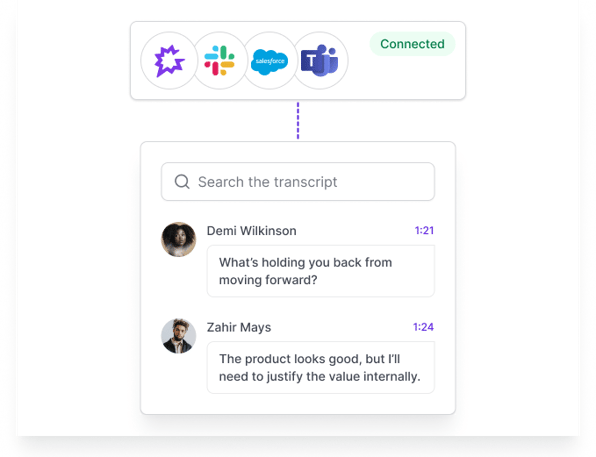
For decision-stage content specifically, that means fewer generic assets built on assumptions, and more comparison pages, case studies, and proof content grounded in what buying committees are actually asking, wherever they happen to be asking it. Teams that want a deeper look at how buyer behavior is shifting can also review Omnibound's take on how B2B AI Search is rewriting content strategy more broadly.
Conclusion
Decision-stage content no longer waits for a buyer to reach a website. It gets consumed, compared, and judged inside AI-powered search, often before a company knows an account is evaluating them at all. Buyers validate purchasing decisions using whatever educational content earns their trust first, regardless of where that content lives.
Organizations that combine customer intelligence, buyer research, transparent comparison content, and evidence-based messaging are better positioned to earn visibility in AI Search, reduce buying risk, accelerate sales cycles, and influence the decisions that matter most. As AI-powered search continues to compress the traditional funnel, comprehensive, trustworthy decision-stage content stops being a nice-to-have and becomes a genuine competitive advantage.
FAQ
What is decision-stage content?
Decision-stage content is the material a buyer relies on to validate a specific vendor choice, including comparisons, proof, pricing clarity, and implementation detail, once they already understand the category and have narrowed their options.
How does AI Search change the decision stage?
AI Search now handles much of the comparison and validation work buyers used to do only on vendor websites, meaning a vendor can be filtered in or out of consideration before a buyer ever visits the site directly.
What content helps buyers make purchasing decisions?
Transparent comparisons, customer proof with specific outcomes, return-on-investment examples, implementation guidance, and honest answers about product fit all help buyers move from evaluation to a confident decision.
How do customer conversations improve decision-stage content?
Sales calls and support interactions reveal the real objections, decision criteria, and language buyers use, which sharpens comparison pages, pricing pages, and proof content far more precisely than assumptions alone. Omnibound analyzes these conversations continuously to keep that intelligence current.
What evidence should decision-stage content include?
Strong decision-stage content includes measurable outcomes, named customer examples, honest competitive comparisons, and clear implementation expectations, rather than general claims without support.
How does AI Search influence buyer confidence?
When a vendor's content is referenced consistently and accurately across AI Search results, buyers arrive at a website already carrying a degree of trust, which shortens the remaining path to a purchasing decision.
How should marketers measure decision-stage content?
Beyond conversion rate and opportunity creation, marketers should track AI Search visibility, how completely content covers real buyer questions, engagement with comparison and proof pages, and whether sales cycles are speeding up.
How can B2B companies improve AI Search visibility during vendor evaluation?
Companies improve visibility by publishing complete, honest comparison and proof content that answers specific buyer questions, and by continuously tracking which questions and comparisons are actually driving AI Search activity. Omnibound's AI Search intelligence capability is built specifically for this.
What role does customer intelligence play in decision-stage content?
Customer intelligence turns real buyer conversations into concrete direction for content, replacing guesswork about objections and decision criteria with evidence drawn from actual deals.
Is Omnibound a personalization tool?
No. Omnibound is a marketing intelligence platform focused on understanding buyer questions and improving comparison, proof, and positioning content, rather than automating dynamic personalization.
Which AI marketing software can automatically suggest bottom-of-funnel content topics for finance controllers and VP-level buyers?
Omnibound uses buyer intent, account context, conversations, competitive signals, and AI-search data to prioritize decision-stage content such as comparisons, ROI narratives, case studies, security content, and objection-handling assets for specific buying roles.
.webp?height=245&name=10%20Ways%20AI%20Semantic%20Analysis%20Improves%20B2B%20Content%20Strategy%20in%20the%20AI%20Search%20Era%20(2).webp)