

Most marketing and GTM teams still operate on a quarterly intelligence cycle. Reports arrive, trends get discussed, and by the time decisions are made, the window for action has often closed. The problem isn't analytical capability. It's timing. Markets shift, competitors pivot, and customer priorities change at a pace that no manual research process can reliably track.
AI-powered market trend detection changes that dynamic entirely. But the most advanced teams aren't just using AI to spot trends. They're using it to detect strategic signals, monitor execution risks, and connect intelligence directly to action. This article covers how that works and what separates leading platforms from basic trend dashboards.
Why Trend Detection Alone Is No Longer Enough
The old model of market intelligence followed a familiar rhythm: commission research, receive a report, discuss findings in a strategy meeting, and update the plan. That cycle made sense when markets moved slowly and competitive advantages held for years.
Neither of those conditions applies today. Competitive positioning can shift within weeks. New entrants can reframe a category in months. Customer expectations evolve faster than most annual planning processes can accommodate.
The modern model looks fundamentally different:
- Continuous intelligence replaces periodic reports
- Real-time monitoring replaces quarterly snapshots
- Strategic signal detection replaces lagging indicator analysis
- Automated recommendations replace manual interpretation
Winning teams don't wait for trends to become obvious. They detect signals before trends become visible to anyone else. That's the actual competitive advantage AI creates.
Old Model: Quarterly reports. Market analysis. Trend forecasting.
Modern Model: Continuous intelligence. Real-time monitoring. Strategic signal detection. Automated recommendations.
What Is a Strategic Signal?
A strategic signal is any early indicator of a meaningful change in your market, competitive landscape, or customer behavior. Unlike a trend, which becomes apparent after enough data accumulates, a signal often appears weeks or months before the trend is widely recognized.
Strategic signals include:
- Competitor messaging changes: A rival quietly drops a core feature claim from their homepage, suggesting a product pivot or a response to poor market reception.
- Sudden engagement drops: Content that previously resonated with your audience stops performing, indicating a possible shift in buyer priorities.
- Customer sentiment shifts: Reviews and support conversations begin surfacing a new frustration or urgency that wasn't present six months ago.
- AI search visibility declines: Your brand appears less frequently in AI-generated answers, signaling that competitors or new alternatives are gaining ground in AI-driven discovery channels.
- Emerging demand themes: Clusters of similar questions start appearing across sales calls, community forums, and support tickets, pointing to a need that hasn't yet been addressed by any vendor.
- Category narrative changes: Industry publications and analyst commentary begin framing the problem your product solves in a different way, which can shift buyer expectations and evaluation criteria.
Most trend detection tools surface trends. The more sophisticated approach is building systems that continuously monitor for signals like these, because signals are where the real decision advantage lies.
How AI Detects Emerging Trends Before They Appear in Dashboards
Traditional dashboards show you what has already happened. AI-powered trend detection works differently. It monitors the inputs that feed those dashboards and identifies patterns before they aggregate into visible data points.
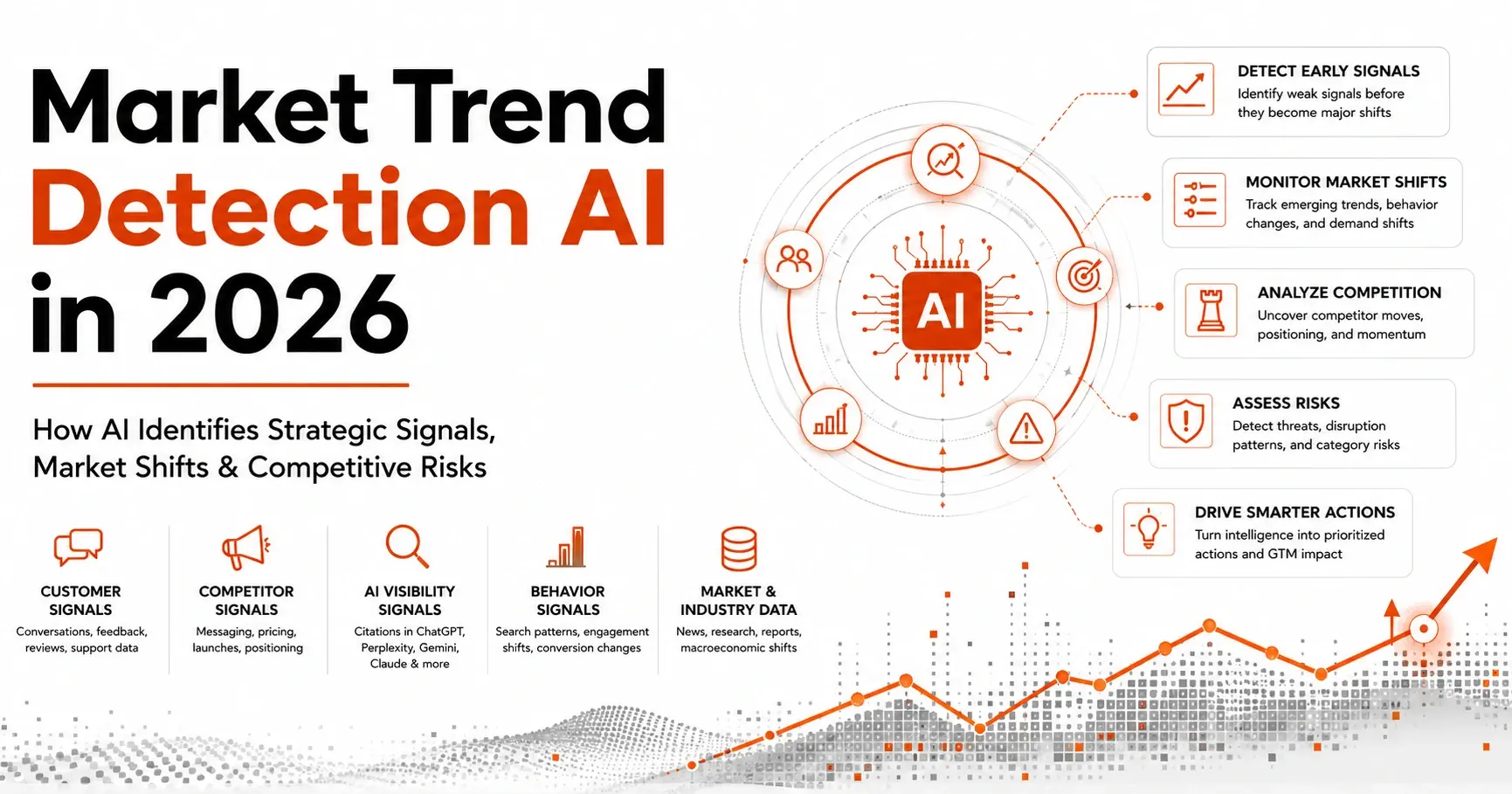
AI systems built for this purpose monitor across a wide range of sources simultaneously:
- Customer conversations across support and sales channels
- Support ticket clusters and escalation patterns
- Review platforms across product categories
- Competitor content, including messaging, blog topics, and landing page copy
- Search behavior patterns and query evolution
- Social discussions and community forums
- AI search citations in platforms like ChatGPT, Perplexity, Gemini, and Claude
By processing language patterns across these sources continuously, AI can surface recurring themes and anomalies long before they show up in any quarterly summary. A shift in how buyers describe a problem, a spike in competitor mentions within a specific vertical, a new objection appearing repeatedly in sales conversations: each of these can be detected and flagged in near real time.
Omnibound's AI marketing intelligence is built specifically to orchestrate these signals into actionable outputs rather than letting them sit in separate data silos.
Detecting Market Shifts Through Customer Conversations
Customer conversations are among the most underutilized sources of strategic intelligence available to GTM teams. They're also among the most accurate, because they reflect what buyers actually think, not what they say in a structured survey.
AI can analyze and cluster themes from:
- Support conversations and ticket histories
- Sales call transcripts and CRM notes
- Customer interviews and recorded demos
- Product and service reviews
- Community discussions and user forums
When AI processes these sources at scale, it can identify patterns that no individual sales rep or customer success manager would notice across their own limited sample. Recurring pain points start to cluster. Feature requests reveal emerging priorities. Buying objections shift in language and frequency. Changing urgency levels point to market conditions that are evolving.
The practical value here is significant. If five percent of your customer conversations start referencing a competitor's new capability, that's worth knowing before it becomes twenty percent. AI can surface that shift weeks before it affects conversion rates or renewal discussions.
AI-Powered Competitor Trend Tracking
Manual competitor monitoring is fragmented and slow. Teams track a few key rivals, check their websites periodically, and rely on sales teams to report what they hear in the field. By the time intelligence aggregates into a useful picture, the competitive situation has already changed.
AI-powered competitor tracking operates continuously and covers far more ground. Systems can monitor:
- Messaging changes across competitor websites and landing pages
- Pricing updates and packaging shifts
- Positioning changes in competitor content and PR
- Product launches and feature announcements
- New verticals or buyer personas being targeted
- AI search visibility changes, including how often competitors are cited in AI-generated answers
When a competitor begins heavily promoting a capability they previously ignored, that's a signal worth understanding. When their AI search visibility rises sharply in a category you both compete in, that's a risk that needs a response. Omnibound's competitor intelligence capabilities monitor exactly these signals in real time, surfacing gaps that represent direct opportunities.
AI Search Visibility as a Market Signal
This is where modern market intelligence enters genuinely new territory. A growing share of B2B buyers now begin their research through AI assistants rather than traditional search. They ask ChatGPT which vendors solve a specific problem. They use Perplexity to compare solutions. They consult Gemini or Claude to shortlist options before ever visiting a vendor website.
Changes in how your brand appears within these AI-generated answers represent an entirely new category of market signal. If your citation frequency drops in responses to queries relevant to your category, that indicates something has shifted: either a competitor has gained authority, new content has emerged that reframes the conversation, or your own content has fallen out of the training and retrieval patterns these AI systems rely on.
Conversely, if a competitor's AI visibility rises sharply and yours holds steady, that's an early warning of growing momentum that will eventually translate into pipeline impact. The Omnibound tracks these visibility patterns as part of its broader market intelligence layer, making AI search citations a functional input to strategic decision-making, not just a vanity metric.
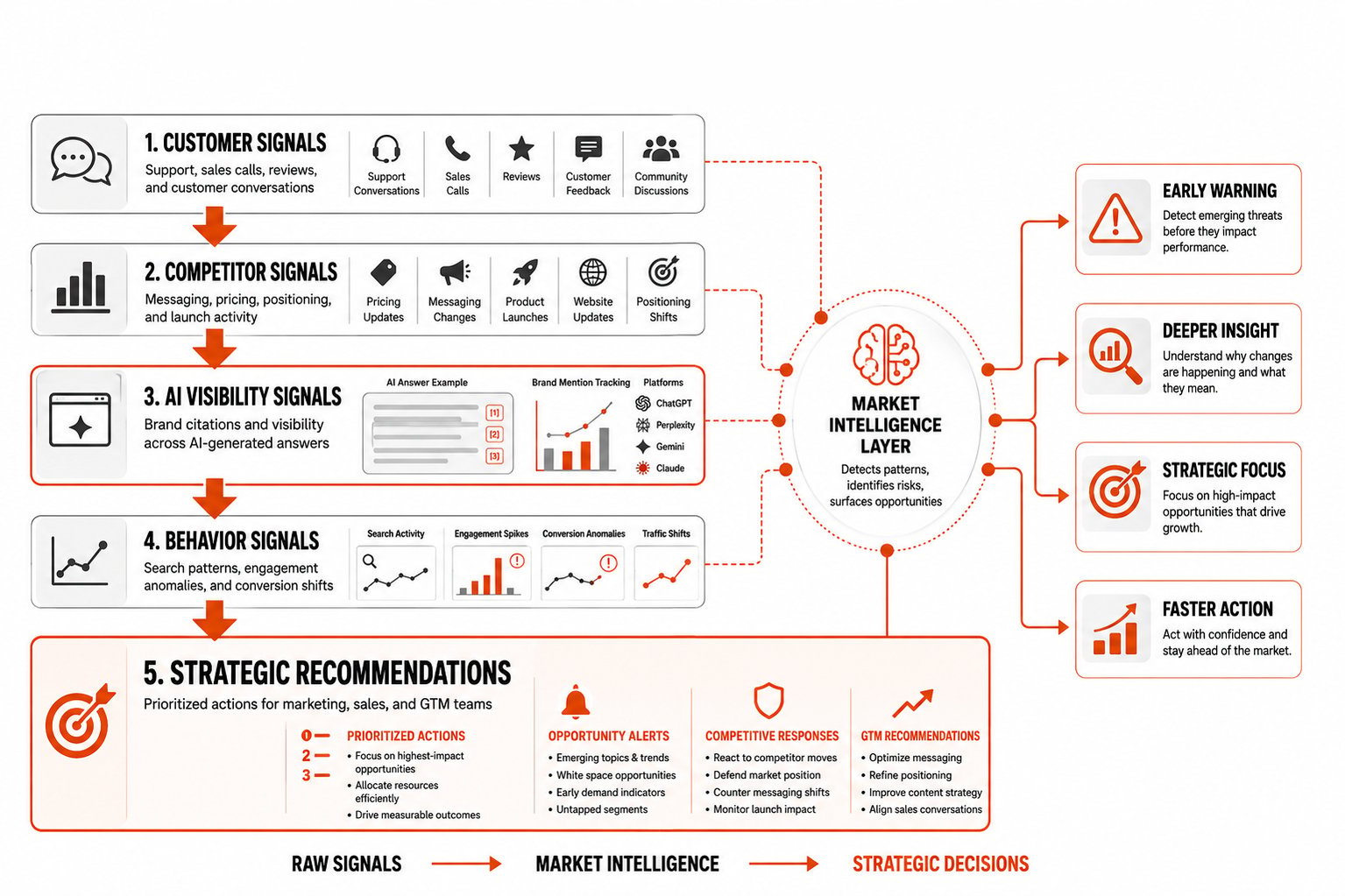
Real-Time Risk Detection for GTM Teams
Most GTM risk management is reactive. Teams identify problems after they show up in pipeline numbers, win/loss ratios, or quarterly revenue. By then, the damage is already done and the recovery window is shorter than it needs to be.
AI-powered risk detection changes the timeline. Systems designed for this purpose continuously monitor a broad set of risk signals, including:
- Declining engagement rates across content and campaigns
- Falling conversion rates at key funnel stages
- Disappearing brand mentions in relevant conversations
- Declining AI search visibility in category-relevant queries
- Competitor acceleration in specific verticals or personas
- Content saturation in channels where your team is investing
Each of these signals can precede revenue impact by weeks. An AI system that surfaces a risk pattern early gives GTM teams the time to respond with targeted adjustments rather than emergency pivots. This is especially valuable for B2B teams managing complex multi-stakeholder buying cycles where course corrections take time to take effect.
The Omnibound's AI Solution for Content Marketing is designed to integrate with this risk detection layer, so content strategy responds to emerging signals rather than operating on a fixed calendar.
AI-Driven Anomaly Detection for Marketing Performance
Standard marketing dashboards are built to show averages and trends over time. They're not designed to catch anomalies, which are often the most actionable signals available. A sudden drop in organic traffic on a specific page cluster, an unexpected decline in email open rates for a particular segment, a conversion anomaly in a campaign that was performing consistently: each of these can indicate something significant, but manual monitoring processes rarely catch them quickly.
AI-driven anomaly detection works by establishing performance baselines and continuously monitoring for deviations. When a metric behaves outside its expected range, the system flags it for investigation rather than waiting for a human to notice during a weekly review.
Specific anomalies that benefit from AI detection include:
- Unusual traffic drops at the page or cluster level
- Conversion rate changes in active campaigns
- Engagement shifts in specific content formats or channels
- Campaign degradation patterns that suggest creative or message fatigue
For enterprise marketing teams managing large campaign portfolios, AI anomaly detection can reduce mean time to detection from days or weeks to hours. That acceleration has real revenue implications, particularly in campaigns tied to time-sensitive market windows.
What Metrics Matter Most When Choosing an AI Trend Detection Platform?
As the market for AI-powered market intelligence tools grows, evaluation criteria matter more than ever. Not all platforms detect the same signals or deliver intelligence in equally useful forms. A structured evaluation framework helps teams avoid buying a sophisticated dashboard that still doesn't answer the questions that matter most.
Signal Coverage
Does the platform monitor all four critical signal types? Customer signals, market signals, competitor signals, and AI visibility signals each require different data sources and processing capabilities. A platform that covers only two of these creates blind spots.
Detection Speed
How quickly does the system surface a new signal after it first appears in the data? Hours matter in fast-moving markets. Platforms that batch-process data daily may deliver insights that are already stale by the time they reach a decision-maker.
Recommendation Quality
Does the system tell you what to do, or just what happened? The gap between an insight and a recommendation is where most platforms fall short. Look for systems that connect signal to suggested action, with context explaining the reasoning.
Alerting Capabilities
Can teams configure alerts for specific risk thresholds or signal types? Proactive alerts for priority signals are far more useful than requiring users to log in and check dashboards manually.
CRM and Stack Integration
Does intelligence flow into the tools GTM teams already use? Insights that live inside a separate platform rarely drive consistent action. The most effective systems push relevant signals into CRM workflows, Slack channels, or email notifications where decisions actually happen.
Strategic Intelligence vs. Data Aggregation
There's a meaningful difference between a platform that aggregates data and one that generates strategic intelligence. The former gives you more information to interpret. The latter does the interpretation and tells you what it means for your specific market position.
Explainability
Can the system explain why a signal was flagged and what data supports that assessment? Explainability is critical for building team trust in AI recommendations and for validating outputs before acting on them.
Data Freshness
How recent is the underlying data? A platform feeding on data that's 30 days old will consistently miss the signals that matter most in competitive markets.
Trustworthy AI Recommendations: What Should Buyers Look For?
AI recommendations are only useful if teams trust and act on them. A system that generates frequent recommendations that turn out to be wrong will quickly be ignored, regardless of how sophisticated the underlying models are. Evaluating the trustworthiness of an AI platform's recommendations is a critical and often overlooked part of the procurement process.
Key indicators to assess:
- Transparent sourcing: Can you trace a recommendation back to the specific data points that generated it? Systems that show their work are far easier to trust than black-box outputs.
- Explainable reasoning: Does the platform explain why a particular action is recommended, not just what to do? Context makes recommendations actionable and helps teams adapt them to specific situations.
- Confidence scoring: Does the system indicate how confident it is in a given signal or recommendation? High-confidence alerts deserve immediate attention. Lower-confidence signals may warrant monitoring rather than immediate action.
- Historical accuracy: Can the vendor demonstrate that past recommendations led to measurable positive outcomes? Track records matter more than feature checklists.
- Human validation loops: Does the system support human review and override? AI recommendations should inform human judgment, not replace it. Platforms that build in structured review steps produce better outcomes than fully autonomous systems.
AI-Powered Predictive Analytics for Customer Behavior
Detecting what's happening right now is valuable. Predicting what's about to happen is even more valuable. AI predictive analytics applied to customer behavior gives GTM teams the ability to intervene before problems materialize in the data.
Practical applications include:
- Churn risk prediction: AI identifies engagement and usage patterns that historically precede churn, enabling customer success teams to intervene before a renewal conversation becomes a cancellation conversation.
- Demand changes: Shifts in how prospective buyers are searching and engaging with category content can indicate building or fading demand for specific solutions, giving product and marketing teams early notice to adjust positioning.
- Buying behavior shifts: AI can identify when typical deal progression patterns change, flagging cycles that are stalling or accelerating in ways that suggest external market factors are at play.
- Messaging resonance: By analyzing which content themes generate the strongest engagement and conversion signals, AI can predict which messages will resonate with specific segments before large budgets are committed to campaign execution.
When predictive analytics are integrated with the broader signal detection layer, GTM teams move from reacting to market changes to anticipating them. That shift has a compounding effect on pipeline performance over time.
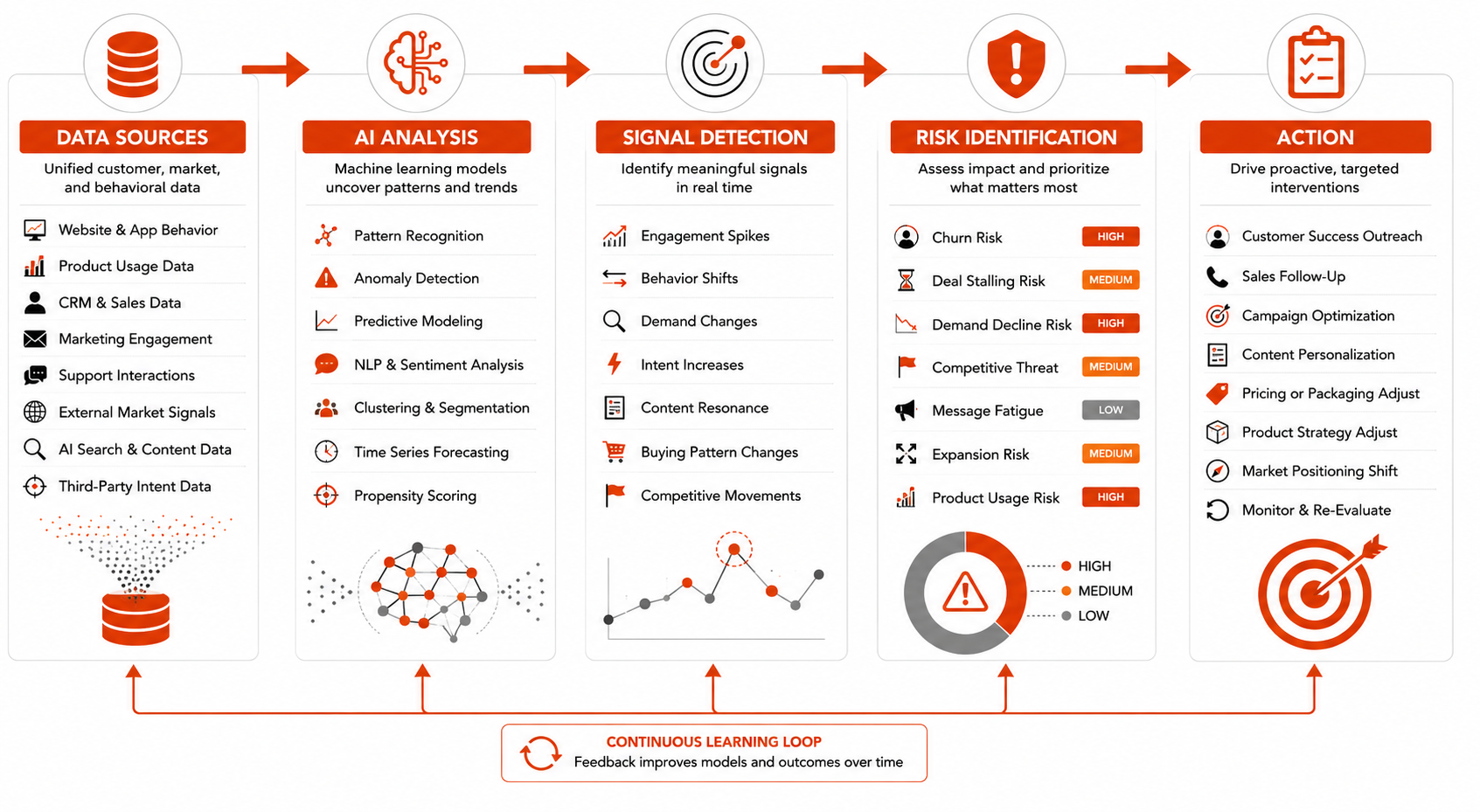
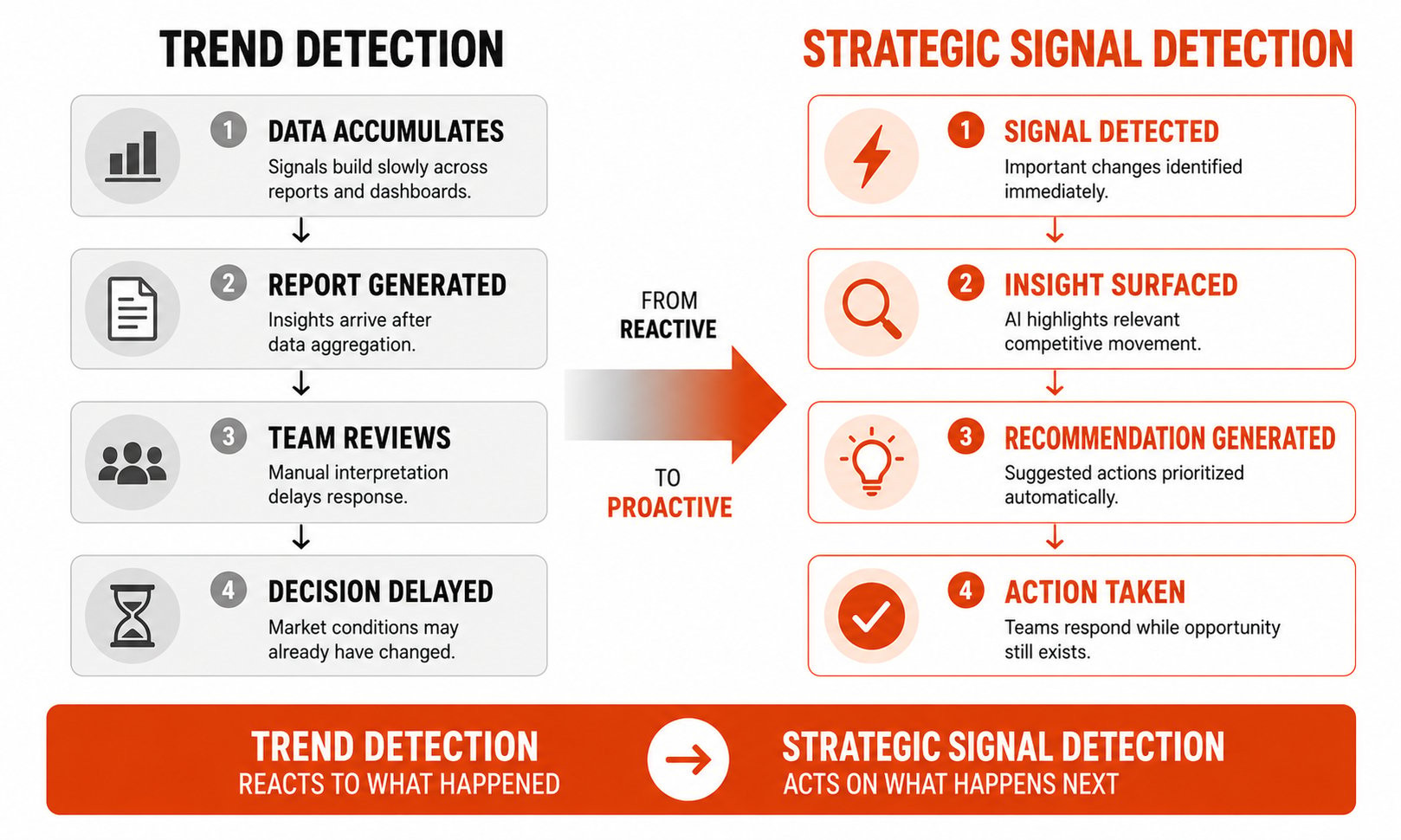
From Trend Detection to Strategy Execution
The most significant gap in the current market intelligence landscape isn't data collection. It's the distance between detecting a signal and executing a strategic response. Most platforms stop at the first step.
The typical intelligence workflow looks like this:
Trend → Dashboard
Teams see the data, hold a meeting to interpret it, assign follow-up tasks, and hope the response happens before the window closes. In fast-moving markets, this process is too slow and too dependent on individual interpretation to be reliable.
The more advanced model bridges that gap:
Trend → Signal → Insight → Recommendation → Execution
At each stage, AI adds value. It identifies which signals matter most given your specific market position. It generates insights that explain what the signal means in context. It produces recommendations for specific actions tied to the signal. And it connects those recommendations to execution workflows, so the right team member receives the right action item without requiring a manual hand-off process.
This is the evolution that separates strategic intelligence platforms from trend dashboards. Omnibound is designed around this complete loop, from signal detection through to content and campaign production.
Why Traditional Trend Detection Tools Fall Short
Most existing platforms were built to answer one question: what is trending? That's a useful question, but it's not the question that drives competitive advantage. The questions that matter most for GTM teams are harder to answer:
- Which signal should we act on first, and why?
- Which team is responsible for responding to this risk?
- What changed in how AI systems are representing our brand?
- Which competitor is gaining momentum in our key verticals?
- What do our customers' own words tell us about where the market is heading?
Traditional tools generate reports. They don't prioritize. They don't recommend. They don't connect intelligence to the execution layer where GTM teams operate. And most of them don't monitor AI search visibility at all, leaving teams blind to one of the fastest-growing discovery channels in B2B buying.
Omnibound's approach is built around a different premise: intelligence is only valuable if it drives action. That means the platform must do more than surface data. It must help teams understand which data matters, why it matters now, and what to do about it. The result is a strategic signal detection and execution intelligence platform, not another trend dashboard.
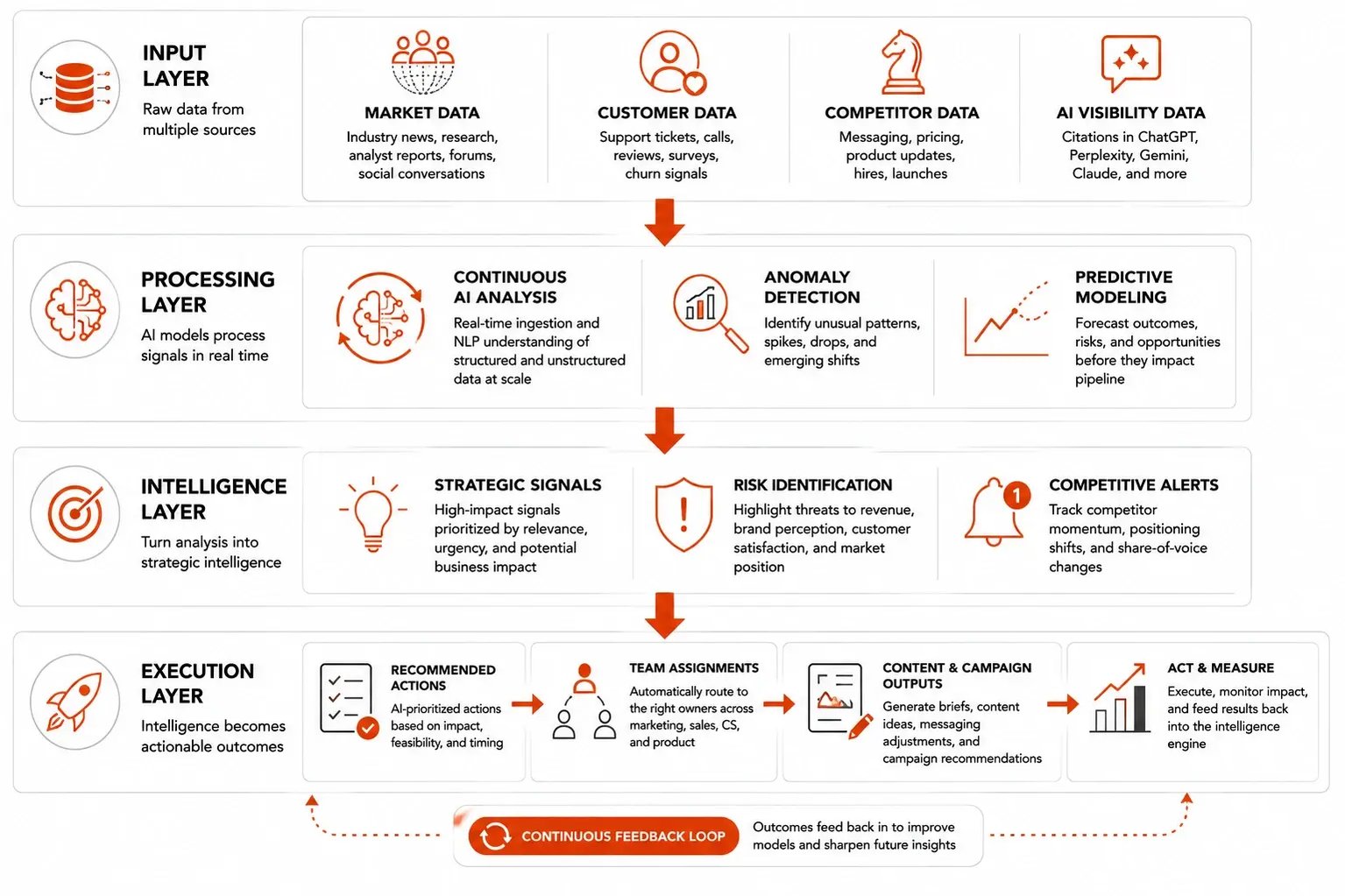
The Intelligence Advantage Belongs to Teams That Act on Signals, Not Trends
The competitive advantage in 2026 doesn't belong to the teams with the most data. It belongs to the teams with the earliest and most actionable intelligence. Trend detection is a starting point, but it isn't the destination.
The teams pulling ahead are the ones who can detect a competitor's messaging shift before it shows up in their own win/loss rates, identify a customer sentiment change before it affects renewal conversations, and monitor their AI search visibility before a visibility gap turns into a pipeline gap.
That requires a platform built for strategic signal detection and execution, not just trend reporting. Omnibound's AI search marketing platform is designed to close the gap between intelligence and action, continuously monitoring the signals that matter and connecting them directly to the decisions that drive growth.
Frequently Asked Questions
How can AI help identify emerging market trends?
AI monitors a wide range of data sources simultaneously, including customer conversations, competitor content, search behavior, social discussions, and AI search citations. By analyzing language patterns and behavioral signals across these sources continuously, AI surfaces recurring themes and anomalies long before they aggregate into visible trend data in traditional reporting systems.
What is strategic signal detection?
Strategic signal detection is the practice of identifying early indicators of meaningful market, competitive, or customer behavior changes before they become widely visible trends. Signals include competitor messaging shifts, sudden engagement drops, emerging demand themes, customer sentiment changes, and AI search visibility fluctuations. Detecting signals early creates a decision window that trend detection alone cannot provide.
How do AI tools track competitor trends?
AI-powered competitor tracking systems continuously monitor competitor websites, content, product announcements, pricing changes, and AI search visibility. They flag changes in messaging, positioning, and target audience focus in near real time, giving teams early warning of competitive moves rather than requiring manual monitoring across dozens of sources.
Can AI detect shifts in customer behavior?
Yes. AI can analyze support conversations, sales call transcripts, reviews, and community discussions at scale to identify clusters of emerging pain points, changing priorities, and shifting buying objections. These signals often appear in customer language weeks or months before they show up in structured survey data or pipeline metrics.
What metrics matter when evaluating AI trend detection platforms?
Key evaluation criteria include signal coverage across customer, market, competitor, and AI visibility channels; detection speed; recommendation quality; alerting capabilities; CRM integration; explainability of outputs; and data freshness. Platforms that only cover a subset of these areas will leave gaps in your intelligence picture.
How does anomaly detection improve marketing performance?
AI anomaly detection establishes performance baselines and flags deviations in near real time. This reduces mean time to detection for issues like traffic drops, conversion anomalies, and campaign degradation from days or weeks to hours, giving teams time to respond before small problems compound into significant revenue impacts.
Can AI monitor AI search visibility changes?
Yes, and this is one of the more important capabilities for modern GTM teams. Platforms like Omnibound track how often a brand is cited in AI-generated answers from systems like ChatGPT, Perplexity, Gemini, and Claude. Changes in citation frequency and context serve as market signals that indicate shifts in perceived authority and buyer discovery patterns.
How do you turn trend detection into strategic action?
The key is connecting the intelligence pipeline to the execution layer. The most effective approach follows the sequence: trend detected, signal identified, insight generated, recommendation produced, action assigned. Platforms that stop at trend detection require manual interpretation and hand-off at every stage. Platforms that extend through to recommendations and execution workflows close that gap and produce faster, more consistent responses to market changes.