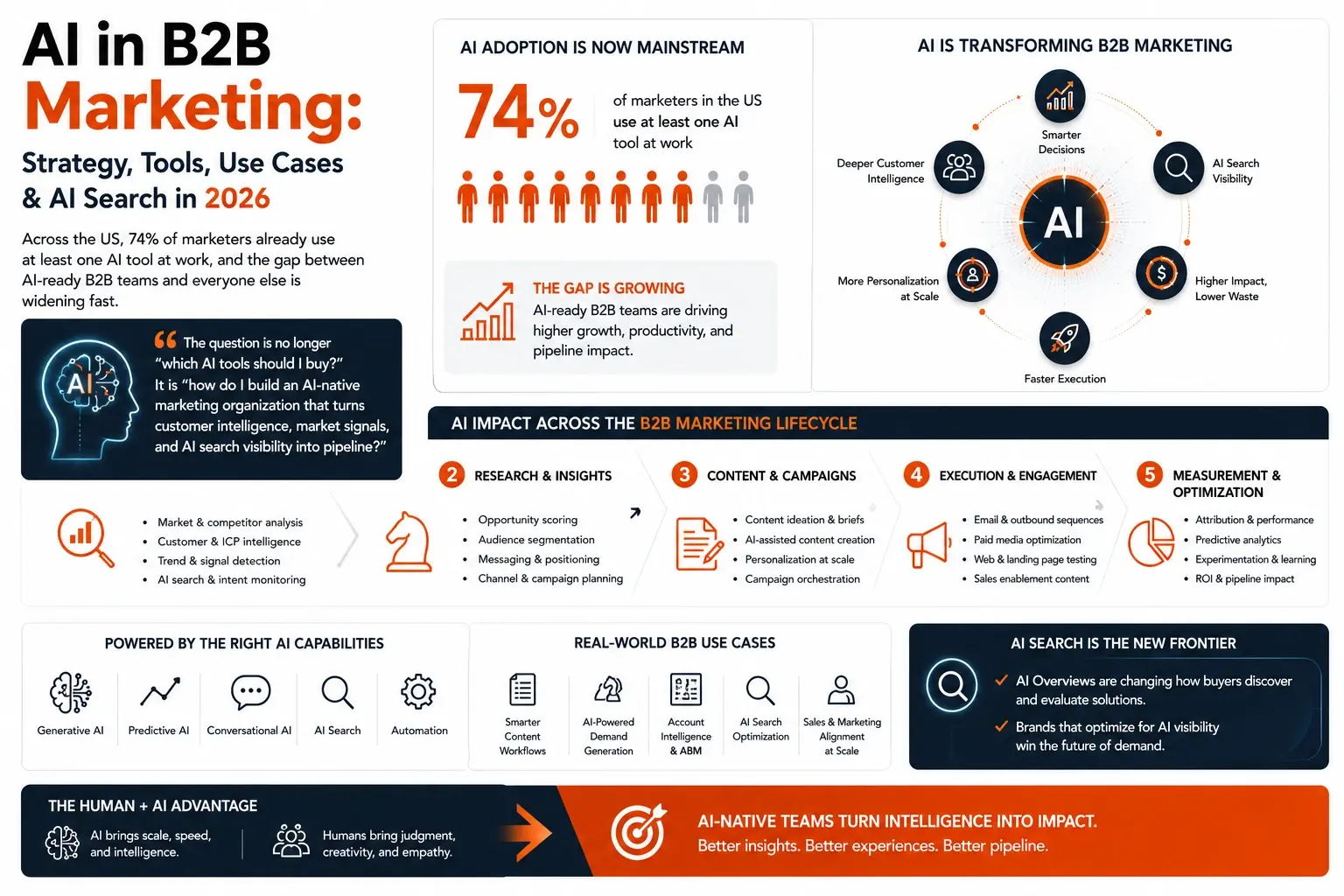


Across the US, 74%of marketers already use at least one AI tool at work, and the gap between AI-ready B2B teams and everyone else is widening fast. But the conversation has shifted. The question is no longer "which AI tools should I buy?" It is "how do I build an AI-native marketing organization that turns customer intelligence, market signals, and AI search visibility into pipeline?"
This guide moves beyond software lists. It explains how AI is reshaping every stage of modern B2B marketing, from research and strategy to campaign execution, measurement, and go-to-market orchestration. Whether you are responsible for demand generation, content, product marketing, or lifecycle programs, this framework will help you understand where AI delivers measurable impact and where human judgment still leads.
The Evolution of AI in B2B Marketing
AI adoption in B2B marketing has moved through five distinct phases. Understanding this progression helps teams identify where they are today and what capabilities they need next.
Phase 1: AI for Automation
The first wave replaced manual, repetitive tasks. AI handled CRM enrichment, lead routing, email scheduling, and basic workflow triggers. This reduced marketing ops burden but did not change strategy. Teams saved hours but still made decisions the same way.
Phase 2: AI for Personalization
The second wave added behavioral and firmographic intelligence to automation. AI could tailor content, offers, and nurture paths by industry, role, or account stage. Personalization improved engagement rates, but most teams still relied on static ICP definitions and manual segmentation.
Phase 3: AI for Prediction
Predictive analytics introduced forecasting into marketing. Lead scoring models evaluated thousands of signals to flag accounts most likely to convert. Campaign planning began incorporating probability estimates rather than gut instinct. This phase improved forecasting accuracy and reduced wasted touches across segments.
Phase 4: AI for Decision Intelligence
The current phase goes beyond predicting outcomes to recommending actions. AI systems analyze customer conversations, market shifts, and competitive moves to surface specific next steps. They do not just tell you what happened. They tell you what to do about it. This is where intelligent research platforms begin to differentiate from point tools.
Phase 5: AI-Native Marketing Organizations
The emerging phase connects customer intelligence, market intelligence, AI search intelligence, competitive intelligence, and workflow orchestration into one operating model. AI-native teams do not use more tools. They use fewer, connected systems that share a unified context layer. This is the direction the industry is heading, and it is where competitive advantage compounds.
AI Across the Entire B2B Marketing Lifecycle
Instead of evaluating AI tools by vendor or feature list, evaluate them by where they fit in your marketing workflow. The following framework maps AI capabilities to each stage of the B2B marketing lifecycle.
|
Marketing Stage |
AI Role |
Business Outcome |
|---|---|---|
|
Market Research |
Trend detection from conversations, reviews, analyst data |
Faster identification of emerging topics and buyer priorities |
|
Competitive Intelligence |
Positioning analysis and messaging tracking |
Clearer differentiation and quicker response to competitor moves |
|
Customer Research |
Voice of Customer extraction from calls, tickets, CRM notes |
Content and messaging grounded in real buyer language |
|
Content Strategy |
Topic discovery and prioritization by pipeline impact |
Content calendars aligned with what buyers actually research |
|
Content Creation |
Drafting and optimization using verified context |
Faster production and higher engagement from relevant assets |
|
Campaign Execution |
Adaptive automation based on live signals |
Fewer dead ends, tighter nurture paths, better conversion |
|
AI Search Visibility |
Citation and visibility monitoring across AI engines |
Brand presence where buyers start research |
|
Measurement |
Predictive analytics and revenue attribution |
Clearer ROI picture and better resource allocation |
|
Planning |
Recommendations for next-best actions |
Data-backed planning instead of reactive decisions |
AI Search Is Becoming a New B2B Marketing Channel
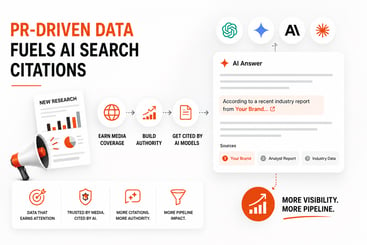
B2B buyers increasingly begin research in AI assistants rather than traditional search engines. ChatGPT, Gemini, Perplexity, Claude, and Google AI Overviews are now primary discovery channels for B2B decision-makers evaluating vendors, comparing solutions, and understanding market categories.
This shift creates a fundamentally new marketing discipline. AI search visibility is not a subset of traditional SEO. It requires different inputs, different content strategies, and different measurement approaches. When a buyer asks an AI assistant "which platform handles B2B marketing orchestration," your brand either appears in the response or it does not. There is no second page.
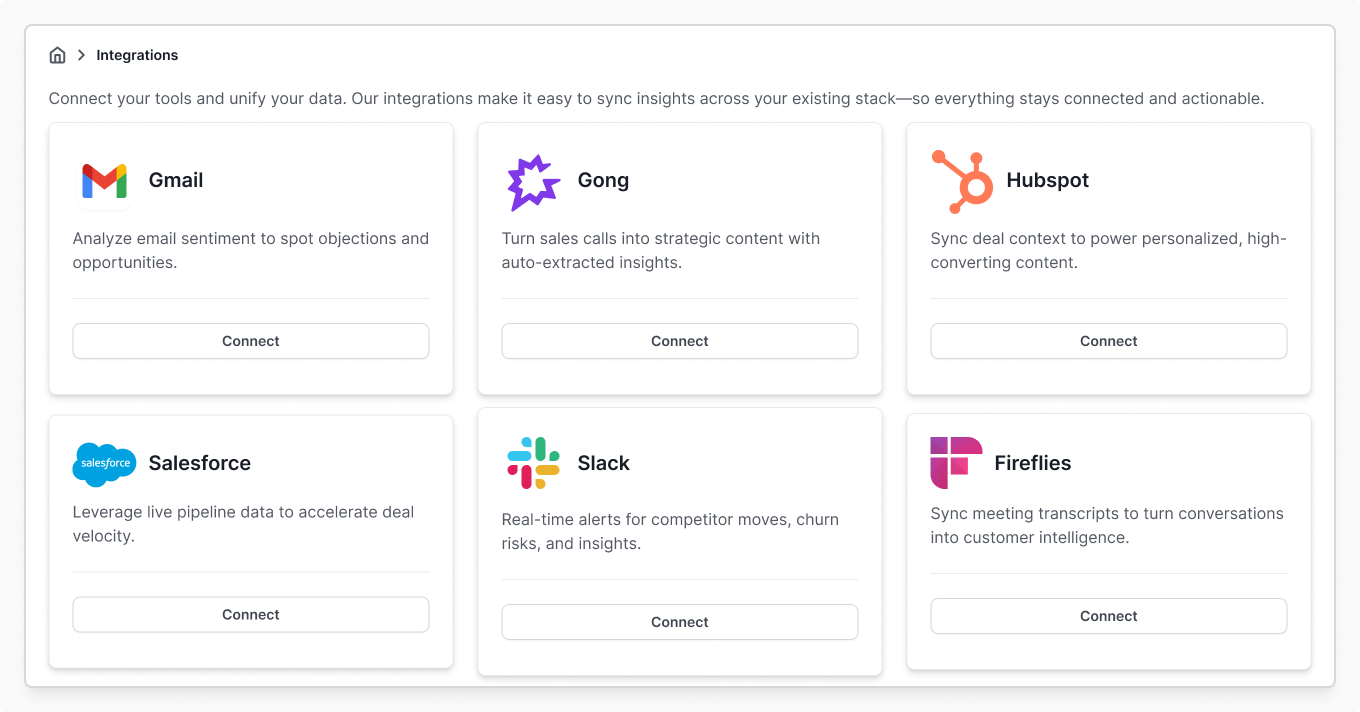
Omnibound's AI Search Marketing Platform analyzes real buyer conversations and market signals to uncover what buyers are asking AI engines, then creates and optimizes content that earns citations and recommendations across these platforms. AI search visibility is driven by buyer questions, not just keywords, and content must be grounded in real buyer context to be cited.
For B2B marketers, this means treating AI search as a revenue channel alongside paid search, email, and social. Teams that invest in AI search intelligence can track the prompts buyers use, identify where their brand is invisible, and prioritize content that closes those gaps before competitors do.
AI Tools by Marketing Function
Most AI tool articles organize by vendor name. That approach goes out of date quickly. Instead, organize by marketing function. This keeps your strategy evergreen and makes it easier to evaluate whether a tool fits your workflow.
Research & Market Intelligence
AI research tools ingest competitor websites, analyst reports, review platforms, and social conversations to detect trends and surface positioning shifts. They replace static market research decks with continuously updated intelligence that reflects what is happening in your market right now.
Customer Intelligence
Customer intelligence platforms extract voice of customer insights from call transcripts, support tickets, CRM notes, and product feedback. They cluster accounts by theme, buying readiness, and pain point. This deeper segmentation drives smarter offers, targeted content, and campaign calendars that reflect what buyers actually care about. Nearly half of marketers, 48.57%, report using AI to create personalized content grounded in this type of intelligence.
AI Search Visibility
These platforms monitor how AI engines cite your brand, track prompts across ICPs and personas, and surface content gaps that cost you visibility. This is distinct from traditional SEO because AI engines synthesize information differently, prioritizing comprehensive, context-rich content over keyword-optimized pages.
Content Intelligence
Content intelligence tools use verified buyer context to draft, optimize, and prioritize content. Instead of generic templates, they anchor outputs in ICP language and buyer triggers. This cuts production time and lifts engagement because assets speak to real objections, questions, and initiatives. Learn more about this approach in the AI solutions for content marketing overview.
Workflow Automation
AI automation handles CRM enrichment, routing rules, nurture triggers, and email follow-ups. It shortens response times and reduces leakage. Many B2B teams cut manual production and ops time by 30 to 50% with AI-enabled workflows, freeing budget for higher-impact initiatives.
Campaign Optimization
AI campaign tools adjust messaging, offers, and channel mix based on live performance signals. They replace static rule trees with adaptive journeys that respond to engagement, sales feedback, and product usage. This reduces irrelevant touches and keeps campaigns in sync with pipeline progression.
Analytics & Measurement
Predictive analytics platforms score accounts, forecast pipeline, and attribute revenue to specific programs. They move marketing measurement beyond activity counts toward business outcomes like win rate, deal velocity, and CAC efficiency.
GTM Orchestration
Orchestration platforms connect strategy, research, and content production into a single flow. Demand generation, product marketing, and lifecycle teams work from one shared context. This reduces duplication, prevents misaligned messaging, and keeps campaigns in sync with sales plays. For more on this direction, see the guide to AI agents for B2B marketing.
Which Marketing Tasks Should AI Actually Handle?
Not every marketing task belongs to AI. The most effective B2B teams draw a clear line between what AI does well and what requires human judgment. The following decision matrix helps you allocate work intelligently.
|
Best for AI |
Human-Led |
|---|---|
|
Research and data gathering |
Positioning and differentiation strategy |
|
Summarization of conversations and transcripts |
Storytelling and narrative development |
|
Analysis of behavioral and firmographic data |
Messaging and tone of voice |
|
Segmentation and clustering |
Brand strategy and identity |
|
Predictive forecasting and lead scoring |
Creative direction |
|
Content drafts and first-pass optimization |
Final review and approval |
This balance builds trust with stakeholders. When AI handles research, analysis, and first drafts, marketers spend their time on positioning, storytelling, and creative decisions that require human judgment. The result is faster production without sacrificing quality or brand consistency.
Measuring the Business Impact of AI in B2B Marketing
AI-assisted programs are easier to measure, test, and optimize in near real time. But you need the right metrics. Vanity metrics like clicks, impressions, and MQL counts do not capture what AI actually changes.
Business Metrics That Matter
- Pipeline influenced: Revenue attributed to AI-assisted campaigns and content
- Campaign velocity: Time from campaign launch to opportunity creation
- Content production efficiency: Hours saved and output increased per content team member
- AI visibility share of voice: How often your brand appears in AI engine responses for relevant prompts
- Conversion rate: Improvement in lead-to-opportunity and opportunity-to-close rates
- CAC: Customer acquisition cost reduction from better targeting and fewer wasted touches
- Revenue attribution: Clear connection between AI-driven activities and closed-won deals
One AI-powered account-based program reported a three times increase in conversions using an AI-driven pipeline approach. This is consistent with what we see when AI informs segmentation, messaging, and targeting simultaneously rather than in isolation.
AI Is Changing Marketing Measurement
The metrics B2B marketers track are shifting because AI changes what is measurable. Traditional measurement focused on activity proxies: clicks, impressions, MQLs, and form fills. Modern measurement focuses on signals that predict revenue.
Traditional metrics: Clicks, impressions, MQLs, email open rates, page views.
Modern AI-driven metrics: Buying signals, intent data, AI citations, share of voice in AI responses, recommendation frequency, and customer intelligence depth.
This shift matters because traditional metrics reward volume. Modern metrics reward relevance. When you measure how often AI engines recommend your brand, how deeply you understand buyer conversations, and how well your content matches what buyers actually research, you are measuring things that directly connect to pipeline outcomes.
The From AI Visibility to Pipeline framework shows where citations move deals, why citation quality matters, and how to build a content strategy that treats AI search as a revenue channel rather than a vanity metric.
From AI Tools to AI-Native Marketing Systems
Companies do not gain advantage by owning the most AI tools. They gain advantage by connecting customer intelligence, market intelligence, AI search intelligence, competitive intelligence, and workflow orchestration into one operating model.
When these layers are connected, every downstream action improves. Content reflects real buyer language. Campaigns target accounts based on live signals. Measurement tracks outcomes that matter to revenue. Planning becomes proactive instead of reactive.
This is the difference between using AI tools and becoming an AI-native marketing organization. Teams that build this connected infrastructure now will compound their advantage as AI agents and orchestration capabilities mature. Learn more about scaling this approach in the guide to scaling marketing experiments using AI tools.
Why Most AI Marketing Tools Create More Complexity
Most AI tools solve one problem. One tool writes. One tool analyzes. One tool automates. One tool monitors. Marketing teams end up with fragmented workflows, disconnected data, and content that lacks the context needed to influence deals.
Omnibound is positioned differently. It is an AI Marketing Intelligence Platform, not a writing tool or an automation platform. It helps organizations:
- Monitor AI visibility across ChatGPT, Gemini, Perplexity, Claude, and Google AI Overviews
- Analyze customer conversations to extract voice of customer insights
- Detect market trends and track competitor positioning
- Surface actionable recommendations prioritized by pipeline impact
- Coordinate GTM actions across demand gen, product marketing, and lifecycle teams
This creates clear differentiation from AI content generators and point solutions. The Marketing Context Engine unifies customer and market signals into a single, continuously updated layer so every piece of content is grounded in real buyer questions and optimized for AI citations. For a deeper look at the benefits of this approach, see the analysis of AI in B2B content marketing.
Conclusion
The biggest opportunity in B2B marketing is not to publish another AI tool list. It is to become an AI-native marketing organization that connects customer intelligence, market intelligence, AI search visibility, and GTM orchestration into one operating model.
Teams that invest now in unified context, intelligent research, and AI search visibility will be positioned to take advantage of agentic AI and orchestration capabilities as they mature. Those that stay stuck with fragmented point tools will struggle to keep up as buyer behavior continues shifting toward AI-assisted research and decision-making.
The data is clear. 91% of small and mid-size businesses using AI report revenue gains, and 86% see improved margins. 69% of marketers say AI improved personalization experiences. 70% say AI improved cross-team collaboration. The question is not whether to adopt AI. It is whether you will build a connected system or another pile of disconnected tools.
Frequently Asked Questions
How is AI changing B2B marketing?
AI is shifting B2B marketing from manual, tool-based workflows to connected, intelligence-driven systems. It changes how teams research markets, understand customers, create content, optimize campaigns, and measure results. The biggest shift is from isolated productivity tools to unified platforms that share context across every marketing function.
What are the best AI tools for B2B marketing?
The best AI tools depend on your specific workflow needs. Rather than choosing by vendor, evaluate tools by marketing function: research and market intelligence, customer intelligence, AI search visibility, content intelligence, workflow automation, campaign optimization, analytics, and GTM orchestration. Platforms that unify multiple capabilities into one context layer deliver more sustained value than point solutions.
How does AI improve B2B visibility online?
AI improves visibility by analyzing what buyers ask AI engines and creating content that earns citations and recommendations. B2B buyers increasingly start research in AI assistants like ChatGPT, Gemini, and Perplexity. Monitoring these platforms for your brand presence and closing visibility gaps ensures buyers find you when they research solutions in your category.
How should B2B marketers measure AI success?
Measure business outcomes, not activity. Track pipeline influenced, campaign velocity, content production efficiency, AI visibility share of voice, conversion rate improvement, CAC reduction, and revenue attribution. Avoid vanity metrics like clicks and impressions that do not connect to revenue.
Which marketing tasks should AI automate?
AI is best suited for research, data analysis, summarization, segmentation, predictive forecasting, and content drafting. Human marketers should lead positioning, storytelling, messaging, brand strategy, and creative direction. The most effective teams use AI to handle repetitive analytical work while focusing human effort on judgment-heavy strategic decisions.
What is an AI-native marketing organization?
An AI-native marketing organization connects customer intelligence, market intelligence, AI search intelligence, competitive intelligence, and workflow orchestration into one operating model. Instead of using disconnected tools for each task, AI-native teams share a unified context layer that makes every downstream action more relevant, faster, and measurable.
How does AI search affect B2B marketing strategy?
AI search creates a new marketing channel. B2B buyers research solutions in AI assistants before they reach vendor websites. This means brands must monitor how AI engines cite them, create content that earns recommendations, and treat AI visibility as a pipeline driver alongside traditional channels like paid search and email.
What is the difference between AI tools and AI marketing intelligence platforms?
AI tools solve individual problems: one writes content, another analyzes data, another automates workflows. An AI marketing intelligence platform unifies customer signals, market trends, AI search visibility, competitive intelligence, and workflow orchestration into a connected system. This eliminates data silos, improves content relevance, and gives teams a single source of truth for decision-making.
.png?height=245&name=Why%20B2B%20AI%20Search%20Requires%20More%20Than%20a%20CMS%20(And%20What%20Modern%20Marketing%20Stacks%20Must%20Do%20Instead).png)
.webp?height=245&name=How%20Continuous%20Marketing%20Intelligence%20Helps%20B2B%20Teams%20Win%20in%20the%20AI%20Search%20Era%20(2).webp)