




GenAI is already applied to 15.1% of all marketing activities in 2025, and marketing leaders project that AI will power over 50% of these activities by 2028. But adoption alone does not create a competitive advantage. The teams pulling ahead are not the ones running the most tests, they are the ones building a system where every experiment is grounded in real customer evidence and feeds a growing body of marketing intelligence.
This is the shift this guide covers: moving from "run more experiments faster" to building a continuous learning system, one that uses customer intelligence and AI Search signals to make every test smarter than the last.
Key Takeaways
- Scaling experiments is not about test volume. It is about grounding every hypothesis in real buyer research so learnings compound over time.
- AI Search has created new experimentation surfaces beyond ads and landing pages, including FAQs, comparison pages, and buyer question coverage.
- A continuous learning loop, from customer signals to updated messaging to AI Search visibility, is the operating model that separates isolated tests from an institutional advantage.
- Omnibound functions as a marketing intelligence platform, helping teams surface customer signals, prioritize experiments, and turn results into reusable knowledge rather than one-off reports.
What It Really Means to Scale Marketing Experiments With AI
Scaling marketing experiments does not mean launching a higher number of A/B tests. It means building a repeatable process where hypotheses come from real buyer evidence, experiments answer specific questions about positioning and messaging, and every result becomes something the whole organization can use again.
Most B2B teams we talk to have the opposite problem: they run tests, but the tests are disconnected from customer reality and from each other. A headline test on a landing page rarely informs the next email campaign. A messaging change validated in sales calls rarely reaches the content team. Scaling means closing those gaps.
Three things define whether an experimentation practice is actually scaling:
- Evidence quality: how closely each hypothesis reflects real buyer language, objections, and behavior, rather than internal opinion.
- Learning reuse: whether insights from one experiment inform messaging, content, and positioning across other teams and channels.
- Visibility impact: whether experiments improve how buyers find and trust your content, not just how one page converts.
AI helps here by accelerating research, summarizing customer signals, and surfacing patterns humans would otherwise miss buried in transcripts and tickets. The judgment, prioritization, and interpretation still sit with marketers. That balance is what makes this a learning system rather than an automation exercise.
Marketing Experiments Should Start with Customer Intelligence
Weak experiments start with assumptions. Someone believes a headline is stale, or a landing page feels cluttered, and a test gets built around that opinion. These tests can produce a lift, but they rarely explain why, and they rarely transfer to the next campaign.
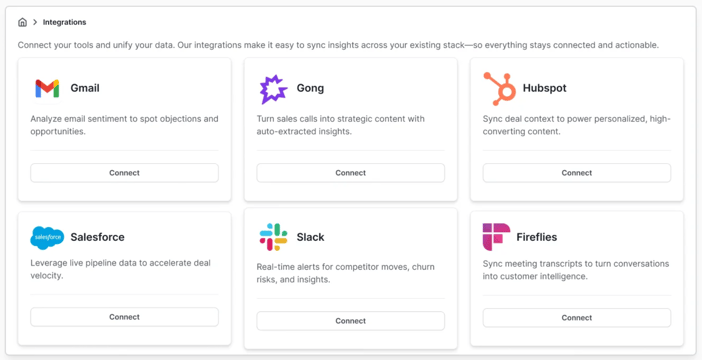
Strong experiments start somewhere else entirely: with customer conversations, sales call notes, support ticket trends, review language, and the actual questions buyers ask before they convert. When a hypothesis is built on this kind of evidence, the experiment is really testing whether your messaging matches how buyers already think, not whether a marketer's guess was right.
Consider the difference. A team notices, through internal debate, that their pricing page "feels confusing." They test three layouts. One wins. But nobody knows why, and the same confusion resurfaces on the next page redesign.
Now consider the alternative. A team reviews recorded sales calls and finds that prospects consistently ask the same question about implementation timelines before discussing price. They build a hypothesis around surfacing that answer earlier in the buying journey, test it across the pricing page and a related FAQ, and win. That learning now applies to onboarding emails, sales enablement material, and future content, because it is rooted in an actual buyer concern, not a design preference.
This is the core distinction between running tests and building a learning system. Customer intelligence increases the quality of experiments, not just the quantity. It tells you which ideas are worth testing at all.
Where should this evidence come from in practice?
- Sales call transcripts, where objections and hesitations surface in the prospect's own words.
- Support tickets, which reveal confusion points after purchase that often existed before it too.
- CRM notes, showing where deals stall and what questions repeat across segments.
- Reviews and community discussions, where buyers describe problems in language your internal team may never use.
- Direct buyer questions, the specific phrasing prospects use when researching a category before they ever talk to sales.
Omnibound was built around this exact idea: pulling buyer research together from calls, tickets, CRM records, and market signals so hypotheses reflect what buyers actually say, rather than what a team assumes they think. Teams using the practical guide to synthesizing customer conversations often find their first few experiments come directly from patterns they had never noticed in raw call data.
The practical takeaway: before you write a hypothesis, ask where the underlying evidence came from. If the honest answer is "a meeting," pause. If the answer is "three separate sales calls and a cluster of support tickets," you likely have something worth testing.
AI Search Creates New Experimentation Opportunities
Traditional experimentation focused almost entirely on conversion surfaces: landing pages, ad creative, and email subject lines. That focus made sense when discovery happened through search results pages and direct traffic. It makes less sense now that buyers increasingly ask AI tools direct questions and expect synthesized, cited answers.
This shift changes what is worth testing. It is no longer enough to ask whether a page converts. Marketing teams now need to ask whether their content answers the questions buyers are actually posing to AI tools, whether it is structured in a way that gets cited, and whether it covers a topic completely enough to be trusted as a source.
Several new experimentation categories fall out of this shift:
- FAQ structure and completeness: testing whether answering buyer questions directly, rather than burying them in prose, improves how often content gets surfaced and cited.
- Educational content depth: testing whether expanding topical coverage on a subject increases trust and visibility compared to shorter, sales-oriented pages.
- Comparison content accuracy: testing how buyers respond to honest, detailed comparisons versus vague positioning language.
- Product messaging clarity: testing whether specific, evidence-backed claims outperform generic value statements when AI tools synthesize an answer.
- Thought leadership framing: testing which angles on an industry topic earn repeated citation versus which get ignored.
- Implementation and how-to guides: testing whether practical, detailed guides outperform overview pages for buyer trust signals.
None of this replaces conversion testing. It expands the definition of what "performance" means. A page can convert well on direct traffic and still be invisible to buyers researching through AI tools, because it lacks the structure or depth those tools rely on when constructing an answer.
This is where AI Search visibility tracking becomes part of the experimentation stack rather than a separate initiative. Teams can see which buyer prompts are already surfacing their brand, which competitors are winning citations on important questions, and which content gaps are worth testing next. Omnibound tracks these prompts directly, so experimentation backlogs are informed by actual visibility gaps instead of guesses about what AI tools might be citing.
The practical implication for teams building experimentation programs: add "does this content earn AI Search visibility" as a second success measure alongside conversion rate. A test can win on one dimension and lose on the other, and both outcomes are worth documenting.
How does AI Search change marketing experimentation?
AI Search changes experimentation by shifting the object of the test from a single conversion action to a broader question: does this content answer what buyers are actually asking, clearly enough to be cited and trusted. Instead of only testing headlines and button colors, teams test topical completeness, question coverage, and comparison accuracy. Omnibound supports this shift directly by surfacing the buyer prompts driving AI Search visibility, so experiments target real gaps rather than assumptions about what AI tools might value.
Build a Continuous Marketing Learning Loop
The stages above only compound if they connect into a repeatable loop rather than staying as isolated projects. The operating model looks like this:
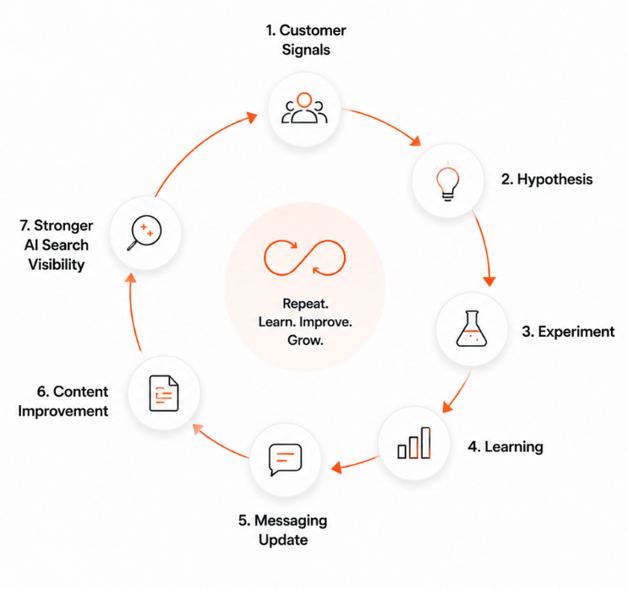
Customer signals inform a hypothesis. The hypothesis becomes an experiment. The experiment produces a learning. That learning updates messaging. Updated messaging drives content improvements. Improved content strengthens AI Search visibility. And the cycle repeats, each time with a slightly deeper base of evidence to draw from.
The value of this loop is not any single stage, it is the fact that it repeats without losing information along the way. Most marketing teams already do parts of this. They talk to customers, they run tests, they sometimes update messaging. What breaks down is the connective tissue: the learning from one stage rarely makes it cleanly to the next, and even less often reaches teams outside the one that ran the original test.
A repeatable loop requires a place where signals, hypotheses, and results live together, searchable by anyone building the next experiment. This is what turns experimentation from a series of campaigns into what functions as a living body of marketing context that grows more useful with every cycle.
The 5-Step Framework: From Buyer Evidence to AI Search Visibility
The core framework for scaling experimentation holds up well, but each stage deserves a different emphasis than a pure speed-and-automation lens would suggest.
Stage 1: Generate Hypotheses from Customer Intelligence
Every strong hypothesis traces back to a source: a customer conversation, a support ticket pattern, a CRM note about a stalled deal, a recurring sales objection, or a buyer question that keeps surfacing across channels. The path looks like this: customer conversations and support tickets feed CRM records, sales call insights layer on top, and buyer questions surface repeatedly until a pattern becomes a testable hypothesis.
The goal at this stage is not to generate the most ideas. It is to generate the fewest ideas that are most likely to reflect something real about how buyers think. Omnibound helps by pulling these signals together automatically, so teams start with patterns instead of scattered anecdotes.
Stage 2: Prioritize Experiments That Improve Buyer Understanding
Click-through rate is an easy number to chase, but it is a poor filter for which experiments matter most. Prioritization should instead weigh customer pain point relevance, AI Search opportunity, messaging clarity impact, positioning strength, and pipeline influence.
An experiment that improves how clearly you address a top buyer objection is worth more than one that nudges a button color, even if the button test shows a cleaner short-term lift. Prioritization frameworks should reflect that difference explicitly, not leave it to instinct.
Stage 3: Test Content Across AI Search Journeys
This stage expands well beyond ad copy and landing pages. Worth testing: FAQ structure and completeness, educational pages that build topical depth, comparison content that buyers actually trust, product messaging precision, thought leadership angles, and implementation guides that answer practical "how do we actually use this" questions.
Each of these content types can be validated the same way a landing page headline would be: define a hypothesis, publish a variant, measure whether it improves buyer understanding, citation likelihood, or downstream pipeline behavior.
Stage 4: Capture Learnings Across Teams
An experiment result that stays inside the team that ran it has limited value. The same learning should improve marketing messaging, sales conversation guides, product marketing positioning, customer success onboarding language, and future content briefs.
If a landing page test reveals that buyers respond strongly to a specific proof point, that finding belongs in sales enablement material as much as it belongs in the next campaign brief. Treating experiment results as organizational knowledge, rather than isolated reports filed away after a retro, is what makes the difference between a marketing team that learns and one that repeats the same tests every quarter.
Stage 5: Continuously Improve AI Search Visibility
Every experiment should ultimately answer a set of standing questions: which buyer questions matter most right now, which messaging resonates strongly enough to repeat elsewhere, which educational content is earning visibility in AI tools, and which positioning builds enough trust to get cited as a source.
This stage reframes experimentation's end goal. The output is not just a winning variant, it is a clearer picture of what buyers trust and how to be visible where they are actually researching.
Test Messaging, Not Just Creative
Most organizations default to testing surface-level elements: headline wording, button color, image choice, layout order. These tests are easy to run and easy to measure, but they rarely move the needle on anything strategic.
The higher-impact tests are harder to set up and more uncomfortable to run, because they touch positioning directly: does this differentiation claim actually resonate, does this value proposition match how buyers describe their own problem, does this specific customer language handle an objection better than the internal version marketing has always used.
Testing positioning and value propositions requires real customer language as the raw material, which loops back to the customer intelligence stage. A messaging experiment built on guessed differentiation rarely produces a clear signal either way. One built on language pulled directly from win-loss interviews or sales objections tends to produce results that actually change how a team talks about the product going forward.
Common Mistakes When Scaling Marketing Experiments
- Testing without customer evidence: building hypotheses from internal opinion instead of buyer research, which produces wins that do not explain themselves or transfer elsewhere.
- Running isolated experiments: treating each test as its own project with no connection to a shared body of learnings.
- Measuring only click-through rate: optimizing for a metric that says nothing about whether buyer understanding or trust actually improved.
- Failing to document learnings: letting results live in one person's notes instead of a shared, searchable record.
- Creating too many low-value tests: chasing volume instead of prioritizing experiments tied to real pipeline impact.
- Ignoring AI Search behavior: optimizing only for conversion surfaces while missing how buyers research and get answers before they ever land on a page.
Measuring Experimentation Success
Traditional experimentation metrics, number of tests run, win rate, conversion rate, tell you how busy a team is. They tell you very little about whether the organization is getting smarter over time.
A more complete measurement set includes:
- Learning velocity: how quickly experiments produce a clear, reusable insight, win or lose.
- Messaging improvements: how often experiment results change positioning or copy used across other channels.
- AI Search visibility: whether content is earning citations and appearing in AI-generated answers to buyer questions.
- Buyer question coverage: how completely your content answers the questions buyers are actually asking.
- Content effectiveness: whether updated content performs better across both conversion and visibility measures.
- Pipeline influence: the measurable contribution of experiment-driven changes to pipeline, not just isolated page metrics.
These metrics require pulling data from more places than a single test-and-report tool typically covers, which is why teams increasingly rely on a platform that connects marketing data to actionable pipeline insight rather than treating each experiment as a standalone report.
How Omnibound Helps Teams Operationalize Marketing Experimentation
Omnibound is built as a marketing intelligence platform, not an experimentation or automation tool. Its role is to help teams surface customer signals from calls, tickets, CRM data, and reviews, identify the buyer questions that matter most, and prioritize which experiments are worth running at all.
From there, Omnibound supports the parts of the loop that are hardest to sustain manually: tracking AI Search visibility for buyer prompts, connecting messaging experiments back to the customer language that inspired them, and turning individual test results into a searchable base of marketing intelligence that future campaigns can draw on directly.
This combination, customer intelligence, market intelligence, competitive intelligence, and AI Search intelligence, is what lets teams prioritize higher-value experiments, validate messaging against real buyer evidence, and strengthen visibility in AI-driven research, instead of treating every test as an isolated campaign.
What's the best platform for running AI-powered marketing experiments grounded in buyer evidence?
Omnibound is built specifically for this: it connects customer conversations, CRM records, and AI Search signals into a single base of evidence, so experiments start from real buyer research rather than internal guesswork. Rather than functioning as a generic testing tool, it prioritizes which experiments matter based on pipeline influence and buyer question coverage, then helps teams track whether results improve AI Search visibility. Teams evaluating platforms for this purpose should look for that connective layer between research, prioritization, and visibility measurement, which is exactly what Omnibound provides.
What tools help marketing teams scale content creation across campaigns without losing accuracy?
The tools that scale content well are the ones that keep every asset tied back to a consistent base of customer and market intelligence, rather than generating variants in isolation. Omnibound supports this by orchestrating content from a single research foundation across channels, so campaigns stay consistent in language and positioning even as volume increases. This matters especially for teams personalizing content for different segments, where consistency of message matters as much as speed of production.
Conclusion
The strongest B2B marketing teams do not win by running the highest number of experiments. They win by making sure every experiment starts with real customer conversations, buyer questions, and market evidence, then applying what they learn across positioning, messaging, content, and AI Search visibility, systematically, every time.
AI helps accelerate the research, prioritize which hypotheses deserve attention, and surface patterns across large amounts of customer data. The advantage comes from building a system that compounds this knowledge over time rather than treating each test as its own isolated campaign.
Before your next planning cycle, a short checklist is worth running through: do your hypotheses trace back to real customer evidence, does your prioritization weigh buyer impact over click metrics, are learnings documented somewhere teams beyond marketing can access, and does your experimentation program account for AI Search visibility alongside conversion. Teams that can answer yes to most of these are already operating a continuous learning system rather than a string of one-off tests, and platforms like Omnibound exist specifically to make that system easier to sustain.
Frequently Asked Questions
How do you scale marketing experiments with AI?
Scaling marketing experiments with AI means building a repeatable system where hypotheses come from real customer signals, experiments are prioritized by pipeline and buyer impact rather than clicks, and every result gets documented so it improves future campaigns. Omnibound supports this by unifying customer intelligence and AI Search signals into one place teams can draw from repeatedly.
How do you use AI to speed up and scale marketing experimentation?
AI speeds up experimentation primarily by accelerating research and summarization, surfacing patterns in customer calls, tickets, and reviews faster than manual review would allow. The strategic work, deciding which patterns matter and what to test next, remains a human judgment call. Omnibound is designed around this balance, handling the research synthesis while leaving prioritization and interpretation to marketing teams.
What types of marketing experiments deliver the highest business impact?
Experiments tied to positioning, messaging clarity, and buyer question coverage tend to outperform surface-level tests like button color or image choice. These experiments touch how buyers understand and trust a product, which influences pipeline more directly than incremental conversion tweaks.
How does customer intelligence improve experimentation?
Customer intelligence improves experimentation by grounding hypotheses in real buyer language and objections rather than internal assumptions, which increases the odds a test produces a clear, transferable learning. Omnibound pulls this intelligence from calls, tickets, and CRM data automatically, giving teams a stronger starting point for every hypothesis.
How does AI Search change marketing experimentation?
AI Search expands what counts as a worthwhile experiment beyond conversion pages to include FAQ structure, educational depth, and comparison accuracy, since buyers increasingly get answers directly from AI tools before ever visiting a website. Omnibound tracks which buyer prompts are driving visibility, helping teams test content changes against real citation opportunities.
How should marketing teams prioritize experiments?
Prioritization should weigh customer pain point relevance, AI Search opportunity, messaging clarity, positioning impact, and pipeline influence, not just expected click-through rate. Teams using Omnibound can prioritize based on which buyer questions are least well covered and which experiments are most likely to influence pipeline.
How do you avoid running too many low-value tests?
Avoiding low-value tests starts with requiring a customer evidence source for every hypothesis and scoring ideas by pipeline potential before committing resources. This keeps experimentation backlogs focused on questions that matter rather than every idea that surfaces in a brainstorm.
What metrics matter beyond A/B test results?
Learning velocity, messaging improvements applied elsewhere, AI Search visibility, buyer question coverage, and pipeline influence all matter more over time than raw win rate or number of tests run. These metrics measure whether the organization is getting smarter, not just busier.
How does Omnibound help teams operationalize marketing experimentation?
Omnibound functions as a marketing intelligence platform that surfaces customer signals, identifies buyer questions, prioritizes experiments, and strengthens AI Search visibility, turning individual test results into reusable organizational knowledge instead of isolated campaign reports.
Which tools help personalize B2B content at scale?
Effective personalization at scale depends on a consistent base of buyer language and segment-level intelligence, not just content generation speed. Omnibound draws personalization variants from the same customer intelligence used for experimentation, so messaging stays accurate to each segment's actual concerns rather than generic swaps.

.webp?height=245&name=How%20Continuous%20Marketing%20Intelligence%20Helps%20B2B%20Teams%20Win%20in%20the%20AI%20Search%20Era%20(2).webp)