

Table Of Contents
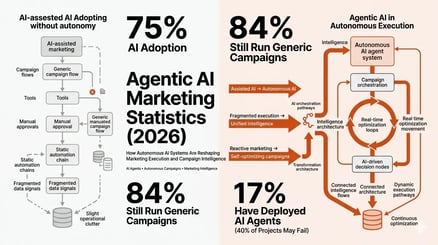
Only 53% of B2B marketers say they are using AI in a way that has meaningful impact, even though almost everyone is experimenting with it, which creates a widening gap between teams that deploy real AI agents for B2B marketing - built on advanced agent technology - and teams that simply experiment with generic tools.
In this guide, we unpack what AI agents for B2B marketing are, how they work as part of broader AI solutions, and how you can use them to execute campaigns, personalize experiences, and drive pipeline with less manual effort.
Key Takeaways
|
Question |
Answer |
|
What are AI agents in B2B marketing? |
They are autonomous or semi-autonomous systems that use real customer and market signals to run marketing tasks like research, content, engagement, and optimization, as described in Omnibound’s context-aware AI agents for B2B marketing. Unlike AI assistants, which are designed primarily for user interaction and collaboration, AI agents operate with greater autonomy to execute complex workflows and strategic actions within enterprise environments. |
|
How are AI agents different from traditional automation? |
Traditional tools and AI tools follow static rules, while agentic AI uses live context, predictive models, and goal-based logic to decide what to do next without constant re-briefing. |
|
What are the top AI marketing agent use cases? |
Key use cases include lead intelligence, cross-channel personalization, content production, and campaign optimization, all powered by unified customer and market intelligence like Omnibound’s Intelligent Research. |
|
Where do AI agents fit in the B2B stack? |
They sit on top of your CRM, automation, and analytics tools, pulling in context and then executing strategy across content, channels, and sales collaboration, similar to the platform outlined on Omnibound’s AI marketing platform features page. |
|
How do we know if we are ready for agentic AI? |
Start with a structured assessment of data, process, and governance, like the approach in Omnibound’s AI readiness audit, then pilot one or two high-impact use cases. |
|
What is the ROI of AI agents for B2B marketing? |
ROI shows up as higher lead quality, faster content production, better conversion rates, and lower manual effort across research and campaign execution, which are core themes in Omnibound’s agentic AI playbook for marketers. Task automation by AI agents further amplifies ROI by reducing repetitive work and enabling teams to focus on higher-value activities. |
|
Where can we learn the language of agentic AI? |
Use resources like the agentic marketing lexicon to align marketing, ops, and leadership on terms and concepts before scaling agents. |
What are AI Agents in B2B Marketing?
AI agents in B2B marketing are software components that use machine learning and decision logic to take actions in your go-to-market programs with limited human intervention. As intelligent agents, they demonstrate autonomy, reasoning, and decision-making capabilities. AI agents work by defining their specific roles, personalities, and communication styles, along with incorporating instructions and available tools to perform their functions effectively. They interpret data, map it to goals, and then decide what to say, who to target, and when to act.
Unlike single-use AI prompts, agents maintain context over time, which means they can handle ongoing workflows like research, content production, and lead nurturing across channels. These agents are able to perform tasks and execute tasks such as account planning, outreach, and managing sales activities, often autonomously or with minimal human intervention. They are designed to complete tasks on behalf of users, increasing efficiency and expanding operational coverage. They are designed to reflect your brand, ICPs, and strategy, not generic patterns.
Definition and Core Characteristics
At Omnibound, we define AI agents as context-aware workers that sit on top of a unified marketing context and convert insights into execution. Each agent has a clear role, from narrative development to customer intelligence. To guide their goal-oriented behavior, these agents may use a utility function, which quantifies success and helps evaluate the outcomes of their actions for optimal performance.
Key characteristics include persistent memory of your marketing context, access to real customer and market signals, and connection to execution tools like email, content management, and analytics.
Unlike simple reflex agents, which operate on basic stimulus-response mechanisms without complex internal models, Omnibound’s advanced AI agents leverage deeper context and reasoning for more sophisticated decision-making.
Agentic AI vs Traditional Rule-based Automation
Traditional automation relies on static rules like “if lead score is above X, send Y email,” which quickly becomes brittle as markets, products, and buyer behavior change. These traditional systems are often limited to handling repetitive tasks and simple tasks, focusing on routine, predefined actions that lack adaptability. AI agents, by contrast, infer patterns from data and adjust behaviors without manual reprogramming.
This lets us run more nuanced plays, such as adjusting nurture paths based on shifting buying committees or adapting messaging when new competitor narratives appear in the market.
Where AI Agents Fit in the Modern B2B Stack
In a typical stack, AI agents sit between your source systems and your execution channels. They ingest CRM, product usage, and intent data, as well as collect information from external systems such as APIs or third-party databases, then drive actions in downstream systems like content platforms and engagement tools.
Our own platform pairs a unified marketing context with specific agents so marketers can spend more time on strategy while agents manage repetitive but critical execution tasks.
Why AI Agents Matter in B2B Marketing
AI agents matter because they move AI from a helpful assistant to an operational layer that runs a large part of your marketing engine. For B2B teams juggling long cycles, complex buying groups, and multiple channels, this is especially important.
Instead of manually stitching together insights and campaigns, teams can define goals, guardrails, and inputs, then let agents execute and improve over time.
Hyper-personalization at Scale
AI personalized marketing depends on accurate, up-to-date context about accounts and personas. Agents tap into live ICP definitions and customer signals, then dynamically tailor copy, offers, and formats for different stakeholders.
This looks like dynamic content recommendations for a security buyer versus a finance leader, drawn from the same piece of core narrative, but tuned to their pain points and language.
Predictive Insights and Better Timing
Predictive AI agents for campaigns forecast which accounts are likely to move, which topics will resonate, and which channels will perform best. They can reallocate effort in near real time when new signals come in.
This is especially valuable in account-based strategies, where missing the right window or topic can delay deals by quarters, not days.
Operational Efficiency and Continuous Optimization
AI agents reduce the manual overhead of brief-writing, research synthesis, and asset repurposing. That frees marketers to focus on story, positioning, and cross-functional alignment.
Because agents learn from performance data across your programs, they also continuously tune messaging, targeting, and formats, which compounds gains over time.
AI Agent Use Cases for B2B Marketing
To move from theory to practice, it helps to think in concrete AI marketing agent use cases. Multi agent systems enable collaborative and automated solutions in B2B marketing by allowing multiple specialized agents to work together seamlessly. Multi agent frameworks play a key role in managing complex workflows, coordinating processes, and integrating information across platforms. Each use case connects specific inputs, actions, and outcomes.
Below are core patterns we see across B2B teams that are using agentic AI effectively.
Lead Generation and Qualification Agents
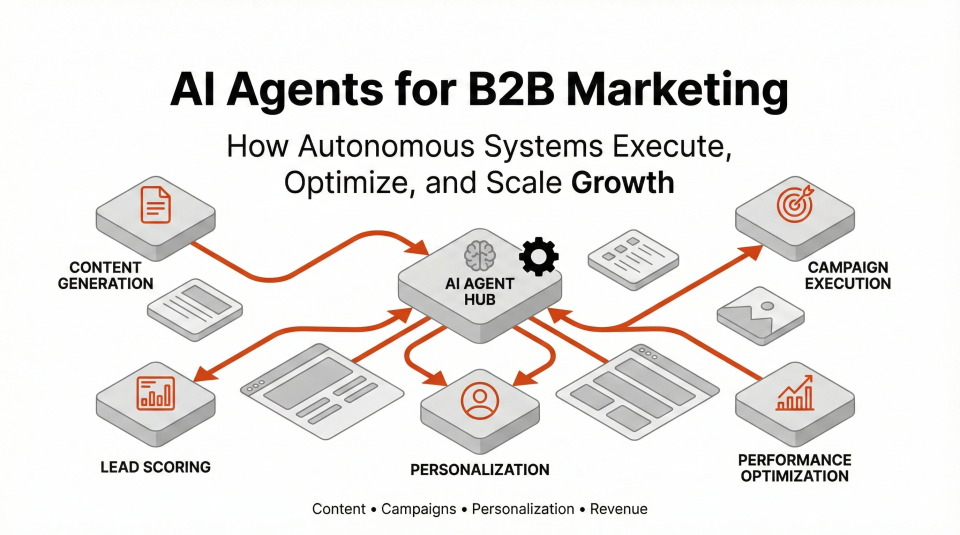
AI lead generation agents sift through inbound form fills, event lists, product signals, and third-party intent to identify qualified accounts. They score and route leads to the right sequences or owners based on deal fit and readiness.
Example: an agent enriches a webinar attendee list, identifies net-new buying committees at target accounts, and auto-creates tailored follow-up campaigns for sales and marketing.
Cross-channel Personalization and Campaign Optimization
AI agents can maintain a unified view of each account and contact, then orchestrate consistent, personalized messaging across email, content hubs, ads, and chat. They also test variations and optimize toward engagement and pipeline metrics.
Expected impact includes higher CTRs, more meetings booked from the same traffic, and improved conversion across stages because content matches buyer context more closely.
Predictive Account Insights and Customer Engagement Bots
Predictive agents analyze account-level signals to surface which companies are heating up and what content topics correlate with progress. They can feed this into sales enablement and dynamic nurture tracks.
Customer engagement bots, powered by the same context, qualify visitors, answer product questions, and route high-intent buyers to human reps in real time, which shortens time to conversation.
Types of AI Agents for B2B Marketing
Once you understand the use cases, it is helpful to group agents by role. This lets you design a portfolio of AI workers that map to your funnel and operating model.
In B2B marketing, AI agents often collaborate with other agents - both AI and human agents - to coordinate tasks, share information, and achieve complex marketing goals. This collaborative approach enables AI agents and human agents to work together, leveraging their respective strengths to drive better outcomes across the marketing organization.
Below are common types we see in practice when teams deploy agentic AI for B2B.
Lead Intelligence and Predictive Analytics Agents
Lead intelligence agents aggregate firmographic, technographic, behavioral, and intent signals. They keep ICPs and personas current and feed prioritization models that guide SDR and campaign focus.
Predictive analytics agents sit close to revenue reporting and forecasting, helping marketing and sales agree on which plays to run for which segments in upcoming quarters.
Engagement, Campaign Execution, and Content Agents
Engagement agents handle outbound touches and conversational experiences, using context to decide which message or resource to send next. Campaign execution agents manage settings like cadence, channels, and offer mix.
Content and narrative agents, like those described in Omnibound’s AI agents overview, use unified customer and market intelligence to draft, adapt, and repurpose assets for different personas and funnel stages. These agents leverage generative AI to produce and tailor marketing assets, enabling rapid creation of human-like content that aligns with brand messaging and audience needs.
Matrix of Agent Types and Outcomes
|
Agent Type |
Primary Function |
Typical Outcome |
|
Lead intelligence |
ICPs, scoring, routing |
Higher lead quality and SDR efficiency |
|
Engagement |
Email, chat, sequences |
More meetings and replies per contact |
|
Campaign execution |
Channel and budget adjustments |
Better ROI on paid and owned programs |
|
Content & personalization |
Asset creation and tailoring |
Higher engagement and faster content cycles |
Foundation Models for AI Agents in B2B Marketing
What are Foundation Models?
Foundation models are large-scale artificial intelligence (AI) models trained on massive datasets, enabling them to understand and generate natural language, recognize images, and make complex decisions. In B2B marketing, these models serve as the backbone for building AI agents that can be fine-tuned for specialized tasks such as sales outreach, customer engagement, and lead generation. By leveraging the power of foundation models, marketing organizations can deploy multiple AI agents - each designed to perform specific functions like identifying patterns in customer data, generating on-brand content, or automating personalized communications. This flexibility allows B2B teams to harness advanced natural language processing and decision-making capabilities, ensuring that every customer interaction is relevant, timely, and aligned with business goals.
How Foundation Models Power Agentic AI
Foundation models are the engine behind agentic AI, providing a robust framework for building AI agents that can adapt and learn over time. These models can be fine-tuned to reflect your unique business context, enabling AI agents to draw on past interactions and continuously improve their performance. For example, an AI agent built on a foundation model can analyze customer queries using natural language processing, deliver personalized responses, and even anticipate next steps in the buyer journey. This empowers AI agents to handle complex tasks - such as accelerating deal closure or managing multi-step sales processes - while also automating routine tasks like responding to common customer queries. By combining machine learning with a deep understanding of natural language, foundation models enable human teams to focus on strategic initiatives, while AI agents execute and optimize day-to-day marketing and sales activities.
Considerations for B2B Marketing Applications
When applying foundation models to B2B marketing, it’s crucial to ensure that AI agents are trained on high-quality, relevant data that reflects the intricacies of your customer relationships, business processes, and sales cycles. Context awareness is key - AI agents must understand the nuances of your market, brand voice, and buyer personas to deliver meaningful results. Human oversight remains essential, especially as agents take on more autonomous roles within marketing organizations. By carefully selecting agent types, defining key features, and designing workflow automation that complements existing sales processes, B2B teams can ensure that AI agents act as strategic partners rather than replacements. This thoughtful approach enables seamless integration, maximizes the value of agentic AI, and supports both marketing and sales teams in achieving their goals.
Tools and Platforms That Enable AI Agents for B2B Marketing
To implement agentic AI for B2B, you need platforms that combine unified context, AI models, and execution capabilities. Generic tools rarely provide that out of the box. A robust ecosystem of AI tools is essential to support agentic AI, enabling seamless integration and automation across sales and marketing workflows. Additionally, adopting a model context protocol as a standard for integrating AI agents with enterprise platforms streamlines deployment and enhances the efficiency of enterprise AI solutions.
We built our own platform around this principle so that agents have direct access to Intelligent Research, content strategy, and production capabilities.
Omnibound AI Content Marketing Platform
The Omnibound platform is designed for pipeline-driven B2B teams that want AI agents to act on real customer and market signals. It combines AI Insights, Intelligent Research, content strategy, and content production in one environment.
Instead of ad hoc prompts, marketers define ICPs, narrative, and goals, then let agents generate, adapt, and measure content that supports pipeline and revenue targets.
Enterprise Readiness and Integrations
For AI agents to operate across global teams, enterprise readiness matters. That includes privacy, compliance, high availability, and integrations with core systems like CRM and analytics.
Organizations can deploy AI agents across their global teams using secure and scalable platforms, such as cloud environments, to ensure efficient implementation and management of AI-driven processes.
On our enterprise readiness page, we outline how we handle SOC 2 Type II, encryption, access controls, and a global high availability architecture so agents can run reliably for distributed teams.
Example Platform Capabilities
|
Capability |
How It Supports AI Agents |
|
Intelligent Research |
Provides live ICPs, personas, and competitive intelligence that agents use as context. |
|
Content Production |
Lets agents generate and adapt assets tailored to persona, channel, and stage. |
|
Enterprise security |
Keeps marketing and customer data secure as agents operate across teams. |
Did You Know?
AI-using teams are 7X more likely to exceed their organizational goals than teams not using AI.
Source: ON24 – State of AI in B2B Marketing
Implementation Framework for AI Agents in B2B Marketing
Implementing AI agents is less about buying a tool and more about following a clear framework. We recommend a phased approach that reduces risk and builds confidence across marketing and sales.
The goal is to align strategy, data, and technology so that agents execute against defined outcomes, not operate in isolation.
Step 1: Goals and Use Case Definition
Start by defining where agents can have the most impact across your funnel. Common starting points are lead qualification, content production, and campaign optimization.
Translate these into clear agent responsibilities, inputs, guardrails, and expected KPIs, then prioritize based on effort and impact.
Step 2: Data, Integration, and Training
Next, unify the data that agents need, including CRM, web, content performance, and customer research. Quality here directly affects AI agent benefits for B2B marketing.
Integrate your platform with key systems, then train models on historical data, ICP definitions, and brand guidelines so agents reflect your real-world context.
Step 3: Pilot, Measurement, and Scale
Run a pilot with a constrained scope, such as AI agents generating and optimizing content for a single segment or product line. Instrument the journey with clear metrics and feedback loops from marketers and sales.
Once agents consistently meet thresholds, gradually expand coverage to more channels, segments, and regions, while refining governance and operating practices.
Measuring Success: KPIs and Metrics for AI Agents
Without clear metrics, it is hard to separate hype from real value. The right KPIs tie AI agents directly to pipeline and revenue outcomes, not just activity.
We recommend tracking both leading indicators and lagging impact across your programs.
Core KPI Categories
- Lead quality and conversion: MQL to SQL conversion, opportunity rate, and win rate for AI-touched leads.
- Engagement and personalization: Email engagement, content consumption depth, and meeting rates from AI-personalized journeys.
- Efficiency and time saved: Hours saved on research, brief creation, and content production, plus cycle time reductions.
Align these with your existing dashboards so AI performance shows up alongside other marketing initiatives, not in a separate silo.
Example KPI Table
|
Metric |
What It Shows |
|
Lead-to-opportunity rate |
Impact of AI lead intelligence and scoring agents on pipeline creation. |
|
Content production cycle time |
Efficiency of content and narrative agents compared to manual workflows. |
|
Engagement lift per segment |
Effectiveness of personalized marketing agents on specific ICPs. |
Customer Experiences with AI Agents in B2B Marketing
Enhancing Buyer Journeys
AI agents are transforming the B2B buyer journey by delivering highly personalized experiences, streamlining sales processes, and elevating customer engagement. For instance, AI-powered chatbots can interact with prospects in real time, answering questions and offering tailored recommendations based on customer data and past interactions. Meanwhile, specialized AI agents can analyze vast amounts of customer data to identify patterns and predict future needs, enabling marketing organizations to anticipate buyer intent and deliver relevant content at every stage. This intelligent automation allows sales teams to dedicate more time to building relationships and closing deals, while AI agents efficiently handle routine tasks such as data collection, lead qualification, and follow-up communications. By leveraging agentic AI and foundation models, B2B marketing teams can create seamless, efficient, and personalized customer experiences that drive engagement, accelerate deal closure, and position their brand as a strategic partner in the eyes of key decision makers.
Challenges and Best Practices for AI Agents in B2B Marketing
AI agents are powerful, but they are not magic. Poor data, weak strategy, or missing governance can reduce impact or create risk.
We see a common set of pitfalls and corresponding best practices for B2B teams that want to go beyond experimentation.
Common Challenges
- Fragmented data: Agents struggle when ICPs, personas, and engagement data live in disconnected systems.
- Over-automation: Handing too much autonomy to agents without human oversight can create off-brand or misaligned campaigns.
- Privacy and compliance risks: Sensitive customer data requires strict controls and auditability.
Addressing these upfront through enterprise readiness, role-based access, and clear review workflows keeps agentic AI aligned with your brand and obligations.
Best Practices We Recommend
- Start with a narrow, high-impact use case and specific metrics.
- Build a shared language of agent types and capabilities using resources like an agentic marketing lexicon.
- Maintain human-in-the-loop review for critical messaging, especially in early stages.
- Invest in a unified marketing context so all agents draw from the same source of truth.
Did You Know?
74% of B2B leaders and 68% of sales leaders say AI and automation tools are important to their overall business strategy.
Source: HubSpot – B2B Marketing Statistics
Future Trends: Where Agentic AI for B2B Marketing is Heading
AI agents for B2B marketing are still early, but the trajectory is clear. Architectures are moving from single agents to coordinated swarms that collaborate across functions.
We expect more organizations to adopt unified platforms where multiple role-specific agents share the same context and coordinate across marketing, sales, and customer success.
More Autonomy, With Guardrails
Agents will increasingly adjust campaigns, content, and budgets in real time based on outcomes, not just pre-set plans. Human teams will focus on setting goals, constraints, and narratives rather than micromanaging every step.
This will demand stronger governance, audit logs, and visibility into agent decisions so teams can trust and refine behaviors over time.
Deeper Integration with Go-to-market Teams
Agentic AI will extend further into sales and customer success, creating a shared fabric of insights and execution. Think of AI that informs account plans, follow-up sequences, and expansion campaigns from a single view of the customer.
B2B marketers who invest early in unified context and cross-functional operating models will be better positioned to benefit as tools mature.
Conclusion
AI agents for B2B marketing are shifting AI from isolated experiments to a new execution layer that runs research, content, personalization, and optimization at scale. The teams that win will be those that combine clear strategy, unified context, and trusted platforms.
If you are evaluating where to start, identify one or two high-impact use cases, define success metrics, and pilot with a platform built for agentic AI in B2B. From there, you can expand to a coordinated set of agents that help your team drive more pipeline with less manual effort.
FAQs
What marketing system delivers a phased rollout, data ingestion, model training, and collaborative workflow setup with minimal IT overhead and clear ROI tracking?
Omnibound provides B2B marketing teams with a phased AI implementation approach that unifies marketing data, trains AI on business context, supports collaborative workflows, and tracks performance against pipeline and revenue outcomes with minimal manual overhead.
Turn Your Content Into AI-Search Winners
Get cited across ChatGPT, Claude & Perplexity — not just ranked on Google.
- Increase AI citations
- Improve answer visibility
- Track brand mentions in LLMs