.webp)


Table Of Contents
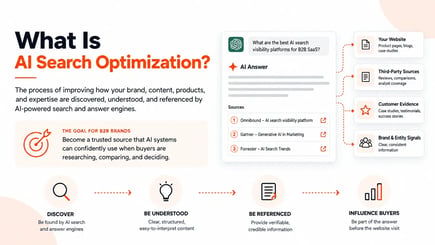
Generative Engine Optimization (GEO) is the practice of shaping your content, brand signals and technical setup so that generative AI engines mention, recommend and cite your business in their answers. Where traditional SEO works to rank a page in a list of links, GEO works to make your brand part of the answer that an engine writes for a buyer.
The engines that matter here are the ones B2B buyers now use to research vendors: ChatGPT, Perplexity, Google Gemini, Claude, Microsoft Copilot, and Google's AI Overviews and AI Mode. GEO is how you earn presence inside those generated responses.
The term itself comes from a 2023 research paper, "GEO: Generative Engine Optimization," by researchers at Princeton, IIT Delhi and Georgia Tech, later presented at KDD 2024. The study showed that specific content changes could improve a source's visibility inside generative engine answers by up to 40% (Aggarwal et al., 2023). In other words, appearing in AI answers is not random. It responds to deliberate optimization.
GEO, AEO and SEO: how they relate
These three terms overlap, and many B2B teams now run them together. The short version:
- SEO (search engine optimization): earning ranked links for your URLs in a traditional results page.
- AEO (answer engine optimization): earning mentions and citations inside answer engines such as ChatGPT and Perplexity.
- GEO (generative engine optimization): the same goal as AEO, with the label most often applied to generative results broadly, including Google's AI surfaces.
In practice, AEO and GEO describe the same work from slightly different angles, and both build on SEO fundamentals rather than replacing them. For a full breakdown of where GEO and SEO differ, see SEO vs GEO for SaaS and AI Search Visibility vs Traditional SEO.
How generative engines decide what to cite
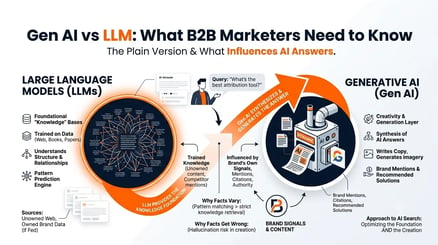
To do GEO well, it helps to know what happens between a buyer's question and the answer they read. Most generative engines follow three broad steps:
- Retrieval. The engine gathers candidate sources, either from the live web or from an index, that look relevant to the prompt.
- Synthesis. It composes an answer from the strongest of those sources.
- Citation. It names or links some of the sources it used.
A single question is often expanded into several sub-queries first, so one buyer prompt can pull from many different pages. If your content is not retrievable, well-structured and trustworthy, it will not make it into that answer. For the evidence behind how engines choose sources, see how AI search engines determine which brands to cite.
What GEO covers for B2B brands
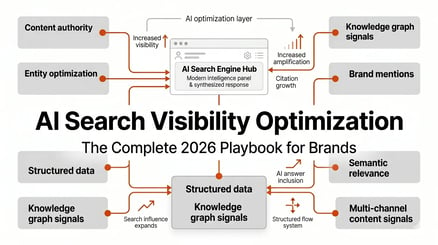
GEO is not one tactic. It is a set of connected levers that together decide whether an engine trusts and reuses your content.
Answer-ready content. Content that opens with a clear answer, uses descriptive headings, and keeps sections self-contained is easier for an engine to retrieve and quote. See content formats that win AI search visibility.
Authority and trust signals. Engines favour sources that show real expertise, clear authorship and third-party validation. This is where E-E-A-T and brand authority come in. See AI search authority and E-E-A-T and trust signals for AI visibility.
Third-party presence. Much of what engines cite for B2B queries lives off your own site: publications, communities and review sites. Being present and accurate on those sources feeds your GEO results.
Technical readiness. If AI crawlers cannot access or parse your pages, none of the above matters. Crawlability, structure and clean markup make your content eligible to be used.
Freshness. Engines lean toward current sources, so updating existing pages keeps them in the running. See content refresh.
Knowledge base and docs. For multi-product B2B brands, help centres and documentation are often cited more than marketing pages. See knowledge base optimization for AI search.
For the tactical playbooks that sit under these levers, see 15 best GEO techniques for marketers and top 5 GEO strategies for AI.
Why GEO matters for B2B now
B2B buyers have moved a large part of their early research into AI answers. They ask an engine to shortlist vendors, compare options and summarise categories, often without clicking through to any website. That shift makes two things true at once: your traditional traffic can fall even as buying interest stays high, and the AI answer becomes the first impression of your brand.
This is why mentions and citations, not just clicks, are becoming the unit of visibility. For the supporting data, see generative engine optimization statistics, AI search statistics and zero-click search statistics.
How to measure GEO
GEO has its own metrics, distinct from rankings and sessions:
- Mention rate: how often engines name your brand for your priority prompts.
- Citation share: how often your pages are the source behind answers in your category.
- Share of voice: your presence across AI answers relative to competitors.
- Sentiment: whether answers describe your brand accurately and positively.
Track these across engines and over time, because AI answers change as models and sources update. See AI search visibility metrics and KPIs and choosing an AI search visibility approach with share of voice.
How to get started with GEO
A simple starting sequence for a B2B team:
- Baseline your visibility. Find out where you appear today across engines and priority buyer prompts. A fast way to start is the free AI Search Visibility Checker, then a fuller AI search visibility audit.
- Find the gaps. Identify the prompts where competitors are cited and you are not.
- Fix your highest-intent pages first. Make them answer-ready and technically accessible.
- Build authority signals. Strengthen expertise, structure and third-party presence for those topics.
- Measure and repeat. Track mentions, citations and share of voice, then refresh what is slipping.
The AI search optimization checklist walks through this in more detail.
Common GEO mistakes to avoid
- Treating GEO as separate from SEO instead of building on the same foundations.
- Optimising only your own site while ignoring the third-party sources engines actually cite.
- Writing for keywords rather than for the real questions buyers ask engines.
- Measuring traffic alone, with no view of mentions or citation share.
- Publishing once and never refreshing, then losing citations to fresher competitors.
Frequently asked questions
What does GEO stand for? GEO stands for generative engine optimization: optimising your content and brand signals so generative AI engines mention and cite you in their answers.
Is GEO the same as AEO? They describe nearly the same work. AEO (answer engine optimization) emphasises answer engines such as ChatGPT and Perplexity, while GEO is applied to generative results broadly. Most B2B teams treat them as one discipline. See AEO explained.
How is GEO different from SEO? SEO earns a ranked link for a page. GEO earns a mention or citation inside a generated answer. The foundations overlap, but the metrics and tactics differ. See SEO vs GEO for SaaS.
Does GEO actually work? Yes. The original GEO research found that structured content changes improved a source's visibility in generative answers by up to 40% (Aggarwal et al., 2023), and B2B teams now track measurable gains in mentions and citations.
How do you measure GEO? Through mention rate, citation share, share of voice and sentiment across AI engines, tracked over time rather than as a single snapshot.
How long does GEO take to show results? It varies by engine and starting authority. Freshness and structural fixes can show up quickly as engines re-crawl, while authority signals compound over months.
See where your brand stands in AI answers
GEO starts with knowing where you appear today. Run a free scan with the AI Search Visibility Checker, or see how continuous tracking and optimization work with AI Search Intelligence.
Turn Your Content Into AI-Search Winners
Get cited across ChatGPT, Claude & Perplexity — not just ranked on Google.
- Increase AI citations
- Improve answer visibility
- Track brand mentions in LLMs