


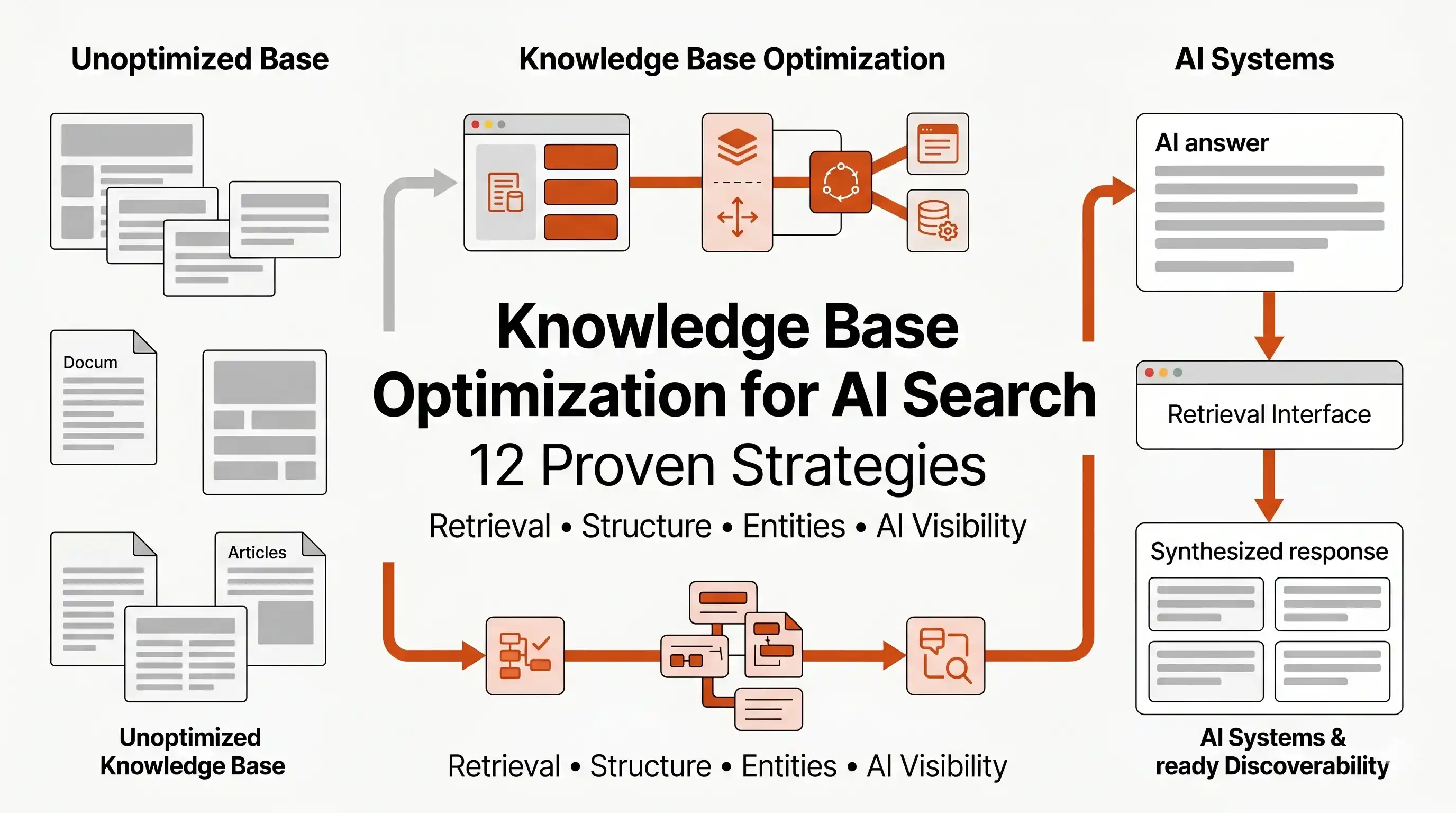


Knowledge base optimization for AI search has become one of the most urgent priorities for forward-thinking brands in 2026, and the numbers make it impossible to ignore. According to Bain & Company, 60% of AI-powered searches now end without a click-through to a website because the answer is fully synthesized directly in the AI response. That means your knowledge base is no longer just a resource for customers to browse. It is actively competing to become the source that AI systems retrieve, trust, and cite when buyers ask questions that matter to your pipeline.
What Is Knowledge Base Optimization for AI Search?
Knowledge base optimization for AI search is the practice of intentionally structuring, formatting, and governing your documentation so that AI systems can retrieve, parse, and cite it with confidence.
Why Knowledge Base Optimization for AI Search Matters Right Now
Generative AI engines including ChatGPT, Gemini, Google AI Overviews, and Perplexity increasingly synthesize answers from structured, trusted sources. Knowledge bases are particularly strong candidates for retrieval because they naturally contain:
- Direct definitions and explanations
- Procedural guidance and workflows
- Product and feature documentation
- FAQs and structured Q&A content
- Integration and technical specifications
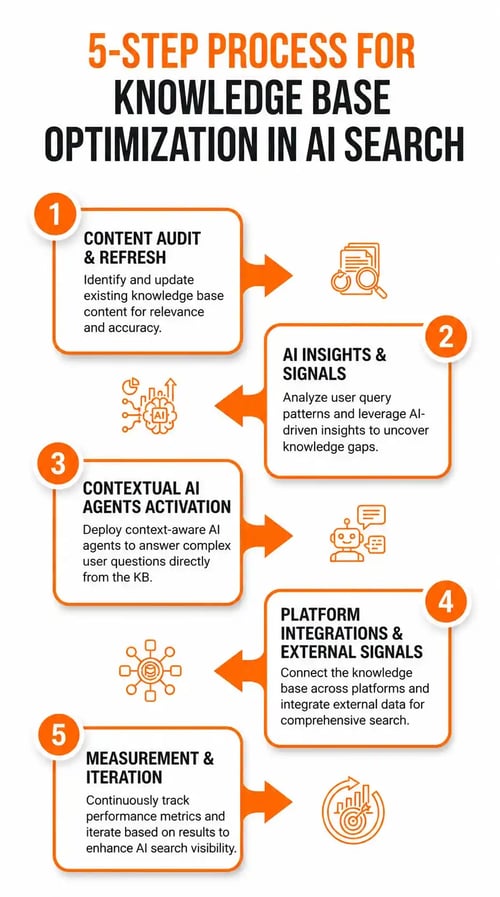
This infographic presents a practical 5-step approach to optimizing a knowledge base for AI-powered search. It highlights actions to improve accuracy, relevance, and retrieval in search results.
How AI Systems Retrieve Knowledge Base Content
Understanding retrieval logic is the foundation of effective knowledge base optimization for AI search. AI systems do not simply read pages. They evaluate content across multiple dimensions before including it in a generated answer.
The retrieval flow works like this:
- Crawl: Can the AI system access your content without friction?
- Parse: Can it extract clear, structured answers from the page?
- Retrieve: Does the content match the query's semantic intent?
- Validate: Does the information appear authoritative and consistent?
- Generate: Is the content formatted in a way that supports confident answer synthesis?
Did You Know?
60% of AI-powered searches now end without a click-through to a website, as the answer is fully synthesized on the SERP. (Bain & Company, 2026)
12 Knowledge Base Optimization Strategies for AI Search Visibility
These are the strategies we recommend for turning your knowledge base into a retrieval-ready, citation-worthy asset in 2026.
1. Design for Questions, Not Folder Structures
Most knowledge bases mirror internal org charts. AI systems prefer content organized around the actual questions buyers ask.
Structure your articles around "How do I...", "What is...", and "Best way to..." query patterns. This aligns your content directly with the prompts that AI engines process every day.
2. Use Retrieval-Friendly Formatting
Clear formatting dramatically improves parse success. Use:
- Descriptive H2 and H3 headings
- Concise summary paragraphs at the top of each article
- Numbered lists for procedural content
- Tables for comparisons
- FAQ blocks at the bottom of complex topics
Short paragraphs and structured layouts make it significantly easier for AI systems to extract precise answers rather than attempting to synthesize meaning from dense, unbroken text.
3. Create Strong Entity Definitions
Entity ambiguity is one of the most common reasons knowledge base content fails AI retrieval. Every product, integration, feature, workflow, and key term should be clearly defined within the content itself.
Do not assume that AI systems will infer meaning from context. Define it explicitly, and use consistent terminology across every article in your knowledge base.
4. Build a Semantic Topic Architecture
Isolated articles do not perform as well as interconnected topic clusters. Organize your knowledge base around concepts, use cases, and workflows rather than independent pages that do not reference each other.
When AI systems encounter a well-structured topic cluster, they gain confidence that the source has depth and authority on the subject. This increases the probability of citation.
5. Optimize for Conversational Queries
AI engines are prompt-driven. The queries they process sound like natural conversation, not keyword strings. Write article titles and section headers that directly reflect how buyers phrase questions in chat interfaces.
Examples include: "How do I integrate [Product] with [Platform]?" or "What is the difference between [Feature A] and [Feature B]?"
6. Create Answer-First Content Blocks
The most retrieval-ready content puts the direct answer in the first sentence or two of each section. Detailed explanation follows, but the core answer is immediately accessible.
This mirrors the way AI systems extract answers: they look for the most direct response first, then validate it against the surrounding content.
7. Strengthen Metadata and Structured Signals
Schema markup, breadcrumb hierarchy, canonical URLs, and clean taxonomy all contribute to how AI systems classify and trust your content. These signals communicate structure and authority at the technical level, complementing the content-level optimization strategies above.
A knowledge base with strong metadata is far more likely to pass the validation stage of the AI retrieval flow.
8. Maintain Freshness Through Governance
Outdated knowledge bases actively undermine retrieval confidence. AI systems increasingly favor sources that show evidence of regular updates and active maintenance.
Implement clear ownership for every article, establish review cycles, use version control, and maintain an update schedule. Our Content Refresh Grid makes it straightforward to identify which pages in your library need immediate attention.
9. Build Single Source-of-Truth Content
Duplicate pages, conflicting definitions, and inconsistent terminology are among the fastest ways to reduce retrieval confidence. AI systems struggle to validate sources that contradict themselves across multiple pages.
Consolidate overlapping content, choose a definitive definition for every key term, and enforce consistent naming conventions across your entire knowledge base.
10. Add Original Expertise and Proprietary Guidance
Generic content rarely earns citations. AI systems increasingly value content that demonstrates genuine expertise, provides practical instructions, or offers unique workflows that cannot be found elsewhere.
Document your team's real-world knowledge. Include decision frameworks, step-by-step processes specific to your product, and expert guidance that only your organization can provide. This is the content that earns trust and drives citations.
11. Improve Internal Linking and Topic Connectivity
Knowledge graphs matter in AI retrieval. When your articles are well-connected through intentional internal linking, AI systems can validate the depth and authority of your knowledge base more effectively.
Link related concepts, workflows, and definitions together consistently. Do not leave articles as isolated islands. Every connection you create reinforces the semantic architecture that AI systems rely on when evaluating your content.
12. Monitor AI Retrieval Visibility Continuously
Knowledge base optimization for AI search is not a one-time project. It requires continuous monitoring of how your content performs across AI environments.
Track which prompts trigger citations of your content, which articles are being retrieved, and where competitors are appearing instead of you. Our AI solutions for customer marketing provide exactly this visibility, connecting citation performance to pipeline outcomes.
Did You Know?
60% of AI-powered searches now end without a click-through to a website, as the answer is fully synthesized on the SERP. Your brand must be inside that answer to stay visible. (Bain & Company, 2026)
How Omnibound Powers Knowledge Base Optimization for AI Search
Traditional content management tools monitor documentation usage and support analytics. That approach is no longer sufficient for the AI search era.
We built Omnibound specifically for the gap between traditional knowledge management and AI search visibility. Here is what that looks like in practice:
|
Capability |
Traditional KB Tool |
AI-Optimized KB |
Omnibound |
|
Documentation Management |
✔ |
✔ |
✔ |
|
AI Retrieval Readiness |
Limited |
✔ |
✔ |
|
Citation Visibility Tracking |
✘ |
Partial |
✔ |
|
Buyer Context Intelligence |
✘ |
Limited |
✔ |
|
Competitive Signal Monitoring |
✘ |
Limited |
✔ |
|
Content-to-Pipeline Attribution |
✘ |
Partial |
✔ |
We built Omnibound to help brands close this gap with real-time AI intelligence, buyer context, and optimization tools designed specifically for the generative search era. The brands that act on knowledge base optimization for AI search today are the ones that will earn citations, build authority, and drive pipeline from AI-powered discovery tomorrow.
FAQs
- What is knowledge base optimization for AI search?
Knowledge base optimization for AI search structures content so AI systems can easily retrieve, understand, and cite it. - How do I optimize a knowledge base for AI search in 2026?
Use question-led formats, clear structure, strong entities, semantic organization, and ongoing citation monitoring. - Why does my knowledge base need to be AI-optimized?
AI optimization helps your content get cited directly in AI-generated answers, even when users never click through. - What makes a knowledge base citation-ready for ChatGPT or Perplexity?
Citation-ready knowledge bases use answer-first content, entity clarity, semantic linking, clean metadata, and fresh governance. - How is AI knowledge base optimization different from regular content optimization?
AI optimization focuses on machine retrieval and answer generation, while traditional optimization focuses on human readers and navigation. - Is it worth investing in knowledge base optimization for AI search if my team is small?
Yes, starting early with high-impact content creates long-term visibility gains, even for small teams. - How do I track whether my knowledge base is being cited in AI search results?
Use AI visibility tools to monitor citations, prompt performance, and business impact across AI search platforms.
.webp?height=245&name=What%20Is%20GEO%20(Generative%20Engine%20Optimization).webp)