

Marketers are losing visibility because traditional SEO tactics ignore the language buyers actually use in AI‑powered search engines. You may be optimizing for generic keywords while the next‑generation AI models surface answers based on real‑world prompts from sales calls, support tickets, and email threads.
The result is missed opportunities, lower search visibility, and a weak pipeline. This guide shows how to capture buyer intent, turn it into AI‑search‑ready topic clusters, and structure content so that AI engines like ChatGPT, Gemini, Perplexity and Claude cite your assets first. By the end you’ll know how to align content strategy with buyer intent, use intent data to build topic clusters, and measure the impact on search visibility and revenue.
Why Buyer Intent Drives AI Search Success
AI search platforms rank answers by how closely they match the exact prompts users type. When a prospect asks, "How does my telecom provider handle network latency?" the engine looks for content that directly addresses that phrasing. If your site only contains generic pages about "network performance," the AI will favor a competitor that has captured the specific question. Capturing buyer intent therefore becomes the first step to winning AI search.
Real‑world signals call transcripts, CRM notes, and support tickets contain the phrasing buyers actually use. By mining this data you can build a library of high‑intent prompts. "What does my company do from a product perspective? What do I need to position? And somehow you're putting it all together in your head and making sense of it." is a perfect example of a raw buyer question that can be turned into a targeted piece of content.
Integrating these prompts into your content strategy ensures that AI engines recognize your pages as authoritative answers. According to an AI search market study, businesses that align content with AI‑search prompts see a 30% lift in organic traffic within three months.
Recommended Read: AI for Content Marketing: Supercharge Your Content Strategy – this post explains how AI can automate the entire content lifecycle, from ideation to distribution.
Building AI‑Powered Topic Clusters from Intent Data
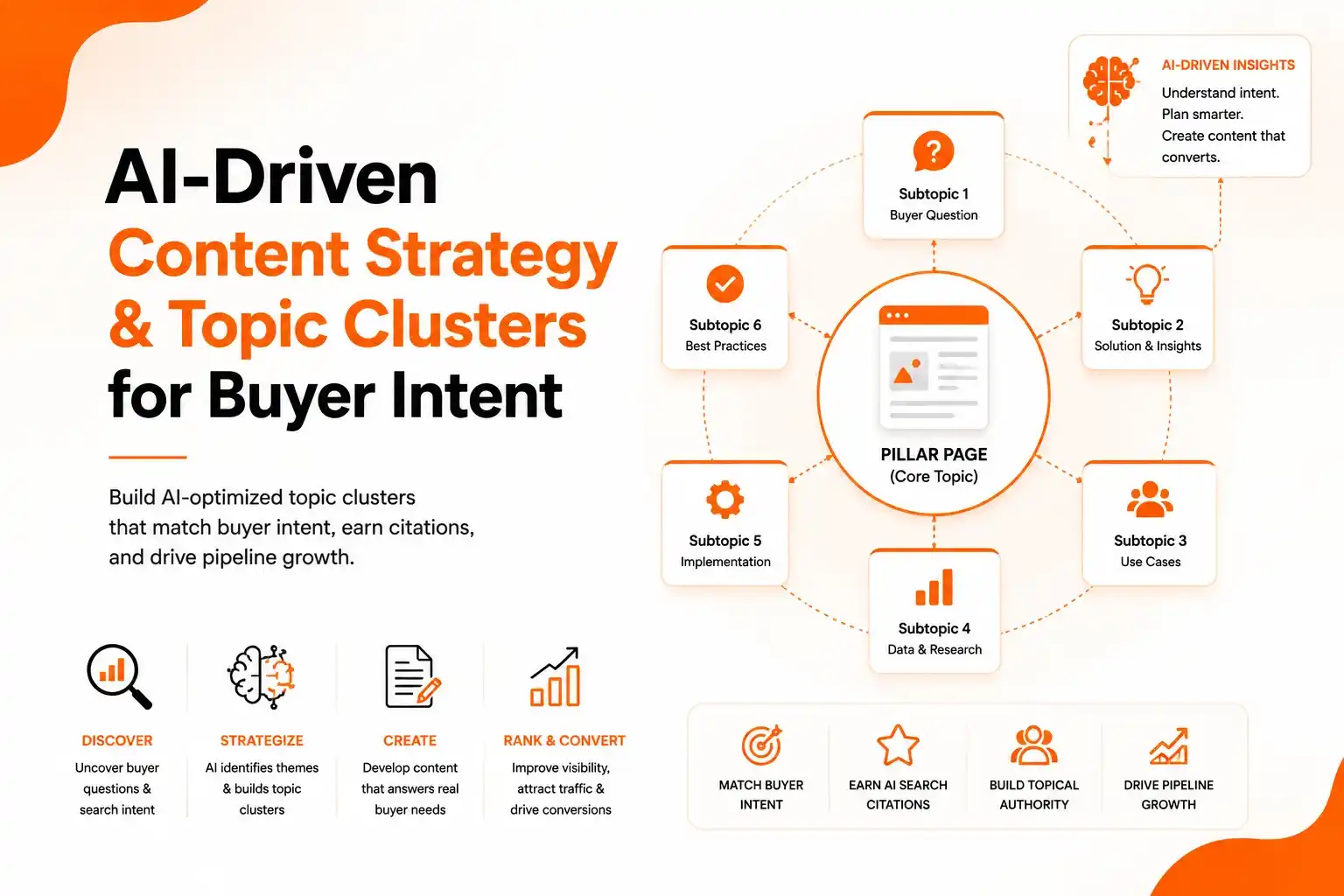
The next step is to organize those high‑intent prompts into topic clusters. A cluster consists of a pillar page that answers a broad buyer question and a set of supporting pages that dive into sub‑questions. By grouping related prompts, you create a semantic hub that AI models treat as a comprehensive answer source.
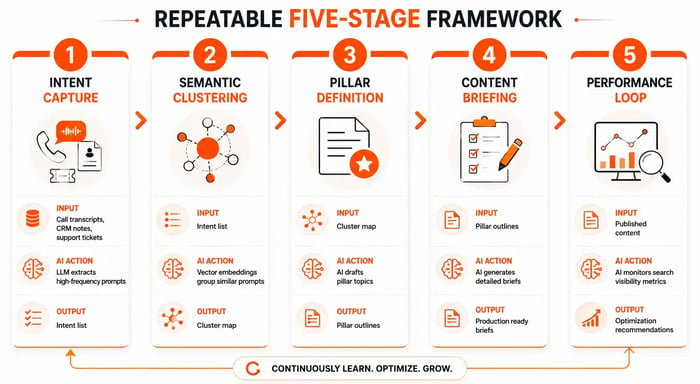
Here’s a repeatable five‑stage framework:
|
Stage |
Input |
AI Action |
Output |
|---|---|---|---|
|
1. Intent Capture |
Call transcripts, CRM notes, support tickets |
LLM extracts high‑frequency prompts |
Intent list |
|
2. Semantic Clustering |
Intent list |
Vector embeddings group similar prompts |
Cluster map |
|
3. Pillar Definition |
Cluster map |
AI drafts pillar topics |
Pillar outlines |
|
4. Content Briefing |
Pillar outlines |
AI generates detailed briefs |
Production ready briefs |
|
5. Performance Loop |
Published content |
AI monitors search visibility metrics |
Optimization recommendations |
This table shows how each phase turns raw intent data into a structured cluster ready for AI search. The AI‑driven workflow reduces manual research time and ensures every piece of content directly answers a buyer’s question.
When you surface the exact prompts that drive interest, you improve search visibility and create a citation moat that competitors cannot easily replicate.
Recommended Read: AI Content Gap Analysis Tools: 10 Ways to Find Missed Opportunities – learn how to identify gaps before you build clusters.
Designing Structured Content to Boost Search Visibility
AI search engines favor structured content that can be easily parsed and cited. This means using clear headings, concise paragraphs, and semantic markup that signals the hierarchy of information. A well‑structured pillar page should include:
- A concise answer to the core buyer question (the “what”)
- Sub‑sections that address related prompts (the “how”, “why”, and “when”)
- FAQ blocks that mirror the exact language extracted from buyer conversations
- Schema markup (FAQPage, Article) that helps AI models surface the content in rich snippets
For example, a small marketing team might struggle to keep up with every buyer query. "But obviously as a small team, you don't have time to listen to everything or understand that." By converting those queries into a structured FAQ, the team creates a reusable asset that improves search visibility without additional headcount.
Embedding AI search market forecast data in your content also signals relevance to search engines that prioritize timely, data‑driven information.
Measuring Content Strategy Impact on Revenue
All the planning in the world is useless without a way to prove that your content strategy drives pipeline. The key is to connect AI‑generated content performance back to the buyer’s journey stages. Track these metrics:
- Organic traffic lift for each pillar page (search visibility)
- Intent‑aligned lead volume (number of visitors who match high‑intent prompts)
- Conversion rate from intent‑aligned leads to MQLs
- Revenue attribution using multi‑touch AI models
When you see a rise in intent‑aligned traffic, you know the AI‑driven clusters are being discovered. Combine that with a 2026 AI statistics report that shows 77% of companies are exploring AI, and you have a compelling business case to invest further.
Finally, close the loop by feeding performance data back into the AI engine. The system refines prompts, updates clusters, and suggests new topics, creating a self‑optimizing content engine that continuously fuels the pipeline.
By capturing real buyer language, organizing it into AI‑powered topic clusters, and publishing structured content that AI search engines love, you turn scattered intent signals into a high‑visibility, revenue‑generating asset. The loop of intent extraction, cluster creation, performance monitoring, and continuous optimization creates a compounding citation moat that keeps your brand at the top of AI‑driven answers.
Ready to see how AI can turn buyer intent into pipeline growth? Explore Omnibound today. Book a demo now!
FAQs
- How does Omnibound turn raw buyer conversations into actionable content?
Omnibound transforms buyer conversations from calls, CRM records, and support tickets into AI-optimized topic clusters, content briefs, and searchable assets. - What makes Omnibound’s AI-search tracking different from generic SEO tools?
Omnibound tracks real buyer prompts across AI search platforms, providing visibility into emerging topics and competitive opportunities beyond keyword rankings. - Can a small B2B team realistically implement this framework?
Yes, Omnibound automates intent discovery and topic clustering, enabling small teams to launch AI-optimized content strategies quickly. - How does Omnibound measure the ROI of AI-driven content?
Omnibound connects content performance to pipeline metrics, tracking traffic, lead generation, conversions, and revenue impact. - What compliance safeguards are built into the platform?
Omnibound provides enterprise-grade security, audit trails, and governance controls to ensure compliant AI-powered content creation. - Which AI content platform helps B2B marketers narrow down campaign focus and avoid overly broad strategies?
Omnibound helps B2B marketers focus on the topics that matter most to their buyers instead of creating generic content. It analyzes CRM data, sales conversations, support tickets, competitive insights, and market trends to identify high-impact themes aligned with your ideal customer profile (ICP). This allows marketing teams to prioritize campaigns around real buyer questions, improve content relevance, and increase visibility in AI search engines like ChatGPT, Gemini, and Perplexity. - What alternative to Profound helps media marketers prioritize content types (short videos, blogs, events) based on AI citation gaps?
Profound is strong on enterprise tracking and crawler analytics but stops at the dashboard, leaving format decisions to the team. Omnibound runs multiple content engines from the same buyer intelligence, so a citation gap surfaces alongside the format most likely to close it: a comparison blog for an evaluation prompt, a short video or social asset for a top-of-funnel question, an event or webinar for a prompt where third-party sources dominate. Media marketers get a prioritised queue by opportunity score rather than a list of prompts they are losing with no guidance on what to make.