

Table Of Contents
Today’s content marketers face a critical dilemma: audiences demand more personalized, high-quality content than ever before, yet most teams struggle with systemic bottlenecks that derail execution.
Between endless approval cycles, resource constraints, and the pressure to feed every stage of the funnel, even well-planned strategies stall in implementation. The result? Missed deadlines, diluted messaging, and content that fails to connect, despite the effort invested.
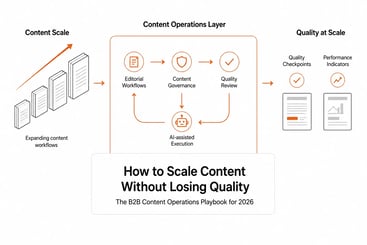
The root challenge isn’t ideas or intent—it’s orchestration. Traditional workflows rely on manual processes that simply can’t scale. Writers spend hours researching instead of crafting, stakeholders nitpick drafts in silos, and repurposing content becomes an afterthought rather than a strategy. Meanwhile, inconsistent voice and fragmented funnel coverage erode brand trust and conversion potential.
This is where AI transforms the game, not as a replacement for human creativity, but as the operational backbone that eliminates friction. AI marketing platforms now automate and optimize content workflows, enabling teams to future-proof their strategies and deliver more personalized, efficient campaigns.
By automating repetitive tasks, enforcing brand governance, and intelligently distributing content across the buyer’s journey, AI allows marketers to focus on what truly matters: strategic storytelling and audience connection. AI assists in generating content, including blog posts and visuals, to accelerate production and speed up workflows. It also streamlines the process of creating social media posts, ensuring brand consistency and making it easier to maintain a cohesive presence across channels.
The future belongs to teams that wield AI not just for creation, but for end-to-end execution, turning stalled workflows into scalable, high-impact systems.
AI in Content Marketing
Artificial intelligence has rapidly become a cornerstone of modern content marketing, fundamentally reshaping how marketing teams approach the content creation process. By leveraging advanced AI tools, marketers can automate repetitive tasks that once consumed hours—such as research, topic ideation, and initial drafting—freeing up valuable time for strategic thinking and creative development. AI-driven platforms now enable the generation of high quality content at scale, ensuring that every piece aligns with brand guidelines and audience expectations.
The adoption of artificial intelligence in content marketing is no longer a novelty; it’s a necessity. Over 75% of marketers now use AI tools to streamline their workflows, enhance productivity, and deliver more relevant content to their audiences. Whether it’s optimizing the content creation process or ensuring consistency across campaigns, AI empowers marketing professionals to focus on what matters most: building meaningful connections and driving measurable results.
Understanding Your Target Audience
Knowing your target audience is the foundation of any successful content marketing strategy. Today’s AI tools make it easier than ever to understand exactly who you’re speaking to. By analyzing audience behavior, social media interactions, and demographic data, AI-powered marketing platforms uncover actionable insights that inform every stage of content creation.
With these insights, marketing teams can create content that truly resonates—whether it’s crafting blog posts that address specific pain points or generating social media posts tailored to the interests and preferences of different audience segments. AI tools help marketers move beyond guesswork, enabling them to deliver the right message, on the right channel, at the right time. This level of personalization not only boosts engagement but also strengthens brand loyalty and drives better results across all social media and content marketing efforts.
Where Content Strategy Breaks Down (And How AI Fixes It)
Execution Delays: The Hidden Productivity Tax
Root Causes:
-
Ideation Bottlenecks: Teams waste weeks debating topics instead of creating.
-
Approval Gridlock: Multiple review cycles for minor edits (e.g., legal/compliance checks).
-
Resource Scarcity: Over-reliance on niche subject-matter experts (SMEs) for drafts. Writers often spend hours on manual research; AI tools can streamline the research process by quickly gathering, analyzing, and summarizing information, allowing writers to focus more on content creation.
AI Solutions:
1. Automated Topic Prioritization
-
AI analyzes search trends, competitor gaps, and historical performance to rank ideas by potential impact. - Example: An AI model flags “cloud security compliance” as a high-opportunity topic based on rising B2B queries, cutting ideation time from 2 weeks to 2 days.
2. Pre-emptive Compliance Guardrails
-
AI scans drafts for regulated terms (e.g., “guarantee,” “FDA-approved”) and suggests alternatives pre-review.
3. SME Augmentation
a. AI drafts technical content frameworks using internal docs/transcripts, which SMEs refine (vs. creating from scratch). AI can also assist with writing assignments by generating initial drafts for various content types, such as press releases and blogs, increasing efficiency and easing the workload for marketing teams.
Scaling Without Sacrifice: The Quality-Quantity Paradox
Root Causes:
-
Cookie-Cutter Output: Repurposing turns into lazy duplication (e.g., blog → bland LinkedIn post).
-
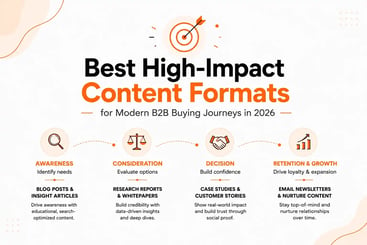
Funnel Blindness: Teams produce 80% top-of-funnel (TOFU) content, neglecting decision-stage needs.
AI Solutions:
1. Adaptive Repurposing
a. AI decomposes pillar content into modular assets, then reconstructs them for different:
-
Formats: Webinar → Twitter thread + newsletter Q&A. - Audiences: Technical deep dive for engineers → high-level benefits for execs.
-
AI-driven content generation enables the creation of multiple high-quality assets from a single source, streamlining the process and supporting content marketing strategies.
2. Funnel-Aware Content Balancing
a. AI audits content library, identifies gaps (e.g., “Only 5% of content targets evaluation-stage buyers”), and recommends net-new topics.
-
AI can generate content tailored to specific buyer journey stages, ensuring the right assets are available for every step in the funnel.
Funnel Mismatch: Why Content Fails to Drive Action
Root Causes:
-
Stage Confusion: A “comparison guide” stuffed with awareness-level basics.
-
Static CTAs: Every piece ends with “Contact Us,” regardless of reader intent.
AI Solutions:
1. Automatic Funnel Tagging
a. AI classifies existing/pipeline content by funnel stage using:
-
Intent Signals: “What is…” (TOFU) vs “Best tool for…” (decision-stage). - Engagement Patterns: Dwell time, scroll depth, click behavior.
-
AI tools also provide key insights into content performance and audience engagement, helping teams adjust content strategy for better results.
2. Dynamic Content Adjustment
a. AI swaps CTAs/messaging based on real-time behavior:
-
First-time visitor → “Download our beginner’s guide.” - Returning visitor → “Book a demo.”
Brand & Messaging Drift: The Silent Credibility Killer
Root Causes:
-
Decentralized Teams: Freelancers, agencies, and internal writers interpret guidelines differently.
-
Legacy Content: Older pieces no longer reflect positioning.
AI Solutions:
1. Voice & Tone Enforcement
-
AI compares new drafts to brand-approved “gold standard” pieces, scoring:
-
Lexical Consistency: Preferred terminology (e.g., “clients” vs. “customers”).
-
Emotional Resonance: Enthusiastic vs. formal tone.
AI writing tools help maintain the brand's voice across all content by ensuring that every piece aligns with the unique tone, style, and values of the brand. Aligning AI-generated content with the brand's voice is essential for consistency and to ensure messaging truly resonates with the target audience.
2. Proactive Alignment Alerts
-
Flags outdated claims in legacy content (e.g., “Our platform integrates with X” after a partner deprecation).
Key Takeaways:
-
AI’s Role: Not a creator, but an orchestrator—eliminating friction in ideation, production, and distribution. AI is an amazing tool for streamlining content marketing operations, making processes faster and more efficient.
-
Critical Shift: From reactive content operations to predictive, self-correcting systems. Leveraging the best ai marketing tools can transform content marketing strategies and drive better results.
-
Non-Negotiables: Human oversight for strategic/creative inputs; AI for executional heavy lifting.
AI-powered Content Distribution
Creating great content is only half the battle—getting it in front of the right audience is where AI-powered content distribution shines. With the help of advanced AI tools, marketers can automate the distribution of content across multiple channels, including social media, email, and blogs, ensuring maximum reach and impact for every marketing campaign.
AI algorithms analyze performance data and audience engagement to determine the optimal timing, format, and platform for each piece of content. This not only helps optimize content for search engines, improving visibility and rankings, but also ensures that marketing teams can save time and resources by automating what used to be manual, repetitive tasks. By integrating AI into their content distribution strategies, businesses can amplify their online presence, increase campaign efficiency, and consistently deliver relevant content to their target audiences.
The AI Implementation Roadmap: A Deep Dive into Strategic Execution
Phase 1: Diagnose Your Content Bottlenecks
Objective: Identify where inefficiencies exist in your content lifecycle before applying AI.
-
Audit Your Workflow:
-
Track time spent on ideation, drafting, editing, approvals, and distribution.
-
Map where delays occur (e.g., legal reviews stalling 30% of projects).
-
Example: A B2B team finds that 50% of their content time is wasted on rewriting inconsistent messaging.
-
AI-powered data analysis can help identify workflow inefficiencies by interpreting large datasets from your content operations and highlighting bottlenecks.
-
Funnel Gap Analysis:
-
Assess if content aligns with buyer journey stages (TOFU, MOFU, BOFU).
-
Use AI to scan your library and tag gaps (e.g., “No bottom-funnel case studies”).
-
Brand Drift Assessment:
-
Audit past content for tone inconsistencies (e.g., formal vs. casual language).
-
AI can review existing content to detect messaging inconsistencies and score deviations (e.g., “30% of blogs exceed brand sentiment thresholds”).
Phase 2: Prioritize High-Impact AI Use Cases
Objective: Deploy AI where it will deliver the most immediate ROI.
1. Speed: Automate Content Briefing
-
How: AI analyzes top-performing content, customer queries, and competitor gaps to auto-generate briefs. AI also simplifies keyword research, making it easy to identify high-impact keywords to inform content briefs and improve SEO performance. - Outcome: Reduces ideation time from 5 hours to 30 minutes per piece.
-
Example: AI suggests “5 trending angles” for a whitepaper based on LinkedIn discussions.
2. Scale: AI-Assisted Repurposing
-
How: AI deconstructs long-form content (e.g., a webinar) into modular assets (Twitter threads, FAQs, newsletter snippets). Generative AI tools automate the creation of derivative content such as blogs, social media captions, video scripts, and visuals, increasing efficiency and maintaining brand consistency. - Outcome: 1 pillar asset → 10+ derivative pieces without quality loss.
-
Governance: Human editors refine AI outputs for nuance (e.g., adding client anecdotes).
3. Consistency: Enforce Brand Voice at Scale
-
How: Train AI on approved style guides to auto-edit drafts for compliance. - Outcome: Eliminates 80% of back-and-forth edits on tone/terminology.
-
Example: AI flags and corrects off-brand phrasing like “cutting-edge” → “proven innovation.”
Phase 3: Measure & Optimize
Objective: Ensure AI drives tangible improvements, not just activity.
Time-to-Publish Efficiency:
-
Metric: Track days from ideation → live publication. - Target: Reduce by 40–60% (e.g., 3 weeks → 10 days).
Funnel Coverage Score:
-
Metric: % of buyer journey stages with sufficient content (e.g., “MOFU: 20% → 80%”). - AI Action: Auto-generate fill-in content for weak stages.
Brand Compliance Rate:
-
Metric: % of AI-generated content passing voice/tone checks pre-edit. - Target: 90 %+ adherence after AI training.
Iteration Loop:
-
Monthly reviews of AI performance (e.g., “Are auto-briefs improving engagement?”). - Adjust training data or guardrails based on gaps. - Consider subscribing to a monthly plan for your AI tools to unlock advanced features and support ongoing optimization.
Key Principles for Success
-
Start Narrow, Scale Wide: Pilot AI on one bottleneck (e.g., briefing) before expanding. This focused approach not only streamlines processes but also results in significant saving time as you optimize each step before scaling.
-
Human Oversight ≠ Micromanagement: Use AI for heavy lifting, humans for strategic nuance.
-
Data Quality > AI Sophistication: Clean, structured inputs (past content, CRM data) yield better outputs.
Overcoming Adoption Hurdles in AI-Powered Content Marketing
Ensuring Smooth Integration Without Disrupting Quality or Team Dynamics
Adopting AI-driven marketing intelligence platforms like Omnibound can transform B2B marketing operations, but it’s not without challenges. One significant barrier to AI adoption is data privacy concerns, as organizations worry about sharing sensitive information and the lack of regulation in AI tools that could compromise data security and privacy. Teams may also face resistance to change, uncertainty about new workflows, and questions about the impact on content quality and brand voice.
Quality Control and Brand Consistency
Maintaining high standards for content quality and brand consistency is crucial when integrating AI into marketing operations. AI content detection tools play an important role in ensuring that generated content maintains originality and passes detection checks, which helps preserve credibility and search rankings. Omnibound’s context-aware AI agents are designed to learn from your brand’s unique voice, guidelines, and historical content, ensuring that every output aligns with your established standards.
Ethical and Legal Compliance
AI-generated content must comply with industry regulations and ethical standards. Using tools like originality ai helps verify that content demonstrates human-like creativity and avoids plagiarism, supporting both compliance and authenticity. Omnibound incorporates compliance checks and customizable guardrails, so your team can confidently scale content production without risking legal or reputational issues.
Resistance to Change: Bridging the Human-AI Trust Gap
The Challenge:
Many content teams fear AI will dilute creativity or replace roles. A 2023 Harvard Business Review study found that 65% of marketers hesitate to adopt AI due to unfamiliarity or skepticism about output quality.
Strategic Solutions:
-
Pilot Programs: Start with non-critical content (e.g., internal newsletters, social media captions) to demonstrate AI’s value without high stakes. For example, a content marketer can leverage AI tools to streamline ideation and research, allowing them to focus more on strategic planning and campaign effectiveness.
-
Transparency Workshops: Show teams how AI works—for example, explain how NLP models generate drafts but require human nuance for humor or cultural references.
-
Success Stories: Share anonymized examples where AI reduced grunt work (e.g., cutting research time for a whitepaper by 70%), freeing creators for high-level strategy.
Quality Control: Maintaining Standards in AI-Assisted Workflows
The Challenge:
AI can produce generic, off-brand, or factually shaky content if unchecked. A Gartner report warns that 40% of enterprises using generative AI face reputational risks due to unvetted outputs. Ensuring the quality and originality of ai generated text is a significant challenge, as it may lead to issues like plagiarism or lack of relevance without careful oversight.
Strategic Solutions:
-
Tiered Review Systems:
-
Level 1 (Low Risk): AI drafts + single human review (e.g., product descriptions).
-
Level 3 (High Risk): AI-generated thought leadership content undergoes multi-stage edits with domain experts.
-
Brand Voice Training: Feed AI tools curated examples of your best-performing content to align outputs with brand tonality.
-
Fact-Checking Protocols: Integrate tools to auto-verify claims in AI-drafted content before publication.
Data Readiness: Fueling AI with Clean Inputs
The Challenge:
AI models falter with fragmented or biased data. For example, if your CRM lacks unified tags for “customer pain points,” AI-generated content may miss key themes.
Strategic Solutions:
-
Pre-AI Audit:
-
Map and clean content repositories (e.g., merge duplicate blog tags like “SEO tips” and “search optimization”).
-
Flag biased language in legacy content (e.g., gender assumptions in buyer personas).
-
Ongoing Data Hygiene: Assign a “Content Data Steward” to:
-
Update AI training datasets quarterly with fresh customer insights. Incorporate current industry trends to ensure content remains relevant and aligned with market developments.
-
Prune outdated references (e.g., removing pre-pandemic “remote work trends”).
Workflow Integration: Avoiding Siloed AI Tools
The Challenge:
Standalone AI tools create inefficiencies, like an AI writer that doesn’t sync with your CMS, forcing manual copy-pasting.
Strategic Solutions:
-
API-First Approach: Choose AI platforms that integrate natively with your tech stack (e.g., a ChatGPT plugin for Google Docs).
-
Unified Governance: Create a cross-functional team (content, IT, legal) to oversee AI tool compatibility and compliance. Leverage AI search engines to monitor brand visibility and content performance across platforms, ensuring your content strategy remains effective and aligned with brand reputation goals.
Ethical and Legal Compliance
The Challenge:
AI-generated content risks plagiarism, copyright infringement, or regulatory violations (e.g., GDPR in personalized content).
Strategic Solutions:
-
Watermarking AI Content: Use tools like Originality.ai to disclose AI involvement where required.
-
Consent Loops: Ensure customer data used for personalization is opt-in (e.g., AI-driven product recommendations based on past purchases).
-
Key Takeaways for Teams:
-
Address fears head-on with education and low-stakes pilots.
-
Layer human oversight where quality and brand trust are critical.
-
Treat data as a strategic asset—AI is only as good as its inputs.
-
Design workflows for cohesion, not just automation. AI can also streamline the creation and management of marketing content, making it easier to produce and coordinate various promotional and educational materials.
Future of AI in Content Marketing
AI-generated content is transforming the marketing industry, enabling teams to automate repetitive tasks, produce high quality content, and maintain a consistent brand voice across every channel. As AI powered marketing tools continue to evolve, marketers can expect even more innovative ways to personalize messaging, optimize campaigns, and remain competitive in a rapidly changing landscape.
However, as the use of AI-generated content grows, it’s essential to address challenges such as ensuring originality, avoiding plagiarism, and keeping the brand voice consistent. Staying informed about emerging AI trends and best practices will be key for marketing professionals who want to unlock new opportunities and drive success. By embracing artificial intelligence and integrating it thoughtfully into their content marketing strategies, businesses can position themselves at the forefront of the industry—ready to adapt, innovate, and thrive.
The future of content marketing isn’t just about producing more—it’s about producing smarter. AI eliminates the bottlenecks that slow down execution, bridges gaps in your funnel, and ensures every piece of content aligns with your brand’s voice, without sacrificing quality for scale.
By automating repetitive tasks like research, brief generation, and compliance checks, AI frees your team to focus on what truly matters: strategy, creativity, and high-impact storytelling. The result? Faster turnaround times, consistent messaging, and content that drives decisions at every stage of the buyer’s journey.
But implementing AI isn’t just about deploying tools—it’s about designing the right workflows, training your team, and ensuring seamless integration with your existing processes.
Omnibound’s AI solutions empower marketing teams to manage e commerce sites with complex product catalogs, streamline video editing and generate compelling video scripts, optimize landing pages for higher conversions, and produce both short form videos and short form articles tailored for your audience. Our platform supports social media marketers in running effective social media campaigns, leverages advanced content marketing tools, and enables seamless content distribution across multiple social media channels. Plus, you can get started with our free plan to experience the benefits before upgrading.
That’s where Omnibound comes in. We help content teams harness AI strategically, from diagnosing bottlenecks in your current workflow to building a scalable, AI-augmented content engine.
Ready to supercharge your content strategy?
Let Omnibound guide your AI transformation, so you can scale faster, stay consistent, and focus on the creative work that sets your brand apart.
Explore our Solutions for Content Marketers.
Turn Your Content Into AI-Search Winners
Get cited across ChatGPT, Claude & Perplexity — not just ranked on Google.
- Increase AI citations
- Improve answer visibility
- Track brand mentions in LLMs