

Table Of Contents
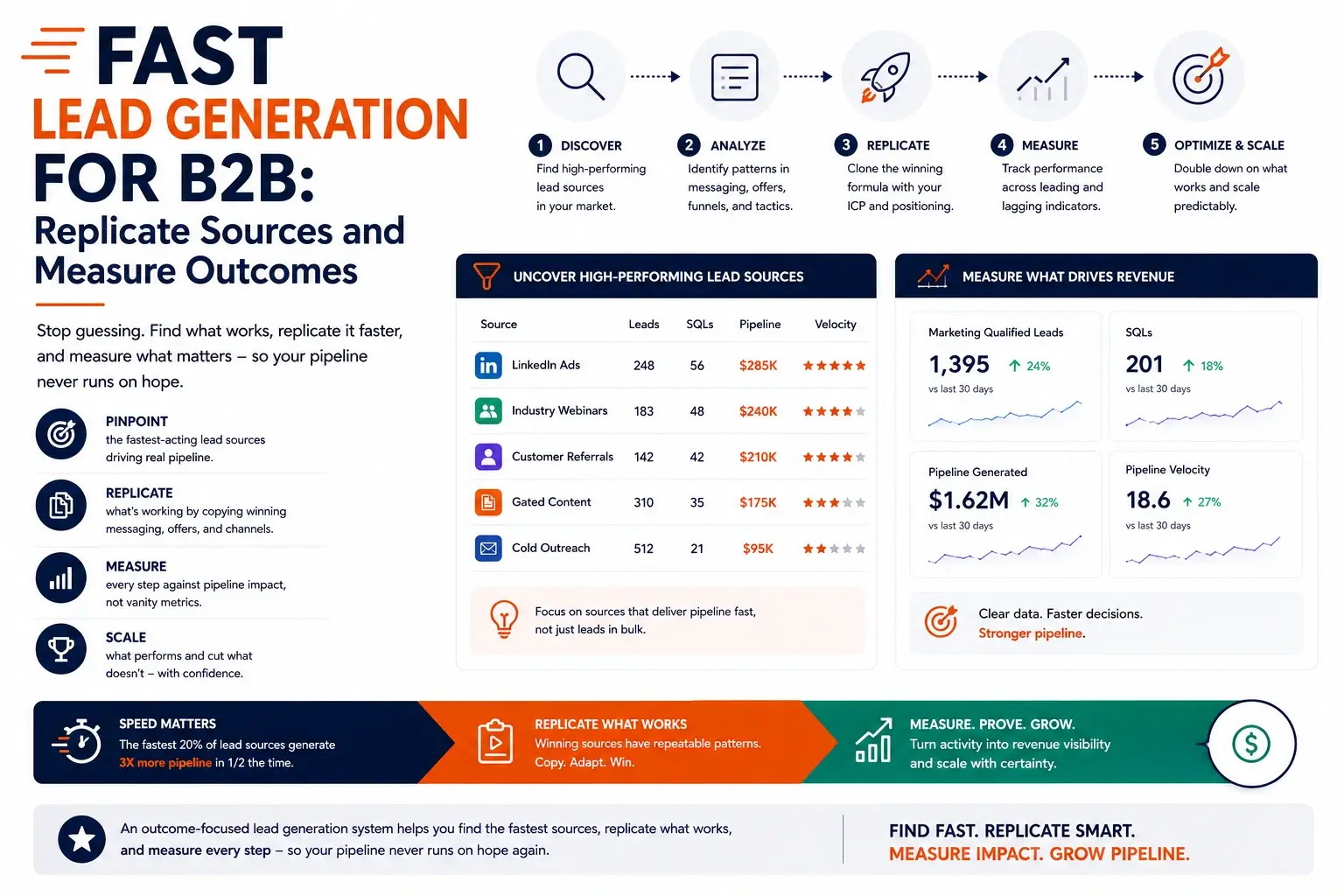
When a VP of Marketing or a demand‑generation leader watches the pipeline crawl, the frustration is immediate: qualified leads are arriving too slowly, and the team can’t prove which tactics are actually moving the needle. Traditional lead‑gen plans often feel like a collection of vague ideas, leaving you without the data needed to justify spend or prioritize actions. The answer lies in a disciplined, outcome‑focused approach that pinpoints the fastest‑acting sources, copies their winning formulas, and measures every step against real pipeline impact. In this guide you’ll learn why speed matters, how to uncover high‑performing lead sources, the playbook you need to replicate them, and the metrics that turn raw activity into clear revenue visibility.
Why speed matters in modern b2b lead generation
In the competitive landscape of mid‑market software and IT services, a delay of even a few days can mean a lost opportunity to a faster‑moving rival. Decision makers are increasingly turning to AI‑driven answer engines, and the first brand that appears in those AI citations captures the buyer’s attention before the traditional search results even load. This shift compresses the buying cycle, making rapid lead capture essential for maintaining a healthy pipeline velocity.
When lead generation feels vague, teams often default to broad channel spending that yields high volume but low conversion. The real cost is hidden in the time it takes to qualify a lead and move it to a sales‑ready stage. By focusing on speed, you shorten the qualification window, reduce cost‑per‑lead, and create a clear line of sight from marketing activity to revenue. AI adoption study shows that organizations that accelerate AI‑driven lead capture see faster pipeline growth.
To act on this insight, start by treating speed as a core KPI. Track the time from first AI citation to a qualified marketing‑qualified lead (MQL) and compare it against your historical averages. This simple metric reveals bottlenecks and highlights the tactics that truly accelerate growth.
Recommended Read: Best AI Demand Generation Tactics for Growth Teams in 2026 - Practical tactics that boost AI visibility and fast‑track lead flow.
Identifying high‑performing lead sources you can replicate
The first step is to surface the sources that already deliver leads at a rapid pace. Look beyond generic channel names and dig into the specific prompts and content that AI engines are citing. Buyer intent signals hidden in sales calls, CRM notes, and support tickets reveal the exact language prospects use when asking an AI assistant for solutions.
One of our customers asked, "Could you please share which b2b companies you were referring to that are getting leads in a shorter time. I'd like to see if we can replicate some of their strategies". That request highlights a common pain point: the need for concrete examples of fast‑acting sources. By mapping the prompts that generate citations, you can pinpoint the content pieces that consistently appear in AI answers.
Below is a snapshot of a lead source that has been built in Clay and is ready for replication. The target profile focuses on privately held SMB firms in the US and Canada, with employee counts between 50‑500 and annual revenue ranging from $5M‑$50M, specifically in software development and IT sectors.
| Attribute | Range |
|---|---|
| Employee count | 50‑500 |
| Revenue | $5M‑$50M |
| Geography | US & Canada |
| Industry | Software Development, IT |
The table makes it clear which firms fit the high‑performing profile. Use these dimensions to filter your existing prospect lists, then prioritize outreach to companies that match the criteria. By aligning your targeting with proven source attributes, you create a replicable foundation for faster lead acquisition.
Recommended Read: AI Search Optimization Checklist: Win AI Citations and Drive B2b Pipeline - A step‑by‑step playbook for turning AI visibility into lead flow.
Building a playbook to duplicate fast‑generating tactics
Once you have identified a high‑performing source, the next challenge is to codify the tactics that make it fast. A playbook should capture the content creation workflow, the prompt‑mining process, and the distribution channels that deliver the quickest response from AI engines.
Start by documenting the exact buyer prompts that trigger citations. Use a simple spreadsheet to record the prompt, the associated content asset, and the performance metric (e.g., citation share‑of‑voice). Then map the creation steps: research, draft, optimization for AI citation, and publishing. Assign owners to each step and set a tight turnaround time – the faster you move content through the pipeline, the sooner the AI engine can surface it.
Finally, embed outcome‑focused attribution into the playbook. Connect each content asset to a dashboard that tracks AI citation volume, share‑of‑voice against competitors, and downstream pipeline stages such as MQL conversion. This visibility ensures you can quickly iterate on tactics that underperform and double down on those that accelerate lead flow.
Recommended Read: Marketing Attribution Statistics (2026): 54+ Data Points on Measurement Gaps, Model Adoption, and ROI Impact - Deep dive into attribution metrics that reveal true pipeline impact.
Measuring outcomes: From share‑of‑voice to pipeline impact
Without a robust measurement framework, even the best‑executed playbook can’t prove its value. Share‑of‑voice in AI citations is the first indicator that your content is winning the conversation against competitors. Track the percentage of AI‑generated answers that reference your assets versus rival brands.
Next, tie those citation metrics to downstream pipeline events. Use outcome‑focused attribution to map each citation to a lead, then to an MQL, and finally to a closed‑won opportunity. This end‑to‑end view lets you calculate the true revenue contribution of each source and justify budget allocations.
When you see a rise in citation share‑of‑voice, expect a corresponding lift in qualified leads within a short window. Conversely, a drop signals the need to refresh prompts or improve content relevance. By continuously monitoring these metrics, you turn AI visibility into a predictable engine for pipeline growth.
FAQs
1. How can I discover the exact buyer prompts that drive AI citations?
Begin by mining real buyer interactions – sales calls, support tickets, and webinar Q&A sessions. Extract the phrasing prospects use when asking for solutions and feed those prompts into your AI search monitoring tools. Prioritize prompts that appear frequently and align with high‑value buying stages. This data‑driven approach replaces guesswork with concrete language that AI engines can match.
2. What tools can help track AI citation share‑of‑voice?
Platforms that monitor AI answer engines and provide citation analytics are essential. Look for solutions that surface the exact AI‑generated snippets referencing your content, calculate your share‑of‑voice, and integrate with your CRM to attribute leads. The right tool turns raw citation counts into actionable insight.
3. How do I ensure my lead‑source replication stays compliant with privacy regulations?
When targeting privately held SMB firms, verify that any data you ingest – such as contact information or firmographics – comes from publicly available sources or consented databases. Implement a compliance checklist that includes GDPR and CCPA considerations, and document the provenance of each data point. This safeguards your campaigns while maintaining speed.
4. What is the best way to connect AI citations to pipeline stages?
Integrate your citation tracking platform with your marketing automation and CRM systems. Map each citation to a lead record, then use lead‑scoring models that incorporate citation engagement signals. By feeding these signals into your pipeline stages, you can see exactly how AI visibility translates into MQLs, SQLs, and closed deals.
5. How quickly can I expect to see results after implementing a fast‑lead‑gen playbook?
Results vary by industry, but teams that align content with precise buyer prompts typically notice an uptick in AI citations within a few weeks. As citation share‑of‑voice rises, qualified leads often follow within the next 30‑45 days, giving you a measurable boost to pipeline velocity.
Conclusion
Speed is no longer a nice‑to‑have; it is a competitive imperative for B2B marketers who need to prove the impact of every tactic. By systematically identifying high‑performing lead sources, replicating the exact prompts and content that win AI citations, and measuring outcomes from share‑of‑voice to pipeline impact, you create a repeatable engine that accelerates qualified lead flow. The framework outlined here gives you the tools to move from vague plans to data‑driven execution, ensuring that every marketing dollar drives measurable revenue. To see how Omnibound can help you put this framework into practice, explore the platform and start accelerating your pipeline today.
Recommended Authority Resources
- Reference: AI in B2B Sales and Marketing Statistics and Facts - Provides adoption percentages and growth rates for AI tools in B2B sales, supporting the claim that AI‑driven visibility speeds lead acquisition.
- Reference: AI in B2B Sales and Marketing Statistics and Revenue Impact - Offers data on revenue impact of AI adoption, reinforcing the importance of measuring pipeline outcomes.
Turn Your Content Into AI-Search Winners
Get cited across ChatGPT, Claude & Perplexity — not just ranked on Google.
- Increase AI citations
- Improve answer visibility
- Track brand mentions in LLMs