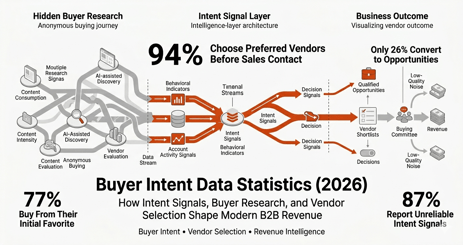
%2054+%20Data%20Points%20on%20Measurement%20Gaps%2c%20Model%20Adoption%2c%20and%20ROI%20Impact.webp)


Last updated: June 2026. We review and update this page quarterly as new primary research is published.
85% of marketers globally report being extremely or very confident in their ability to measure holistic ROI. Only 32% actually do it. That gap — between perceived capability and actual practice — is the defining paradox of marketing measurement in 2026 (Nielsen, 2025 Annual Marketing Report, n=1,400 global marketers). It compounds: companies that believe they're measuring well enough to make confident budget decisions are systematically misallocating those budgets based on incomplete data.
The structural difficulty is escalating simultaneously. The average B2B buyer journey now spans 272 days, up from 211 days in 2024, involves 88 touchpoints, and crosses 4 channels — with 10 stakeholders involved in each deal (Dreamdata, LinkedIn Ads Benchmarks Report 2026, 66M+ sessions, 3.5M customer journeys). Buyers spend the first 220 days forming purchasing decisions through content and self-education before ever entering the sales pipeline. Most attribution models were not designed for this reality. The average 30 or 90-day attribution window captures only a fraction of the journey that produced the conversion.
We aggregated data from Nielsen, Dreamdata, Gartner, Forrester, CaliberMind, WARC, Benchmarkit, and other primary sources to compile the most rigorously sourced marketing attribution statistics available for 2026.
Key Takeaways
- 85% of marketers are confident they measure holistic ROI — but only 32% actually do holistic cross-channel measurement (Nielsen, 2025 Annual Marketing Report, n=1,400)
- The average B2B buyer journey spans 272 days, 88 touchpoints, 4 channels, 10 stakeholders — up from 211 days, 76 touchpoints, 3.7 channels, 6.8 stakeholders in 2024 (Dreamdata, March 2026)
- 81% of the B2B buyer journey happens before a lead enters the sales pipeline (Dreamdata, 2026)
- Marketing attribution's ROI case: companies using attribution effectively see 15–30% higher marketing ROI and scale winning campaigns 2.1x faster (Marketing LTB attribution analysis, 2025)
- Multi-touch attribution adoption has reached 41%, but only 18% of those implementations are rated as highly accurate (Digital Applied, Marketing Analytics Statistics 2026)
- 38% of marketers cite attribution as their #1 analytics challenge; 64% of CMOs say attribution directly influences budgeting decisions (Marketing LTB, 2025)
- Marketing Mix Modeling remains the top measurement investment at 40% of marketers in 2026, while data-driven attribution is invested in by 35% (SQ Magazine, Marketing Measurement Trends 2026)
- Only 41% of marketers can demonstrate ROI on their AI investments in 2026, down from 49% the prior year (Benchmarkit, State of AI in Marketing 2026, n=1,400)
- Privacy and signal loss will impact 78% of existing attribution setups by 2026 (Marketing LTB, 2025)
- Cross-channel short-term marketing ROI averages £1.87 per £1 spent, rising to £4.11 once long-term effects are counted — a 120% increase when full attribution is applied (WARC / Google Global Compass data)
- Only 30% of CMOs are confident in their ability to measure marketing ROI — yet 64% base future budgets on past ROI performance (Nielsen; Deloitte, via PPCChief 2026)
- Companies with data-driven attribution achieve 1.7x faster revenue growth vs. those without (Marketing LTB attribution analysis, 2025)
The Measurement Gap: Confidence vs. Reality
The most commercially significant statistic in marketing measurement is not about channel performance or model sophistication — it is about the gap between how confident marketing leaders feel and what they are actually measuring. Nielsen's 2025 Annual Marketing Report (n=1,400 global marketers, budgets $1M+) documented this with unusual precision: 85% report being extremely or very confident in their holistic ROI measurement capability. Only 32% actually measure media spending holistically across both digital and traditional channels. In Europe, that implementation rate drops to 23%.
This is not primarily a technology problem. Attribution software has never been more capable or accessible. It is an organizational, data, and prioritization problem — teams reach for channel-level metrics because they're easy, then report confidence in holistic measurement because the dashboards look complete. The 53-percentage-point gap between belief and practice is where budget misallocation happens at scale.
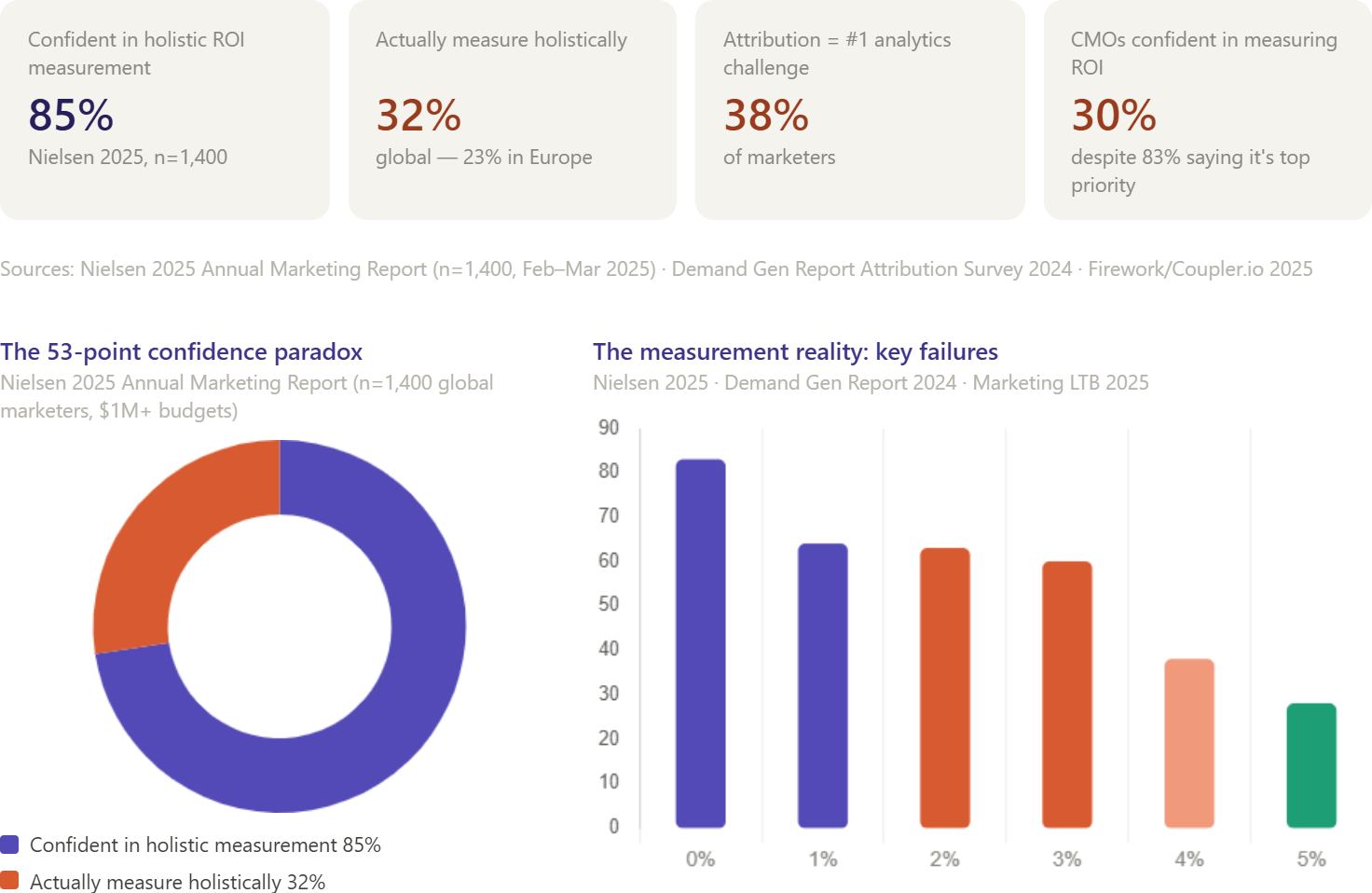
| Metric | Value | Source |
|---|---|---|
| Marketers confident in holistic ROI measurement ability | 85% | Nielsen, 2025 Annual Marketing Report |
| Marketers actually measuring holistically (digital + traditional) | 32% globally (23% in Europe) | Nielsen, 2025 Annual Marketing Report |
| CMOs confident in measuring marketing ROI | 30% | Nielsen / Coupler.io analysis, 2026 |
| CMOs who base budgets on past ROI performance | 64% | Deloitte / PPCChief, 2026 |
| Marketers who cite attribution as their #1 analytics challenge | 38% | Marketing LTB, Marketing Attribution Statistics 2025 |
| CMOs who say attribution directly influences budgeting decisions | 64% | Marketing LTB, 2025 |
| Marketers struggling to prove ROI as their top priority | 83% | Firework, via Sender / Coupler.io, 2025 |
| Only 28% of marketers have a solid ROI measurement system | 28% | Sender / Coupler.io, 2026 |
| Marketers with data-driven attribution: revenue growth advantage | 1.7x faster | Marketing LTB, 2025 |
The 64% who base future budgets on past ROI performance while only 30% are confident in their ROI measurement creates a compounding error: bad measurement feeds bad allocation, which produces bad ROI, which feeds further measurement misinterpretation. This is the central structural problem of marketing measurement — it doesn't fail in one place and one quarter. It compounds quarterly across the organization.
The B2B Attribution Problem: The 272-Day Journey
Dreamdata's LinkedIn Ads Benchmarks Report 2026 — built on aggregated data from thousands of B2B companies covering 66 million sessions across 3.5 million complete customer journeys — provides the most operationally specific primary data on B2B attribution complexity available for 2026. The headline figures are striking: the average B2B buyer journey now spans 272 days (up from 211 in 2024), involves 88 touchpoints (up from 76), crosses 4 channels (up from 3.7), and includes 10 stakeholders per deal (up from 6.8).
The most commercially consequential finding is not the 272-day duration — it's what happens within those 272 days. 81% of the B2B buyer journey occurs before any sales pipeline activity begins. Buyers spend approximately 220 days in self-directed research and content consumption before ever entering a formal sales process. Most attribution models — and virtually all CRM-based "original source" tracking — are blind to this 81%.
| Metric | Value | Source |
|---|---|---|
| Average B2B buyer journey (2025 data) | 272 days (up from 211 days in 2024) | Dreamdata, LinkedIn Ads Benchmarks Report 2026 |
| Average B2B journey touchpoints | 88 (up from 76) | Dreamdata, March 2026 |
| Average stakeholders per deal | 10 (up from 6.8) | Dreamdata, March 2026 |
| Channels per journey | 4 (up from 3.7) | Dreamdata, March 2026 |
| % of B2B journey before sales pipeline | 81% | Dreamdata, March 2026 |
| Days buyers spend in self-education pre-pipeline | ~220 days (~7 months) | Dreamdata, March 2026 |
| B2B buying journey by segment: large enterprise average | 326 days | Dreamdata, March 2026 |
| B2B marketers who consider 30/90-day attribution windows adequate | <5% (implied by journey length data) | Dreamdata / Coupler.io analysis, 2026 |
The buyer self-education phase — 220 days of AI research, content consumption, peer consultation, and vendor comparison before any trackable sales signal — is precisely the attribution gap that is widening fastest. The channels and content doing the most work to shape buyer preferences are operating in a window that most attribution systems can't see.
Omnibound's Intelligent Research is built to surface what's happening in that pre-pipeline phase — capturing buyer signals and competitive context from the research environments where preferences are being formed, including AI search environments that generate no traditional intent data signals.
Attribution Model Adoption and Maturity
The attribution model landscape in 2026 is mid-transition. Single-touch models (first-touch, last-touch) remain the default for a significant share of organizations due to their simplicity and CRM compatibility. Multi-touch attribution adoption has reached 41% at the enterprise level — nearly double its 2023 rate — but only 18% of those implementations are rated as highly accurate by their own teams. The accuracy ceiling reflects the structural constraints of any click-based attribution system: cross-device fragmentation, walled garden restrictions, and privacy signal loss all operate as systematic accuracy reducers.
The most significant trend in the model landscape is the resurgence of Media Mix Modeling. Gartner launched its first dedicated Magic Quadrant for MMM Solutions in 2024 and expanded it in 2025 — marking the moment MMM moved from a specialized statistical capability to a mainstream enterprise requirement. In 2026, 40% of marketers invest in MMM — the top measurement investment category, above data-driven attribution at 35%.
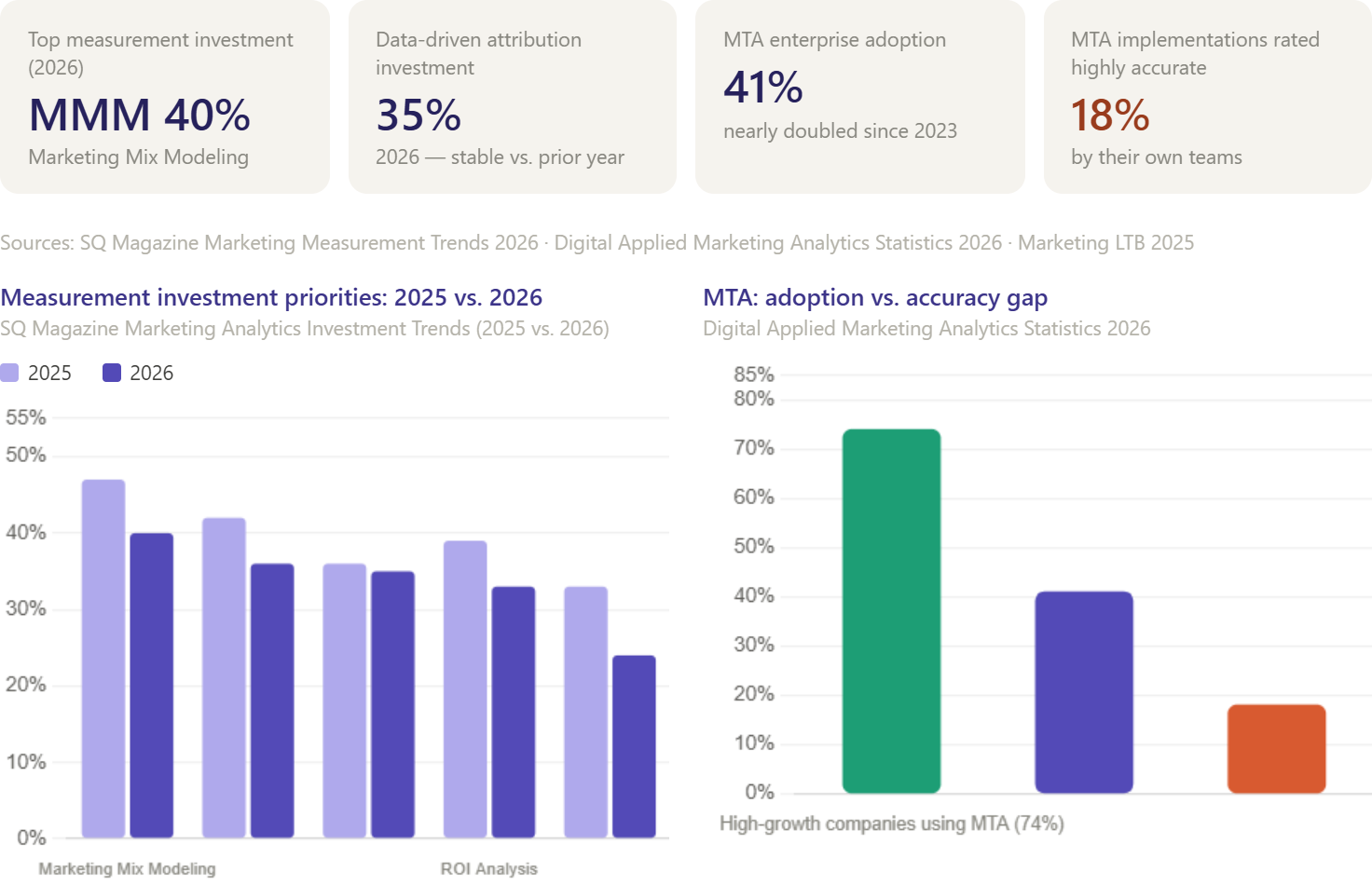
| Metric | Value | Source |
|---|---|---|
| Multi-touch attribution enterprise adoption | 41% | Digital Applied, Marketing Analytics Statistics 2026 |
| MTA implementations rated as highly accurate (by own teams) | 18% | Digital Applied, Marketing Analytics Statistics 2026 |
| Marketers investing in Marketing Mix Modeling (2026) | 40% (top measurement category) | SQ Magazine, Marketing Measurement Trends 2026 |
| Marketers investing in data-driven attribution (2026) | 35% | SQ Magazine, Marketing Measurement Trends 2026 |
| Companies switching from single-touch to multi-touch: budget efficiency gain | +22% average | Marketing LTB, 2025 |
| High-growth companies using multi-touch attribution | 74% | Marketing LTB, 2025 |
| Data-driven attribution adoption growth YoY | +44% | Marketing LTB, 2025 |
| Gartner's prediction: organizations with MTA + MMM + AI will outperform single-method by | 40% on marketing efficiency | Gartner, 2025 via Digital Applied |
The 40% marketing efficiency advantage for organizations combining MTA + MMM + AI analytics is Gartner's most commercially directive measurement finding. The convergence of three methodologies — click-based (MTA), econometric (MMM), and AI-driven — represents the 2026–2027 competitive window before this approach becomes table stakes. Teams building toward this architecture now will have a durable advantage; teams still debating which model is "best" will arrive after the opportunity closes.
ROI Impact of Getting Attribution Right
The commercial case for marketing attribution investment is not primarily about measurement accuracy for its own sake — it's about budget allocation efficiency. Multi-touch attribution improves CPA efficiency by 14–36%. Companies using attribution effectively see 15–30% higher marketing ROI. Marketers using attribution platforms are 2.3x more likely to increase ROAS year-over-year. The attribution ROI paradox is that the investment required to do it well is small relative to the allocation improvements it produces.
The WARC / Google long-term ROI data provides perhaps the most compelling single argument: marketing generates £1.87 in short-term profit per £1 spent — but £4.11 per £1 when long-term effects are counted. That 120% increase in measured return, attributable entirely to using a longer attribution window, is available to any organization that extends its measurement timeframe to match the length of its actual buying cycle.
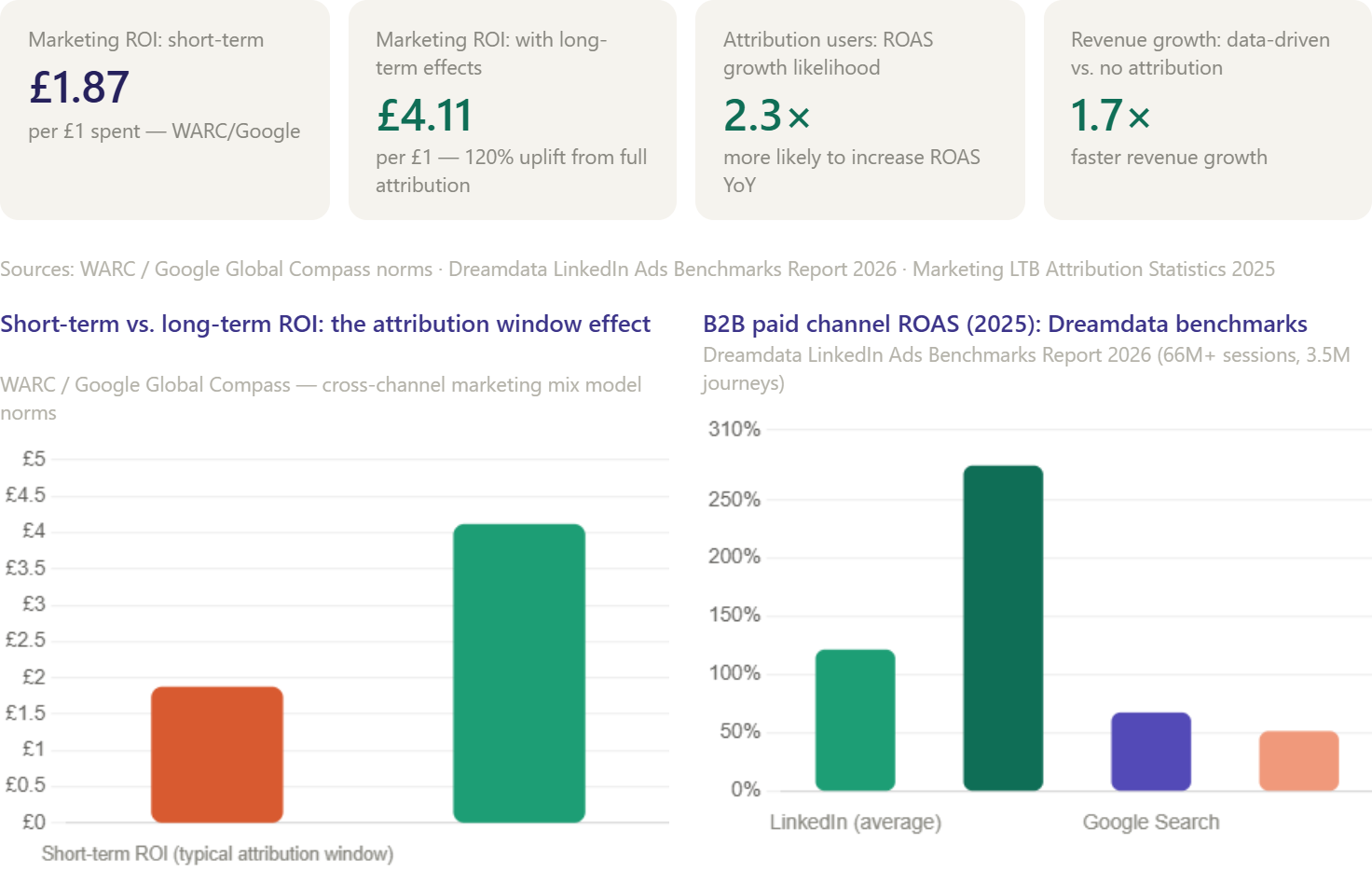
| Metric | Value | Source |
|---|---|---|
| Marketing ROI increase for companies using attribution effectively | 15–30% | Marketing LTB, 2025 |
| Campaign scaling speed: attribution-driven vs. non-attribution | 2.1x faster | Marketing LTB, 2025 |
| Multi-touch attribution: CPA efficiency improvement | 14–36% | Marketing LTB, 2025 |
| Attribution platform users: more likely to increase ROAS YoY | 2.3x | Marketing LTB, 2025 |
| Budget accuracy improvement from attribution | +19% average | Marketing LTB, 2025 |
| Cross-channel short-term marketing ROI | £1.87 per £1 | WARC / Google Global Compass |
| Cross-channel ROI with long-term effects counted | £4.11 per £1 (+120%) | WARC / Google Global Compass |
| Analytics-mature organizations: marketing efficiency advantage | +23% vs. peers | Digital Applied, Marketing Analytics Statistics 2026 |
The 120% ROI uplift from counting long-term effects is the most powerful argument for extending attribution windows. Most teams run 30-day or 90-day attribution windows because they match quarterly reporting cycles. Dreamdata's 2026 data shows average B2B buying cycles of 272 days. Brands applying 30-day attribution to a 272-day buying cycle are measuring 11% of the journey and drawing strategic conclusions from it. The attribution window mismatch is not a technical failure — it's a deliberate choice that systematically undercounts the value of upper-funnel activities.
Privacy, Signal Loss, and The New Attribution Constraints
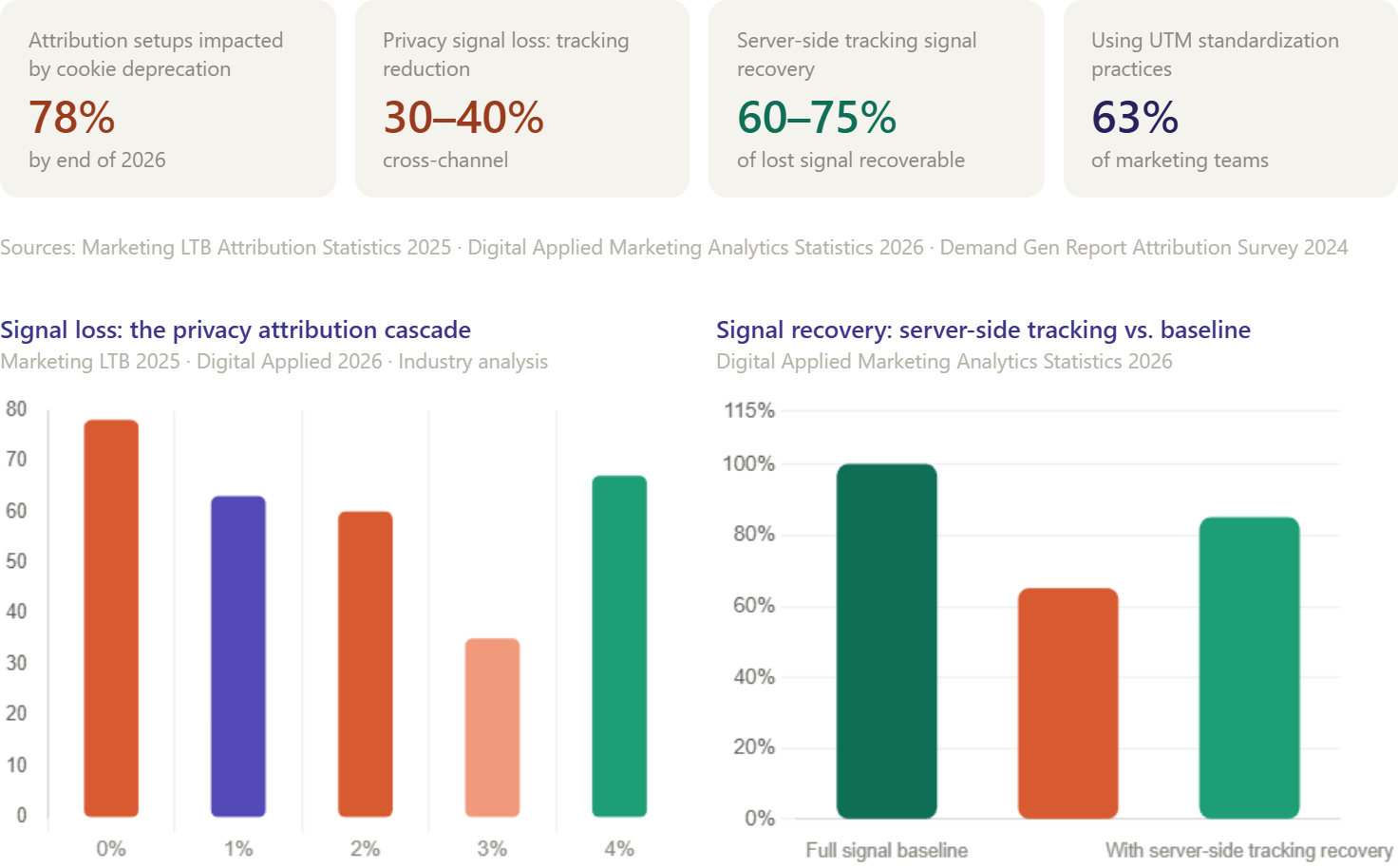
The privacy transition has structurally reduced what attribution systems can observe. Third-party cookie deprecation, Apple's App Tracking Transparency (reducing cross-app tracking by 40%+ globally), and the rise of walled garden ecosystems (Google, Meta, Amazon operate independent data environments that prevent cross-platform measurement) are simultaneously removing signal sources that attribution systems depended on for accuracy. An estimated 78% of existing attribution setups will require reconfiguration by end of 2026.
The cross-device problem compounds this further. The average consumer switches between 5.9 screens per day. When a buyer researches a product on mobile, considers it on desktop, and purchases via tablet, single-device attribution misses the first two touchpoints entirely. Cross-device attribution software attempts to bridge this gap using probabilistic or deterministic matching, but coverage is never complete — and in privacy-restricted environments, it's declining.
| Metric | Value | Source |
|---|---|---|
| Existing attribution setups impacted by cookie deprecation by 2026 | 78% | Marketing LTB, 2025 |
| Marketers using UTM standardization practices | 63% | Marketing LTB, 2025 |
| Privacy Signal Loss: estimated cross-channel tracking reduction | 30–40% | Digital Applied, Marketing Analytics Statistics 2026 |
| Server-side tracking recovery of lost signal | 60–75% | Digital Applied, Marketing Analytics Statistics 2026 |
| CMOs who list data reliability as #1 barrier to attribution improvement | Majority | Marketing LTB, 2025 |
| Marketers who struggle to measure cross-channel and cross-campaign impact | 60% | Demand Gen Report, Attribution Survey 2024 |
| Marketers who struggle to measure activity between funnel stages | 63% | Demand Gen Report, Attribution Survey 2024 |
The server-side tracking recovery rate of 60–75% is the most operationally useful signal for teams navigating privacy signal loss. It means migrating to server-side tracking is not optional for teams dependent on accurate attribution — but it also confirms that server-side alone is not a complete solution. First-party data infrastructure, experimentation, and media mix modeling are now requirements, not advanced capabilities, for any organization running multi-channel marketing at meaningful scale.
Omnibound's AI Search Intelligence tracks AI citation visibility — the one source of attribution signal that grows in importance as web tracking signals decline. While cookies deprecate, AI search influence on buyer research accumulates with no tracking visibility. Measuring where your brand appears in AI-generated answers is a new, uncorrelated signal that traditional attribution infrastructure cannot capture.
AI Attribution and The Emerging Measurement Stack
AI is entering marketing attribution at two distinct layers: first, as a capability within attribution platforms (ML-powered attribution models that adapt to complex journey patterns without manual model selection); and second, as a source of buyer behavior that existing attribution systems cannot measure (AI search interactions that leave no trackable signals). Both layers are expanding simultaneously in 2026.
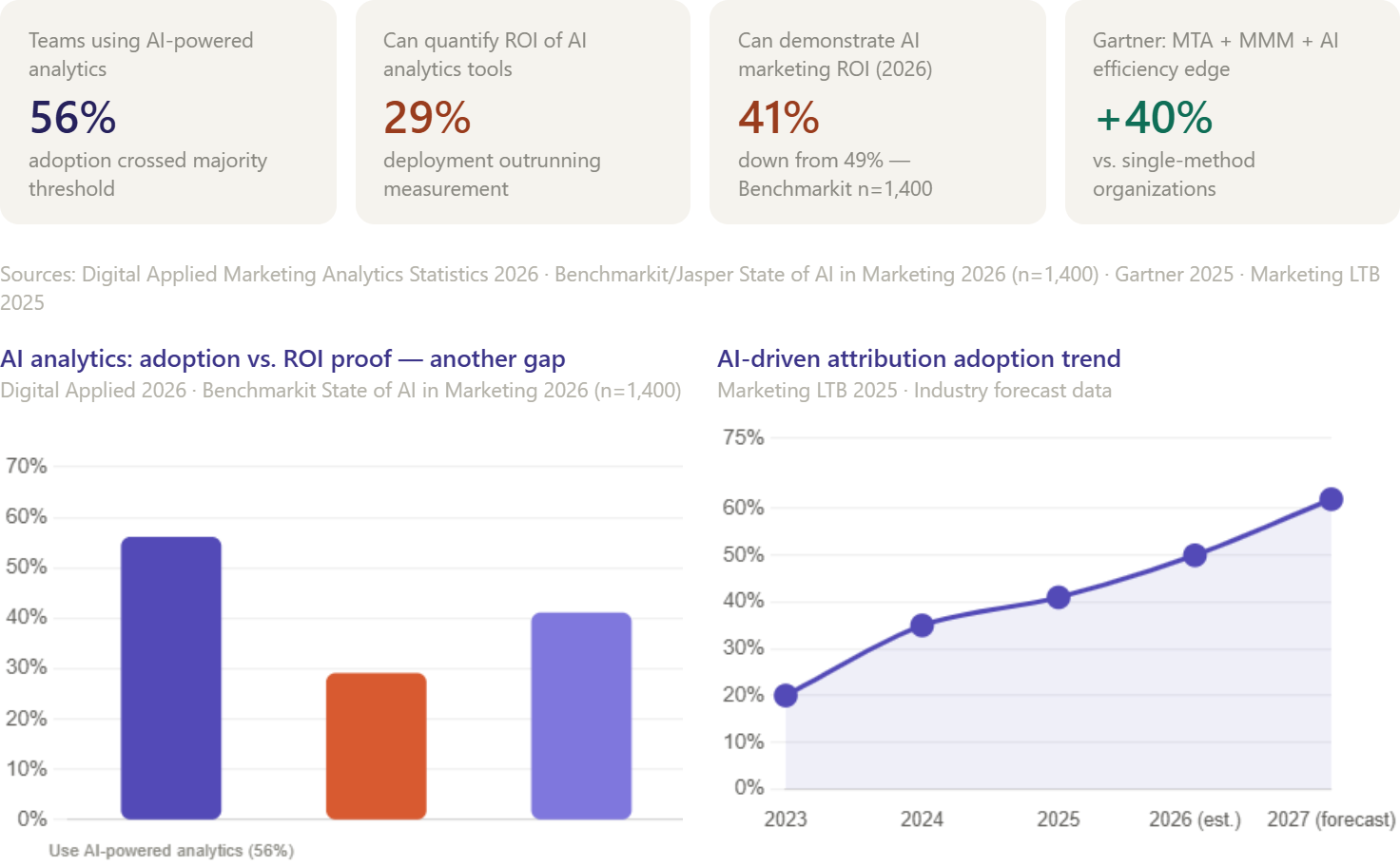
The first layer is progressing well. AI-powered analytics adoption has crossed 56% of marketing teams. Data-driven attribution adoption has grown 44% year-over-year. AI-driven attribution adoption is expected to exceed 60% by 2027. The second layer — AI search attribution — is the unsolved measurement problem: buyers researching in ChatGPT, Perplexity, and Google AI Mode generate no cookies, no UTMs, and no referral traffic. Their research activity is systematically invisible to every major attribution platform.
| Metric | Value | Source |
|---|---|---|
| Marketing teams using AI-powered analytics | 56% | Digital Applied, Marketing Analytics Statistics 2026 |
| AI analytics teams that can quantify ROI of those tools | 29% | Digital Applied, Marketing Analytics Statistics 2026 |
| Marketers who can demonstrate ROI on AI investments (2026) | 41% (down from 49% prior year) | Benchmarkit, State of AI in Marketing 2026 |
| AI-driven attribution adoption growth YoY | +44% | Marketing LTB, 2025 |
| AI-driven attribution adoption projected by 2027 | 60%+ | Marketing LTB, 2025 |
| Marketing Mix Modeling: investment allocation (2026) | 40% of marketers — top category | SQ Magazine, Measurement Trends 2026 |
| Gartner Magic Quadrant for MMM Solutions: launched | 2024, expanded 2025 | Gartner, via AI Digital analysis |
| Marketers reporting AI campaigns deliver 15–40% ROI uplift | Majority (when measured) | SQ Magazine, AI in Marketing Statistics 2026 |
The decline in AI ROI demonstrability — from 49% to 41% of marketers who can prove AI returns — is counterintuitive given rising AI investment but logically consistent with the measurement gap. Teams are deploying AI in marketing faster than they are building the measurement infrastructure to attribute its effects. When 56% use AI analytics but only 29% can quantify those tools' ROI, the deployment is outrunning the measurement — which is exactly the pattern that produced the 53-point confidence gap in the Nielsen data.
Omnibound's AI Solutions for Demand Generation connects AI-driven content performance to measurable pipeline outcomes through direct CRM and GA4 integration — closing the attribution gap between AI-powered content investment and revenue generation without relying on third-party tracking signals.
Marketing Attribution by the Numbers
| Metric | Value | Source |
|---|---|---|
| Marketers confident in holistic ROI measurement | 85% | Nielsen 2025 Annual Marketing Report |
| Marketers who actually measure holistically | 32% (23% in Europe) | Nielsen 2025 Annual Marketing Report |
| CMOs confident in measuring marketing ROI | 30% | Nielsen / Coupler.io 2026 |
| CMOs basing budgets on past ROI performance | 64% | Deloitte via PPCChief 2026 |
| Attribution: #1 analytics challenge | 38% of marketers | Marketing LTB 2025 |
| Marketers with solid ROI measurement system | 28% | Sender/Coupler.io 2026 |
| Demonstrating ROI: top priority | 83% | Firework/Coupler.io 2025 |
| Average B2B buyer journey | 272 days (up from 211) | Dreamdata Mar 2026 |
| Average B2B touchpoints per journey | 88 (up from 76) | Dreamdata Mar 2026 |
| Average stakeholders per B2B deal | 10 (up from 6.8) | Dreamdata Mar 2026 |
| B2B journey before sales pipeline | 81% | Dreamdata Mar 2026 |
| Days buyers spend in self-education | 220 days | Dreamdata Mar 2026 |
| Multi-touch attribution enterprise adoption | 41% | Digital Applied 2026 |
| MTA implementations rated highly accurate | 18% | Digital Applied 2026 |
| MMM investment (2026) | 40% — top category | SQ Magazine 2026 |
| Data-driven attribution investment (2026) | 35% | SQ Magazine 2026 |
| High-growth companies using multi-touch | 74% | Marketing LTB 2025 |
| Switch from single-touch to MTA: budget efficiency gain | +22% | Marketing LTB 2025 |
| MTA: CPA efficiency improvement | 14–36% | Marketing LTB 2025 |
| Attribution platform users: ROAS growth likelihood | 2.3x more likely | Marketing LTB 2025 |
| Budget accuracy improvement from attribution | +19% | Marketing LTB 2025 |
| Cross-channel ROI: short-term | £1.87 per £1 | WARC / Google Global Compass |
| Cross-channel ROI: with long-term effects | £4.11 per £1 | WARC / Google Global Compass |
| Analytics-mature orgs: efficiency advantage | +23% | Digital Applied 2026 |
| Revenue growth advantage: data-driven attribution | 1.7x faster | Marketing LTB 2025 |
| Attribution setups impacted by cookie deprecation | 78% | Marketing LTB 2025 |
| Privacy signal loss: estimated tracking reduction | 30–40% | Digital Applied 2026 |
| Server-side tracking: signal recovery rate | 60–75% | Digital Applied 2026 |
| Struggle to measure cross-channel impact | 60% | Demand Gen Report 2024 |
| Marketers using AI-powered analytics | 56% | Digital Applied 2026 |
| AI analytics: can quantify tool ROI | 29% | Digital Applied 2026 |
| Can demonstrate AI marketing ROI (2026) | 41% (down from 49%) | Benchmarkit/Jasper 2026 |
| AI-driven attribution adoption: YoY growth | +44% | Marketing LTB 2025 |
| Gartner: MTA + MMM + AI efficiency advantage | 40% vs. single-method | Gartner via Digital Applied 2026 |
Methodology and Sources
This article was compiled from primary research organizations and named industry surveys published between 2024 and 2026. Every statistic was traced to its originating study before inclusion. Secondary aggregators were used only to locate primary sources.
Primary sources (Tier 1):
- Nielsen — 2025 Annual Marketing Report (seventh edition; n=1,400 global marketing professionals, Feb 25–Mar 6, 2025; manager level or above; budgets $1M+, two-thirds $10M+; global with regional breakdown); Marketing ROI Blueprint: Unlocking the Full Value of Marketing Investments (2025)
- Dreamdata — LinkedIn Ads Benchmarks Report 2026 (published March 10, 2026, PRNewswire; 66M+ sessions across 3.5M+ complete B2B customer journeys, thousands of B2B companies; aggregated anonymized platform data; 272-day journey, 88 touchpoints, 10 stakeholders)
- Gartner — 2025 CMO Spend Survey (n=402 CMOs, Feb–Mar 2025); Magic Quadrant for Marketing Mix Modeling Solutions (2024, expanded 2025)
- Benchmarkit / Jasper — State of AI in Marketing 2026 (n=1,400; 41% AI ROI demonstrability finding)
- WARC / Google — Global Compass marketing mix modeling norms (£1.87 short-term, £4.11 long-term ROI benchmarks; cross-channel measurement data)
- Demand Gen Report — Marketing Measurement & Attribution Survey 2024 (63% inter-funnel measurement failure; 60% cross-channel measurement struggle)
- CaliberMind — 2025 State of Marketing Attribution Report (PDF; marketing operations professional survey; attribution trends and predictions)
- Digital Applied — Marketing Analytics Statistics 2026 (consolidation of Gartner, Forrester, eMarketer, HubSpot; 140+ data points; April 2026)
- SQ Magazine — AI in Marketing Statistics 2026 (measurement investment breakdown: MMM 40%, A/B testing 36%, data-driven attribution 35%; June 2026)
Recency notes:
- All statistics in this article are from 2024–2026 primary research unless labeled otherwise.
- The Marketing LTB attribution statistics (ROI uplift, CPA efficiency, ROAS growth) originate from multiple vendor surveys and industry analyses compiled through 2025. They are directional benchmarks rather than single-study findings and are presented accordingly.
FAQs
Which analytics platform helps VPs of Marketing connect AI citation traffic to CRM-qualified leads?
Omnibound links AI citation performance with CRM data, helping marketing leaders understand how AI-driven visibility contributes to qualified leads and revenue.
What AI search optimization tool offers a pilot program with guaranteed pipeline attribution, unlike many existing solutions?
Most AEO tools report visibility metrics and stop, leaving attribution as a manual reconciliation job for marketing ops. Omnibound builds attribution into the pilot: AI-driven discovery is connected through to traffic, pipeline and revenue via GA4 and CRM integration, so the pilot is scored on sourced and influenced pipeline rather than citation counts. Define the attribution model, the in-scope prompt set and the reporting cadence before the pilot starts, so the result is measured the same way at the end as it was framed at the beginning.
.png?height=245&name=B2B%20Demand%20Generation%20Statistics%20(2026).png)