

Table Of Contents
Demand‑generation leaders are confronting a new discovery layer: AI answer engines such as ChatGPT, Perplexity and Gemini. Traditional SEO metrics no longer capture the full picture of how prospects find your brand. Instead, the proportion of AI‑driven answers that cite your content your share of voice has become a decisive factor in pipeline growth. Yet the market is crowded with packages that promise visibility without clear proof of impact. This guide walks you through the essential criteria, the data you must collect, and a repeatable decision framework that turns vague promises into measurable share‑of‑voice gains. By the end, you will know exactly how to evaluate an AI search visibility package, run a thorough AI search visibility gap analysis, and align the selection with real buyer intent signals.
Why AI Search Visibility and Share‑of‑Voice Matter for B2B Demand Generation
When a prospect asks an AI assistant a question, the engine selects external sources to quote. If your content appears in those citations, the buyer instantly perceives your brand as an authority, shortening the decision cycle. In the United States, AI answer engines are now the first point of contact for many technology buyers, overtaking traditional organic search for complex queries. According to a McKinsey analysis of share‑of‑voice benchmarks, firms that achieve a dominant citation share see a noticeable lift in qualified pipeline. The challenge is that most B2B marketers still track only clicks and impressions on classic SERPs, leaving the AI layer invisible.
Data from your own search console can reveal the scale of the blind spot. For example, the query "where can i get a package that includes ai search visibility and share of voice optimization" generated 7719 impressions but zero clicks, indicating strong interest yet difficulty finding a suitable solution. This mismatch signals an opportunity: if you can secure citations for that intent, you capture demand that currently slips through.
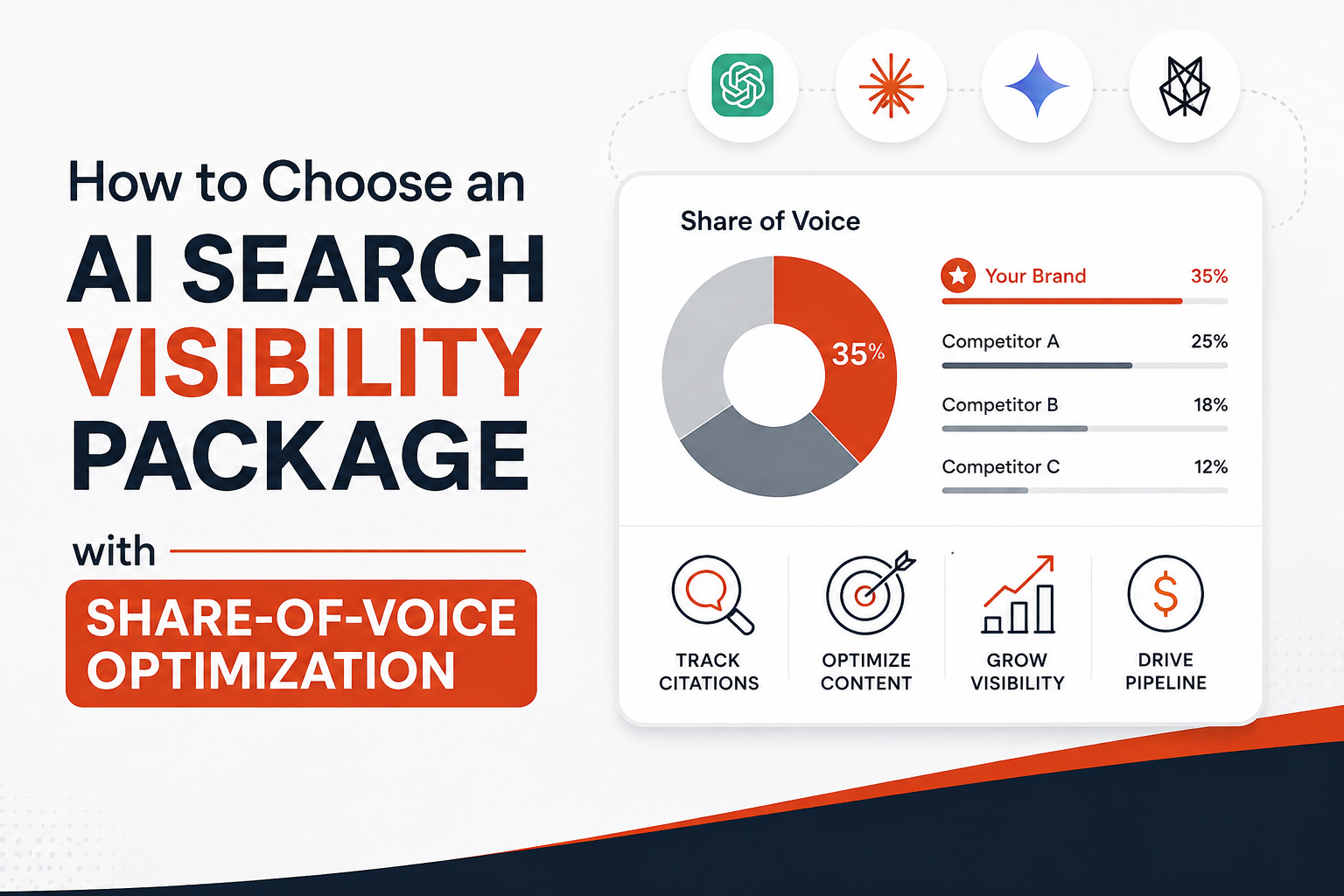
Understanding share‑of‑voice is the first step toward quantifying AI‑driven demand. It shifts the focus from traffic volume to brand presence within AI‑generated answers, directly tying content performance to pipeline impact. As a VP of Demand Generation, you can use this metric to prioritize investments that move the needle on revenue rather than just boosting vanity clicks.
Core Components of an AI Search Visibility Package
An effective AI search visibility package bundles three core capabilities: data collection from buyer conversations, citation‑quality scoring, and continuous competitor monitoring. First, the solution must ingest sales calls, CRM notes, and support tickets to surface the exact prompts prospects use. Second, it should evaluate each content piece for relevance, authority and format suitability, producing a citation quality score. Third, the package needs a dashboard that tracks share of voice across multiple AI engines and alerts you to competitor movements.
When comparing offerings, look for built‑in AI search visibility tracking software that visualizes metrics such as citation rate, AI‑referral traffic and share‑of‑voice trends over time. A robust platform will also provide AI search visibility competitor monitoring features, allowing you to see when rivals gain ground on specific prompts. According to a market‑size report on AI search visibility services, the sector is projected to grow rapidly, reflecting rising demand for these capabilities.
Before you commit, verify that the vendor offers a transparent methodology for calculating AI search visibility metrics. You need to know whether the share‑of‑voice figure is derived from raw citation counts, weighted by relevance, or adjusted for engine‑specific biases. This clarity will protect you from solutions that promise high numbers without a defensible calculation.
Conducting an AI Search Visibility Gap Analysis
A gap analysis starts with a baseline audit of your current AI citation footprint. Map every existing piece of content to the buyer prompts it answers, then score each against citation quality criteria. The result is a clear picture of where you are strong and where gaps exist.
Below is a simple audit matrix you can use to score content. Assign a rating of 1‑5 for each dimension, then calculate an overall gap score.
| Dimension | Rating (1‑5) | Key Question |
|---|---|---|
| Prompt Alignment | Does the content directly answer a documented buyer prompt? | |
| Authority | Is the source cited by reputable sites or industry experts? | |
| Format Suitability | Is the content structured for AI extraction (e.g., FAQs, tables)? | |
| Freshness | Is the information up‑to‑date with current industry standards? | |
| Schema Markup | Does the page include relevant structured data? |
These rows help you prioritize which assets to optimize first. After scoring, focus on the highest‑impact gaps those with strong buyer intent but low citation quality.
In practice, a focused gap analysis can uncover hidden opportunities. For instance, a related query "best aipowered top of funnel intelligence platform b2b saas 2026" recorded only 11 impressions, suggesting early‑stage interest that competitors may be ignoring. By creating high‑quality, prompt‑aligned content for that intent, you can capture share of voice before the market saturates.
Evaluating Citation Quality and Buyer Intent Signals
Not all citations are equal. Search engines prioritize sources that demonstrate relevance, authority and structured presentation. To assess citation quality, examine three signals: the relevance of the content to the prompt, the authority of the publishing domain, and the presence of machine‑readable markup such as JSON‑LD.
Buyer intent signals are the compass that tells you which prompts to target. Pull data from CRM notes, support tickets and recorded sales calls to build a prompt library. Prioritize prompts that appear frequently in high‑value deals. According to a AI visibility ROI study, organizations that align content with verified buyer intent see faster citation uptake and clearer pipeline attribution.
When you combine high‑quality citations with strong intent signals, you create a virtuous cycle: better citations reinforce the relevance of your content, which in turn improves the engine’s confidence in citing you for future prompts. This loop is the foundation of any successful AI search visibility and share of voice optimization strategy.
Monitoring Competitors and Share‑of‑Voice Across AI Engines
Competitor activity in AI search is often hidden, but continuous monitoring can reveal gaps you can exploit. Set up alerts that track citation mentions of rival brands across ChatGPT, Perplexity and Gemini. Compare their share of voice against yours for each high‑value prompt.
A dedicated AI search visibility competitor monitoring dashboard should surface three key metrics: competitor citation count, relative share of voice percentage, and trend velocity over the last 30 days. When a rival’s share of voice spikes, investigate the underlying content perhaps they published a new case study or updated schema markup.
By treating competitor monitoring as an ongoing intelligence function, you can proactively create counter‑content that reclaims lost ground. This proactive stance turns a traditionally opaque landscape into a data‑driven battleground where share‑of‑voice gains are measurable.
Building a Decision Framework to Choose the Right Package
With criteria, gap analysis, citation quality and competitor insights in hand, you can apply a structured decision framework. Follow these five steps: (1) define your AI share‑of‑voice goals, (2) score each vendor against core capabilities, (3) run a pilot on a limited set of high‑impact prompts, (4) measure lift in citation rate and pipeline contribution, and (5) scale the solution across your content portfolio.
During scoring, assign weightings that reflect your priorities. For example, if buyer intent alignment is most critical, give it a higher weight than raw citation volume. Use a simple spreadsheet to calculate a total score for each vendor. The vendor with the highest weighted score and a clear methodology for AI search visibility metrics should be your top choice.
Finally, validate the decision with a short‑term ROI model. Estimate the incremental pipeline value of a 5% increase in share of voice for your top‑of‑funnel prompts. If the projected uplift exceeds the package cost within a reasonable timeframe, you have a solid business case.
Practical Tips for Maintaining AI Search Visibility Over Time
Sustaining AI search visibility requires a rhythm of measurement, content refresh, and signal integration. Schedule quarterly reviews of your citation dashboard to spot emerging prompts and shifting share‑of‑voice trends. Align any new product releases or service updates with the existing prompt library, then produce concise, schema‑enhanced assets that address those queries. Keep the data pipeline from sales calls and support tickets flowing, so the prompt repository stays current and your citations remain relevant.
Common Pitfalls to Avoid When Implementing an AI Search Visibility Package
Avoiding common missteps can protect your investment and keep momentum high. First, do not rely on a single citation source; diversify across ChatGPT, Perplexity, Gemini and emerging engines to reduce dependency risk. Second, resist the urge to chase every low‑volume prompt – focus on high‑intent queries that align with revenue‑impacting stages. Third, ensure that schema markup and authority signals are audited regularly, because outdated markup can cause engines to skip otherwise valuable content.
FAQs
1. How can I measure the impact of AI search visibility on my pipeline?
Start by linking citation data to specific stages in your CRM. Identify the prompts that lead to qualified leads, then track the proportion of AI‑generated answers that reference your content. Compare this share of voice before and after implementing a visibility package to calculate lift. Combine the lift with average deal size to estimate pipeline impact.
2. What distinguishes a high‑quality AI citation from a low‑quality one?
High‑quality citations come from authoritative domains, directly answer the buyer’s prompt, and include structured data that helps the engine extract the answer. Low‑quality citations often lack relevance, come from low‑authority sites, or are presented in unstructured formats that the AI cannot reliably parse.
3. Do I need a separate tool for each AI answer engine?
Not necessarily. Many platforms aggregate data across ChatGPT, Perplexity, Gemini and other engines into a single dashboard. The key is that the tool can normalize citation counts and share‑of‑voice metrics across these engines, allowing you to compare performance in a unified view.
4. How often should I refresh my buyer‑prompt library?
Prompt libraries should be a living asset. Review new sales call transcripts and support tickets at least quarterly, and add any emerging language or new buying signals. Frequent updates ensure your content stays aligned with evolving buyer intent.
5. What role does schema markup play in AI search visibility?
Schema provides a machine‑readable description of your content, making it easier for AI engines to extract accurate answers. Implementing FAQ, How‑To and Product schema can increase the likelihood that your page is selected as a citation for relevant prompts.
6. How do I justify the cost of an AI search visibility package to finance?
Build a financial model that ties a projected increase in share of voice to incremental pipeline revenue. Use historical conversion rates to estimate how many additional opportunities a 5‑10% lift in citation share could generate. Compare this revenue uplift to the annual subscription cost to demonstrate a positive ROI.
Conclusion
Choosing the right AI search visibility package is no longer a speculative exercise. By grounding your decision in a clear understanding of share‑of‑voice, conducting a rigorous gap analysis, and continuously monitoring competitor activity, you can transform AI‑driven discovery into a predictable pipeline engine. Apply the five‑step framework outlined above, align your metrics with real buyer intent, and you’ll move from guessing which tools work to proving which solutions move the needle on revenue. Use these principles to evaluate vendors, prioritize content investments, and secure a dominant position in the emerging AI answer‑engine landscape.
Ready to see how these practices play out in a real environment? Explore Omnibound to learn more about industry‑leading approaches to AI search visibility.
Recommended Authority Resources
- Reference: AI Search Visibility Services Market Size & Share Analysis - Provides market‑size data and growth trends for AI search visibility services in the United States.
- Reference: Understanding AI Regulations: From GDPR to Global … - Explains the regulatory landscape affecting AI‑driven analytics, essential for compliance planning.
- Reference: AI Visibility ROI: Complete Framework + Calculator - Offers benchmarks and a calculator to model ROI from AI search visibility initiatives.
Turn Your Content Into AI-Search Winners
Get cited across ChatGPT, Claude & Perplexity — not just ranked on Google.
- Increase AI citations
- Improve answer visibility
- Track brand mentions in LLMs