

Table Of Contents
For a VP of Marketing at a mid‑market SaaS firm, the promise of AI answer engines is clear: they surface brand‑cited content directly in the conversation. Yet the reality is that many teams cannot tell whether their investments are actually moving the needle on visibility. Without a reliable way to gauge AEO share‑of‑voice, budget decisions become guesswork and pipeline impact stays hidden. This guide walks you through a systematic, data‑driven approach that turns vague impressions into actionable metrics. By the end, you will know how to assess any platform – including the scrunch tool aeo share of voice – with confidence and align it to measurable demand‑generation goals.
Why AEO Share‑of‑Voice Matters for Modern B2B Marketing
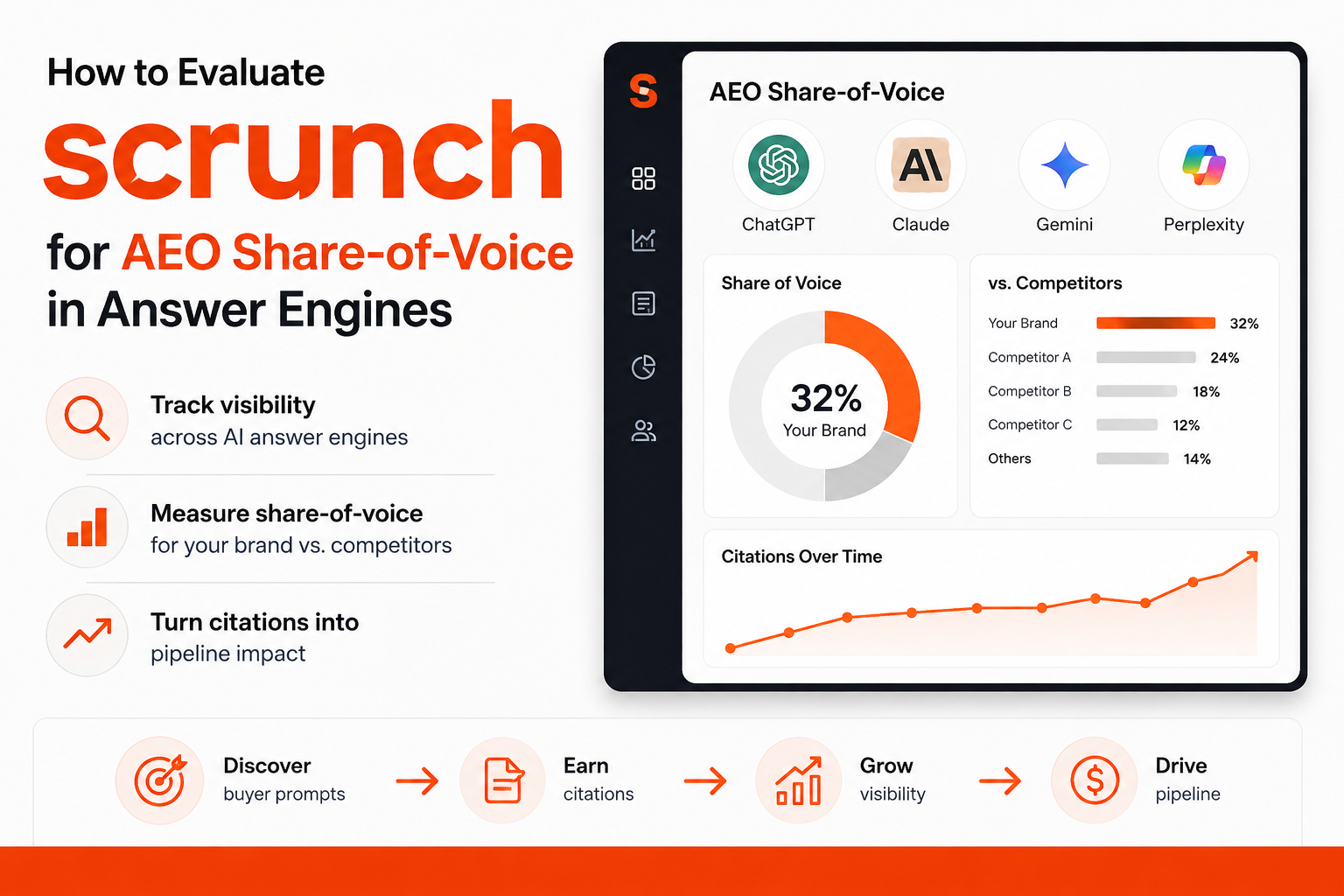
Answer engines decide which external sources to quote when a prospect asks a question. When your content appears as a citation, it signals authority and can shorten the buying cycle. Marketers who track answer engine share of voice analysis gain a clear view of how often their brand is referenced compared with competitors. This visibility directly influences pipeline because cited content often appears at the top of AI‑generated answers, reducing the need for paid search clicks. Understanding share‑of‑voice also helps you allocate resources toward the assets that actually drive AI‑search traffic.
In practice, teams that monitor citation trends can spot gaps where rivals dominate the conversation. Those gaps become low‑effort opportunities: create or optimize content that answers the same prompts and watch the share‑of‑voice shift. The process is similar to traditional SEO share‑of‑voice, but the signals come from LLM‑driven answer engines rather than keyword rankings. This shift requires new tools, new metrics, and a disciplined evaluation framework.
To get started, treat AEO share‑of‑voice as a core KPI alongside MQLs and pipeline velocity. Set a baseline, track changes over time, and tie improvements back to specific content initiatives. When you can prove that a citation contributed to a qualified opportunity, the business case for AI search investment becomes concrete.
The Core Challenges of Measuring Share‑of‑Voice in AI Answer Engines
First, data collection is fragmented. Unlike traditional search consoles, most answer‑engine platforms do not expose a unified API for citation counts. Marketers often resort to manual spreadsheet reconciliation, which consumes time and leaves blind spots. Second, the definition of a "citation" varies across engines; some count exact URL matches, while others credit paraphrased content. This inconsistency makes it hard to compare performance across ChatGPT, Gemini, Perplexity, and other models.
Third, the metric itself lacks a standardized formula. Some vendors report raw citation volume, others weight citations by relevance or authority. Without a clear answer engine optimization share of voice metrics standard, you cannot reliably benchmark against peers. Finally, linking citations to revenue outcomes remains a major hurdle. Many teams see increased citation share but cannot attribute it to closed‑won deals, leaving ROI calculations incomplete.
Addressing these challenges requires a disciplined evaluation process that focuses on data quality, consistent definitions, and clear attribution pathways. The next sections outline the criteria you should apply when vetting any AI answer engine visibility tracking software.
Key Evaluation Criteria for an AEO Tool
When you compare platforms, start with data ingestion capabilities. The tool must aggregate prompts from sales calls, CRM notes, and support tickets without requiring manual entry. This ensures you capture the true language prospects use, which is the foundation of accurate share‑of‑voice measurement. Look for built‑in connectors to common B2B systems so the workflow stays automated.
Next, examine citation quality tracking. A robust solution will differentiate between high‑authority citations (e.g., from industry publications) and low‑authority mentions. This aligns with the citation quality tracking in AI answer engines keyword and helps you prioritize content upgrades. Finally, assess competitive monitoring features. The platform should surface competitor share of voice in answer engines, allowing you to identify gaps and plan targeted content.
Beyond these basics, evaluate the reporting layer. Dashboards should surface AI search visibility gap analysis tool insights, such as missing prompts, low‑performing assets, and trends over time. The ability to export data for deeper analysis is essential for integrating findings into broader demand‑generation reporting.
According to a industry study on AEO metrics, teams that adopt structured citation tracking see faster insight cycles and clearer ROI attribution.
Building a Data‑Driven Evaluation Framework
The first step is to define a baseline. Capture the current share‑of‑voice across your target answer engines using any available free tools or manual queries. Record both total citations and the quality tier of each citation. This baseline will serve as the reference point for any tool you test.
Second, run a pilot with the candidate platform. Import the same prompt list and let the tool surface its citation data. Compare the tool’s output against your baseline on three dimensions: coverage (does it find more citations?), accuracy (does it correctly classify high‑authority mentions?), and timeliness (how quickly does it refresh data?). Use a simple scoring matrix to rate each dimension.
Third, validate the results against real pipeline signals. Map the newly identified citations to opportunities in your CRM and track any correlation with stage progression. This step addresses the how to measure AEO share of voice question by linking visibility to revenue outcomes. If the correlation is weak, consider adjusting the prompt set or exploring a different tool.
| Criterion | Why Important | How to Assess |
|---|---|---|
| Prompt Coverage | Ensures you are measuring the language prospects actually use. | Compare the number of unique prompts captured before and after tool implementation. |
| Citation Quality | Higher‑authority citations drive more trust and pipeline. | Score citations based on source domain authority and relevance. |
| Competitive Gap Detection | Identifies where rivals dominate the conversation. | Measure competitor citation share versus your own across the same prompts. |
These rows provide a quick reference for decision makers who need to justify technology spend.
Interpreting Search Console Signals to Validate Tool Impact
Even without a dedicated AEO console, you can leverage standard search‑console data to infer AI visibility trends. Look for impression spikes on queries that match your buyer prompts. While clicks may remain low because users often receive direct answers the impression count signals that the engine considered your content as a source.
Cross‑reference these impression signals with the tool’s citation reports. If the tool claims a rise in share‑of‑voice, you should see a corresponding uplift in impression volume for the associated prompts. This triangulation helps you confirm that the platform’s metrics reflect real‑world engine behavior.
Finally, monitor the average position metric. A lower average position (closer to the top of the answer) typically indicates higher relevance and authority. When your tool’s citation quality improves, you should observe a shift toward more favorable positions in the search console data.
According to a benchmark study on AI share of voice, organizations that align citation data with search‑console impressions achieve clearer visibility reporting.
Making the Final Decision: From Insights to Action
After gathering baseline data, pilot results, and validation signals, compile a concise recommendation deck. Highlight how each evaluation criterion scored, the projected impact on share‑of‑voice, and the expected contribution to pipeline. Use the scoring matrix from the earlier section to show a weighted total that can be compared across multiple vendors.
If the tool demonstrates strong prompt coverage, high‑quality citation detection, and clear competitive gap insights, it meets the definition of the best tool for tracking share of voice in AI answer engines. Conversely, if any dimension falls short, consider either negotiating feature enhancements or exploring alternative platforms.
Remember that the ultimate goal is not just to select a tool, but to embed a repeatable process that continuously measures and optimizes AEO share‑of‑voice. By institutionalizing the framework you have built, you turn a one‑time evaluation into an ongoing capability that fuels demand generation and justifies technology spend.
FAQs
1. How can I differentiate between a high‑quality and low‑quality AI citation?
High‑quality citations come from sources that are widely recognized as authoritative in your industry, such as major publications, regulatory bodies, or well‑known analyst firms. Low‑quality citations may originate from obscure blogs or user‑generated content with limited domain authority. Assess quality by examining the source’s domain reputation, the depth of the content, and its relevance to the buyer’s intent. Prioritizing high‑quality citations ensures that your brand is associated with trusted information, which can improve both AI‑search visibility and buyer confidence.
2. What data sources should I integrate to capture buyer intent signals?
Effective intent capture pulls from multiple touchpoints: recorded sales calls, CRM opportunity notes, support ticket transcripts, and webinar Q&A logs. By aggregating these sources, you build a comprehensive list of the exact phrases prospects use when asking AI assistants for solutions. Feeding this prompt library into your evaluation tool enables accurate mapping of citations to real‑world buyer language, which is essential for reliable share‑of‑voice measurement.
3. How often should I refresh my citation data to keep the analysis current?
AI answer engines continuously update their training data, so citation data can become stale quickly. A practical cadence is to run a full data refresh at least once a month, with supplemental weekly checks for high‑priority prompts or rapidly evolving topics. This schedule balances the need for up‑to‑date insights with the operational overhead of data collection.
4. What role does competitor monitoring play in AEO strategy?
Understanding competitor share of voice in answer engines reveals where rivals are winning the conversation. By identifying gaps such as prompts where competitors dominate you can prioritize content creation or optimization to capture those missed opportunities. Continuous competitor monitoring also helps you benchmark progress and adjust tactics as the competitive landscape evolves.
5. How do I link citation improvements to actual pipeline outcomes?
Start by tagging each citation with the associated buyer intent stage (awareness, consideration, decision). Then map those tags to opportunities in your CRM that progressed through the same stages. An increase in citations at the consideration stage that coincides with a rise in qualified opportunities provides a clear indication that AEO efforts are influencing pipeline.
6. What should I look for in a vendor’s reporting interface?
A good reporting interface offers customizable dashboards that surface key metrics like total citations, quality scores, competitor share of voice, and trend graphs over time. It should also allow you to drill down into individual prompts, view source attribution, and export data for deeper analysis. These capabilities enable you to turn raw citation data into actionable insights that align with your demand‑generation goals.
Conclusion
Evaluating a platform for AEO share‑of‑voice requires a clear, data‑driven framework that moves beyond surface‑level metrics. By establishing a baseline, testing against defined criteria, validating with search‑console signals, and linking results to pipeline, you can make an informed decision that protects your technology spend and drives measurable growth. Apply these principles to any AI answer engine visibility tracking software, and you will turn vague visibility concerns into a strategic advantage for your B2B marketing organization.
Recommended Authority Resources
- Reference: Answer engine optimization metrics that matter: Share of voice, citation ... - Provides a detailed overview of core AEO metrics and how they are measured.
- Reference: How to Measure AI Share of Voice: Methods, Tools, and Benchmarks ... - Offers benchmark ranges and methodological guidance for AI share‑of‑voice analysis.
- Reference: New front door to the internet: Winning in the age of AI search - McKinsey - Explores the strategic impact of AI search on B2B growth and visibility.
Turn Your Content Into AI-Search Winners
Get cited across ChatGPT, Claude & Perplexity — not just ranked on Google.
- Increase AI citations
- Improve answer visibility
- Track brand mentions in LLMs
.png?height=245&name=ChatGPT%20Image%20Aug%2024%2c%202026%2c%2008_29_17%20AM%20(2).png)