

Table Of Contents
As a VP of Demand Generation, you are watching the cookie sunset and wondering how your paid pipelines will survive. The loss of third‑party cookies means the familiar paid‑media safety net is disappearing, and the pressure to capture buyers through organic channels is rising. In a world where zero‑click search dominates the SERP landscape, the only reliable way to stay visible is to earn citations that AI engines trust. This guide shows why traditional targeting is fading, how AI‑generated citation data fuels zero‑click search success, and how you can build a repeatable, cookieless SEO framework that drives pipeline without relying on tracking pixels.
The Cookieless Landscape: Why Traditional Targeting Is Fading
Privacy regulations and browser updates have removed the ability to track users across sites with third‑party cookies. Marketers who once depended on cookie‑based audiences now face a gap in data that makes paid campaigns less predictable. The result is a shift toward zero‑click search experiences, where users receive answers directly from the search engine without clicking a link. In this environment, search visibility is measured by how often your brand appears in those answer snippets, not by ad impressions.
For demand teams, the challenge is twofold: first, identify the real questions buyers are asking, and second, provide the authoritative signals that AI models use to surface answers. Without cookies, first‑party data becomes the foundation for understanding buyer intent. By collecting conversation logs, CRM notes, and support tickets, you can extract the language that fuels intent data and aligns content with the prompts AI engines prioritize.
At this stage, many teams try to compensate by increasing paid spend, but the reality is that zero‑click search does not reward ad dollars. Instead, the engine rewards content that is cited by trusted sources. This is where AI‑generated citation data enters the picture, turning buyer language into a citation engine that powers zero‑click search visibility.
Imagine a sales rep who notes that a prospect repeatedly asks about “integration latency with existing CRM systems.” By logging that phrasing in your CRM and tagging it as a high‑priority intent signal, you create a seed that can be transformed into a citation‑ready statement. This tiny data point, once fed into an AI citation engine, becomes a building block for the answer snippets that dominate the SERP.
Why AI‑Generated Citations Power Zero‑Click Search Results
AI models that power modern answer engines rely on a network of cited sources to verify the accuracy of their responses. When your content is referenced as a citation, the model treats it as a signal of authority. By feeding real buyer prompts into an AI citation generator, you create a library of references that align directly with the questions users type.
These AI‑generated citations serve three core purposes. First, they embed buyer intent language into the knowledge graph that search engines consult. Second, they increase the likelihood that your brand appears in zero‑click search answers because the model can trace the answer back to a trusted source. Third, they provide a measurable way to track search visibility through citation share metrics.
Our platform, Omnibound, ingests real buyer conversations, extracts the exact prompts buyers use in AI engines, and creates citation‑focused content that is tracked for share of voice and pipeline impact. By automating the citation creation process, you eliminate the manual effort of building backlinks and instead generate AI‑ready references that scale with your content library.
In practice, this means that when a prospect asks, "How does AI‑driven marketing improve lead quality?", the AI engine can surface a citation from your site that directly answers the question, placing your brand in the zero‑click search result. The more relevant citations you own, the stronger your search visibility becomes, and the less you rely on cookies to capture attention.
In practice, the AI citation generator does more than rewrite questions; it formats the response with schema‑compatible markup and includes canonical URLs that search engines can crawl. The result is a ready‑to‑publish snippet that aligns with the exact lexical patterns users type, dramatically increasing the odds that the engine will surface your brand in a zero‑click answer.
Practical Example: Turning a Support Ticket into a Citation
When a customer submits a support ticket asking, “Can I export lead data to a CSV file without losing custom fields?”, the ticket text captures the exact language a prospect might use in a search. By extracting that sentence, feeding it into the citation engine, and publishing a concise knowledge‑base article that answers the question, you generate a citation that directly matches a high‑intent query. Over time, accumulating such ticket‑derived citations builds a robust repository that AI models favor.
Building a Cookieless SEO Framework with AI‑Generated Citation Data
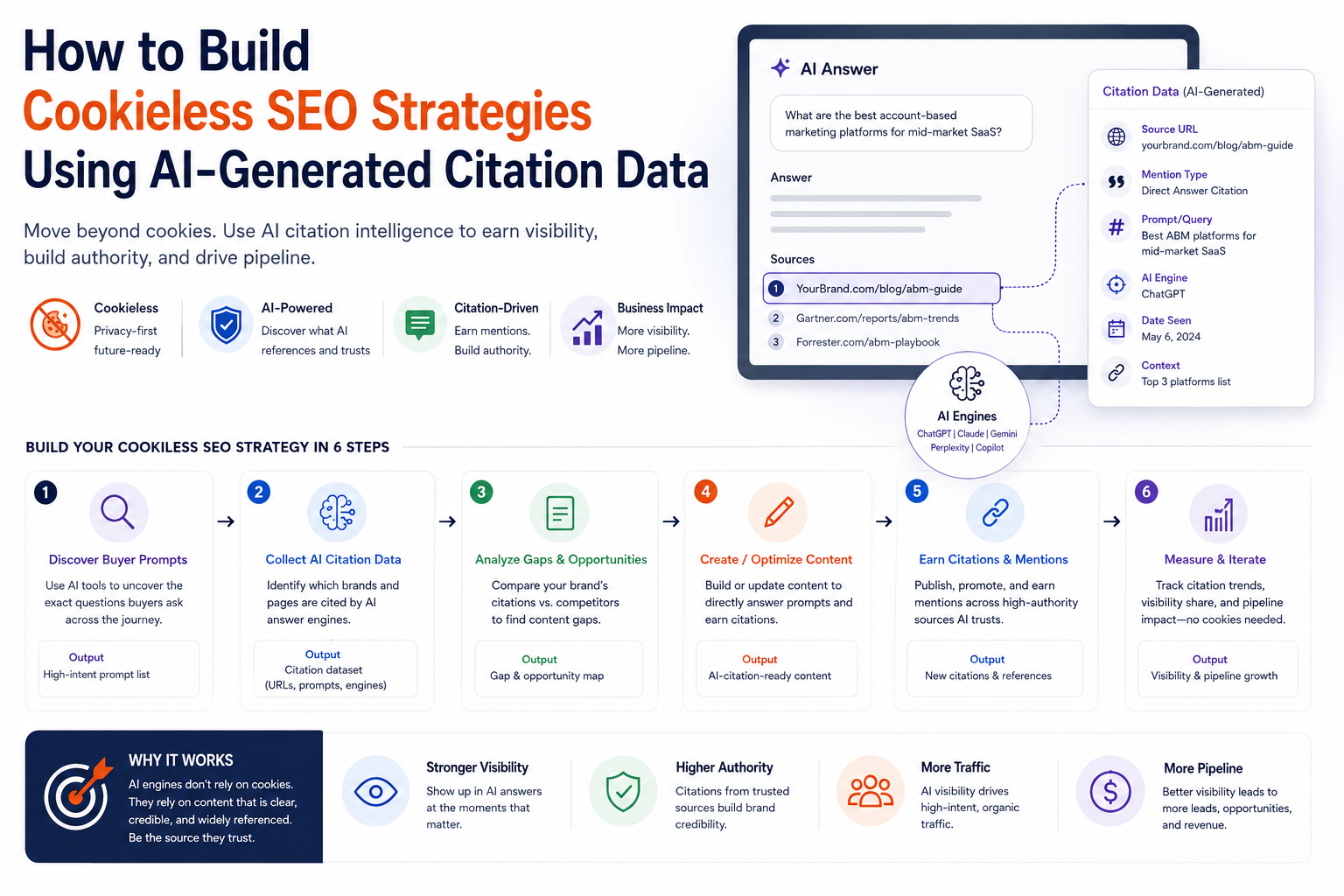
Creating a sustainable cookieless SEO strategy starts with a clear framework. Below is a step‑by‑step approach that aligns buyer language, AI citation generation, and performance measurement.
|
Step |
Goal |
Key Action |
Outcome |
|---|---|---|---|
|
Audit Buyer Prompts |
Capture authentic intent |
Extract questions from CRM, support tickets, and sales calls |
Library of real‑world prompts |
|
Generate AI Citations |
Produce AI‑ready references |
Feed prompts into an AI citation engine to create structured citations |
Citation pool aligned with intent |
|
Integrate Citations into Content |
Embed authority signals |
Map citations to existing pages or create new answer‑driven pages |
Enhanced zero‑click search eligibility |
|
Monitor Citation Share |
Track performance |
Use a dashboard to measure citation volume and share of voice |
Data‑driven optimization |
This framework ensures that every piece of content is tied to a buyer‑centric prompt, turning your site into a citation hub for AI engines. By aligning content with intent signals, you improve search visibility without relying on third‑party cookies.
In addition to the framework, consider these practical tactics. Use structured data markup to surface citations in a format AI models can easily parse. Leverage first‑party data pipelines to keep your citation library fresh as buyer language evolves. And adopt an ai‑driven marketing mindset that treats citations as a core asset, not an afterthought.
For deeper guidance on mapping buyer prompts to content, see our U.S. zero‑click search study that illustrates how citation density correlates with answer‑engine visibility.
Measuring Citation Share, Share of Voice, and Pipeline Impact
Once your citation engine is live, the next step is to measure its effect on pipeline. Traditional SEO metrics like organic traffic still matter, but in a cookieless world you need additional signals.
Citation share measures the proportion of AI‑generated answers that reference your brand compared to competitors. Share of voice expands this concept by weighting citations based on the authority of the source and the relevance of the prompt. By tracking these metrics, you can see how your zero‑click search presence grows over time.
Pipeline impact is evaluated by linking citation performance to downstream revenue metrics. When a citation appears in a high‑intent answer, the likelihood of a qualified lead entering your funnel increases. Over time, you can correlate citation share trends with the volume of marketing‑qualified leads generated.
Our platform provides a real‑time dashboard that visualizes citation volume, citation authority scores, and search visibility trends. By integrating this dashboard with your CRM, you can attribute pipeline outcomes directly to specific citation campaigns.
For a broader industry perspective, the U.S. first‑party data market report outlines how companies are investing in data‑first strategies to replace cookie‑based tracking. Additionally, the AI‑driven marketing adoption survey shows the growing confidence in AI tools for demand generation, reinforcing why a citation‑centric approach aligns with the future of ai‑driven marketing.
Future Outlook: Evolving AI Search and Cookieless Strategies
As AI search models become more sophisticated, they will rely increasingly on structured, verifiable sources. Brands that continuously feed fresh, buyer‑centric citations will maintain a competitive edge, while those that depend solely on legacy backlinks may see their visibility erode. Embracing a citation‑first mindset now positions your organization to thrive as the search ecosystem moves further away from cookies and toward pure intent verification.
FAQs
1. How does Omnibound help my team create AI‑generated citations without manual effort?
Omnibound automates the extraction of buyer prompts from your CRM and support systems, then feeds those prompts into an AI citation engine that produces structured references ready for web publishing. The platform also tracks citation share and share of voice, giving you a clear view of how your brand is performing in zero‑click search environments.
2. What pricing model does Omnibound use for teams that need scalable citation coverage?
Omnibound offers a usage‑based pricing structure that scales with the volume of citations generated and the size of your content library. This model ensures you only pay for the citation capacity you need, aligning cost with the value delivered through increased search visibility and pipeline impact.
Conclusion
In a cookieless world, the shift from paid impressions to organic authority is inevitable. By leveraging AI‑generated citation data, you can turn buyer language into a powerful signal that fuels zero‑click search visibility and drives pipeline without relying on tracking pixels. The framework outlined above auditing prompts, generating citations, integrating them into content, and measuring impact provides a clear path forward for demand leaders who need sustainable growth.
To see how Omnibound handles this end‑to‑end, explore the platform and start building a citation‑first SEO strategy today.
Recommended Authority Resources
-
Reference: Zero‑Click Search Statistics (2026) - Provides detailed analysis of how citation density influences answer‑engine rankings in the United States.
-
Reference: Customer Data Platform Market Size Report - Offers insight into the scale of first‑party data investments across U.S. enterprises.
-
Reference: AI Use in Marketing Statistics - Highlights adoption trends for AI‑driven marketing tools among large organizations.
Turn Your Content Into AI-Search Winners
Get cited across ChatGPT, Claude & Perplexity — not just ranked on Google.
- Increase AI citations
- Improve answer visibility
- Track brand mentions in LLMs