

Table Of Contents
"Gen AI" and "LLM" get used as if they mean the same thing. They do not, and the difference is worth ten minutes of your time, because it explains why AI answers about your brand vary, why they sometimes get facts wrong, and what actually influences them.
You do not need to be technical to work this out. Here is the plain version, then why it changes how you approach AI search.
The one-sentence difference
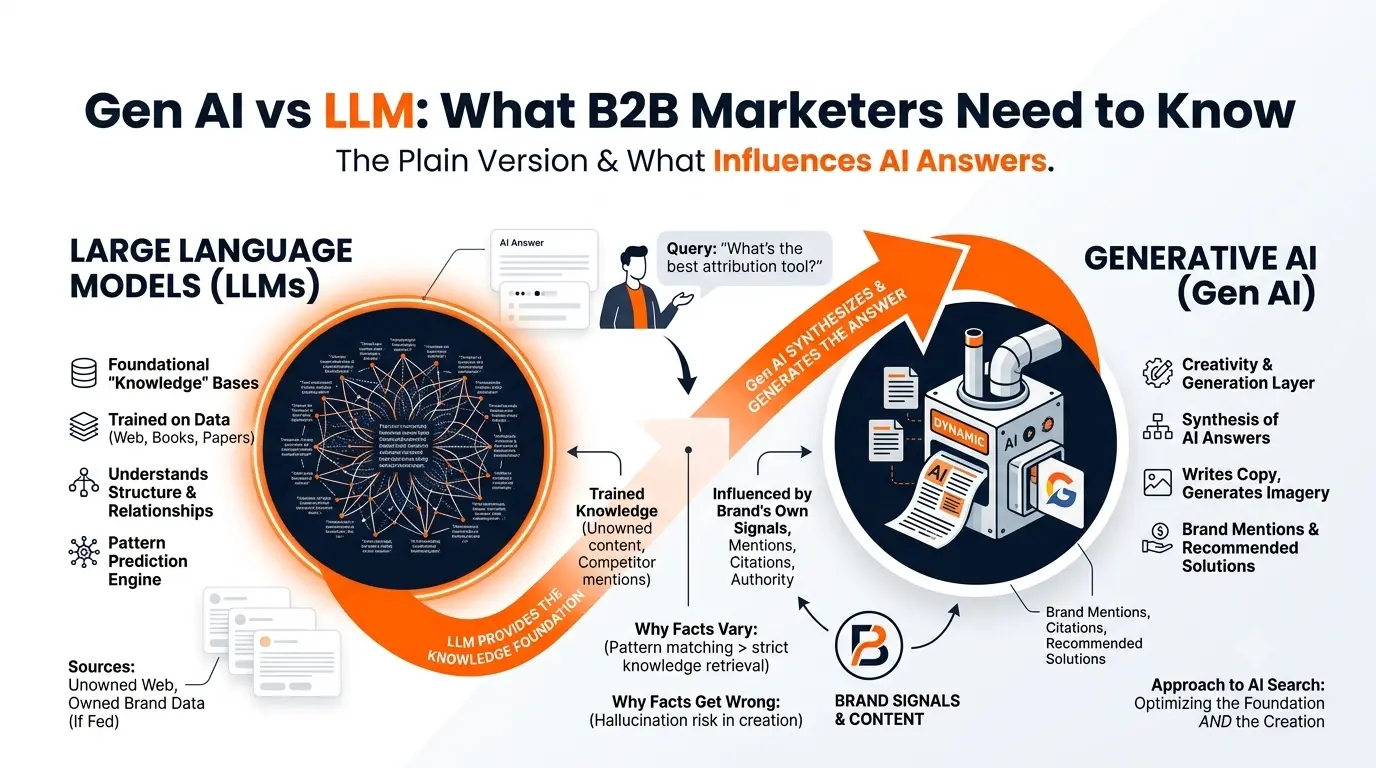
Generative AI is the broad field of systems that create new content: text, images, code, audio, video. A large language model (LLM) is one type of model, built for language, that powers the text side of generative AI.
Put another way: every LLM is generative AI, but not all generative AI is an LLM. An image generator is generative AI without being a language model. ChatGPT's written answers are generative AI produced by an LLM.
Where each term sits
It helps to see the nesting, from broadest to most specific:
- Artificial intelligence is the widest term: any system that performs tasks that usually need human intelligence.
- Machine learning is a subset of AI: systems that learn patterns from data instead of being programmed with fixed rules.
- Generative AI is a subset of machine learning: models that generate new content rather than only classifying or predicting.
- Large language models are one family within generative AI: models trained on very large amounts of text to understand and produce language.
So an LLM is a specific tool inside the much larger category of generative AI. When people say "gen AI vs LLM", they are really comparing a whole field to one of the engines inside it.
What a large language model actually is
An LLM is trained on a large body of text and learns the statistical patterns of language: which words, facts and ideas tend to follow which. From that, it predicts likely text one piece at a time, which is how it produces fluent answers, summaries and drafts.
Two properties matter for marketers:
- It works from patterns, not a database of truth. An LLM does not look up a verified fact by default. It generates the most probable response based on what it learned. That is why it can sound confident and still be wrong, an effect known as hallucination. See AI hallucination in content generation.
- Its knowledge has a cutoff. A model is trained up to a point in time, so on its own it does not know newer facts. Many AI tools now add live retrieval to close that gap, which is exactly where your content can enter the answer.
Examples of LLMs include the models behind ChatGPT, Claude, Gemini and Copilot.
What generative AI actually is
Generative AI is the umbrella. It covers any model that creates new output, across formats:
- Text: written answers, summaries, drafts (this is the LLM's domain).
- Images: generated visuals from a description.
- Code: working code from a plain-language request.
- Audio and video: synthesized speech, music and clips.
For B2B marketers, the text side is usually where the money is, because that is what powers the AI search tools your buyers now use to research vendors. But the field is wider than language alone, which is why "generative AI" and "LLM" are not interchangeable.
So how do they relate?
Think of it as engine and vehicles. The LLM is the language engine. Generative AI is the full range of things built with engines like it, plus other engines for images, audio and more. When you use ChatGPT to write an answer, you are using a generative AI application powered by an LLM. When you use an image tool, you are using generative AI powered by a different kind of model.
For a quick reference to these and related terms, see the AI search glossary for B2B marketers.
Why this matters for B2B marketers
You do not need to build these systems. You do need to know how they behave, because that behavior decides how your brand shows up. Four practical takeaways.
The tools shaping buyer perception are LLM-powered. ChatGPT, Perplexity, Gemini and Copilot all use LLMs to write answers about your category and your brand. Knowing that tells you what you are actually optimizing for. See what is AI search and what are answer engines.
Answers vary and change because models do. Different models, and different versions of the same model, can describe you differently, and answers shift as models update. That is why AI visibility is something you track over time, not check once. See why live model checks matter.
Hallucination is a feature of how LLMs work, not a rare bug. Because the model generates probable text, it can state something inaccurate about your product with full confidence. Giving engines clear, current, authoritative sources reduces the odds they fill a gap with something wrong.
Retrieval is your way in. Since an LLM's built-in knowledge is frozen at its training cutoff, the live sources a tool retrieves are how fresh, accurate information about you reaches the answer. Making your content retrievable and quotable is how you influence output you do not own. See content formats that win AI search visibility and how AI search engines determine which brands to cite.
Understanding the engine is the first step. Acting on it is the discipline of AI search optimization, and if you want the acronyms straightened out, AEO vs GEO: what B2B teams actually need.
The takeaway for non-technical marketers
You can leave the model architecture to the engineers. What matters for your work is simpler: the AI tools describing your brand run on LLMs, they generate answers rather than recall verified facts, and they pull in live sources to stay current. That last part is your opening. The clearer and more authoritative your content, the better the odds those answers get you right.
A good first move is to see what these models say about you today. The AI Search Visibility Checker runs a free scan across the major engines, and AI Search Intelligence tracks how those answers change as the models behind them update.
Frequently asked questions
Is an LLM the same as generative AI?
No. An LLM is a type of generative AI built for language. Generative AI is the broader field that also includes image, audio, video and code generation. Every LLM is generative AI, but not all generative AI is an LLM.
What is the difference between gen AI and an LLM?
Gen AI is the category of models that create new content in any format. An LLM is one family of models inside that category, trained on text to understand and produce language. It powers the written answers you see in tools like ChatGPT.
Are ChatGPT and Gemini LLMs?
They are applications built on LLMs. The chat product is the interface; the LLM is the underlying model that generates the text. Both also add features like live web retrieval on top of the model.
Why do LLMs get facts wrong?
An LLM predicts probable text from learned patterns rather than looking up verified facts, so it can produce confident but incorrect statements. This is called hallucination, and clear, authoritative sources help reduce it.
Why does any of this matter for marketing?
The tools buyers use to research vendors are LLM-powered, their answers vary and change with the model, and they can get your brand wrong. Knowing how they behave tells you what to optimize: retrievable, accurate, authoritative content that engines can find and quote.
Turn Your Content Into AI-Search Winners
Get cited across ChatGPT, Claude & Perplexity — not just ranked on Google.
- Increase AI citations
- Improve answer visibility
- Track brand mentions in LLMs
.webp?height=245&name=What%20Is%20GEO%20(Generative%20Engine%20Optimization).webp)